CARTER: Let’s talk about the publishing of Eating Smoke, because I’m sure there are dozens of expats across Asia reading this who feel that they, too, have exciting stories which deserve a place on bookshelves, yet are unsure of how to go about getting published.
So once Blacksmith Books expressed an interest in your proposal what kind of writing process did you embark on to complete the book?
THRALL: After six months of writing, when Blacksmith Books contacted me, I had pretty much the first draft written – 230,000 words at the time. The problem was I’d never studied English above high school level, so I spent a year referring to books, websites and online forums, teaching myself proper punctuation (not what we were taught at school!), grammar, and the art of self-editing.
CARTER: What kind of final editing was done to Eating Smoke? Were there any major changes to it and, overall, was it a hostile or pleasant experience? I ask because editors and authors don’t usually see eye-to-eye.
THRALL: According to Blacksmith’s editor, the manuscript was structurally sound. I’d pretty much worked out for myself what did and did not need to be in there.
Any anecdote not taking the story forward or adding to the understanding of a character or situation, I took out.
As far as the end result is concerned, it was great to see the manuscript polished, with some incorrectly used words amended, some over-ripe humor taken out, and some excess sentences deleted. That’s not to say it wasn’t a stressful experience at the time.
Editors are good at spotting mistakes and cutting out excess lines. But that can leave un-poetic passages that don’t flow well on the page. My editor and publisher were completely accommodating, allowing me to rewrite any amendments myself in my own writing style – or understanding when I insisted that certain lines were left in the book, for continuity, or sentimental reasons because the story is true-life.
Chris Thrall
CARTER: The literary landscape is changing, some say deteriorating.
Where once New York publishers actually sought out quality literature that would last through the ages (John Steinbeck, Pearl Buck), today they only seem interested in boardroom-created-blockbusters like “Twilight” or throwaway celebrity memoires.
To add insult to injury, newspapers like the “New York Times” are notoriously anti-POD (Print on Demand) and will only review Big 6-published books despite the recent sales surge of self-published titles.
What’s your advice, then, for aspiring authors who lack literary connections but feel that their book is too good for CreateSpace?
THRALL: If you truly believe you have a story that will be of interest to many people, think carefully about sending your manuscript to a busy executive in a publishing house that probably has fifty other manuscripts land on their desk everyday and no time to read them.
Instead, consider hiring (or find) an agent that has some influence with the big players or simply send your first chapter to an author in a similar genre. Authors tend to be very kind and approachable people – as I found out, Tom! – and having been through the process themselves, they know what a publisher is looking for. If they like what they read then there’s a good chance they’ll recommend you.
Writers want other writers to have success. In addition, you’ll get pointers if your writing is lacking in any area. I’m currently writing a free e-book that will be available to download soon from http://www.christhrall.com to guide people through the process of writing a memoir and getting it published.
CARTER: What’s next for Chris Thrall? Tales from your time with the Corps of Her Majesty’s Royal Marines? Or perhaps some fiction?
THRALL: Not sure. You’ll have to ask the readers of Eating Smoke that question!
Chris Thrallwas born in the UK. At eighteen, he joined the Royal Marine Commandos. Following active service in the Northern Ireland Conflict and training in Arctic warfare and survival, he earned his parachutist’s ‘wings’ and went on to serve as part of a high-security detachment onboard an aircraft carrier. In 1995, Chris moved to Hong Kong to oversee the Asia-Pacific expansion of a successful network-marketing operation he’d built, part-time, while serving in the Forces. Less than a year later, he was homeless, hooked on crystal methamphetamine and working for the 14K, Hong Kong’s largest triad crime family, as a doorman in Wanchai’s infamous red-light district. Eating Smoke, a humorous yet deeply moving first book, is his account of what happened.
CARTER: One of the main characters in “Eating Smoke” is a Filipina prostitute named Apple who, after being your friend, sells you out to the triads. Filipinos are the second largest ethnic group in Hong Kong, however their career paths seem to be limited as nannies for wealthy families, cover bands, or bar girls.
Why is that, and do you think their situation will ever improve?
THRALL: I think it’s because the Philippines’ economy is relatively poor when compared to Hong Kong’s. Even with the pittance they receive in wages, these women are able to send a lot of hard-earned dollars home to their families, while getting a travel experience they likely otherwise ill afford.
As to whether their situation will improve, Filipinos are generally humble, in my experience. They don’t complain and seem to appreciate the chance to earn money abroad.
Of course, wherever there is inequality, they’ll be incidents of exploitation, which isn’t nice. But if their union – if there is such a thing – pushed for higher pay then perhaps the demand for their services would drop off as there are Hong Kong locals who could fill these jobs.
CARTER: Another reoccurring character in Eating Smoke is an expatriate named Cameron who insists on trying crystal meth despite your warnings of its highly addictive nature. Cameron shows up later in the book exclaiming how much he loves the drug even though it’s obvious that he, too, is now addicted. To quote a passage in your book, “Unable to stop and not wanting to anyway.”
What about methamphetamine makes it so popular even though everyone knows that it can, nay, will destroy you?
THRALL: I can only speak from my own experience. Some people try meth and say, “Ah. It’s OK. But nothing special.” Then get on with their life. For others it seems to be the key in lock, the answer to all of life’s insecurities and problems. Perhaps people in the former category have had more stable upbringings and hence less insecurity and the resultant need to feel “right” for a change.
A drug that makes you feel cool, calm and supremely confident, in addition to giving you a massive surge of creative energy – allowing you to discover abilities you were told you were a failure at in school – is always going to be in demand.
The problem is, like Superman with his Kryptonite, you begin to crave that feeling more and more to the point where you no longer feel normal without it. That’s called addiction. Either you beat it or it destroys you.
Continued on October 19, 2011 in Eating Smoke – Part 4, return to Part 2 or if you have the time and do not want to wait for the five-part series to finish posting, click View as Single Page.
Chris Thrallwas born in the UK. At eighteen, he joined the Royal Marine Commandos. Following active service in the Northern Ireland Conflict and training in Arctic warfare and survival, he earned his parachutist’s ‘wings’ and went on to serve as part of a high-security detachment onboard an aircraft carrier. In 1995, Chris moved to Hong Kong to oversee the Asia-Pacific expansion of a successful network-marketing operation he’d built, part-time, while serving in the Forces. Less than a year later, he was homeless, hooked on crystal methamphetamine and working for the 14K, Hong Kong’s largest triad crime family, as a doorman in Wanchai’s infamous red-light district. Eating Smoke, a humorous yet deeply moving first book, is his account of what happened.
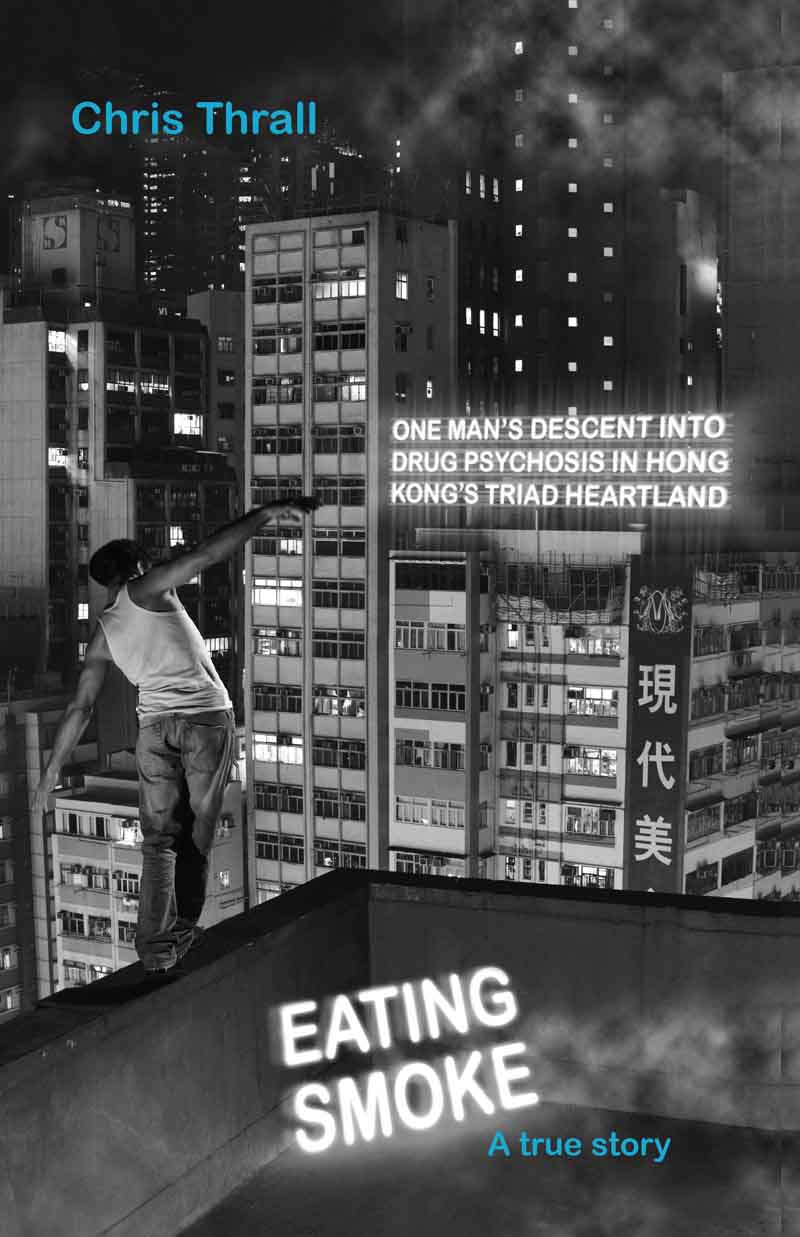
Tom Carter, author of “CHINA: Portrait of a People”, catches up with Chris Thrall to discuss his new book “Eating Smoke“, a memoir about Thrall’s descent into drug psychosis in Hong Kong’s triad heartland.
In the fall of 2009, whilst traveling in India to create my next photography book, I was contacted via email by a British writer who had read Down and out in Hong Kong, one of my online travel articles, which described this poor, dusty backpacker’s real-time impressions of Asia’s wealthiest city.
Chris Thrall said he connected with my article’s conclusion that, in spite of my western heritage, and due to my personal circumstances, I ultimately had more in common with the destitute third-world inhabitants of the Chungking Mansions, the infamous immigrant ghetto of Kowloon, than I did with the rich white bankers et al who comprise the other half of Hong Kong’s multinational population.
Chris went on to explain that he was writing a book about his own experiences living in Hong Kong, which was dramatically different from mine or any other expatriate I ever knew, and that he once worked for the 14K, the world’s largest Chinese crime family.
Attached to his email was the first chapter of his memoir, a gripping opening salvo that finds the narrator hiding from pursuing henchmen on a roof top—alongside two corpses, a disemboweled mother and child.
As a voracious reader, I know a bestseller when I see it. I immediately forwarded Chris’s manuscript to my publisher in Hong Kong, Pete Spurrier, who runs the iconic Blacksmith Books, which specializes in Asian-themed literature.
Pete likewise was knocked off his feet by Chris’s incredible story; the next I heard, Chris was a fellow Blacksmith label mate with a book deal.
Chris Thrallwas born in the UK. At eighteen, he joined the Royal Marine Commandos. Following active service in the Northern Ireland Conflict and training in Arctic warfare and survival, he earned his parachutist’s ‘wings’ and went on to serve as part of a high-security detachment onboard an aircraft carrier. In 1995, Chris moved to Hong Kong to oversee the Asia-Pacific expansion of a successful network-marketing operation he’d built, part-time, while serving in the Forces. Less than a year later, he was homeless, hooked on crystal methamphetamine and working for the 14K, Hong Kong’s largest triad crime family, as a doorman in Wanchai’s infamous red-light district.
“Eating Smoke“, a humorous yet deeply moving first book, is his account of what happened.
Continued on October 17, 2011 in Eating Smoke – Part 2, or if you have time and do not want to wait for the five-part series to finish posting daily, click View as Single Page.
Carter did not suggest a subject for this post, but he did ask that I include the promotional video for his next book with whatever I wrote, and it “rather” fits the topic I decided to write about, which is that most of America may learn something from those Americans that “really” want to do business in China and India.
Besides, Carter’s photos of India are as stunning as those he took of China are.
Vikas Bajaj wrote the NYT’s piece, and we learn that Amazon is moving into India and whatever Amazon’s plans are for entering India’s consumer market, Amazon is not talking.
However, “while dozens of electronic commerce firms have recently sprung up to capitalize on India’s growing Internet use” Bajaj wrote, “they have a problem. Indians are not yet comfortable with shopping on the Web. Many of them remain unwilling to use credit cards online. So the Indian retailers have gone to great lengths to gain customers. Customers may pay in cash on delivery, and the company fields delivery squads to ensure shipments get to customers quickly.”
What we learn from this quote is that cultural differences influence how people shop but culture goes deeper than shopping habits, which is a fact that many Americans do not understand.
In addition, a Blog at Stanford.edu says, “Approximately half of Amazon.com’s revenue comes from outside the United States, according to the company’s Senior Vice President of International Retail, Diego Piacentini. This makes global strategy a key component to the company’s continued success,” and “Amazon aims to be the ‘most customer-centric company on the planet’.”
Then Matt Harvey, who wrote the post for the Stanford Blog, asked, “But what do you build, and how do you act, to make this mean something?”
The answer may come from Amazon’s Diego Piacentini when he said, “When Amazon began doing business in China in 2004, some of the company’s core values came into conflict with traditional business practice.” Meanwhile, Goldman Sachs was quoted in 2010 saying Amazon has competition in China with Taobao.com.
Taobao.com, the Chinese equivalent of eBay, generates estimated annual sales of close to $60 billion—about 75% of all online retail sales in China while, according to Goldman Sachs, Amazon had only $750 million in annual sales in China in 2009 with estimates that Amazon sales in China would increase to $1 billion in 2010. Amazon has a long way to go to catch up with Taobao.
The moral of this story is that Western retailers such as Amazon must learn to do business in other cultures such as China and/or India without attempting to change the people.
They must “start with the customer and work backwards”, which isn’t what most of America’s politicians and religious leaders are doing and the best quote that explains why comes from a Henry Kissinger quote that I have used before. “American exceptionalism is missionary. It holds that the United States has an obligation to spread its values to every part of the world.”
From what I understand, two of the world’s greatest conquerors, Alexander the Great and Genghis Khan, knew the key to hold an empire together was not to change other cultures but to allow those cultures to remain unchanged, so why can’t the rest of the West learn from them?
Lloyd Lofthouse is the award-winning author of The Concubine Saga. When you love a Chinese woman, you marry her family and culture too. This is the love story Sir Robert Hart did not want the world to discover.
To subscribe to “iLook China”, look for the “Subscribe” button at the top of the screen in the menu bar, click on it then follow directions.
Pub Med Central provides a better history of the one-child policy.
“In 1979, the one-child family policy was developed and implemented in response to concerns about the social and economic consequences of continued rapid population growth,” Pub Med said, and, “implementation was more successful in urban areas than rural areas.”
Pub Med says, “It was hoped that third and higher order births could be eliminated and that about 30% of couples might agree to forgo a second child… In some of the largest and most advanced cities like Shanghai, sizeable proportions of couples already chose to have only one child (regardless of the law).
“As a result, it was not long before 90 percent of couples in urban areas were (easily) persuaded to restrict their families to a single child.”
However, Pub Med says, in rural areas of China the opposite happened, and 90 percent of women with one child went on to have a second (regardless of the law) and there wasn’t much the Communist Party could do to stop them.
AP’s Louise Watt writes, “Under China’s one-child policy in place for the last three decades to control population growth, couples can be penalized for having more than one child. In Beijing, the penalty is a one-off fee 3-10 times the city’s average income, a maximum of 250,000 yuan ($40,000).”
Watt also tells us that among the 20,000 Chinese with at least 100 million yuan ($15 million) 27 percent have already left China and 47 percent are considering it, and they want to leave so they can have more children on the cheap and buy land that does not belong to the government.
These wealthy Chinese Louise Watt writes of may be surprised to discover that if the U.S. wants to build a school, park, freeway or shopping center, and your house is in the way, it will be bought and bulldozed.
The law for this is called Eminent Doman and 60 Minutes at CBS Newsreported on possible abuses of this in the United States in February 2009. Rebecca Leung of CBS News wrote, “But did you know the government can also seize your land for private use if they can prove that doing it will serve what’s called ‘the public good’?”
In addition, it would be interesting to discover if some or all of the wealthy Chinese claiming to have left China to have more children and buy a home left for other reasons they are not talking of.
In The Danger of False Truths, I mentioned that thousands of corrupt Chinese officials stole more than $120-billion U.S. and fled overseas—and the U.S. was a top destination.
If so, the real reason many of these “wealthy” Chinese left China may have been to avoid going to prison or being executed.
In addition to Eminent Domain, if an American cannot pay the annual property tax or income tax in the United States, the house will be lost to the government. I estimate that the property tax I paid since I first owned a home in 1973 would have paid the penalty for a dozen extra children in China.
In fact, due to property tax, no one really owns their homes in America and everyone is just a tenant, and the U.S. Government is the landlord. In China, they call it like it is, while in the US, most people believe in fairy tales.
And if you were worth $15 million dollars and wanted a second or third child, $40,000 a child would not dent that fortune. In addition, in China when someone buys a house for that 70-year lease, the property tax is paid only once at the time of the purchase and currently there is no law that says you have to pay any property tax again unless it is an investment property.
When these rich Chinese arrive in the US and buy a million dollar house, they will be paying property tax annually. Taxes on land and the buildings on it are the biggest source of revenue for local governments.
In California, for example, property tax for a million dollar house costs about $10,000 a year, and forty years of property tax would cost about a half million dollars, which is much more than $40,000 for the second child and another $40,000 for the third child.
Maybe Louisa Watt should have also mentioned that U.S. citizenship is for sale for foreign millionaires and the details may be found at All Voices.com, and most Americans could not afford this legal bribe (sorry, I meant deal).
In fact, there’s a lot about China’s one-child policy that Louise Watt isn’t revealing, and what she writes may have to do with America’s busy-body, do as I say morality, which interferes as often as possible in the domestic philosophies and affairs of other countries—something China does not do.
For decades, China’s one-child policy has been criticized in America and/or the West mostly by evangelical, fundamentalist Christians that represent one of American’s squeaky wheels with a political agenda to force their beliefs on others.
However, what these critics do not know may shock them, but I doubt if it will deter their misguided zeal.
In the September/October 2011 issue of Foreign Policy magazine, Phillip Longman wrote The World Will Be More Crowded With Old People, and said, “Another related megatrend is the rapid change in the size, structure, and nature of the family. In many countries such as Germany, Japan, Russia, and South Korea, the one-child family is now becoming the norm (without a law)… Today about one in five people in advanced Western countries, including the United States, remains childless.”
AP’s Louise Watt also doesn’t tell us the one-child policy does not apply to the hundred million people in China that belong to one of the fifty-six minorities or many of the Han Chinese living in rural China where most Chinese don’t pay property tax, rent or a mortgage payment since the land is owned collectively and may not be sold.
Since minorities in China are a small segment of the population, China’s government practices flexibility with the minority birth rate in order to keep minorities an important part of China’s culture.
For example, Tibetans may not live the feudal, nomadic lifestyle with the 35-year lifespan they once had under the Dalai Lama (the average lifespan in Tibet today is more than 60 without the Dalai Lama), which they had before Mao sent the People’s Liberation Army (PLA) into Tibet in 1950.
Isn’t it horrible how the Tibetans were forced to give up that shorter average lifespan and feudal servitude?
However, as a minority, Tibetans may have as many children as they want and the penalty Louise Watt writes of does not exist for them.
We often hear of the Uighur Muslims since this minority has an Islamic separatist movement in the northwest near Afghanistan where the US is fighting a war against a similar insurgency, but the Uighurs are a minority so the one-child policy also does not apply them, and they are not the only Muslims in China.
The Hui are unique among the fifty-six officially recognized minorities of China in that Islam is their only unifying identity. They do not have a unique language as the other minorities do and often intermarry with Han Chinese.
In fact, many live outside the Hui autonomous region. Since the Hui are considered a minority, the one-child policy also does not apply to them.
The Chinese government says if it weren’t for the one-child policy, there would be another four-hundred million mouths to feed and provide shelter for. Instead of 1.3 billion people in China, there would be almost 2 billion—more than six times the population of the US, and China cannot grow crops on about 90% of its land.
Chinese law allows married couples in Shanghai that are both the only child of their parents to have two children even if they are Han Chinese.
To make sure these married couples are aware of this exception, China provides support from government run family planning centers that check on women’s health and inform them of their rights and responsibilities to have more than one child.
The Shanghai government encourages married couples eligible to have more than one child to do so, which, in Shanghai, means most married couples.
The Shanghai Family Planning Commission first promoted this policy in 2009. The reason for this campaign lies in Shanghai’s population demographics.
Because of the one-child policy, Shanghai has been particularly hard hit by an age disparity, and 22 percent of the citizens of Shanghai are over sixty and these numbers are expected to grow.
Xu Xihua, the director of Shanghai’s Aging Development Center says that by adjusting the one-child policy in Shanghai, this disparity in ages can be partially reduced and giving couples an opportunity to have two children is part of the plan.
However, the central government stresses it is not abandoning its family planning policies or its control over the number of births. Fear of overpopulation and potential famines remains high in a country that has a history of droughts, floods and famines, which is something the U.S. has not yet experienced in its brief history.
France 24 International Newsalso reported how one Chinese couple wanted to have more than one child and the couple took advantage of loopholes in the one-child policy to have three.
The mother’s first child was a boy, and she was desperate to have a girl.
Since fines are less for a second child if delivered in a remote rural province, the couple moved south.
However, the mother discovered she was pregnant again soon after the birth of the second child, which was a girl, and the doctor told her that because of health reasons she couldn’t have an abortion.
And recently, authorities in China’s most populous province have asked Beijing to ease the one-child policy.
In addition,wealthy Chinese businessmen, television and movie stars often avoid the one-child policy since they have money to pay the fine Louise Watt writes of in her AP piece, and ten percent of rich Chinese have an average of three children and this practice is spreading among the upper-middle class. Since they stay in China, these wealthy Chinese avoid paying annual property tax in America.
Peng Xizhe, dean of social development and public policy at Fudan University, says “In the Maoist era everyone was controlled by his work unit. It’s over now. Many workers are independent. It becomes more and more difficult for the government to pressure people to having only one child.”
In fact, according to some experts, China will adopt a two-child policy in several years.
However, unexpected problems besides an aging population may have developed from the one-child policy, which is explained by a NPR All Things Considered report by Louisa Lim’s Lightning Divorces Strike China’s ME Generation.
Lim says Beijing has the highest divorce rate in China with 39 percent of all marriages ending in a split.
One Beijing woman, Cheng, tells Lim of her six-month marriage that ended as fast as it started. Cheng blamed the divorce on belonging to the generation of spoiled singletons (one-child), known as the post-1980’s generation.
Dr. Perry, a professor of economics and finance in the US, agrees that the upsurge in China’s divorce rate is because of the selfish and narcissistic generation of spoiled one-child children in China (have you already forgotten that many of these urban parents decided to have only one child before or in spite of the law).
But hold on, there may be another explanation why Beijing’s divorce rate is soaring. Eight years ago, a married couple needed permission from their work unit to divorce. Today, couples have the freedom to divorce in China without asking.
Although it may be difficult to link China’s changing divorce rate to the one-child policy, there is another outcome that cannot be denied.
China may have cut off a foot to save its stomach from starvation.
Studies predict that China will soon be short 24 million wives. It doesn’t matter that it is illegal in China to take a test for non-medical reasons that determines the sex of the fetus.
Since China’s culture traditionally prefers boys to girls, many parents go to underground private clinics to find out what the sex of the fetus is. If it is a girl, many terminate the pregnany with an illegal abortion.
The results is a growing shortage of women leading to illegal forced marriages and prostitution (sex slaves), which is a challenge for the police and courts to deal with.
After you learn more of the details of China’s one-child policy, you discover that it was a law without many teeth and didn’t deserve the criticism it received, which leads to the conclusion that the American and/or West’s reaction is due mostly to racist Sinophobia.
______________
Lloyd Lofthouse is the award-winning author of The Concubine Saga. When you love a Chinese woman, you marry her family and culture too. This is the love story Sir Robert Hart did not want the world to discover.
To subscribe to “iLook China”, look for the “Subscribe” button at the top of the screen in the menu bar, click on it then follow directions.
 Guest-Post by Tom Carter


 Posted by Lloyd Lofthouse

 iLook China