A Forbidden Love Saved an Empire

August 27, 2026

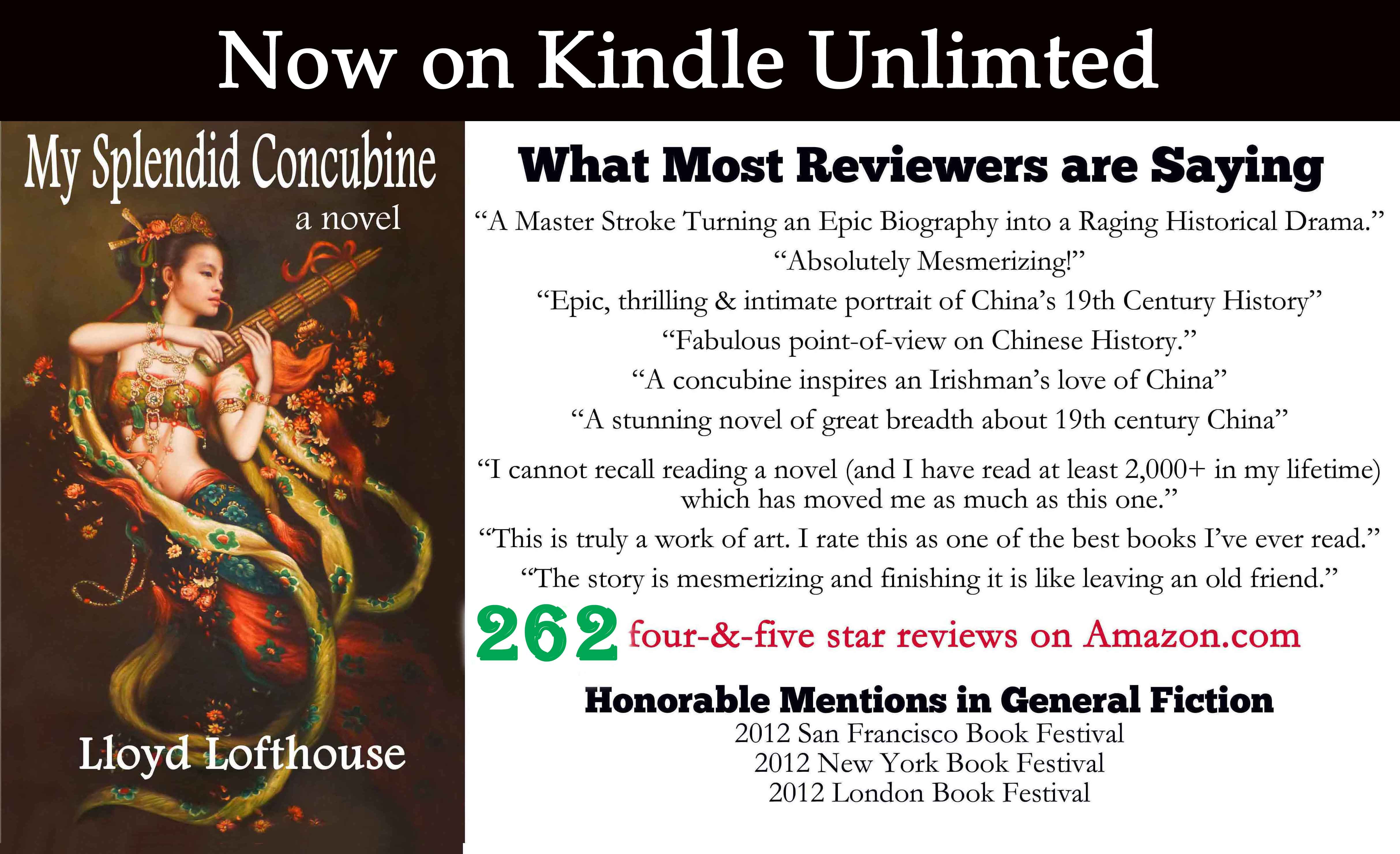
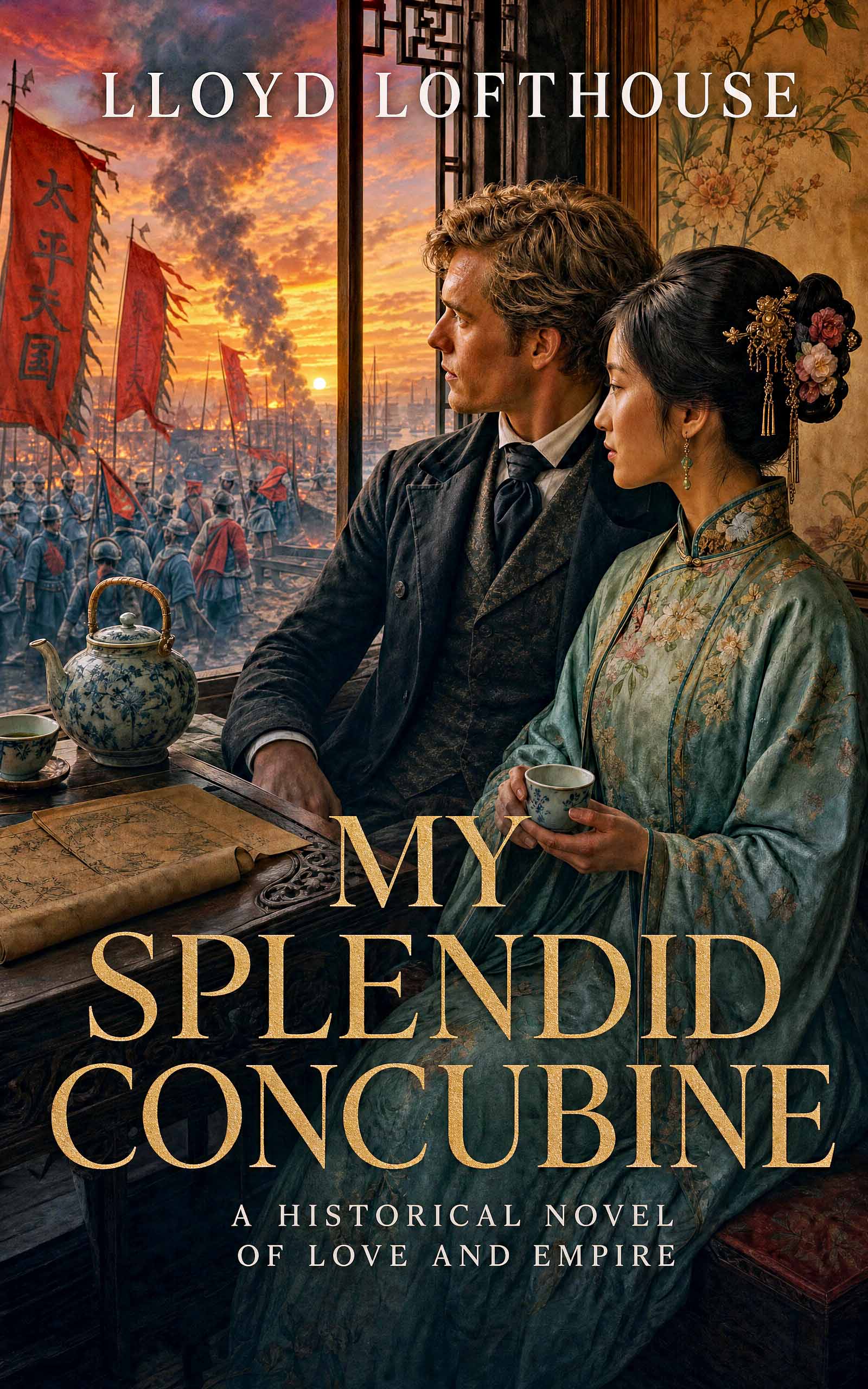
China, 1854. Nineteen-year-old Robert Hart crosses the world to outrun disgrace and illness, only to collide with a destiny far greater than his shame. In the teeming treaty ports of the Qing Dynasty, he purchased a quiet, perceptive concubine whose language, intuition, and courage open doors he never knew existed. As her whispered guidance leads him past courtiers and cutthroats, Hart learns to read a civilization from the inside out—and to risk everything for the woman who steadies his soul.

From the smoke-choked fields of the Taiping Rebellion to the shadow diplomacy of the Opium Wars, Hart navigates treacherous alliances with warring Western powers and wary imperial officials, rising from outcast foreigner to a confidant within the Dragon Throne. Battles rage and treaties twist, but in the hush of their shared rooms, a partnership of heart and mind forges the steel he’ll need to confront betrayal, negotiate peace, and drive an astonishing program of modernization that will reverberate across the Far East.

Dramatic, sensuous, and impeccably researched, My Splendid Concubine reveals the little-known genesis of a towering figure—haunted by scandal, sustained by love—whose vision transformed a nation. Lloyd Lofthouse’s rich prose and intimate storytelling illuminate the perilous bargain between passion and power, and the remarkable woman whose quiet strength helped alter the course of history.

Hart’s great understanding of Chinese culture and his ability to see things from the Chinese perspective meant that he became a trusted and influential figure, valued by the Chinese government and foreign ministers alike, who often sought his advice. The extent to which he was appreciated is reflected in the numerous titles and awards bestowed upon him by both the Chinese and the British. These included, on the part of the Chinese, the award of a Red Button (highest rank), a Peacock’s Feather, and the Order of the Double Dragon, while the British granted him the orders of CMG (1880), KCMG (1882), GCMG (1889) and ultimately, a baronetcy (1893). Source: SOAS

Sir Robert Hart oversaw the creation of China’s modern lighthouses, naval fleet elements, meteorological offices, and the Imperial Chinese Postal service, unifying the vast nation’s communication and trade networks. He managing trade relations and tariffs directly under Chinese imperial employment, he helped Beijing navigate intense Western imperial pressure saving an empire from total collapse.
Start Reading Today


She’s a Healer, but her body is death

October 14, 2025

The Tao of Poison is a powerful, believable story set in 18th century China during the White Lotus Rebellion. The nine-year conflict heavily impacted many districts in central China, leading to widespread losses in the mountainous regions separating Sichuan, Hubei, and Shaanxi provinces.

Qiezi, 17, has practiced mithridatism, a method of building poison resistance, for most of her life. Her body has become toxic. She also studied China’s famous encyclopedia of healing and learned from experts how to heal illness naturally.

Early in the story, a powerful Qing Dynasty official threatens her and her family if she won’t have sex with him. She warns the man that her body is poisonous. The man doesn’t believe her. After he dies, Qiezi and her family are blamed for the powerful official’s death and become fugitives.

Separated from her family while on the run, Qiezi eventually reunites with them after joining a group of Chinese Taoists. These Taoists practice consensual partnered or multi-partnered intimacy to harness sexual energy for self-improvement and spiritual development.

Still, what these Taoists practice is illegal. If caught, they will be executed.

This is a fascinating story of survival in a dangerous China.

The Author

Isham Cook is an American essayist and novelist based in China since 1994. His writing philosophy is big concept, discriminating, provocative. His influences are Ballard, Beckett, Borges, Dick, Kafka, Hesse, Melville, Mishima, Sade—authors and artists who fearlessly forge new territories.


Frozen in China but the sky is Blue

January 1, 2020

Tourism is an important industry in China and if you prefer colder weather, like me, the place to go for winter fun is Harbin.

CNN Travel reports, “China has invested heavily in bringing commercial and tourist traffic to more remote regions of the country. ……… The city of Harbin hosts the annual Harbin International Ice and Snow Sculpture Festival, the biggest of its kind in the world. Every winter, visitors come from across China and the world to see the mammoth creations, which this year included a Buddha statue made from 4,500 square cubic meters of snow, and a 3-D light show reflected against the ice for dramatic effect.”

The festival originated in 1963. … In 2001, the Harbin Ice Festival was merged with Heilongjiang’s International Ski Festival and got a new formal name, the Harbin International Ice and Snow Sculpture Festival.


Sneak Preview of Harbin Snow and Ice World 2020

“More than 100 activities and events will be held in Harbin … The activities and events fall into several categories, namely ice and snow tourism, ice and snow culture, ice and snow fashion culture, ice and snow trade, and ice & snow sports.” ꟷ Ice Festival Harbin.com

The Atlantic reports that more than a million tourists visit Harbin to see the massive ice and snow sculptures.

China Daily.com reports, “The festival officially starts in January 5th every year, but the locals begin to celebrate the festival in the third week of December of the previous year because most of the ice lanterns, ice and snow sculptures are completed by this time. Depending on the weather conditions and activities, the festival usually last until the end of February.”

As of 2015, China is the fourth most visited country in the world, after France, the United States, and Spain, with almost 57 million international tourists per year. In 2017, tourism resulted in revenue of about USD 1.35 trillion, 11.04% of the GDP, and contributed to direct and indirect employment for more than 28-million Chinese.

The Chinese also like to travel outside of China. According to The Telegraph, in 2018, almost 150 million Chinese visited other countries. But domestic tourism adds up to almost 5.5 billion trips annually.

Lloyd Lofthouse is the award-winning author of My Splendid Concubine, Crazy is Normal, Running with the Enemy, and The Redemption of Don Juan Casanova.

Where to Buy

About iLook China


Thanks to Donald Trump’s GUT, US farmers lost the Thanksgiving market in China

November 20, 2019

CNBC reports, “The duties in large part target U.S. farmers, who largely supported Trump in 2016 but suffered from previous shots in the Trump administration’s trade war with China. The thousands of products include peanuts, sugar, wheat, chicken and turkey.”

According to USDA.gov’s internal trade data for chickens, turkeys and eggs exported to China, in 2015, U.S farmers sold 260,102,000 pounds to China. Fast forward to 2018, and those exports fell dramatically to 122,000 pounds. If that is welcome news, send the Real Donald Trump a thank you tweet.

According to The Poultry Site.com, “Most of the world’s turkey meat is produced in just five countries: US, Brazil, Germany, France and Italy.”

Before Donald Trump, China bought most of its turkey meat from the United States.  My guess is that China is now buying its turkey from Brazil. “Although one-fifth of the size of the US industry, turkey production in Brazil rocketed by 220 per cent between 2000 and 2008. Without a doubt, this has been the most dynamic industry in the current decade with output likely to come close to 500,000 tonnes this year making this country the second largest producer in the world.”

By the time Trump arrived and declared his tariff war with most of the world, I think Brazil’s turkey producers were ready.

According to CNBC, “Struggling (U.S.) farmers are losing a huge customer to the (Trump’s) trade war – China.”

And if you think the Chinese do not eat Turkey, you are wrong. Mentalfloss.com tells us that China is #1 among the top five importers of turkey meat. According to Mentalfloss, China imported 82.8 million pounds, and that was back in 2012.

Conclusion, if you are one of the 72,000 American expatriates living and working in China and you want to eat turkey to celebrate Thanksgiving (a U.S. holiday), that turkey probably came from Brazil, Germany, France, or Italy, but not the United States where the farmers that produce turkey are probably facing failure if not already bankrupt.

Lloyd Lofthouse is the award-winning author of My Splendid Concubine, Crazy is Normal, Running with the Enemy, and The Redemption of Don Juan Casanova.

Where to Buy

About iLook China


Healthcare in China

May 8, 2019

After 1949, China’s government established the country’s first national health system more or less from scratch. However, the US National Library of Medicine reports, “the well-established cooperative medical system for the rural areas collapsed within a short time period after the economic reforms in China in the late 1970s, leaving the vast majority of the rural population without health care. In 1999, only 7% of the 900 million rural residents had some kind of health insurance coverage.”

Then in 2003, China’s government again took steps to reform the health care system that had collapsed in the late 1970s, and as you read this post, you will discover that today 95-percent of China’s population has some level of health care.

InterNations.org says, In 2011, new social insurance legislation set out to reform China’s healthcare system, and there are now three insurance programs providing basic coverage for 95% of the population.”

One: The Urban Employee Basic Medical Insurance (UEBMI) applies to workers and employees living in cities. Their contributions are deducted from their salary via payroll taxes.

Two: The Urban Resident Basic Medical Insurance (URBMI) covers the non-working population in Chinese cities, such as children, the elderly, etc. The scheme is partly financed through contributions from individual households, but mostly through government subsidies.

Three: The New Rural Cooperative Medical System (NRCMS) is supposed to revitalize healthcare in China’s countryside. Funds are raised through a mixture of individual contributions, support from collective enterprises, and government subsidies.

In 1949, the life expectancy in China was only 37 years. In 2018, Reuters reported that China has overtaken the United States in healthy life expectancy at birth for the first time, according to World Health Organization data. Chinese newborns can look forward to 68.7 years of healthy life ahead of them, compared with 68.5 years for American babies, the data – which relates to 2016 – showed.” …

While the quality of lifestyles and health care is improving for China’s citizens, what is happening in the United States? “The United States was one of only five countries, along with Somalia, Afghanistan, Georgia and Saint Vincent and the Grenadines, where healthy life expectancy at birth fell in 2016, according to a Reuters analysis of the WHO data, which was published without year-on-year comparisons in mid-May.”

Lloyd Lofthouse is the award-winning author of My Splendid Concubine, Crazy is Normal, Running with the Enemy, and The Redemption of Don Juan Casanova.

Where to Buy

Subscribe to my newsletter to hear about new releases and get a free copy of my award-winning, historical fiction short story “A Night at the Well of Purity”.

About iLook China