Trading Tea for Tibetan Horses

October 26, 2016

Many have heard of or read about the Silk Road between China and Europe, but I think few have heard of the ancient Tea Horse Road (also known as the Tea-Horse Trade Route), which I first read about in the May 2010 issue of National Geographic Magazine (NGM).

Legend says that tea from China arrived in Tibet as early as the Tang Dynasty (618- 906 A.D.). After that, the Chinese traded tea for horses, as many as 25,000 horses annually.

Zhang Yun writes, at The Wandering.com, “Horses obtained from the tea-horse trade between the Song Dynasty and Tibetans could be classified into two kinds: one were good horses from Gansu and Qinghai and Tibet’s Nagqu by way of the tea-horse trade, which could serve as warhorses; the other was horses given as tribute, most of which came by the Sichuan-Tibet Route or from various areas in the southwest. Most of these, however, could only be used as farm horses …”

But that isn’t what struck me the most about the NGM piece. It’s the example that demonstrated why most if not all Chinese peasants loved and possibly worshiped Mao Tse-Tung.

For more than a thousand years, men fed their families by carrying hundreds of pounds of tea on their backs across the rugged mountains into Lhasa. Some froze and died in blizzards. Others fell to their deaths from the narrow switchbacks that climbed to the clouds.

This all ended in 1949 when Mao had a road built to Tibet and farmland was redistributed from the wealthy to the poor. During China’s long Civil War, Mao promised land reforms to the landless peasants who were no better than slaves for the few who owned most of the land and wealth.

“It was the happiest day of my life,” said Luo Yong Fu, a 92-year-old dressed in a black beret and a blue Mao jacket, whom the author of the National Geographic piece met in the village of Changheba.

Discover China’s First Emperor Qin Shi Huangdi, the man that unified China more than 2,000 years ago.

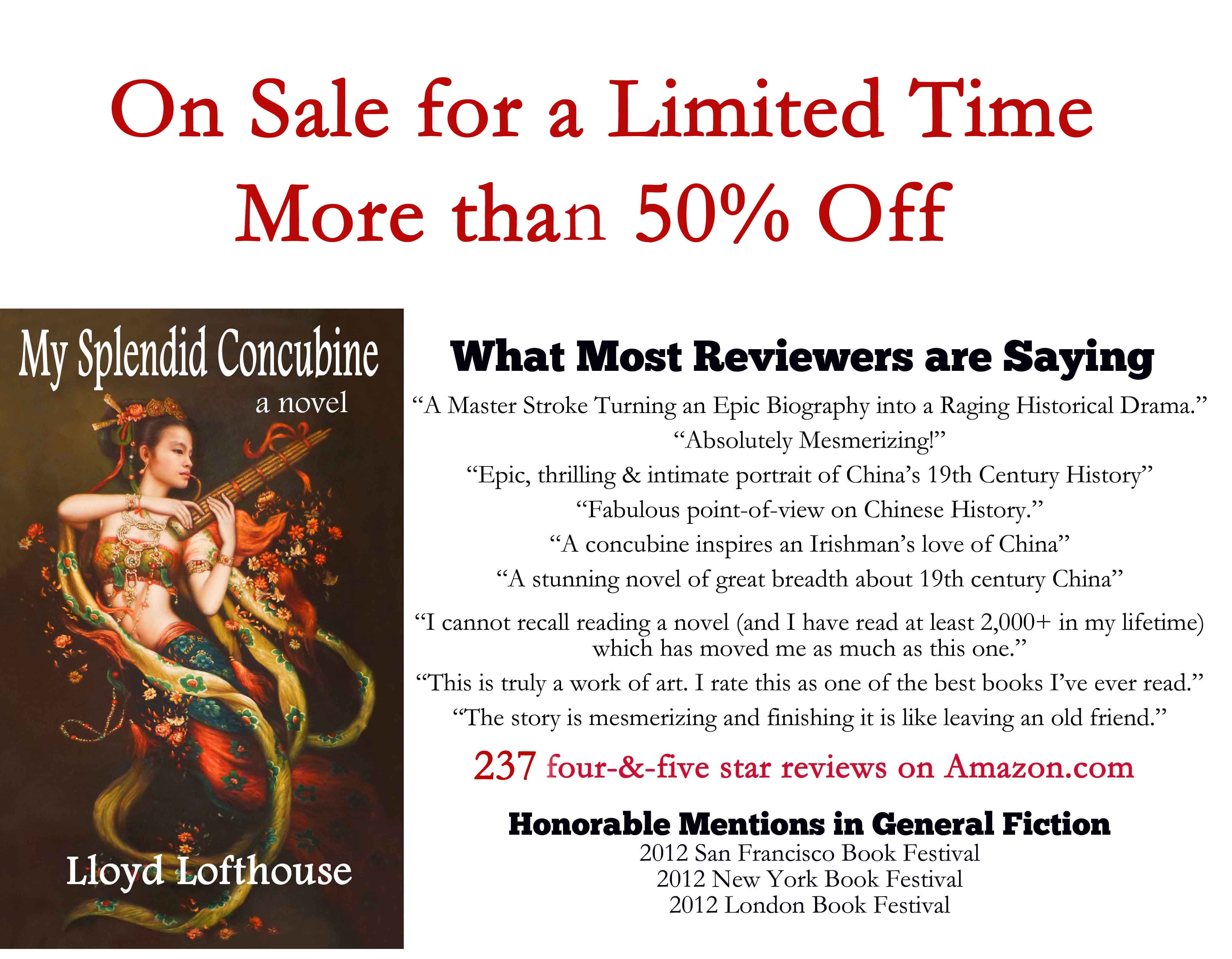
Lloyd Lofthouse is the award-winning author of My Splendid Concubine [3rd edition]. When you love a Chinese woman, you marry her family and culture too. This is the unique love story Sir Robert Hart did not want the world to discover.

on-sale-for-limited-time-oct-nov-2016

Where to Buy

Subscribe to “iLook China”!
Sign up for an E-mail Subscription at the top of this page, or click on the “Following” tab in the WordPress toolbar at the top of the screen.

About iLook China

China’s Holistic Historical Timeline


Music with Two Strings

October 18, 2016

If you Google the name for this two stringed instrument, you may find the same name is used for girls names and a railroad that runs between Beijing and Shanghai. Jing is for the capital and Hu for Shanghai.

Since Chinese is a tonal language, each word is pronounced in a different tone.  The word is also written differently in Chinese when used for a girl’s name or the railroad.

京胡
for the musical instrument


Beijing-Shanghai

The Jing-Hu I’m writing about is a two-stringed instrument often used with Beijing Opera. The Jing-Hu first appeared during the Qing Dynasty (1644 – 1912).  In the 17th century the strings were made of silk. Today, they are often made of steel or nylon.  The Jing-Hu is the smallest of the Chinese fiddles and is related to the larger Erhu.

Discover China’s First Emperor Qin Shi Huangdi, the man that unified China more than 2,000 years ago.

Lloyd Lofthouse is the award-winning author of My Splendid Concubine [3rd edition]. When you love a Chinese woman, you marry her family and culture too. This is the unique love story Sir Robert Hart did not want the world to discover.

on-sale-october-november-2016

Where to Buy

Subscribe to “iLook China”!
Sign up for an E-mail Subscription at the top of this page, or click on the “Following” tab in the WordPress toolbar at the top of the screen.

About iLook China

China’s Holistic Historical Timeline


The Story of Stone and China’s Star Crossed Lovers.

October 12, 2016

The Dream of the Red Chamber (also known as The Story of Stone) is generally considered one of the four greatest Chinese classical novels. The story is so popular in China that it has had several versions and translations and was made into a TV series.

The author, Tsao Hsueh-chin (1715-1763) came from a powerful and wealthy family and lived a privileged life as a child in Nanjing. Later, he became poor and struggled to survive. Going from wealth to poverty provided him with the necessary experiences to write this tragic story.

Although this novel (English translation available on Amazon in addition to a film selection) has great literary merit on many levels, readers might have difficulty keeping the characters straight, because there are more than four hundred characters and almost thirty are major ones.

Nevertheless, readers and students of Chinese history and culture should read this book to develop a better understanding of Imperial China during the Ch’ing Dynasty. The novel paints a vivid portrait of a corrupt feudal society on the verge of the capitalist, market economy we see flourishing in China today.

Another plot is the Romeo and Juliet love story between Chia Pao-yu and Lin Tai-yu, who, like Romeo and Juliet, wanted to be free to marry anyone they desired.

CliffsNotes has also covered Dream of the Red Chamber.

Discover China’s First Emperor Qin Shi Huangdi, the man that unified China more than 2,000 years ago.

Lloyd Lofthouse is the award-winning author of My Splendid Concubine [3rd edition]. When you love a Chinese woman, you marry her family and culture too. This is the unique love story Sir Robert Hart did not want the world to discover.

on-sale-for-limited-time-oct-nov-2016

Where to Buy

Subscribe to “iLook China”!
Sign up for an E-mail Subscription at the top of this page, or click on the “Following” tab in the WordPress toolbar at the top of the screen.

About iLook China

China’s Holistic Historical Timeline


The Peasant Cult that Defeated the Yuan Dynasty

October 11, 2016

Religions, as Christians, Jews and Muslims practice them, have seldom played a major role in Chinese Culture and Politics. Even today, more than 800 million Chinese say they don’t belong to any religion and the largest religion in China is Buddhism with about 10% of the population.  Even during Imperial times, most members of government didn’t belong to organized religions. The same is true today with the Chinese Communist Party.

China’s struggle with pagan cults (for instance, the White Lotus Society) stretches back almost a thousand years. The White Lotus Society appealed to poor Han Chinese peasants and more so to women, who found peace in worshiping the Eternal Mother, Wusheng Laomu. It was believed that this Eternal Mother would gather all her children at the millennium into one family.

White Lotus Societies started out seeking tranquility through a combination of Buddhism with some elements of Daoism (Taoism) and other native Chinese religions. Even in the 12th century, the Yuan Dynasty was distrustful of the Yellow Lotus Society, which didn’t fit comfortably with Confucianism.

Persecution of the White Lotus Society started during the Mongol Yuan Dynasty (1271 – 1368 AD), the first dynasty that was not led by the Han Chinese. Due to this, the White Lotus Society changed from one of peace and tranquility and organized protests to violence against the Mongol rulers.

Since Yuan Imperial authorities distrusted the White Lotus Society, the Dynasty banned them, and the White Lotus went underground.  The White Lotus predicted that a messianic, Christ like figure would come and save them from persecution. That man was Zhu Yuanzhang, a Buddhist monk.

The White Lotus led revolution started in 1352 near Guangzhou before Zhu Yuanzhang joined the rebellion. But soon, he became the leader by forbidding his soldiers to pillage in observance of White Lotus religious beliefs.

By 1355, the rebellion had spread through much of China. In 1356, Zhu Yuanzhang captured Nanjing and made it his capital. Then Confucian scholars issued pronouncements supporting Zhu’s claim of the Mandate of Heaven, the first step toward establishing a new dynasty.

Zhu Yuanzhang liberated China from the Mongols and became the founding Emperor of the Ming Dynasty (1368 – 1643). Known as the Hongwu emperor, he was cruel, suspicious, and irrational, behavior that grew worse as he aged.

Discover Wu Zetian, China’s only female emperor

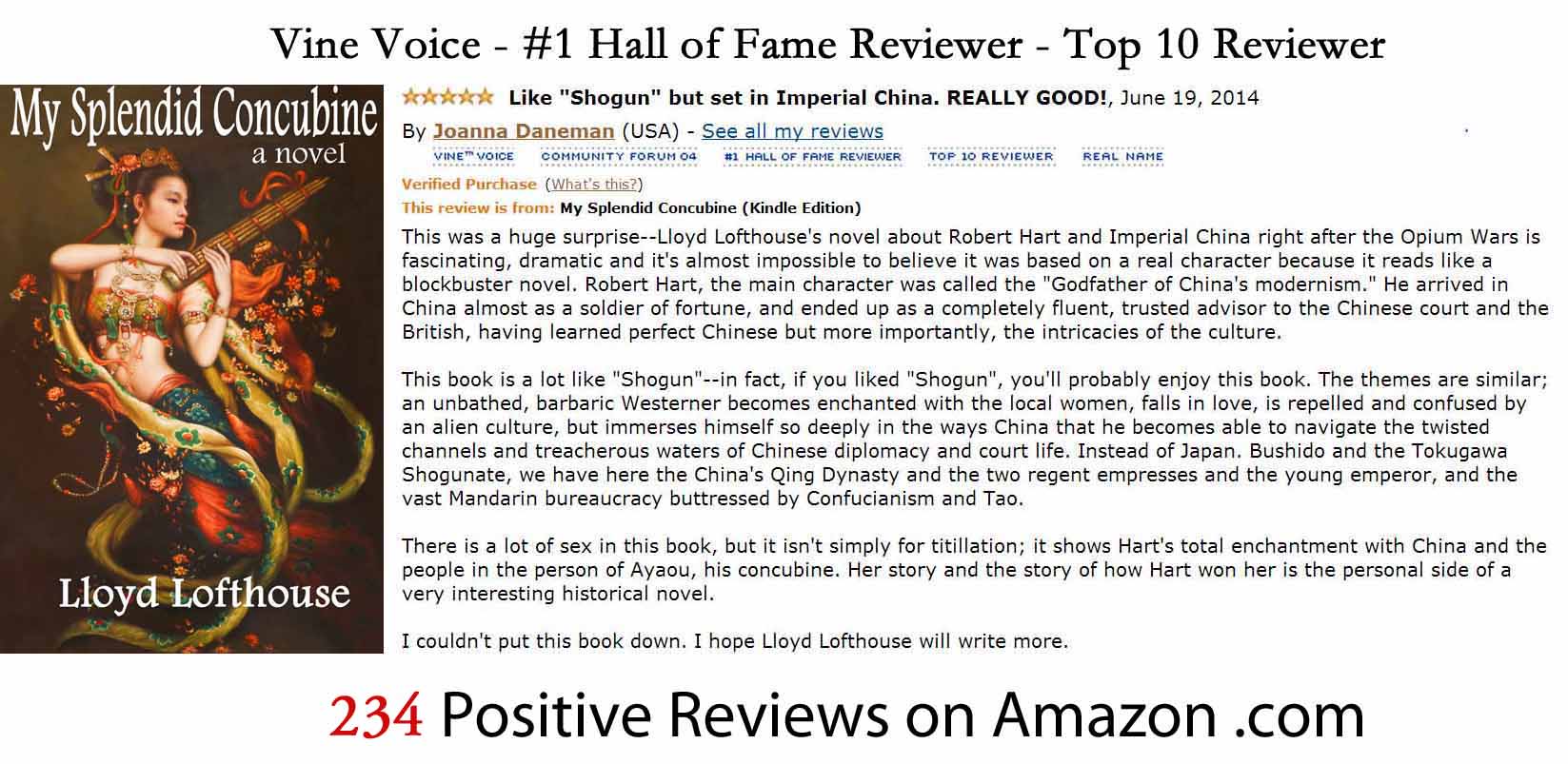
Lloyd Lofthouse is the award-winning author of My Splendid Concubine [3rd edition]. When you love a Chinese woman, you marry her family and culture too. This is the unique love story Sir Robert Hart did not want the world to discover.

#1 - Joanna Daneman review Updated August 26 - 2016_edited-2

Where to Buy

Subscribe to “iLook China”!
Sign up for an E-mail Subscription at the top of this page, or click on the “Following” tab in the WordPress toolbar at the top of the screen.

About iLook China

China’s Holistic Historical Timeline


Marco Polo

October 5, 2016

As a child I was fascinated with Genghis Khan (1162 – 1227 A.D.) and his grandson Kublai Khan (1215 – 1294), who was the 5th Khagan (Great Khan of the Mongol Empire), and the 1st Emperor of the Yuan Dynasty in China (1271 – 1368).  He was the first non-native emperor to conquer all of China. This fascination is why I knew a little bit about Marco Polo. In fact, I’ve known about Marco Polo most of my life but not much detail about what he actually accomplished in China.

map-of-mongol-empire

Marco Polo lived in China for 17 years and loyally served Kublai Khan.  I’ve never seen the first television miniseries (8 episodes) originally broadcast by NBC in 1982, but I have watched season one of the recent Marco Polo series produced by Netflix.

Halfway through Seasons One’s Netflix series, I wanted to know how accurate this fascinating interpretation of Marco Polo’s life in China was and did some digging with help from Google.

In the Bonus material for the 1st season, there’s a thirty-eight minute documentary that I recommend watching before starting the episodes, so you have a better idea of who Marco was and what he did in China.  That way you won’t have to do what I did. Watching the documentary will help you separate fact from fiction while watching the series. I didn’t know about the documentary until I finished watching the episodes.

What I found interesting when I did my research about Marco’s years in China (1275 – 1292) was the show’s ratings on Rotten Tomatoes.  The thirty-three critics gave the show a rating of 4.7 out of 10, but the audience of 2,162 gave the show a rating of 9 out of 10. It was easy for me to side with the audience.

I bought the DVDs for Marco Polo Season 1 from Amazon where it has 4.6 of 5 stars from the 90 customer reviews.

Discover Wu Zetian, China’s only female emperor

Lloyd Lofthouse is the award-winning author of My Splendid Concubine [3rd edition]. When you love a Chinese woman, you marry her family and culture too. This is the unique love story Sir Robert Hart did not want the world to discover.

a1-on-august-26-2016-cover-image-with-blurbs-to-promote-novel_edited-1

Where to Buy

Subscribe to “iLook China”!
Sign up for an E-mail Subscription at the top of this page, or click on the “Following” tab in the WordPress toolbar at the top of the screen.

About iLook China

China’s Holistic Historical Timeline