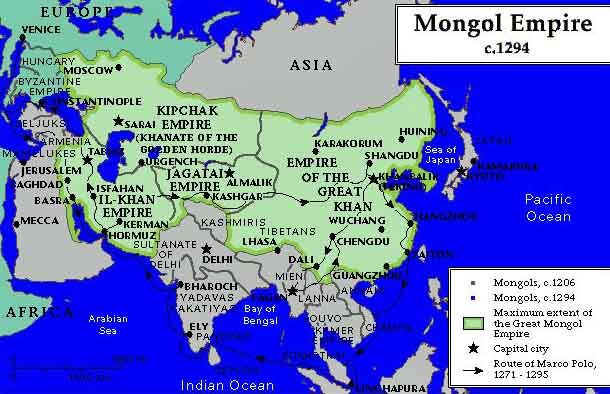
As a child I was fascinated with Genghis Khan (1162 – 1227 A.D.) and his grandson Kublai Khan (1215 – 1294), who was the 5th Khagan (Great Khan of the Mongol Empire), and the 1st Emperor of the Yuan Dynasty in China (1271 – 1368). He was the first non-native emperor to conquer all of China. This fascination is why I knew a little bit about Marco Polo. In fact, I’ve known about Marco Polo most of my life but not much detail about what he actually accomplished in China.
Marco Polo lived in China for 17 years and loyally served Kublai Khan. I’ve never seen the first television miniseries (8 episodes) originally broadcast by NBC in 1982, but I have watched season one of the recent Marco Polo series produced by Netflix.
Halfway through Seasons One’s Netflix series, I wanted to know how accurate this fascinating interpretation of Marco Polo’s life in China was and did some digging with help from Google.
In the Bonus material for the 1st season, there’s a thirty-eight minute documentary that I recommend watching before starting the episodes, so you have a better idea of who Marco was and what he did in China. That way you won’t have to do what I did. Watching the documentary will help you separate fact from fiction while watching the series. I didn’t know about the documentary until I finished watching the episodes.
What I found interesting when I did my research about Marco’s years in China (1275 – 1292) was the show’s ratings on Rotten Tomatoes. The thirty-three critics gave the show a rating of 4.7 out of 10, but the audience of 2,162 gave the show a rating of 9 out of 10. It was easy for me to side with the audience.
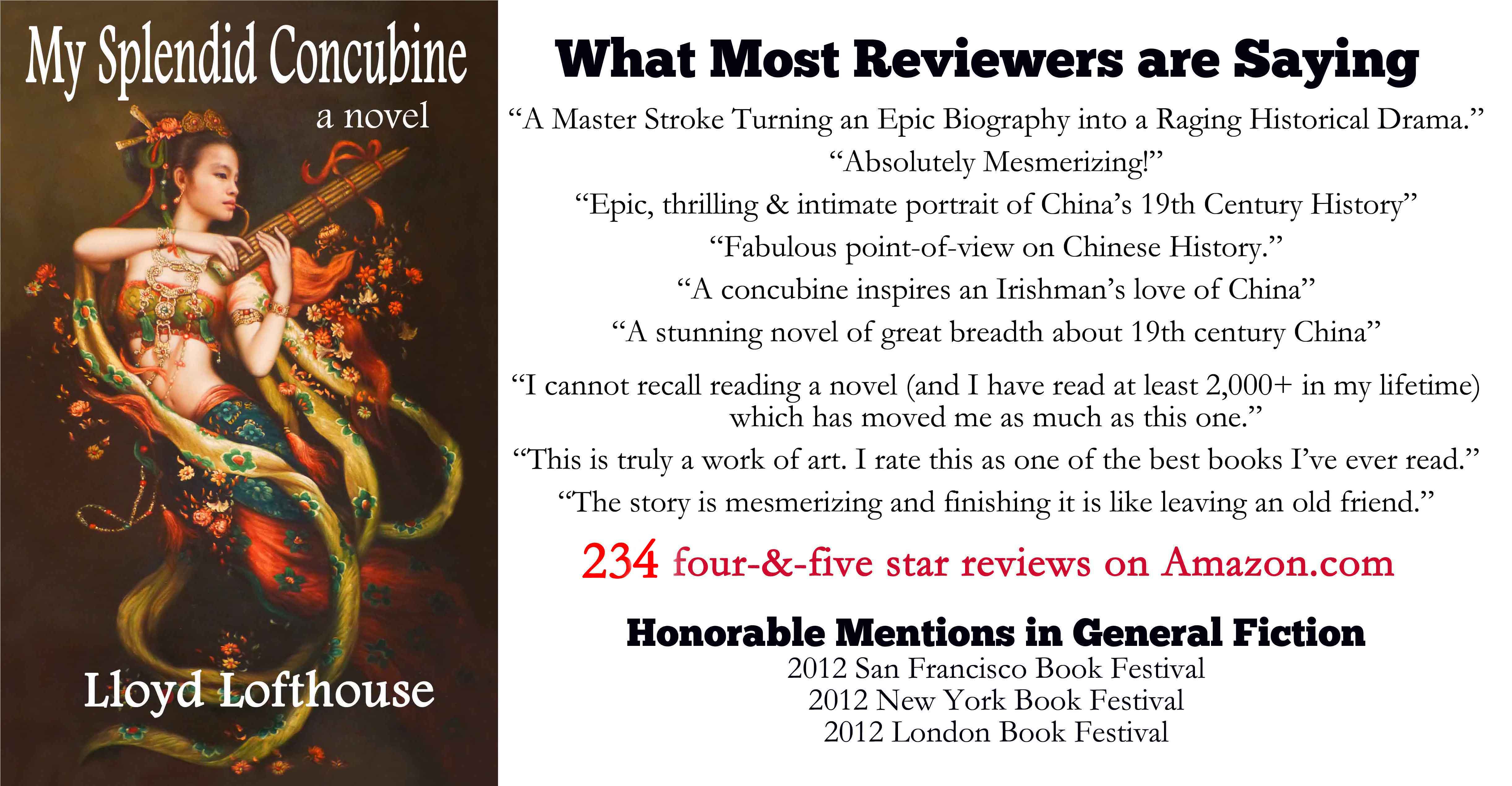
Lloyd Lofthouse is the award-winning author of My Splendid Concubine [3rd edition]. When you love a Chinese woman, you marry her family and culture too. This is the unique love story Sir Robert Hart did not want the world to discover.
Subscribe to “iLook China”!
Sign up for an E-mail Subscription at the top of this page, or click on the “Following” tab in the WordPress toolbar at the top of the screen.
The New York Times reported, “The Chinese map, which was drawn in 1763 but has a note on it saying it is a reproduction of a map dated 1418, presents the world as a globe with all the major continents rendered with an exactitude that European maps did not have for at least another century, after Columbus, Da Gama, Magellan, Dias and others had completed their renowned explorations.”
The voyages of Chinese Admiral Zheng He’s armada were rediscovered in Fujian province in the 1930s. The story was etched in a pillar. By the final, seventh voyage, the fleet had covered over 50,000 kilometers or 30,000 miles and was comprised of three hundred ships and 28,000 men.
But when the Yongle Emperor died in 1424, China’s Hongxi Emperor stopped the voyages of China’s largest fleet. – BBC
A century later, about 1529, another Ming Emperor burned all records of the fleet. This decision to withdraw from the world may have resulted in China not being ready to confront the Western Imperial powers that arrived in the 19th century starting the Opium Wars that devastated China leading to a century of war and unrest.
For a comparison, Christopher Columbus set sale in 1492 with 3 small ships and 88 men. Erik the Red, a Viking explorer, also crossed the Atlantic in even smaller ships to build a settlement in Greenland around 1,000 AD. Some archeologists suggest that the Phoenicians may have reached the Americas before the Vikings and Columbus around 500 BC. Some even say as early as 1500 to 1200 BC.
Columbia.edu says, “From 1405 until 1433, the Chinese imperial eunuch Zheng He led seven ocean expeditions for the Ming emperor that are unmatched in world history.” To learn more about the seven voyages, click the link in this paragraph.
In fact, many layers of myth surround China’s ancient mariner. According to Kenyan lore, some of his shipwrecked sailors survived and married local women in Africa. DNA tests have reportedly shown evidence of Chinese ancestry and a young Kenyan woman, Mwamaka Shirafu, was given a scholarship to study Chinese medicine in China.
Lloyd Lofthouse is the award-winning author of My Splendid Concubine [3rd edition]. When you love a Chinese woman, you marry her family and culture too. This is the unique love story Sir Robert Hart did not want the world to discover.
Subscribe to “iLook China”!
Sign up for an E-mail Subscription at the top of this page, or click on the “Following” tab in the WordPress toolbar at the top of the screen.
The idea of eating soup made from bird saliva gives me the shivers. However, there is a history behind this Southeast Asian delicacy and there may be health benefits but also some degree of danger for a few people.
Myths say the Chinese have been eating bird saliva for 1,500 years since the Tang Dynasty (618-907 AD). But another myth says China’s most famous eunuch, Admiral Zheng Hi, brought these nests made from bird saliva back to China in the 15th century.
What we do know for sure is that the Chinese have been making soup from imported swiftlet nests from Southeast Asia for centuries.
A few comprehensive scientific studies in Asia and China in the 1990s revealed that this particular bird saliva appears to play a crucial role in major normal cellular processes and may help resist the effects of aging.
However, the Malaysian Society of Allergy and Immunology reported that for a few people there is a major risk of an allergic reaction after eating Bird’s Nest Soup that might cause death.
To be fair to the birds and their saliva, eating peanuts, tree nuts, milk, soy, shellfish (Medical Daily), and getting flu shots (CDC) can also end in allergic reactions with severe symptoms for a few.
Lloyd Lofthouse is the award-winning author of My Splendid Concubine [3rd edition]. When you love a Chinese woman, you marry her family and culture too. This is the unique love story Sir Robert Hart did not want the world to discover.
Subscribe to “iLook China”!
Sign up for an E-mail Subscription at the top of this page, or click on the “Following” tab in the WordPress toolbar at the top of the screen.
China has had about 30 dynasties since 2070 BC, but there were seven that contributed more to make China what it is today: the Zhou (1046-771 BC), Qin (221-206BC), Han (206 BC-220AD)), Tang (618-907AD), Sung (960-1279AD), Ming (1368-1644AD), and Qing Dynasties (1644-1911AD).
Although China’s civilization survived, the country’s history is rampant with rebellions, palace coups, corruption among palace officials, and insurrections. Between the longest dynasties, the country usually fell apart into warring regions as it did after 1911.
The most successful emperors managed to stabilize the country while leading wisely as the Communist Party has done since 1976. There will be some who’ll disagree, but results are hard to ignore. In the last few decades since Mao died, China is responsible for 90 percent of the world’s reduction in poverty while avoiding potential leaders like Donald Trump.
The first emperor, who conquered and unified China, was Qin Si Huangdi of the Qin Dynasty.
Emperor Han Wudi (ruled 141 – 87 B.C.) of the Han Dynasty was fifteen when he first sat on the throne.
Wudi is considered one of the greatest emperors in China’s history. He expanded the borders, opened the early Silk Road, developed the economy, and established state monopolies on salt, liquor and rice.
After the Han Dynasty collapsed, China fell apart for almost 400 years before the Tang Dynasty was established (618 -906). The Tang Dynasty was blessed with several powerful emperors.
The first was Emperor Tang Taizong, who ruled from 627-649.
Wu Zetain (624 to 705 AD), China’s only woman emperor, also ruled wisely. She was married to two emperors before becoming one.
Emperor Xuanzong of Tang, Zetain’s grandson, ruled longer (712 – 756) than any Tang emperor (43 years) and the dynasty prospered during the first half of his reign but declined after the Anshi Rebellion (755 – 763).
After the Tang dynasty fell, there would be a short period of about 60 years before the Sung Dynasty reestablished order and unified the country again.
The second emperor of the Sung Dynasty, Sung Taizong (ruled 976 – 997) reunified China after defeating the Northern Han Dynasty. The third emperor, Sung Zhenzong (ruled 997-1022) also deserves credit for maintaining stability.
The Sung Dynasty then declined until a revival by Sung Ningzong, who ruled from 1194 to 1224 AD. After he died, the dynasty limped along until Kublai Khan defeated its last emperor in 1279.
After conquering all of China, Kublai Khan founded the Mongol, Yuan Dynasty (1277-1367). Not long after he died, his dynasty was swept away in 1368, when a peasant rebellion defeated the Yuan Dynasty and drove the Mongols out of China to establish the Ming Dynasty (1271 – 1368) known for rebuilding, strengthening and extending the Great Wall tourists visit today.
Historical records show that under the third Ming Emperor, Ming Chengzu (ruled 1403 – 1424), China was prosperous.
After Chengzu, the dynasty would decline until 1567 when Emperor Ming Muzong reversed the decline. His son, Emperor Ming Shenzong, also ruled wisely from 1573 to 1620.
After Shenzong’s death, the Ming Dynasty quickly declined and was replaced by the Manchurian Qing Dynasty in 1644.
The Opium Wars started by England and France, and the Taiping Rebellion led by a Christian convert in the 19th century, contributed to the fall of the Qing Dynasty in 1911.
The Qing Dynasty was fortunate to have three powerful, consecutive emperors: Emperor Kangxi (1661 – 1722), Yongzhen (1722-1735), and Qianlong (1735-1796). Under these three leaders, for one-hundred-and-thirty-five years, China remained strong and prosperous.
After Dr. Sun Yat-sen died in 1925, the republic he was building in southern China fell apart when Chiang Kai-shek broke the coalition that Sun Yat-sen had formed between the Nationalist and Communist Parties. The Communist Party survived due to Mao’s famous Long March.
Japan invaded China in 1937 more than four years before bombing Pearl Harbor. It’s estimated that 15-20 million Chinese died because of the Japanese invasion. When the World War ended in 1945, the Civil War continued until the Communists led by Mao defeated the Nationalists in 1949.
The victory was made possible because the Communists were supported by China’s peasants that hated, despised and distrusted the Nationalist Party, which represented China’s ruling elite that had mistreated and abused them for centuries.
The Communists gained the support of the peasants by treating them with respect and promising land reforms. After the Civil War, Mao delivered on that promise. Although China suffered through Mao’s Cultural Revolution, today China is an emerging modern nation with a middle class of about 300 million, and many Chinese that can afford to travel internationally have the freedom to go. In fact, more than 100 million leave and return annually.
In addition, Barrons.com reported, “In 2013, nearly 32%, or 225,474, of Chinese students going abroad went to the U.S, according to UNESCO’s latest data. After the U.S., students from China went to Japan (13%), Australia (12%) and the U.K. (11.5%).” The Chinese Ministry of Education reported that 523,700 Chinese students went abroad to study in 2015. Today, regardless of Western criticism of the Chinese Communist Party, the Chinese people have had more freedom with a better quality of life than at any time in their country’s history.
中
Lloyd Lofthouse is the award-winning author of My Splendid Concubine [3rd edition]. When you love a Chinese woman, you marry her family and culture too. This is the unique love story Sir Robert Hart did not want the world to discover.
Subscribe to “iLook China”!
Sign up for an E-mail Subscription at the top of this page, or click on the “Following” tab in the WordPress toolbar at the top of the screen.
The experiences Jack London (1876 – 1916) had in Korea and China in 1904 led to an essay and a story that ignited a debate that he was a racist. At the time, London also took photographs during the Russo-Japanese War in Korea and Manchuria.
He wrote the The Unparalleled Invasion, which takes place in a fictional 1975, when the West decides to destroy China (for no good reason) by using biological warfare.
London’s 1904 essay, The Yellow Peril, contributed to the claim that he was a racist. Using Google, I found sites that support this theory.
The New World Encyclopedia says, “Many of Jack London’s short stories are notable for their empathetic portrayal of Mexicans (The Mexican), Asian (The Chinago), and Hawaiian (Koolau the Leper) characters. But, unlike Mark Twain, Jack London did not depart from the views that were the norm in American society in his time, and he shared common Californian concerns about Asian immigration and ‘the yellow peril’ (which he actually used as the title of an essay he wrote in 1904; on the other hand, his war correspondence from the Russo-Japanese War, as well as his unfinished novel “Cherry,” show that he greatly admired much about Japanese customs and capabilities.”
In addition, Jack London, Photographer (ISBN 978-0-8203-2967-3) by Jeanne Campbell Reesman, Sara S. Hodson and Philip Adam is a beautiful book showing that London had talent beyond writing stories such as White Fang or Call of the Wild.
On page 57, the caption says, “London had his camera confiscated in Japan and was often detained by Japanese officials when he got too close to the front lines, especially as the war spread to the Yalu River, the boundary between Korea and Manchuria.”
After seeing the pictures in Jack London, Photographer, it’s difficult to believe he was a racist. There have also been rumors that London committed suicide, but there’s no evidence to support that theory either.
If London were a racist, why did his Japanese servant Tokinosuke Sekine stay loyal to the end even after London was bankrupt and his ‘fair weather’ friends had abandoned him?
中
Lloyd Lofthouse is the award-winning author of My Splendid Concubine [3rd edition]. When you love a Chinese woman, you marry her family and culture too. This is the unique love story Sir Robert Hart did not want the world to discover.
Subscribe to “iLook China”!
Sign up for an E-mail Subscription at the top of this page, or click on the “Following” tab in the WordPress toolbar at the top of the screen.


 Posted by Lloyd Lofthouse