In 1977, a discovery was made in China—a complete set of chime bellswas unearthed from the tomb of Marquis Yi, who lived during the Warring States Period (475 to 221 BC). These chimes were older than the Qin Dynasty’s famous Terra Cotta warriors (221 to 206 B.C.) that guard the tomb of Qin Shi Huangdi, the emperor that unified China.
When the chimes were discovered in Hubei Province (located in Central China), a plot of land was being leveled to build a factory. The Red Army officer in charge of the work had an interest in archeology.
The officer discovered that the workers were selling the ancient bronze and iron artifacts they were digging up. He convinced local authorities there might be an ancient tomb buried below the site.
When the tomb was unearthed, a set of chime bells was found. These musical instruments were an important part of ritual and court music dating. An American professor in New York City even called these chimes the eighth wonder of the ancient world.
The sixty-five chime bells weighed about 5 tons.
No other set of chimes like these had been discovered in China before, and this set was in excellent condition.
A project was launched in 1979 to duplicate four sets of these chimes. More than a 100 scientists and technicians were recruited. In 1998, twenty years after the discovery, the project was completed. One of the sets was sent to Taiwan as a gift.
中
Lloyd Lofthouse is the award-winning author of My Splendid Concubine [3rd edition]. When you love a Chinese woman, you marry her family and culture too. This is the unique love story Sir Robert Hart did not want the world to discover.
Subscribe to “iLook China”!
Sign up for an E-mail Subscription at the top of this page, or click on the “Following” tab in the WordPress toolbar at the top of the screen.
“My Splendid Concubine” is based on a true story. A larger-than-life bronze statue of Robert Hart, ordered by the Emperor of China, was placed on the Bund in Shanghai, China to honor this Irishman, and it stood for several decades before the Japanese removed it during World War II and turned the metal into bullets. It took almost a decade to research and write this novel.
Lloyd Lofthouse is the award-winning author of My Splendid Concubine [3rd edition]. When you love a Chinese woman, you marry her family and culture too. This is the unique love story Sir Robert Hart did not want the world to discover.
Subscribe to “iLook China”!
Sign up for an E-mail Subscription at the top of this page, or click on the “Following” tab in the WordPress toolbar at the top of the screen.
In the United States, if a public school were to attempt teaching young, deaf and/or disabled students in the art of an intricate dance and required them to drill repeatedly as if they were in the Marine Corps, humanitarians and feminists—due to the attractive young women—would cry foul and soon there would be pressure to cancel it, make it illegal, or hold investigations. There might even be boycotts and protests.
As for autocratic corporate Charter schools that are stealing money from the community-based, democratic public schools in the United States, forget it. Corporations are in it for the higher test scores so they can brag and hijack more children from the public schools to boost profits.
In addition, critics of China infected with the Racist Sinophobia Virus (RSV), a mental illness learned while growing up, might chime in to crucify the Middle Kingdom once again for crimes against humanity reminding us—with more lies and exaggerations—of Tibet, censorship, and more.
But when it was established in 1987, the China Disabled People’s Art Troupe (CDPAT) was an amateur performance troupe supported by the government with members recruited from around the country.
In 2002, that all changed, after the troupe’s first commercial performance. The China Daily reported, “After its first commercial performance, in 2004, the troupe made 10 million yuan (US$1.21 million).”
Tai Lihua, the lead dancer and captain of the CDPAT, has visited many countries with her troupe. For instance, they have performed at the John F. Kennedy Centre in New York City and the Teatro alla Scala in Venice, two of the world’s most prestigious theatres.
The dance of the Thousand-Hand Guan Yin is named after the Bodhisattva of compassion, revered by Buddhists as the Goddess of Mercy, who is a compassionate being that watches for and responds to the people in the world who cry out for help such as the deaf and disabled members of the CDPAT.
Being deaf and mute, these disabled performers endured pain and suffering in vigorous training simply to deliver a message of love, and when you watch the embedded videos and see close ups of the performers’ faces, you will see their dedication.
When I first watched this video, I was reminded of Amy Chua, the Tiger Mother, and how she relentlessly drilled her daughters in piano and violin. US critics raged at this after Chua’s memoir Battle Hymn of the Tiger Mother was published. However, the oldest daughter, Sophia, went to Harvard and enjoys playing the piano.
Often, the rewards of enduring the pain and suffering it takes to achieve near perfection in an art such as playing piano or learning intricate dances comes only after years of challenging and demanding repetition.
What’s amazing about this dance troupe is that all the performers are deaf, making the choreography to the music even more incredible, and the difficulties encountered in training are beyond imagining.
However, four instructors, who can hear and speak, signal the rhythm of the music from four corners of the stage/room, and with repetition and diligent practice, the performance is nearly flawless.
______________________________
Lloyd Lofthouse is the award-winning author of My Splendid Concubine [3rd edition]. When you love a Chinese woman, you marry her family and culture too. This is the lusty love story Sir Robert Hart did not want the world to discover.
Subscribe to “iLook China”!
Sign up for an E-mail Subscription at the top of this page, or click on the “Following” tab in the WordPress toolbar at the top of the screen.
Chinese calligraphy is demonstrated in the videos included with this post. In China, many artists use sidewalks as a canvas and a brush with water to paint the beauty of calligraphy. As the water evaporates, the art vanishes.
In fact, calligraphy is more popular than ever. After the Cultural Revolution (1966 until 1976 when Mao died), many people turned to calligraphy in the hope of finding solace in the calm repetition of its exercises. Then, in 1981, the Chinese government took the lead in setting up a Chinese Calligraphers Association, the first such nationwide body ever to be established in the country.
Both a language and an art, Chinese calligraphy has been traced back more than 4,000 years to the crude form called “Jia Gu Wen” found on turtle shells from the Shang Dynasty.
Calligraphy first bloomed as an art during the Han Dynasty but by the time of the Tang Dynasty, it had declined as an art. > Chinese Calligraphy History
It would be difficult to talk about Chinese art without understanding Chinese calligraphy and its artistic inspiration. A painting has to convey an object, but a well-written character conveys only its beauty through line and structure.
In Shanghai on sidewalks, or Beijing at The Summer Palace, I’ve watched men with long handled brushes, as seen in the first video, using water for ink and concrete for paper. With grace, they exhibit the skills of a Rembrandt breathing life into the characters.
America’s so called street artists should copy the Chinese that practice calligraphy and trade in their cans of spray paint for brushes and water, which would save US taxpayers a lot of money.
Lin Yutang writes in My Country and My People that Western art is more sensual, more passionate, fuller of the artist’s ego, while the Chinese artist and art-lover contemplates a dragonfly, a frog, a grasshopper or a piece of jagged rock—more in harmony with nature.
Owing to the use of writing calligraphy with a brush, which is more subtle and more responsive than the pen, calligraphy as art is equal to Chinese painting.
Through calligraphy, the scholar is trained to appreciate, as regards line, qualities like force, suppleness, reserved strength, exquisite tenderness, swiftness, neatness, massiveness, ruggedness, and restraint or freedom.
Maybe this helps explain why the Chinese are not as warlike as Christian and Islamic cultures.
______________________________
Lloyd Lofthouse is the award-winning author of My Splendid Concubine [3rd edition]. When you love a Chinese woman, you marry her family and culture too. This is the lusty love story Sir Robert Hart did not want the world to discover.
Subscribe to “iLook China”!
Sign up for an E-mail Subscription at the top of this page, or click on the “Following” tab in the WordPress toolbar at the top of the screen.
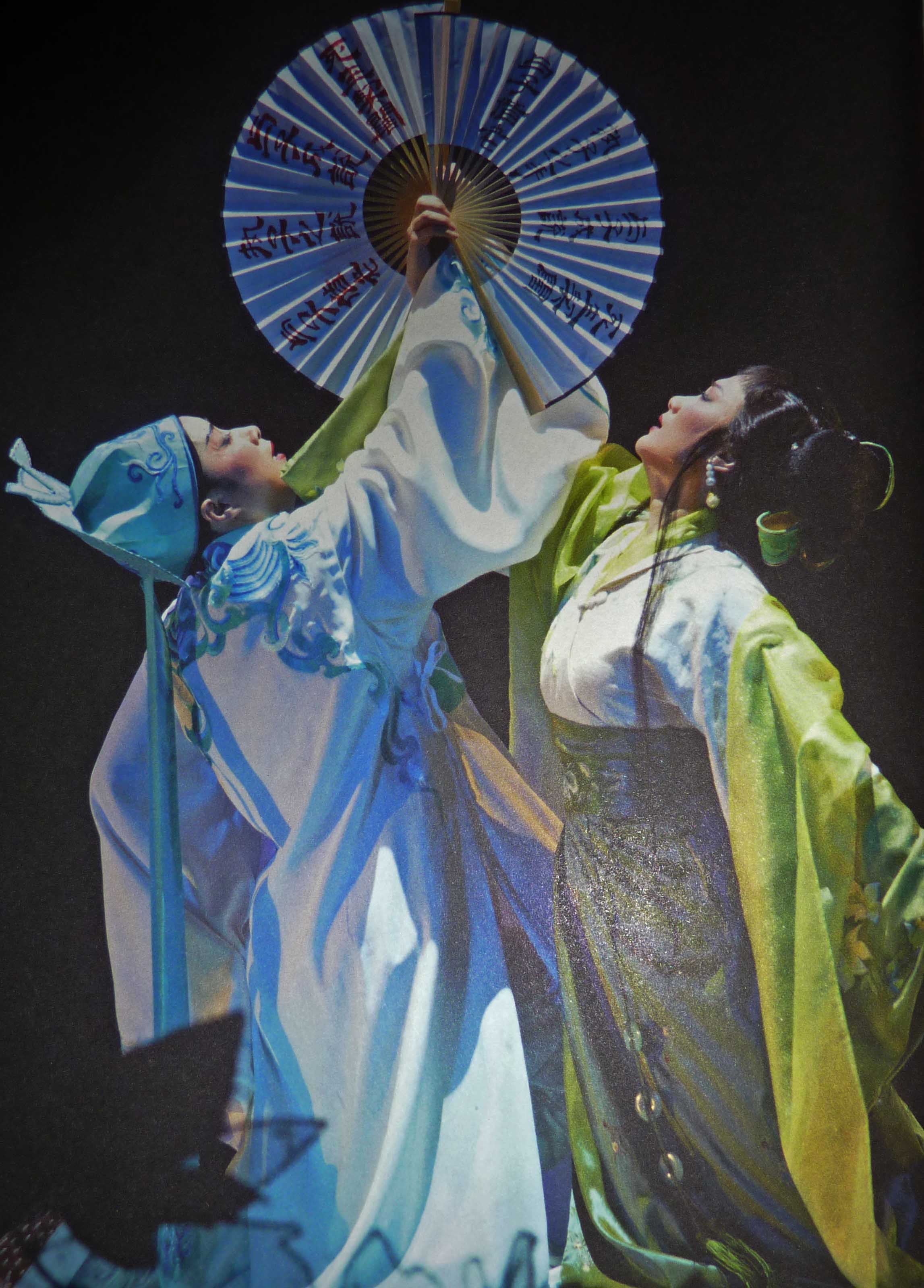
Mao Wei Tao is considered a living treasure in China—she has an estimated 20 million fans. She imitates men in the opera roles she plays—a reversal from Imperial China when women were not allowed on stage so men played female roles.
“In 1923, the training of female actors for this art form was set up. Since 1928, the Shaoxing opera troupes, consisting of solely female actors, began their performances in Shanghai. In a few years, females impersonating males had become the most important feature of this opera form, and at the same time the Yue opera became well known all over China.”
East China’s Zhejiang province gave China’s Shaoxing Opera Mao Wei Tao, who in her decades long career on the stage is best known as an outstanding male impersonator with a cult following of women.
I was introduced to Yue Opera in Hangzhou, Zhejiang Province more than a decade ago.
Mao Wei Tao and her husband have a theater company near the shores of the famous Westlake. My wife translated while I watched the live-opera performance in fascination.
The costumes were lavish and the acting and opera was dramatic while classical Chinese music played in the background.
The challenge today is to keep this form of Chinese opera alive, because the audience for opera is shrinking dramatically in China while remaining popular with the older generation.
Television, movies and the Internet are claiming the shorter attention spans of younger Chinese.
Mao Wei Tao, considered an innovative genius on stage, adapts and works to keep the art form alive. According to her husband, no two performances are exactly alike.
In November 2010, she performed in Taiwan as a cultural ambassador from the mainland. Today, “the company continues to tour and has staged productions in Paris, Hong Kong, Korea, Macau, Taiwan, the United States, Singapore, Spain, Holland, France, Belgium and Japan.” – bangkokfestivals.com
______________________________
Lloyd Lofthouse is the award-winning author of My Splendid Concubine [3rd edition]. When you love a Chinese woman, you marry her family and culture too. This is the lusty love story Sir Robert Hart did not want the world to discover.
Subscribe to “iLook China”!
Sign up for an E-mail Subscription at the top of this page, or click on the “Following” tab in the WordPress toolbar at the top of the screen.


 Posted by Lloyd Lofthouse


 iLook China