Recently, in Closed Minds and Culturally Blind Missionary Zeal, I mentioned Henry Kissinger’s book On China and quoted from the Preface, “American exceptionalism is missionary. It holds that the United States has an obligation to spread its values to every part of the world. China’s exceptionalism is cultural. China does not proselytize (preach); it does not claim that its contemporary institutions are relevant (superior) outside China.”
What Kissinger meant was that China does not believe it has a right to force its cultural beliefs and political system and values on the world while America does believe it has that right.
What do you think? Do you feel the US has the right to preach to other cultures and pressure them to be like America?
I’m still reading “On China”, and it will be some time before I finish because I’m reading several magazines and another book at the same time while writing two Blogs and getting ready to launch my next book, which will see “My Splendid Concubine” and “Our Hart” combined as The Concubine Saga.
The program ran about a half hour so I am going to share a condensed version.
After an introduction, Neal Conan asked, “In the long run, do you think the Chinese Communist Party can survive the political pressures created by the country’s economic successes?”
Kissinger said he believed China’s political system would have to adapt, which several of China’s leaders have already mentioned as a necessity.
When Conan challenged this answer, Kissinger replied, “But there a new administration coming in and right now, it is in a very defensive mode.”
Lloyd Lofthouse is the award-winning author of the concubine saga, My Splendid Concubine & Our Hart. When you love a Chinese woman, you marry her family and culture too.
To subscribe to “iLook China”, look for the “Subscribe” button at the top of the screen in the menu bar, click on it then follow directions.
What kicked off these random thoughts was caused by a Chinese friend quoting Anais Nin, “The only thing psychoanalysis achieves is to make one more conscious of one’s misfortunes.”
I Googled the quote from Anis Nin and found it on Solar Powered Visions and then found the following quote from PSYCHOANALYSIS AND THE TRAGIC SENSE OF LIFE by Richard L. Rubens, Ph.D., “To undertake such a journey is what is asked of patients in psychoanalysis. It is a journey into territory neither analyst nor patient knows completely, and both participants must recognize that they cannot know in advance what they will ultimately discover.… It (psychoanalysis) calls on man (or woman) to recognize his (or her) position in the forward sweep of time and to choose to live his (or her) life in full awareness of the loss that is inextricably bound up with the process of growth and change.”
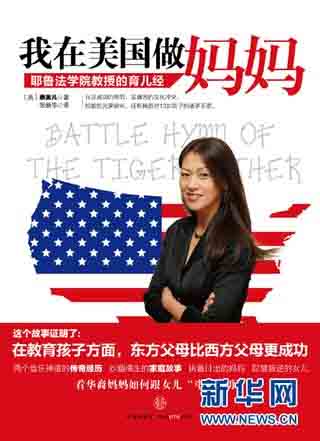
That resulted in my thinking of two of Amy Chua’s critics on the Amazon Forum for Battle Hymn of the Tiger Mother and that these two are unable to grow and change from what they have learned.
One of these anonymous critics calls herself Mandy Wu and the other JLee—both claim to be Asian and/or Chinese. In fact, JLee started out claiming to speak for all Chinese women when she voiced her opinions as a fact that Chinese mothers are not like Amy Chua. Later, the China Daily would prove her wrong, which led to JLee calling me a Cyber bully.
Both Mandy Wu and JLee have demonstrated that Western psychoanalysis has made them aware of how miserable they are and they have identified this misfortune with Amy Chua’s parenting style as described in her memoir. These two critics are unable to recognize their position in the forward sweep of time and to live in full awareness with the process of growth and change. They are stuck.
I replied to my friend, “Amy Chua’s critics should just ‘eat bitterness’ and get over it.”
He said, “That’s not what ‘eating bitterness’ means. It really means to endure hardship in order to build a better life.”
I asked, “Does that apply to both physical and mental hardships such as depression?”
He said yes.
As I walked away, I thought of, “Amy Chua and Amy Tan.” I turned around and asked, “Why is Amy such a popular name among Chinese?”
My friend laughed and replied, “In Chinese ‘Amy’ means ‘love rice’ and Amy is one of the most popular names that Cantonese give to their female children.”
I then went to the MDBG online Chinese dictionary and discovered that “Ai” means love 爱, which in Chinese is pronounced the same as the beginning of “Amy” and then I typed in “rice”, which appeared as “mi” or 米. In Chinese, Amy is written as 爱米.
Lloyd Lofthouse is the award-winning author of the concubine saga, My Splendid Concubine & Our Hart. When you love a Chinese woman, you marry her family and culture too.
To subscribe to “iLook China”, look for the “Subscribe” button at the top of the screen in the menu bar, click on it then follow directions.
After all, how many Caucasions, African Americans and Latino students would have to start at a two or four-year state college if Asians filled 40% of the seats at Ivy League universities? To understand what this means, discover the facts from Recognizing Good Parenting Parts 4 to 8 to learn who works harder (on average).
In The Chinese in America – Part 3, I wrote, “of the continued discrimination against Asian-Americans and Chinese in the US by other ethnic groups, which includes Caucasians, African Americans and Latinos.”
In the US, since the Civil Rights era preferential treatment favored African-Americans and Latinos since Asian-Americans tend to swallow their bitterness instead of protesting violently as the other minorities have.
For example, the NAACP says it fights for social justice for all Americans. However, facts demonstrate that the NAACP tends to favor legislation that focuses on benefits for African Americans. If this were not true, there would be no need for political organizations to serve Latinos and Asian-Americans.
The recent US Census indicated Latinos continue to become a bigger chunk of the American population. With growing numbers come a series of political and social changes to the country. The numbers indicate a growth in Latino political influence will change American politics. Source: rt.com (click on “Latino Political Clout”)
We know that the number of votes a minority such as African-Americans, Latinos and Asian-Americans deliver equals political influence.
African American political organizations demonstrate the power of this influence.
The National Association of Latino Elected and Appointed Officials (NALEO), the non-partisan leadership organization of the nation’s more than 6,000 Latino elected and appointed officials, which has the NALEO Educational Fund — the nation’s leading 501 (c)(3) non-profit, non-partisan organization that facilitates the full participation of Latinos in the American political process, from citizenship to public service.
As demonstrated, Asian American political organizations have a long way to go to catch up to African-American and Latino political influence. You may notice two of the Asian-American organization focus on Chinese-Americans, which represents about 3.5 million Chinese US citizens dividing the potential influence of 14.5 million Asian-Americans.
Asian-Americans and Chinese-Americans are crippled by their cultures when it comes to increasing political influence in the US since Chinese parents teach their children to eat bitterness.
In China, the tradition of “eat bitter” has been passed down from generation to generation. “Eat bitter” is a literal translation of Chinese "吃苦", which refers to endure hardship including discrimination.
The 2010 census shows us minority influence is not equal since there are 40 million African-Americans, 26.7 million Hispanic or Latino Americans but only 14.5 million Asian Americans. Numbers count since more people shout louder.
Elected officials from local, state and national levels would rather have Asian-Americans claiming racism than the larger ethnic populations that often act out their rage at not getting what they believe they are entitled through violence such as burning and looting businesses and wrecking vehicles during riots.
When has the US seen a race riot caused by a mob of Asian Americans? Instead, the few times any action has been taken, Asian-Americans resort to the legal system that may favor the larger, more vocal and violent minorities in America.
I suspect that “Eating Bitterness” was influenced by Taoism, Buddhism and Confucius while in the West the warlike and often-violent religions of Christianity and Islam do not follow the same path.
______________
Lloyd Lofthouse is the award-winning author of the concubine saga, My Splendid Concubine & Our Hart. When you love a Chinese woman, you marry her family and culture too.
To subscribe to “iLook China”, look for the “Subscribe” button at the top of the screen in the menu bar, click on it then follow directions.
The question was, “So what is Chinese mothering and is it superior to Western parenting? Should all moms ascribe to be Amy Chua?”
What follows are a few excerpts from the China Daily opinion piece.
“First, Chua is using the terms ‘Chinese mothers’ and ‘Western parents’ loosely. The Tiger Mother/Chinese Mother can be found in many cultures and is not exclusive within any culture….”
“Unlike in the West where children are encouraged to experiment and develop their own individual talents, Chinese parents believe the child is an extension of oneself. Chinese parents believe they know what is best for their children and therefore override the child’s preferences. Chua concludes that it may come down to a matter of choice. Westerners believe in allowing children a large measure of freedom to choose their own paths while the Chinese parent makes choices for her children.…”
Amy Chua’s daughter Sophia as seen on her Blog
”Trying to untangle Chinese mothering and Western parenting and pick one style of raising a child or the other as the exclusively right way is ultimately a fool’s errand. Certainly, there are elements from both that are worth adopting. Parents can be consistent without being inflexible. They can have high expectations and demand that children work hard without setting up gulag conditions. They can listen and adapt to their children without giving up control or responsibility for raising them.…”
“In the final analysis, Amy Chua has provided readers with a provocative memoir about how she raised her daughters. Certainly, her ideas are worth considering and many are worth adopting. However, no parent should believe that Tiger Mothers have infallible blueprints for raising successful children. Parents still need to chart their own course and be prepared to vary the course according to the needs of each child.”
Instead of listening to the intolerant opinions of inflexible fools from America, why not read what Sophia, Amy Chua’s oldest daughter, has to say in her letter to the New York Post or go to her Blog and discover for yourself that her tiger mother has not damaged her.
Lloyd Lofthouse is the award-winning author of the concubine saga, My Splendid Concubine & Our Hart. When you love a Chinese woman, you marry her family and culture too.
To subscribe to “iLook China”, look for the “Subscribe” button at the top of the screen in the menu bar, click on it then follow directions.
I first ran into this particular wall of intolerance on the Amazon Forum where Amy Chua’s critics left reviews and comments about her parenting methods in a hate fest that had mostly nothing to do with the memoir.
What these critics write are attacks on Chua accusing her of being a child molester, a sociopath, or a narcissist, etc. Often, these critics do not know what they are talking about and the biased ignorance runs deep.
One claim I have been struggling to disprove was the one that said, “Amy Chua does not represent the average mainland Chinese parent and had no right to claim that her parenting methods were Chinese.”
After more than four months, the evidence I have been looking for appeared in China when the China Daily published Tiger Moms’ Popular in China on April 14, 2011.
The China Daily said, “The strict parenting style advocated by Amy Chua, the Yale law professor, in her latest book, Battle Hymn of the Tiger Mother, is still popular in the country today, according to a recent survey.”
“Among 1,795 people polled online by China Youth Daily‘s social research center, 94.9 percent said they know women who are strict mothers, and 55.1 percent said they see merit in Chua’s parenting.…”
“A Beijing high school teacher, surnamed Liu, was quoted as saying that his wife had enrolled their daughter in violin and ballet classes at an early age and had resorted to scolding and spanking when the girl refused to go.
“Strict parenting is also a tradition in other Asian countries, such as Japan and South Korea,” Liu said. “It has merits in raising smarter children and preparing them better for harsh competition in the future.”
In addition, a critic of Chua’s on the Amazon Forum referred to an opinion piece posted on the Psychology Today Blog where Peter Gray, a research professor of psychology at Boston College claimed that 42 one-star reviews from anonymous people that identified themselves as Chinese was enough to conclude that the majority of Chinese (there are more than 1.3 billion Chinese and almost four million are in the US) were critical of Amy Chua’s parenting methods.
When we compare Peter Gray’s opinion in the Psychology Today Blog with information from almost 2,000 people polled online in China, which source do you think is more credible?
Lloyd Lofthouse is the award-winning author of the concubine saga, My Splendid Concubine & Our Hart. When you love a Chinese woman, you marry her family and culture too.
To subscribe to “iLook China”, look for the “Subscribe” button at the top of the screen in the menu bar, click on it then follow directions.


 Posted by Lloyd Lofthouse
 iLook China