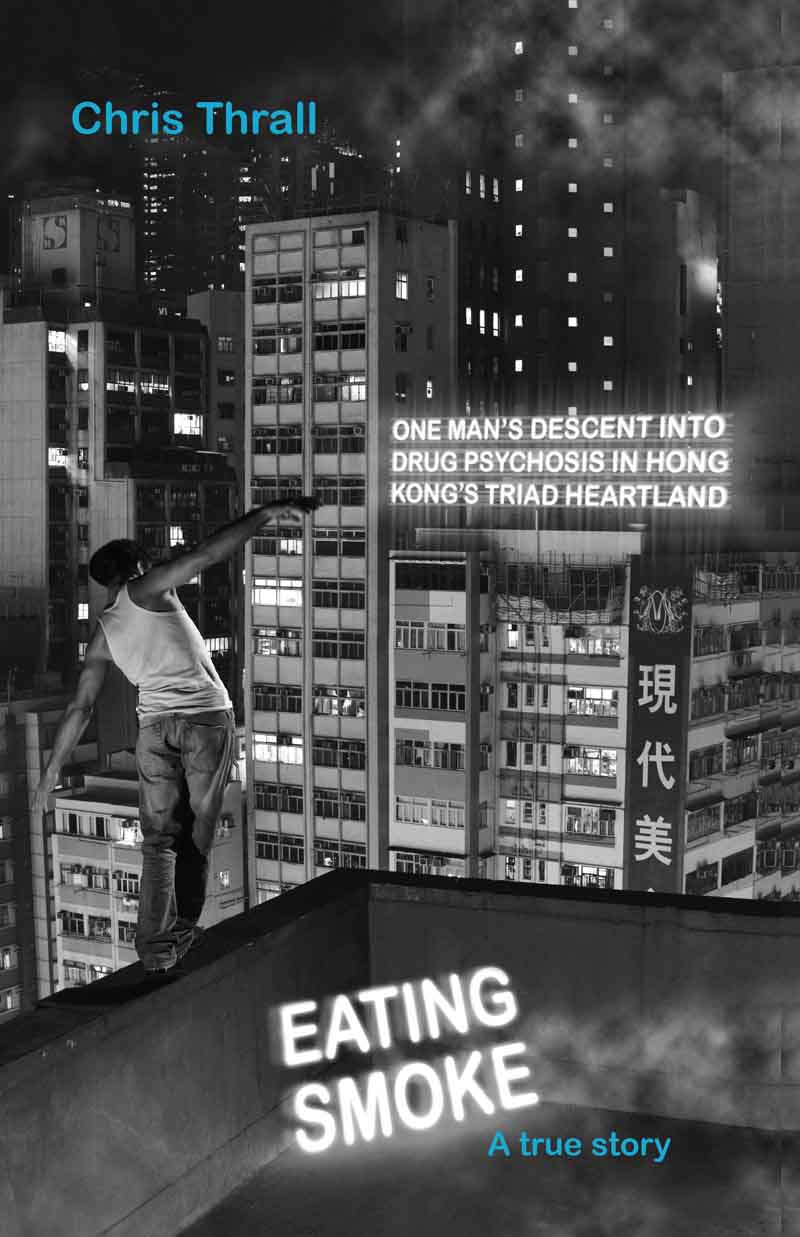
Eating Smoke — a question and answer with the author, Chris Thrall – Part 2/5

October 17, 2011

Guest-Post by Tom Carter
Interview with Chris Thrall, author of Eating Smoke continued…

On October 16, 2011, nearly two years since Chris Thrall originally contacted me, his long-awaited book, “Eating Smoke”, will be released in America and Amazon.com.

Advanced sales have already brought the title to the top of the Hong Kong bestseller list (patting my own back for my prediction) while Eating Smoke has achieved a massive cult following on Facebook.  Hailed as a “Sin – Shantaram” in a review by the South China Morning Post, and being compared by fans to Alex Garland’s The Beach for its drug-adelic theme, we can now confidently predict that Eating Smoke will, too, be optioned for film rights and follow those popular books to Hollywood.

Despite his past connections with Chinese triads, and in spite of his newfound celebrity as a bestselling author, Thrall remains one of the nicest and humblest people I have ever had the pleasure of knowing…even though I have yet to actually meet the man in person.  So it wasn’t too hard to twist his arm into putting my Q&A at the top of his to-do list of media interview requests (ah, the fame!).

TOM CARTER: My first and most pressing question, Chris, is if you are at all worried that the 14K will be hitting you up for a percentage of your book royalties once word of Eating Smoke’s success trickles up the Wan Chai gangland hierarchy?

CHRIS THRALL: Ha ha! The news from Hong Kong is that “serious players” are reading my book as we speak. But I’m not worried as it’s not a tell-all on Hong Kong organized crime. It’s more the story of a former Royal Marine Commando who thought he knew a bit about life, who then moves to Asia to run what was a successful business but spirals down into psychosis from drug addiction.

In that respect, Eating Smoke is unique. I’m not aware of any other book that gives the reader the opportunity to experience what it’s actually like to descend into mental illness through the eyes of someone as they do. I just happened to work for the 14K as a nightclub doorman – moreover, their “East-West go-between” – when it happened.

CARTER: Eating Smoke is about your decent into drug psychosis in Hong Kong’s triad heartland, but it’s also about the series of unfortunate, albeit hilarious, events that prevented you from ever finding your financial footing in Hong Kong, ironically Asia’s wealthiest city; a “testament to the stark reality and ephemeral nature of the relationship between people, drugs and profit,” as you wrote in the book.

Do you have anything to say to all those coked-out rich white bankers that Hong Kong is notorious for?

THRALL: No! I have nothing to say to anyone – coked-out rich white bankers included. If people truly enjoy what they do, they should carry on doing it.

Personally, I didn’t want to see my youth slipping away in a suit as I chased dollar signs at the expense of more fulfilling experiences. So having overcome addiction, I made an inventory of what I wanted to get out of life. Then I set out across six continents through seventy-five countries to get it. Writing a book was the last thing on my bucket list.

CARTER: China is adamantly anti-drugs, and the court system does not hesitate to execute drug traffickers, even foreigners.

In fact, China even blames foreigners for being responsible for a majority of its drug trade, a grudge no doubt held over from the Opium Wars.  Even though there are arguments to be made against the death penalty, the fact remains that, due to their zero-tolerance policy, China has one of the world’s lowest crime rates, a statistic that, all things considered, I’m sure America and the UK envy.

As a former drug user, what’s your take on criminalization of drugs, and do you think the west should follow China’s example?

THRALL: I don’t have a take on it. I’m not a spokesperson on substance use or the law surrounding it. I just told my own story.

However, research would likely show that mankind has always taken drugs in various forms and continues to do so (alcohol and cigarettes often cited as the most damaging), which might suggest that education on their usage and dangers is the way forward, in addition to harm-prevention strategies.

As for crime, a sociologist once said that a zero crime rate would make society a frightening place to be. I think Orwell’s 1984 was meant to imply this. I take no stance on drugs per se or cast judgment on people who choose to buy, sell, or use them.

It was addiction that I battled and that’s a separate issue. It’s a psychological condition that could relate to gambling, sex or food. It makes you wonder how prohibition could ever fix this.

Continued on October 18, 2011  in Eating Smoke – Part 3, return to Part 1, or if you have the time and do not want to wait for the five-part series to finish posting, click View as Single Page.

Chris Thrall was born in the UK. At eighteen, he joined the Royal Marine Commandos. Following active service in the Northern Ireland Conflict and training in Arctic warfare and survival, he earned his parachutist’s ‘wings’ and went on to serve as part of a high-security detachment onboard an aircraft carrier. In 1995, Chris moved to Hong Kong to oversee the Asia-Pacific expansion of a successful network-marketing operation he’d built, part-time, while serving in the Forces. Less than a year later, he was homeless, hooked on crystal methamphetamine and working for the 14K, Hong Kong’s largest triad crime family, as a doorman in Wanchai’s infamous red-light district. Eating Smoke, a humorous yet deeply moving first book, is his account of what happened.

__________________________

Travel photographer Tom Carter is the author of CHINA: Portrait of a People, a 600-page book of photography from the 33 provinces of China, which may be found on Amazon.com.

To subscribe to “iLook China”, sign up for an E-mail Subscription at the top right-hand side of this page and then follow directions.


Eating Smoke — a question and answer with the author, Chris Thrall – Part 1/5

October 16, 2011

Guest-Post by Tom Carter
Interview with Chris Thrall, author of Eating Smoke

Tom Carter, author of “CHINA: Portrait of a People”, catches up with Chris Thrall to discuss his new book “Eating Smoke, a memoir about Thrall’s descent into drug psychosis in Hong Kong’s triad heartland.

In the fall of 2009, whilst traveling in India to create my next photography book, I was contacted via email by a British writer who had read Down and out in Hong Kong, one of my online travel articles, which described this poor, dusty backpacker’s real-time impressions of Asia’s wealthiest city.

Chris Thrall said he connected with my article’s conclusion that, in spite of my western heritage, and due to my personal circumstances, I ultimately had more in common with the destitute third-world inhabitants of the Chungking Mansions, the infamous immigrant ghetto of Kowloon, than I did with the rich white bankers et al who comprise the other half of Hong Kong’s multinational population.

Chris went on to explain that he was writing a book about his own experiences living in Hong Kong, which was dramatically different from mine or any other expatriate I ever knew, and that he once worked for the 14K, the world’s largest Chinese crime family.

Attached to his email was the first chapter of his memoir, a gripping opening salvo that finds the narrator hiding from pursuing henchmen on a roof top—alongside two corpses, a disemboweled mother and child.

As a voracious reader, I know a bestseller when I see it.  I immediately forwarded Chris’s manuscript to my publisher in Hong Kong, Pete Spurrier, who runs the iconic Blacksmith Books, which specializes in Asian-themed literature.

Pete likewise was knocked off his feet by Chris’s incredible story; the next I heard, Chris was a fellow Blacksmith label mate with a book deal.

Chris Thrall was born in the UK. At eighteen, he joined the Royal Marine Commandos. Following active service in the Northern Ireland Conflict and training in Arctic warfare and survival, he earned his parachutist’s ‘wings’ and went on to serve as part of a high-security detachment onboard an aircraft carrier. In 1995, Chris moved to Hong Kong to oversee the Asia-Pacific expansion of a successful network-marketing operation he’d built, part-time, while serving in the Forces. Less than a year later, he was homeless, hooked on crystal methamphetamine and working for the 14K, Hong Kong’s largest triad crime family, as a doorman in Wanchai’s infamous red-light district.

Eating Smoke, a humorous yet deeply moving first book, is his account of what happened.

Continued on October 17, 2011 in Eating Smoke – Part 2, or if you have time and do not want to wait for the five-part series to finish posting daily, click View as Single Page.

__________________________

Travel photographer Tom Carter is the author of CHINA: Portrait of a People, a 600-page book of photography from the 33 provinces of China, which may be found on Amazon.com.

To subscribe to “iLook China”, sign up for an E-mail Subscription at the top right-hand side of this page and then follow directions.


Capturing a Vanishing China

June 23, 2011

I feel compelled to write about a one-star review that appeared recently of Tom Carter’s China: Portrait of a People.

In fact, as I write this post, Carter’s book has had 100 reviews. Eighty-eight earned five stars and eleven four-star reviews. There is only one one-star review.

My wife is Chinese and was born in Shanghai (discover the modern city) during Mao’s Great Leap Forward then was sent to a labor camp as a teen during The Cultural Revolution. When she first saw the photos in Tom Carter’s book, she said he is the first and only photojournalist to capture the heart and soul of China.

What she was talking about was the rural Chinese who have always been the invisible heart and soul of China. If it weren’t for those same rural Chinese, Mao and the Communist Party would have never won China’s Civil War.

What follows is the rambling, rant of a one star review written by someone calling him or herself Xuemin Lin.

Lin says, “Ignorance of all American who think that these photos show the reality China, you don’t know the truth. Tom Carter pictures can only show that poor farmers and rural areas. He ignoring the majority of China’s middle class and developed districts in urban life intentionally. We have a modern apartment and a beautiful new car and stylish clothes. Why Tom Carter just want to show the barefeet farmers and the minorities? His pictures make you believe we Chinese all are swarthy skin and the tooth is not good and make our homes in the mountains area. China’s economy has grown rapidly. The United States owes a debt to total billions of dollars to China. China will soon become a superpower in the world! Han people will lead Asia and then the world. So, do not believe that this book is shows the real China! Tom Carter in a planned way only want to show you the poor! I upload his video got from the Youku website so yourself can see his photos is not the good. Do not by this book I suggest!”

Lin claims that the majority of Chinese belong to the emerging middle class. Lin is wrong. China has a few decades to go until more than a billion people join the modern middle class lifestyle.

Even China’s leaders have admitted that China is not as developed as America or Europe and that China will never rival American super power status. The best China may attain is a regional military super power and a global economic super power.

To understand what I mean, you may want to read Amy Chua’s Day of Empire: How Hyperpowers Rise to Global Dominance–and Why They Fall.

It is a fact that China is modernizing at a pace never before seen in history and more than three hundred million Chinese now live in urban cities similar to Shanghai and Beijing and belongs to China’s middle class. However, that leaves about 1.2 billion people that have not yet joined that middle class and 800 million of those people still live as Carter shows us in his photos.

If China accomplishes its goal to modernize most of China and lift the majority of Chinese into the middle class, the world that Tom Carter captured with his photos will vanish. Our only reminder of that China will be his book.

What Lin’s one-star review really reveals is a shame among some Chinese that should not exist. China should be proud of its rural peasants because they have always been the backbone of China and those people deserve their moment in the sun or between the covers of China: Portrait of a People

When I visit China, I want to escape America for a few weeks but realize that I cannot escape the Golden Arches of McDonalds, or Starbucks, Pizza Hut and KFC, which is the worst thing China could adopt from America.  In addition, China has also inherited the obesity, diabetes, heart disease and cancer that come with this fast food, middle class, and motorcar culture invented in the West.


Some of America’s history captured in photos and song.

In addition, I’ve complained that China has no artist comparable to America’s Charles Russell or Bev Doolittle — great artists that captured the heart and soul of the America that existed before Europe and the industrial revolution arrived to fill the air with poison.

However, Tom Carter’s photos capture some of that world in China that will soon be lost. After China has paved over its past, without Tom Carter’s photos we would never know what that world was like.

Therefore, I ask the Xuemin Lins of China, “What is it you have against Tom Carter capturing what is fast disappearing as China becomes another middle class, smog choked clone of Los Angeles, London, Paris and New York?”

I prefer the China where people are practicing Tai Chi in the early morning fog.

______________

Lloyd Lofthouse is the award-winning author of the concubine saga, My Splendid Concubine & Our Hart. When you love a Chinese woman, you marry her family and culture too.

To subscribe to “iLook China”, look for the “Subscribe” button at the top of the screen in the menu bar, click on it then follow directions.


Daughter of Xanadu – Part 4/4

April 20, 2011


A review (guest post) by Tom Carter of Daughter of Xanadu by
Dori Jones Yang

By story’s conclusion, Messer Polo, who witnessed and wrote about the Mongols’ real-life battle against the Burmese in his book, The Travels of Marco Polo, has elevated “Emmajin the Brave” into the living legend she wanted to be, though she now regrets it.

“These men needed a hero, but I no longer needed to be one.” She resigns her sword and rank, and departs with Polo back to Europe as the Khan’s emissary of peace, leaving the literary door wide open for a sequel.

Dori Jones Yang, who also penned the best-selling Pour Your Heart Into It: How Starbucks Built a Company One Cup at a Time, is a skilled historian.

In researching Daughter of Xanadu, Yang, fluent in Putonghua, traveled all the way to the ruins of Xanadu in remote Inner Mongolia, which this itinerant backpacker can personally attest is no easy journey.

The short chapters and brief sentences, edited with razor precision for a younger audience, along with a helpful glossary for ESL students, make reading Daughter of Xanadu a breeze, though adults will admittedly want to beg this book back afterwards from their tweens.

Return to Daughter of Xanadu – Part 3 or start with Part 1

View as Single Page

______________

Travel photographer Tom Carter is the author of China: Portrait of a People (San Francisco Chronicle Book Review), a 600-page China photography book, which may be found at Amazon.com.

Discover more “Guest Posts” from Tom Carter with Is Hong Kong Any Place for a Poor American?

If you want to subscribe to iLook China, there is a “Subscribe” button at the top of the screen in the menu bar.


Daughter of Xanadu – Part 3/4

April 19, 2011


A review (guest post) by Tom Carter of Daughter of Xanadu by
Dori Jones Yang

Authoress Dori Jones Yang is a Caucasian American, yet she is no stranger to writing from the perspective of conflicted adolescent Chinese girls, as evinced in her previous, award-winning novel, The Secret Voice of Gina Zhang.

In Daughter of Xanadu, she hones in even deeper into the physiological confusion and emotional conflictions that make youth such a joy, turning Emmajin into such a hormonal wreck that this male reviewer often found himself gritting his teeth in frustration at such contradictive revelations as, “if he had pursued me, I would have rebuffed him. By holding himself aloof, he challenged me to win back his esteem.”

Daughter of Xanadu is not all-teenage angst.  As our protagonist matures, so does the content of the story.

Emmajin eventually persuades Khubilai Khan to allow her to train for war against the Burmese at the Battle of Vochan (present-day Yunnan province), where the embarrassment of getting her period in front of the all-male troops is a bloody omen for what’s to come.

Upon seeing her cousin slain, innocent Emmajin is transformed into a “mindless killer.”

  Bloodlust unleashed, the young princess swings her sword indiscriminately (“the hatred pounded in my ears…killing him felt good”), resulting in hundreds of men dead by her hand alone.

One can only imagine all the Mulan vs. Emmajin fan fiction that this novel will inspire!

Continued on April 20, 2011 in Daughter of Xanadu – Part 4 or return to Daughter of Xanadu – Part 2

View as Single Page

______________

Travel photographer Tom Carter is the author of China: Portrait of a People (San Francisco Chronicle Book Review), a 600-page China photography book, which may be found at Amazon.com.

Discover more “Guest Posts” from Tom Carter with Is Hong Kong Any Place for a Poor American?

If you want to subscribe to iLook China, there is a “Subscribe” button at the top of the screen in the menu bar.