China’s Water Woes

June 16, 2010

A man or woman can survive for weeks without food but only days without water. Knowing that, it shouldn’t come as a surprise that Tibet will stay in China for some time and water is the reason.

The Yellow River and Yangtze start in Tibet serving more than a third of China’s population. It’s possible that Mao realized the importance of water from Tibet when he sent 40,000 PRC troops into Tibet to reoccupy the former troublesome province/tributary that at the British Empire’s urging broke from China in 1913.

Tibet has an area of about 1.3 million square kilometers (about 5 million square miles) and it is estimated that there are less than 3 million people living in Tibet. China, on the other hand, serves 1.3 billion people, so who benefits the most from water that starts its journey in Tibet?

Rajendra K. Pachauri, chairman of the Intergovernmental Panel on Climate Change and winner of the 2007 Nobel Peace Prize, said, “At least 500 million people in Asia and 250 million people in China are at risk from declining glacial flows on the Tibetan Plateau.” Source: Circle of Blue Waternews

If Tibet’s water were in the hands of anyone else like a free Tibet that might favor other nations over China, China’s future would be dim at best and dire in a worst-case scenario. As it is, China is one of the earth’s driest areas and the challenge to supply 1.3 billion people with water is a daunting task. In fact, China is in a race with disaster and the finish line will be reached in a few decades.

In 1999, Wen Jiabao, a deputy prime minister, warned of looming water shortages. When he became prime minister, he promised to provide clean water for the people. Today, water and waste pollution is the single most serious issue facing China.

However, China has a large and cumbersome bureaucracy.  Different ministries compete with each other meaning little cooperation, which has led to a growing crisis that must be dealt with for China to avoid the suffering, chaos and anarchy that plagued the nation between 1835 and 1950. See China, The Roots of Madness

While replacing thousands of older, coal-burning power plants with cleaner technologies, building more hydroelectric dams, and constructing nuclear reactors, China is also adding desalinations plants to ease the growing water crises. In 2005, a desalination facility south of Shanghai started producing about 375,000 gallons of fresh water an hour, with a goal to build more plants and produce 250 million gallons of water per day by 2010. Source: Environmental News Network

In fact, to achieve this, China contracted with IDE Technologies in Kadima, Israel to build four new desalination units and the first will go on line near Beijing in 2010. These plants are designed to provide desalinated seawater for a power plant’s steam boilers as well as drinking water for local residents. Source: Water and Wastewater.com

According the Global Water Intelligence and the International Desalination Association, as of June 30, 2008, China was ranked 7th among the top ten desalination countries on the planet and that was before the IDE contract. Source: Water Webster

It doesn’t help China’s growing water shortage when mineral resources and a majority of its arable land exist where water is scarcest. Pollution and dealing with human waste are other challenges. Source: Mongabay.com

______________

Lloyd Lofthouse is the award-winning author of the concubine saga, My Splendid Concubine & Our Hart. When you love a Chinese woman, you marry her family and culture too. 

If you want to subscribe to iLook China, there is a “Subscribe” button at the top of the screen in the menu bar.


American Grasshoppers and Chinese Ants

May 26, 2010

In The Ant and the Grasshopper, as retold from Aesop’s fable and illustrated by Amy Lowry Poole, the grasshopper plays, while the ants work and save diligently gathering grain for winter. The ants urge the grasshopper to prepare for hard times, but the grasshopper will not be bothered.

After all, under Confucianism, absolute obedience to authority, a strict family structure and hard work have been valued for more than two millennia so the ants keep working while grasshoppers play.

In Time to Defriend China, Elizabeth Economy (Is that really Liz’s last name—Economy?) and Adam Segal say we should stop negotiating with China. This post at the “Foreign Policy” Blog, like the grasshopper in Aesop’s fable, is self-centered and out of touch.

Liz and Adam say China isn’t cooperating globally as if China has an obligation. They say, “The sticking points in U.S.-China relations are mirrored in China’s relations with much of the rest world. The European Union and Japan, for example, find it no easier to negotiate with China on issues such as trade, climate change, cyber conflict and the Dalai Lama.”

Really— climate change and cyber conflict? Didn’t China recently announce they were going to cut carbon emissions by 40% or more in the next few years while President Obama thought the US might reach 17%? As for cyber conflict, that’s a two-way street, and the Dalai Lama’s claims are a mix of big lies and small truth.

Meanwhile, China has its hands full with a greater challenge—the 1.2 billion Chinese outside the Communist Party who expect a better life.

In 1950, China was generating 0.005 kilowatts of electricity and much of the country was without.  Under Mao, there was the tragedy of The Great Leap Forward and The Cultural Revolution costing tens of millions of lives. It wasn’t until Mao was gone that China started modernizing and improving the lifestyles of hundreds of millions of people.

Today, China is breaking records building modern cities and growing the second largest economy in the world and with a savings account. However, China still has 750 million people without proper medical care, electricity or modern connivances. In addition, they have problems with Tibet and with the Uyghurs in Xinjiang Province, who want to break free with support from Hollywood and maybe the CIA.

Then there is the Taiwan issue. If the US had not interfered in 1949, that issue would not exist. Taiwan would be part of China today and America would have a larger Chinese population.  Don’t forget that the Kuomintang until the 1980s, was a dictatorship that America supported and the Taiwanese were burdened with martial law for more than thirty years.

When China meets its goals at home, then “maybe,” China will be willing to help the West.

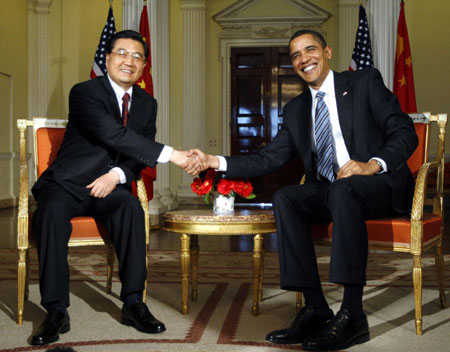
Hu Jintao and Obama shaking hands

Instead of walking away from negotiations as Liz and Adam suggest, the US and the rest of the developed world should find ways to offer a win-win situation that helps China meet its internal goals. How will China do that if they allow the global exchange rate for their currency to fluctuate putting millions of Chinese out of work? If America wants to grow jobs, the US must find ways to do so without hurting the Chinese worker any more than these people have already been hurt. Since the 2008 global economic crises caused by American greed, more than 20 million Chinese workers lost their jobs and 70,000 factories went out of business.

Like those ants in the fable, don’t expect the Chinese to come running to rescue nations that squandered their future while China is still building one. A better opinion on this topic might be this one from Martin Wolf in the Financial Times.

____________________________

Lloyd Lofthouse is the author of the award winning novels My Splendid Concubine and Our Hart. He also Blogs at The Soulful Veteran and Crazy Normal.

Sign up for an RSS Feed for iLook China


Second China Quiz

May 8, 2010
The answers may be found anywhere in the first three hundred posts for this blog.  The first person to answer all the questions correctly will win a free copy of either My Splendid Concubine or Our Hart.

This prize will be open until the first person answers all the questions correctly. Write your answers in a comment to this quiz.  Make sure to number the answers so they match the questions and provide an e-mail address for me to contact you. Each question has a link that will take you to where you may find the answers.

China

1. What does the First of all Virtues mean?

2. What is the Chinese attitude toward health care?

3. What was the life expectancy for the average Chinese person before the Communists won China in 1949?

4. What was the debate on salt and iron about?

5. Chinese Internet users are _____________ as likely to have blogs as Americans. (fill in the blank)

6. (From Similar “Oily” Interests) What is Wahhabism and where does the money come from to pay for this?

7. What happened during Deng Xiaoping’s Beijing Spring?

8.  What happened to Deng Xiaoping’s son when he spoke out against the Cultural Revolution?

9. What vital key does China hold for humanity’s future?

10. How does Communist China treat its minorities compared to the way minorities have been treated in the United States?

11. Who was Faith Dremmer and what happened to her?

12.  What did Peter Hessler say about happiness?

13.  How many of the world’s smokers live in China?

14.  What is the name of China’s Oprah and how large is her audience?

15. What is the difference between China’s labor laws and United States?

16. What did Lin Yutang say about the Chinese and Christianity?

17. What did the first emperor of China consume that contributed to his madness and death? (This answer is in one of the nine linked posts in a series about Qin Shi Huangdi.) Why did Qin Shi Huangdi do this? (must answer both questions for # 17)

18. When the “Cult of the Dead Cow” gains access to your computer, what do they do?

19. Which issue of National Geographic magazine provides proof that Tibet was part of China for centuries before Mao’s invasion and reoccupation?

20. What is the name of the all-electric car being manufactured in a joint effort between Chinese and California partners?

____________________________

Lloyd Lofthouse is the author of the award winning novels My Splendid Concubine and Our Hart. He also Blogs at The Soulful Veteran and Crazy Normal.

Sign up for an RSS Feed for iLook China


Water – Two Countries Tell a Tale

April 19, 2010

The National Geographic special issue, “Water, Our Thirsty World” (April 2007) compares the world’s largest democracy, India, with China. In “The Big Melt” by Brook Larmer, we see a convincing reason why China’s mix of socialism and capitalism may be the world’s answer to avoid future calamities. Where Western style democracies stall due to partisanship, special interests, religious beliefs and political agendas, China’s government, ruled by engineers and scientists, appears to be planning decades ahead.

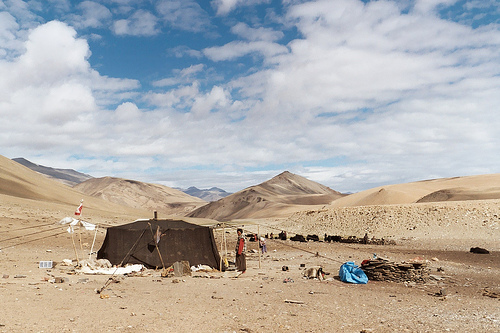
The claims by Tibetan separatists and their supporters that China rules over Tibet with an iron dictatorial fist also appears to be wrong when Larmer visits a family of Tibetan nomads. He writes, “There is no sign of human life on the 14,000 foot high prairie that seems to extend to the end of the world.” Larmer sees “the NOMADS’ tent as a pinprick of white against a canvas of brown.”

Tibetan Nomads

We meet Ba O, a Tibetan nomad. In Ba O’s tent, “there is a small Buddhist Shrine: a red prayer wheel and a couple of smudged Tibetan texts…” A few years earlier, Ba O had several hundred sheep and the grass was plentiful. Now the Tibetan nomad has about a hundred left and fears this way of life is ending.

Ba O says, “This is the way we’ve always done things. And we don’t want that to change.”

However, change is coming, and there is nothing Ba O can do to stop it. The change is not from China’s government. It is from global warming. The Tibetan grasslands are dying and a way of life that has existed for thousands of years may be dying too.

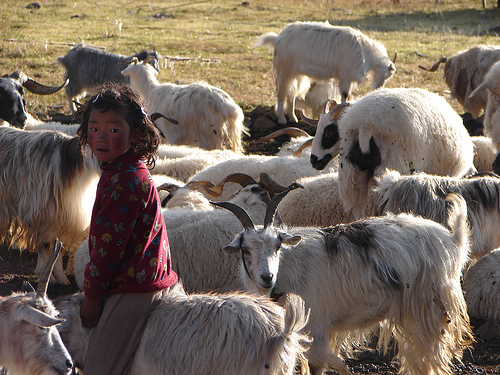
Tibetan girl tending sheep

To insure that the Tibetan nomads will have a place to live, China’s government has been building resettlement villages. The “solid built” houses are subsidized. When the Tibetan nomads can no longer survive on the open Tibetan prairie, it is the nomad’s choice to move into the new villages. The government does not force them to give up their old way of life. Nature does that.

Along with the house comes a small annual stipend for each family so they can eat as they find another way to earn a living. The home Larmer visited had a Buddhist shrine and a free satellite dish for a TV and maybe an Internet connection. In addition, the one child policy does not apply to the Tibetan people since they are a minority in China.

To make sure there will continue to be water to drink, China is planning to build 59 reservoirs in Tibet to capture and save glacial runoff.

In India, the young wife of a fortuneteller spends hours each day searching for water. She lives with her husband and five children in Delhi, India‘s capital. There are fights over water. In a nearby slum, a teenage boy was beaten to death for cutting into a water line.  The demand for water in Delhi exceeds the supply by more than 300 million gallons a day.

What happens to life when there is no water?

See Dictatorship Defined

______________

Lloyd Lofthouse is the award-winning author of the concubine saga, My Splendid Concubine & Our Hart. When you love a Chinese woman, you marry her family and culture too. 

If you want to subscribe to iLook China, there is a “Subscribe” button at the top of the screen in the menu bar.


Tibet Inside China – 5/5

April 13, 2010

Regardless of the evidence that proves the Tibetan government in exile is not telling the truth about Tibet being part of China for centuries before declaring independence in 1913 (when the Ch’ing Dynasty was collapsing and the British Empire urged Tibet to break free for political reasons), the Dalai Lama and his Prime Minister represents less than 100,000 Tibetans outside China.

Tibet Monastery

If Rinpoche’s figure of six million is correct, that means the Tibetan government in exile represents about 1% of the Tibetan population.  If China’s 2.5 million is correct, the percentage goes up to 3.2%.  Not much of a base to wage a violent rebellion. There are more troops in the PRC’s army than the entire Tibetan population inside and outside of China.

I also wonder if that 1% in exile were the Tibetan landowners. Did they leave most of the serfs/slaves behind when they fled?

Maybe the Tibetan separatists/rebels (whatever term you like), with help from the CIA, should join the American Tea Bagger movement and gain the support of Glenn Beck and Rush Limbaugh. They could sit around the campfire during protests and sing hymns about marching into battle to take back the wealth.

Start with Tibet Inside China – Part 1 or discover how Power Corrupts

View as Single Page

_______________

Lloyd Lofthouse is the award-winning author of My Splendid Concubine [3rd edition]. When you love a Chinese woman, you marry her family and culture too. This is the love story Sir Robert Hart did not want the world to discover.

Subscribe to “iLook China”!
Sign up for an E-mail Subscription at the top of this page, or click on the “Following” tab in the WordPress toolbar at the top of the screen.

About iLook China