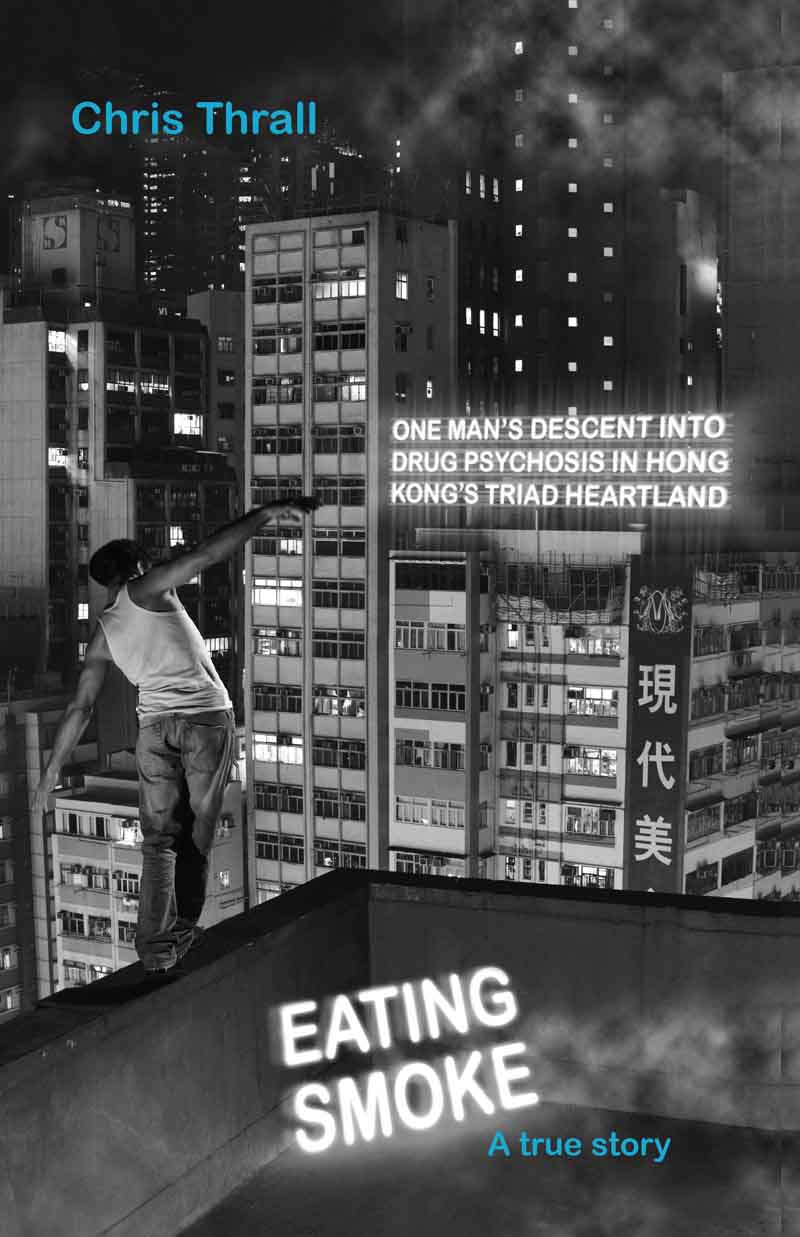
Eating Smoke — a question and answer with the author, Chris Thrall – Part 2/5

October 17, 2011

Guest-Post by Tom Carter
Interview with Chris Thrall, author of Eating Smoke continued…

On October 16, 2011, nearly two years since Chris Thrall originally contacted me, his long-awaited book, “Eating Smoke”, will be released in America and Amazon.com.

Advanced sales have already brought the title to the top of the Hong Kong bestseller list (patting my own back for my prediction) while Eating Smoke has achieved a massive cult following on Facebook.  Hailed as a “Sin – Shantaram” in a review by the South China Morning Post, and being compared by fans to Alex Garland’s The Beach for its drug-adelic theme, we can now confidently predict that Eating Smoke will, too, be optioned for film rights and follow those popular books to Hollywood.

Despite his past connections with Chinese triads, and in spite of his newfound celebrity as a bestselling author, Thrall remains one of the nicest and humblest people I have ever had the pleasure of knowing…even though I have yet to actually meet the man in person.  So it wasn’t too hard to twist his arm into putting my Q&A at the top of his to-do list of media interview requests (ah, the fame!).

TOM CARTER: My first and most pressing question, Chris, is if you are at all worried that the 14K will be hitting you up for a percentage of your book royalties once word of Eating Smoke’s success trickles up the Wan Chai gangland hierarchy?

CHRIS THRALL: Ha ha! The news from Hong Kong is that “serious players” are reading my book as we speak. But I’m not worried as it’s not a tell-all on Hong Kong organized crime. It’s more the story of a former Royal Marine Commando who thought he knew a bit about life, who then moves to Asia to run what was a successful business but spirals down into psychosis from drug addiction.

In that respect, Eating Smoke is unique. I’m not aware of any other book that gives the reader the opportunity to experience what it’s actually like to descend into mental illness through the eyes of someone as they do. I just happened to work for the 14K as a nightclub doorman – moreover, their “East-West go-between” – when it happened.

CARTER: Eating Smoke is about your decent into drug psychosis in Hong Kong’s triad heartland, but it’s also about the series of unfortunate, albeit hilarious, events that prevented you from ever finding your financial footing in Hong Kong, ironically Asia’s wealthiest city; a “testament to the stark reality and ephemeral nature of the relationship between people, drugs and profit,” as you wrote in the book.

Do you have anything to say to all those coked-out rich white bankers that Hong Kong is notorious for?

THRALL: No! I have nothing to say to anyone – coked-out rich white bankers included. If people truly enjoy what they do, they should carry on doing it.

Personally, I didn’t want to see my youth slipping away in a suit as I chased dollar signs at the expense of more fulfilling experiences. So having overcome addiction, I made an inventory of what I wanted to get out of life. Then I set out across six continents through seventy-five countries to get it. Writing a book was the last thing on my bucket list.

CARTER: China is adamantly anti-drugs, and the court system does not hesitate to execute drug traffickers, even foreigners.

In fact, China even blames foreigners for being responsible for a majority of its drug trade, a grudge no doubt held over from the Opium Wars.  Even though there are arguments to be made against the death penalty, the fact remains that, due to their zero-tolerance policy, China has one of the world’s lowest crime rates, a statistic that, all things considered, I’m sure America and the UK envy.

As a former drug user, what’s your take on criminalization of drugs, and do you think the west should follow China’s example?

THRALL: I don’t have a take on it. I’m not a spokesperson on substance use or the law surrounding it. I just told my own story.

However, research would likely show that mankind has always taken drugs in various forms and continues to do so (alcohol and cigarettes often cited as the most damaging), which might suggest that education on their usage and dangers is the way forward, in addition to harm-prevention strategies.

As for crime, a sociologist once said that a zero crime rate would make society a frightening place to be. I think Orwell’s 1984 was meant to imply this. I take no stance on drugs per se or cast judgment on people who choose to buy, sell, or use them.

It was addiction that I battled and that’s a separate issue. It’s a psychological condition that could relate to gambling, sex or food. It makes you wonder how prohibition could ever fix this.

Continued on October 18, 2011  in Eating Smoke – Part 3, return to Part 1, or if you have the time and do not want to wait for the five-part series to finish posting, click View as Single Page.

Chris Thrall was born in the UK. At eighteen, he joined the Royal Marine Commandos. Following active service in the Northern Ireland Conflict and training in Arctic warfare and survival, he earned his parachutist’s ‘wings’ and went on to serve as part of a high-security detachment onboard an aircraft carrier. In 1995, Chris moved to Hong Kong to oversee the Asia-Pacific expansion of a successful network-marketing operation he’d built, part-time, while serving in the Forces. Less than a year later, he was homeless, hooked on crystal methamphetamine and working for the 14K, Hong Kong’s largest triad crime family, as a doorman in Wanchai’s infamous red-light district. Eating Smoke, a humorous yet deeply moving first book, is his account of what happened.

__________________________

Travel photographer Tom Carter is the author of CHINA: Portrait of a People, a 600-page book of photography from the 33 provinces of China, which may be found on Amazon.com.

To subscribe to “iLook China”, sign up for an E-mail Subscription at the top right-hand side of this page and then follow directions.


Eating Smoke — a question and answer with the author, Chris Thrall – Part 1/5

October 16, 2011

Guest-Post by Tom Carter
Interview with Chris Thrall, author of Eating Smoke

Tom Carter, author of “CHINA: Portrait of a People”, catches up with Chris Thrall to discuss his new book “Eating Smoke, a memoir about Thrall’s descent into drug psychosis in Hong Kong’s triad heartland.

In the fall of 2009, whilst traveling in India to create my next photography book, I was contacted via email by a British writer who had read Down and out in Hong Kong, one of my online travel articles, which described this poor, dusty backpacker’s real-time impressions of Asia’s wealthiest city.

Chris Thrall said he connected with my article’s conclusion that, in spite of my western heritage, and due to my personal circumstances, I ultimately had more in common with the destitute third-world inhabitants of the Chungking Mansions, the infamous immigrant ghetto of Kowloon, than I did with the rich white bankers et al who comprise the other half of Hong Kong’s multinational population.

Chris went on to explain that he was writing a book about his own experiences living in Hong Kong, which was dramatically different from mine or any other expatriate I ever knew, and that he once worked for the 14K, the world’s largest Chinese crime family.

Attached to his email was the first chapter of his memoir, a gripping opening salvo that finds the narrator hiding from pursuing henchmen on a roof top—alongside two corpses, a disemboweled mother and child.

As a voracious reader, I know a bestseller when I see it.  I immediately forwarded Chris’s manuscript to my publisher in Hong Kong, Pete Spurrier, who runs the iconic Blacksmith Books, which specializes in Asian-themed literature.

Pete likewise was knocked off his feet by Chris’s incredible story; the next I heard, Chris was a fellow Blacksmith label mate with a book deal.

Chris Thrall was born in the UK. At eighteen, he joined the Royal Marine Commandos. Following active service in the Northern Ireland Conflict and training in Arctic warfare and survival, he earned his parachutist’s ‘wings’ and went on to serve as part of a high-security detachment onboard an aircraft carrier. In 1995, Chris moved to Hong Kong to oversee the Asia-Pacific expansion of a successful network-marketing operation he’d built, part-time, while serving in the Forces. Less than a year later, he was homeless, hooked on crystal methamphetamine and working for the 14K, Hong Kong’s largest triad crime family, as a doorman in Wanchai’s infamous red-light district.

Eating Smoke, a humorous yet deeply moving first book, is his account of what happened.

Continued on October 17, 2011 in Eating Smoke – Part 2, or if you have time and do not want to wait for the five-part series to finish posting daily, click View as Single Page.

__________________________

Travel photographer Tom Carter is the author of CHINA: Portrait of a People, a 600-page book of photography from the 33 provinces of China, which may be found on Amazon.com.

To subscribe to “iLook China”, sign up for an E-mail Subscription at the top right-hand side of this page and then follow directions.


A Snapshot of Democracy in Asia – Part 5/6

October 1, 2011

Among the so-called Asian democracies, India is next.  The Guardian says of corruption in India “All your life you pay for things that should be free.”

The Guardian reported that “one ordinary man” had to pay at least a third of his income to survive. “Of the 40,000 rupees (£520) I earn a month from my restaurant, I pay at least a third in bribes,” Vishal, 26, said. But bribery also extends into his personal life. Vishal has two young children and to get the eldest into the best local school he paid a “donation” of 25,000 rupees (£340) in cash to the headmaster.”

Economy Watch.com said, “India’s underground economy is believed to be 50 percent of the country’s GDP – US$640 billion at the end of 2008,” and Janamejayan’s Weblog goes into detail of one scam that cost $40 billion, which is 3% of India’s GDP.


Poverty in India, 2011

In addition, there is confusion over how many live in poverty in India.

In 2009, the United Nations Development Programme reported that literacy in India was about 74 percent, while the CIA Factbook set the literacy rate at 61 percent (literacy and poverty are linked), which explains The World Bank’s estimates of poverty in India at 41.6 percent.

However, the Hindustan Times says for 2011 that there are 406 million poor in India, which is a third of the population—an increase of 8% since 2009.

In addition, a study by the Oxford Poverty and Human Development Initiative using a Multi-dimensional Poverty Index (MPI) found that there were 645 million poor living under the MPI in India

In 2009, India’s population was about 1.2 billion and the country had 6 nationally recognized political parties and about 46 recognized state/provincial parties. Source: List of Recognized Political Parties in India (Wiki)

India has been the world’s largest democracy since 1947, and although India claims to have reduced poverty from about 53% in 1973-74 to  25.6% in 1999-2000, the definition and difficulty in reporting the exact numbers casts doubt on this claim.


Poverty in Calcutta

However,  in the same time span, China reduced poverty from 64% to less than 3%, and China is not a multi-party democracy.

In addition, according to Time’s Global Spin, a blog about the world, its people and its politics, “The size of India’s middle class was 50 million in 2005, according to this report by McKinsey,” and McKinsey may be wrong and the number may be lower.

In contrast, Martin Trieu, President of Tourmaline Capital, estimates “there are at least 250-300 million people (in China) who now fall into this (middle class) category.”

Helen H. Wang of Forbes Magazine’s China Tracker agrees with Trieu, and says, “Today, China’s middle class is already larger than the entire population of the United States and is expected to reach 800 million in fifteen years.”

Continued on October 2, 2011 in A Snapshot of Democracy in Asia – Part 6 or return to Part 4

______________

Lloyd Lofthouse is the award-winning author of The Concubine Saga. When you love a Chinese woman, you marry her family and culture too. This is the love story Sir Robert Hart did not want the world to discover.

To subscribe to “iLook China”, look for the “Subscribe” button at the top of the screen in the menu bar, click on it then follow directions.


A Snapshot of Democracy in Asia – Part 2/6

September 28, 2011

When you discover the roller-coaster ride of corruption, protests, shootings/assassinations, and military coups/dictatorships that have taken place in the Republic of (South) Korea [RoK], it makes Japan look honest in comparison and provides more evidence of why the West and America, in particular, wants China to become a similar multi-party democracy.

On August 14, 1948, Syngman Rhee became the first president of the RoK. In May 1952, Rhee pushed through constitutional amendments, which made the presidency a directly elected position. To do this, he declared martial law, arrested opposing members of parliament, demonstrators, and anti-government groups.  In 1954, Rhee regained control of parliament by fraudulently pushing through an amendment that exempted him from the eight-year term limit.

Then in 1956,  Rhee’s administration arrested members of the opposing party and executed the leader after accusing him of being a North Korean spy.

The U.S. Department of State says, “President Syngman Rhee was forced to resign in April 1960 following a student-led uprising.”

The Second Republic under the leadership of Chang Myon ended one  year later when Major General Park Chung-hee led a military coup. Park declared martial law, dissolved the National Assembly and suspended the constitution, which resulted in mass protests and a return to democracy.

Park’s rule, which resulted in tremendous economic growth and development but increasingly restricted political freedoms, ended with his assassination in 1979, when a powerful group of military officers, led by Lieutenant General Chun Doo-hwan, declared martial law and took power.

Then on May 18, 1980, students at Chonnam National University protested, which led to the Gwangju Massacre with estimates of the civilian death toll ranging from a few dozen to 2,000. Later, a full investigation by the civilian government reported nearly 200 deaths and 850 injured.

It wouldn’t be until October 1987 that a revised Constitution would be approved by a national referendum leading to the direct elections of President Roh Tae-woo in the first direct presidential election in 16 years.

In 1997, the country suffered a severe economic crises leading to the next civilian president, Roh Moo-hyun being impeached in March 2004 on charges of a breach of election laws and corruption. While under investigation for bribery and corruption, he committed suicide.

Roh’s successor was Lee Myung-bak, who was inaugurated in February 2008 and is still in office.

The CIA says 15% of the RoK’s population lives below the poverty line, while poverty in the United States in 2009 was 14.3%.

In August 2011, CBS reported that 20 percent of American children lived in poverty.

In fact, Homelessness in America remains an issue of deep concern. The American dream is a distant one for about 2.3 million to 3.5 million Americans that do not have a place to call home and about 1.35 million of the homeless are children.

Continued on September 29, 2011 in A Snapshot of Democracy in Asia – Part 3 or return to Part 1

______________

SIDE NOTE: The Gwangju Massacre (1980) in The Republic of (South) Korea—a strong ally of the United States—is the second massacre “I never heard of” while writing this Blog.

However, annually, the media and American politicians remind us of the so-called Tiananmen Square Massacre in 1989, which I wrote of in The Tiananmen Square Hoax after learning from Wiki Leaks that a massacre never happened.

In addition, the protests in Beijing in 1989 were never a democracy movement, which was revealed by a BBC documentary. I wrote of this in What is the Truth about Tiananmen Square?

Then there was the first massacre “I never heard of” until I stumbled on it by accident while researching another post. I wrote of that massacre [by a strong ally of America] in the 2/28 Massacre in Taiwan.

Why is it that the world knows so much about the Tiananmen Square Incident while hardly anyone knows about the Gwangju Massacre and the one in Taiwan?

______________

Lloyd Lofthouse is the award-winning author of The Concubine Saga. When you love a Chinese woman, you marry her family and culture too. This is the love story Sir Robert Hart did not want the world to discover.

To subscribe to “iLook China”, look for the “Subscribe” button at the top of the screen in the menu bar, click on it then follow directions.


A Snapshot of Democracy in Asia – Part 1/6

September 27, 2011

The partnership between capitalism and multi-party democracies in Asia is a joy to behold.

After spending hours researching Japan, South Korea, Singapore, Thailand, India and Taiwan, I understand why the West and America, in particular, keep pressuring mainland China to allow democracy to flourish.

The best way to discover what would happen to China if it were to become a parliamentary multi-party democracy is to look at the Asian democracies surrounding it, and we start with Japan.

In 2009, the Guardian said of Japan, “After more than 50 years of almost uninterrupted power, the ruling Liberal Democratic Party (LDP) has been buried in a general election. Once before, in 1993, change came when a coalition of opposition parties briefly took power, but the LDP still held on to a majority in the Diet’s powerful lower house. This time … the center-left Democratic Party of Japan (DPJ) took more than 300 of 480 seats in the lower house. The LDP rules no more.”

The Guardian says the DPJ, which ended the five-decade rule of the LDP, was “funded to some degree by the US, (and) was put in place to marginalize all left-wing opposition. This involved some strong-arm tactics, especially against the unions…”

The trail of corruption in Japan is long.

Werner Pacha’s study of Corruption in Japan from an Economist’s Perspective says, “Ccorruption can quite simply be understood as the use of public office for private gains.”

Then Pacha reveals a series of scandals starting with the 1954 Shipbuilding Scandal, which contributed to the collapse of the Yoshida cabinet sending one person to prison of the 71 arrested.

Then there was the Lockheed Scandal of 1976, resulting in the arrest of Prime Minister Tanaka for having received payments from Lockheed (an American defense contractor) of about 500 million Yen.

In 1988-89, there was the Recruit Scandal, which concluded with the resignation of Prime Minister Takeshita on April 1989.

In 1991, the Kyôwa Affair, another scandal, included former Prime Minister Suzuki and Kyôwa, a steel-girder construction firm.

Briefly, there followed the Sagawa Kyûbin Scandal of 1991-1993, the Tax Evasion Scandal of 1993,  the Genecon Corruption Scandal of 1993, the Sôkaiya Scandals of 1997, and the 1996 – 1998 Scandals within the Elite Bureaucracy.

The CIA (in 2007) reported that 15.7 percent of the people in Japan lived below the poverty line. In comparison, only 2.8 (in 2007) percent of the People’s Republic of China (PRC) live below the poverty line.

According to a chart on page 7 of his study, Pacha reveals that the multi-party democratic Republic of (South) Korea (RoK) is worse than Japan. South Korea’s democracy snapshot will appear tomorrow.

Continued on September 28, 2011 in A Snapshot of Democracy in Asia – Part 2

______________

Lloyd Lofthouse is the award-winning author of The Concubine Saga. When you love a Chinese woman, you marry her family and culture too. This is the love story Sir Robert Hart did not want the world to discover.

To subscribe to “iLook China”, look for the “Subscribe” button at the top of the screen in the menu bar, click on it then follow directions.