Hollywood to Bollywood to a Rising Chinawood

May 17, 2010

“China is now the second-biggest box office territory for Hollywood films, eclipsing Japan,” says The Hollywood Reporter. Not only that, but Chinese production companies are releasing films for the home market.

It also appears that the Chinese government has done some forgiving. “Zhang Zhao fled China for the U.S. soon after the crushing of the 1989 student democracy movement. But Mr. Zhang returned to China in 1998, and now he’s the man with the money: As head of Enlight Pictures, a unit of Enlight Media and one of the new film companies aspiring to tell Chinese stories to a rapidly expanding domestic audience, he has plans for an initial slate of 40 movies, and no problem with financing.” Source: RealFilmCareer.com

A film produced by Huayi Brothers Media

Then there is Huayi Brothers Media, which the May issue of “The Hollywood Reporter” says raised 160 million in an IPO on the Zhenzhen stock exchange.  The Huayi brothers have already released over 50 films, most of them huge box office hits in China. Source: CNN: Is This China’s Harvey Weinstein?

“Five years ago,” Wang Zhongjun said, “we hoped (the Hollywood studios) could bring us support and investments. Now we’re helping them,” reports The Hollywood Reporter, which predicts box office gross in China could exceed 10 billion yuan by the end of 2010.

Discover What is the Truth about Tiananmen Square?

_______________

Lloyd Lofthouse is the award-winning author of My Splendid Concubine [3rd edition]. When you love a Chinese woman, you marry her family and culture too. This is the love story Sir Robert Hart did not want the world to discover.

His latest novel is the multiple-award winning Running with the Enemy.

Subscribe to “iLook China”!
Sign up for an E-mail Subscription at the top of this page, or click on the “Following” tab in the WordPress toolbar at the top of the screen.

About iLook China

China’s Holistic Historical Timeline


Jobless in America and Angry at China

May 17, 2010

When the economy tanks and Americans lose jobs, I often read or hear that it’s China’s fault.  Timothy V, a typical China basher that I’ve been debating on Gather, is an example. Using China as a scapegoat for lost jobs in America appears to be a popular pastime.  After all, many in America need someone to blame for the hard times.

The truth is that more jobs have been lost to Mexico and Canada than to China. Citizen.org says that because of NAFTA, Americans lost 3 million manufacturing jobs to Mexico and Canada…

The Economic Policy Institute says that between 1997 and 2006, the trade deficit between the U.S. and China could have supported 2,166,000 jobs. This report doesn’t say that manufacturing jobs were lost in America to China. It means that when China joined the WTO (World Trade Organization), jobs were created for Chinese workers that might have gone to the United States. 

What happened after America’s economic bubble popped in 2008? CNN reported that 2009 was the worst year for jobs lost in the United States since 1945.  A sobering U.S. Labor Department jobs report showed the economy lost 1.9 million jobs in the year’s final four months.

Do not forget who caused the current global economic crises and those job losses. “Global Issues.org” describes the crisis that was caused by greed in America.

If you believe someone like Timothy V, those job losses should be blamed on China, but he is wrong. The BBC reported that Chinese migrant factory job losses mount. A Chinese government official, Ma Jian Tang, told reporters in January (2009) he thought roughly 5% of the country’s 130 million migrant workers had returned to their villages after losing jobs. (Note: I wonder why I couldn’t easily find this from an American news source.)

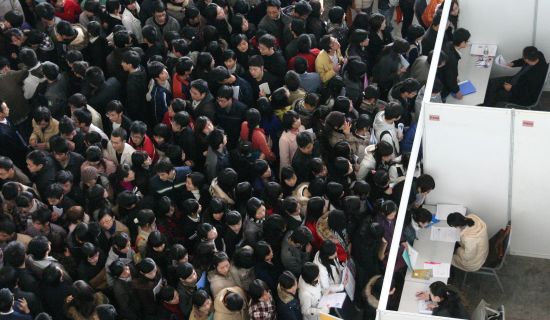
Out of work in China

In fact, a Chinese government survey revealed that 20 million migrant (factory) workers lost jobs, posing a risk for social instability. Some 15.3 percent of China’s 130 million migrant factory workers became jobless. Since the American induced global economic crisis in 2008, Beijing says about 70,000 factories nationwide have closed.

How can anyone in China be stealing jobs from Americans? Do I need to mention the millions of jobs lost to illegals that cross America’s Southern border and take hard, low-paying jobs that Americans don’t want? According to this report from NPR, that number is about 12 million.

When I was fifteen, I started my first job washing dishes in a department store coffee shop that served lunch and dinner and I worked nights and weekends there for three years while attending high school. There were several of us doing that job, and we were all American born teens. Before I joined the US Marines, I worked in a car wash, a McDonald’s and other jobs that most Americans won’t touch today. In Steinbeck’s novels, the farm workers he writes about were mostly poor Americans who went into the fields to plant and pick—not illegals from south of the border.

In fact, the jobs are there but too many Americans won’t consider them because they won’t pay for an American middle-class credit card driven, consumer lifestyle where people eat out more than they eat in and everyone “has” to have the American dream.  Can’t buy that with low wages.

This has happened before. After World War II, American jobs were lost to Japan and Germany.  Then after the Korean War, more jobs were lost to South Korea and Taiwan as they built factories.  In the 1950s, GM, Ford and Chrysler were building and selling about 90% of the cars and trucks globally.  Then Toyota and VW arrived in the United States. Who was stealing US jobs then?  It wasn’t China.

In reality, it’s all about finding a scapegoat to slaughter while the guilty quietly slip away.

Read about American Hypocrisy

____________________________

Lloyd Lofthouse is the author of the award winning novels My Splendid Concubine and Our Hart. He also Blogs at The Soulful Veteran and Crazy Normal.

Sign up for an RSS Feed for iLook China

Four Equals One China—Rural China (Part 4 of 7)

May 16, 2010

It is estimated that 57% (741 million) Chinese still live in rural areas made up primarily of primitive villages that have not changed much from the way things were during the first-half of the 20th century.

Rural village in China

Up until recently, rural China received the least support to modernize during China’s transition from its dark ages into the modern age.

In October 2009, China’s National People’s Congress, the Politburo Standing Committee and Hu Jintao, the president of China, approved the 11th, Five-Year Plan that focuses on bringing modern infrastructure to improve living conditions in rural China.

Historians and experts have written and said that what China has achieved since 1980 is a miracle that no other nation in history has managed to achieve. No nation has modernized as fast. It took more than a century for America to achieve what China has done in thirty years.

Go to Four Equals One China: Part 5 or discover China’s Stick People

_______________

Lloyd Lofthouse is the award-winning author of My Splendid Concubine [3rd edition]. When you love a Chinese woman, you marry her family and culture too. This is the love story Sir Robert Hart did not want the world to discover.

Subscribe to “iLook China”!
Sign up for an E-mail Subscription at the top of this page, or click on the “Following” tab in the WordPress toolbar at the top of the screen.

About iLook China


China’s Moon Calendars

May 13, 2010

This is the year of the Tiger.  I was born in the year of the Rooster. To discover your year, use the Chinese Zodiac Sign Calculator.  Just feed in your date of birth.

Chinese Zodiac - the twelve animals

China’s ancient calendar is based on a twelve-year lunar cycle. At one time, the Chinese calendar was confusing and complex. Buddhists have been given credit for simplifying it by replacing a complex system of numerical symbols with the twelve animals of the Chinese Zodiac.   

There are several Chinese calendars, which are still in use today. Each has its own purpose. Farmers in rural China use one. There’s even a Chinese gender calendar to help conceive a boy or girl.

In addition to the lunar, numerical, astronomical, gender and agricultural calendars, each day also has a name from one of twenty-eight constellations, with a ruling spirit for the day.

In charting the sky, the Chinese divided the heavens into 28 constellations located along the Equator and the ecliptic, each named after a star in the vicinity.

Learn about adding honor in one lunar leap

____________________________

Lloyd Lofthouse is the author of the award winning novels My Splendid Concubine and Our Hart. He also Blogs at The Soulful Veteran and Crazy Normal.

Sign up for an RSS Feed for iLook China


Silence to Beauty

May 12, 2010

The art displayed in this post comes from artists, who are graduates of the Shandong Provincial Rehabilitation and Career School, an institute in China that trains young Chinese with disabilities. These artists are deaf.

In 1949, Mao Zedong launched the People’s Republic of China and ruled with an iron fist for almost three decades.

During Mao’s time, there was almost no free artistic expression in China unless the art served the propaganda needs of the state.

Zhang Guoli, Sons

After Deng Xiaoping opened China to a global market economy, the post Mao generation was introduced to Western art and theory.

Huang Jinpo, Earth

It wasn’t until the late 1980s and early 1990s that art from China started to emerge.

This is the dormitory where the artists live.

The photos in this post are presented with permission from “Embracing the Uncarved Wood, Sculptural Reliefs from Shandong, China“, which was made possible by a generous grant from the E. Rhodes and Leona B. Carpenter Foundation and with assistance from the Office of the Provost of Franklin & Marshall College. ISBN: 978-0-910626-04-0

Discover Chinese Yu Opera with Mao Wei-tao

______________

Lloyd Lofthouse is the award-winning author of The Concubine Saga. When you love a Chinese woman, you marry her family and culture too. This is the love story Sir Robert Hart did not want the world to discover.

To subscribe to “iLook China”, look for the “Subscribe” button at the top of the screen in the menu bar, click on it then follow directions.