Chinese Opera and Mao Wei Tao, China’s Living Treasure

June 18, 2011

Mao Wei Tao is considered a living treasure in China. She imitates men in the opera roles she plays—a reversal from Imperial China when women were not allowed on stage so men played female roles.

“In 1923, the training of female actors for this art form was set up. Since 1928, the Shaoxing opera troupes, consisting of solely female actors, began their performances in Shanghai. In a few years, females impersonating males had become the most important feature of this opera form, and at the same time the Yue opera became well known all over China.”

East China’s Zhejiang province gave China Shaoxing Opera’s Mao Wei Tao.

In her thirty-year career on the stage, she’s best known as an outstanding male impersonator with a cult following of women.
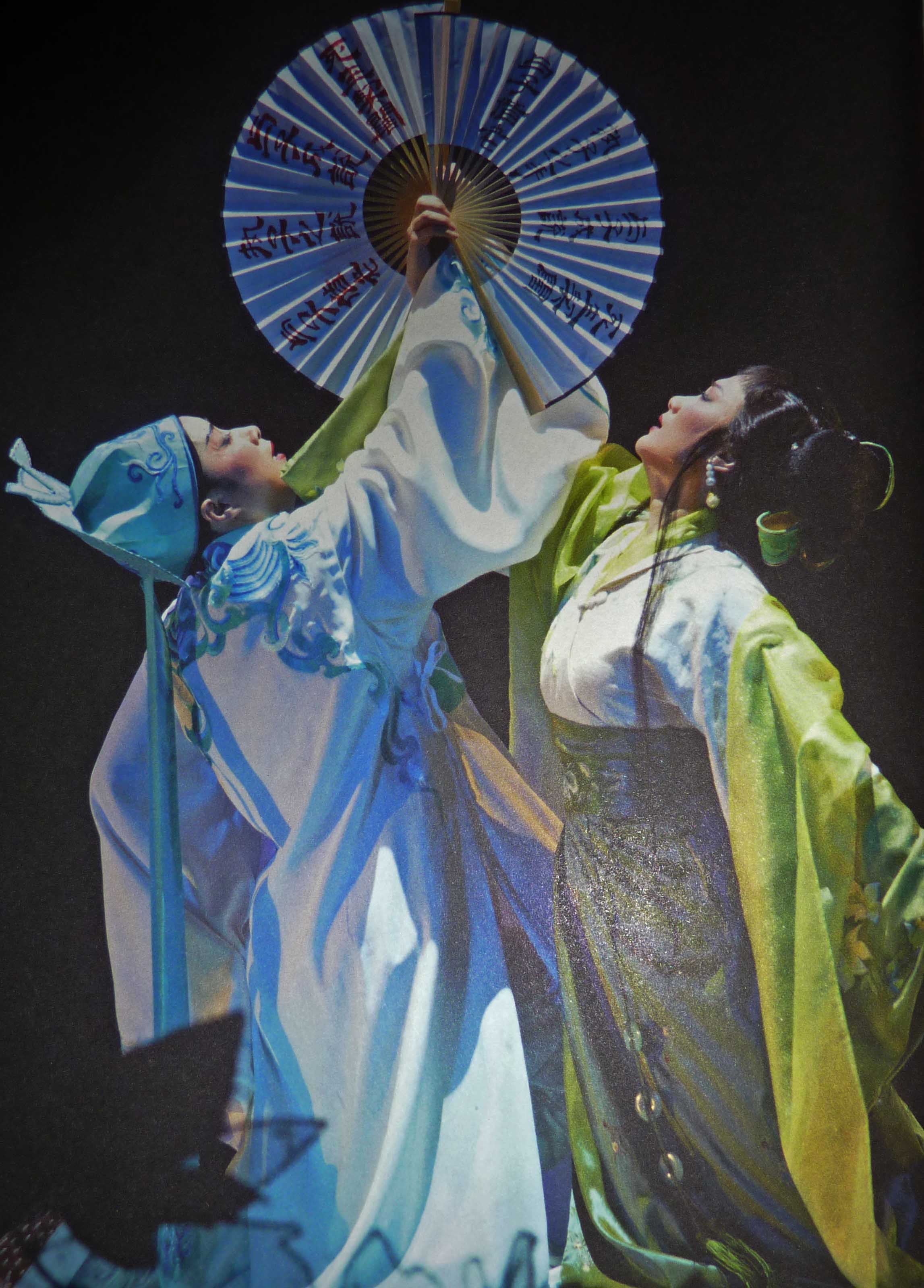
I was introduced to Yue Opera in Hangzhou, Zhejiang Province about a decade ago.

Mao Wei Tao and her husband have a theater company near the shores of the famous Westlake. My wife translated while I watched the live-opera performance in fascination.

The costumes were lavish and the acting and opera was dramatic while classical Chinese music played in the background.

The challenge today is to keep this form of Chinese opera alive. The audience for opera is shrinking dramatically in China while remaining popular with the older generation.

Television, movies and the Internet are claiming the shorter attention spans of younger Chinese

Mao Wei Tao, considered an innovative genius on stage, adapts and works to keep the art form alive. According to her husband, no two performances are exactly alike.

In November 2010, she performed in Taiwan as a cultural ambassador from the mainland.

This revised and edited post first appeared on March 14, 2010 as Mao Weitao and Yue Opera

______________

Lloyd Lofthouse is the award-winning author of the concubine saga, My Splendid Concubine & Our Hart. When you love a Chinese woman, you marry her family and culture too.


To subscribe to “iLook China”, look for the “Subscribe” button at the top of the screen in the menu bar, click on it then follow directions.


China’s Water Challenge – Part 1/3

November 3, 2010

China has many water problems. There are several Chinese characters for water that explain these problems—much water, little water, dirty water, and muddy water.

“Much water” means floods and they happen every year causing great loses of property and life.

The second is “little water”, which means lack of rain causing rivers and lakes to go dry.  Of over six hundred cities in China, three to four hundred face water shortages.

The third is “dirty water”. Due to the number of people and industries, water pollution is a big problem.

Then “muddy water” causes soil erosion. China loses about 5 billion tons of topsoil a year.

All four of these problems are found in the Yellow River, which is called the “Mother River” or the “River of Sorrow”.

The Yellow River carries more sediment than any river—about 1.6 billion tons annually due to erosion.

Over the last 50 years, extensive flood control measures along the Yellow River have saved many lives and protected property.

Soil conservation has become a long-term strategy. Trees have been planted alongside the Yellow River and its tributaries and this has slowed the erosion about 90%.

Another challenge was the industries along the Yellow River. During the 1990s, industries caused the river to dry up. This was a regular occurrence and a challenge to fix.

Qiu Baoxing, Vice Minister of the Ministry of Construction says, “In urban areas 80% or rivers and lakes are seriously polluted.” Treating the sewage is difficult. To solve this will take a huge investment.

Shanghai, with a population of 17 million is showing the rest of the country how to deal with the water pollution. Shanghai’s river and streams were once choked with pollution.  A billion dollars was spent to deal with the problem.

Discover more about China’s Water Woes

______________

Lloyd Lofthouse is the award-winning author of the concubine saga, My Splendid Concubine & Our Hart. When you love a Chinese woman, you marry her family and culture too. 

If you want to subscribe to iLook China, there is a “Subscribe” button at the top of the screen in the menu bar.


Shanghai’s History & Culture

September 2, 2010

For centuries, Shanghai was a fishing village. It didn’t grow into a town until the 13th century during the Southern Song Dynasty (1260 – 1274), when it became an important port and commercial center.

During the Ming Dynasty (1364 – 1644), Shanghai slowly became a national textile and handicraft center.

After the Opium War in 1840, Shanghai was “forced” by the British and French to serve as a major trading port and became an international colony with foreign concessions.

The British built their concession in 1842—the same year an American neighborhood called the  International Settlement was opened.  The  French arrived in 1847.  Source: Facts and Details

The Russians and Germans arrived later and a Japanese enclave was established in 1895.

The video provides a quick overview of Shanghai’s history and culture.

Today, Shanghai’s population is about 21 million making it one of the largest  metropolitan areas in the world.

Shanghai has developed into a leading international center of business, culture and design with an abundant and diverse offering for dining, shopping and nightlife.

Geographically, the Huangpu River divides the city into two areas—Pushi and Pudong. Pushi is the older part of Shanghai.

Twenty years ago, Pudong was rural and green and had little to offer in housing and shopping.  Much has changed since the sleepy fishing village of the 12th century.

See:
Shanghai

Shanghai Huxinting Teahouse

Shanghai Huangpu River Tour

Eating Gourmet in Shanghai

Chinese Pavilion, Shanghai World Expo

_______________

Lloyd Lofthouse is the award-winning author of the concubine saga, My Splendid Concubine & Our Hart. When you love a Chinese woman, you marry her family and culture too. 

If you want to subscribe to iLook China, there is a “Subscribe” button at the top of the screen in the menu bar.


Covered by the China Daily

August 23, 2010

For a Western photo journalist to be featured in the China Daily says a lot when the topic he writes about is China.  For Tom Carter, who has written guest posts for iLook China, it is like a coming of age for a journalist to receive such recognition for his work.

The China Daily is the English language edition of the state-run media.  In China, it is comparable to the London Times, The New York Times, The Los Angeles Times or the San Francisco Chronicle.  When I say it is comparable, the key to that description is “in China”.

The China Daily says of Tom’s work, “There is no single image that can adequately represent the diversity that is China. This is partly why Tom Carter’s 638-page tome of photographs taken during his tour of the country between 2006 and 2008 works so well.”

Photo of Tom Carter in China

“The goal was to portray China as it portrayed itself to me,” Carter says of his travels with his trusty Olympus Camedia C4000, a no-frills four-megapixel camera.

It seems both foreigners and Chinese are hungry for what Carter has to say about “all” of  China.

Recently, Carter had an author event in Shanghai at a bar on the Bund where more than a hundred people came to hear him (paying a 65 yuan cover charge to boot) talk about his journey across China. There was standing room only with a line out the door.

Tom Carter’s book is China: Portrait of a People and is available in the United States through Amazon.

See more about The China Daily

_______________

Lloyd Lofthouse is the award-winning author of the concubine saga, My Splendid Concubine & Our Hart. When you love a Chinese woman, you marry her family and culture too. 

Sign up for an RSS Feed for iLook China


China Securing Its Future (1/3)

August 14, 2010

This three part series is about the reasons behind a new weapon China is developing. This weapon is known as the DF21D, which will be described in part 3.

Suppose that the United States had just ended a century of conflict that started when several foreign nations sent naval/military power halfway around the world to force America to accept cocaine as a product to be sold to all Americans without restrictions.

The United States loses the struggle against this drug being sold to American citizens, and during the next century, more than fifty-million Americans die from more wars indirectly caused by the nations behind the drugs while a third of Americans becomes addicted to the drugs.

As this century of drug and wars end, the same nations invade Mexico and Canada. By the time the wars in Mexico and Canada end, 10 million Canadians and Mexicans have been killed by the invading armies.

For China, what I’m describing is not a “what if”.

http://www.youtube.com/watch?v=GGRlnzTfNrk

Starting in 1839, China fought two Opium Wars and lost about 50,000 troops while the invading nations lost 3,000. The invaders were from the UK, France and, for a limited time, the US. 

These nations forced China’s emperor to allow them to sell opium to his people ruining millions of lives and wrecking families due to drug addiction. 

These invading nations also built enclaves and cities in China—Shanghai, Hong Kong, Macau and others.

Imagine China controlling San Francisco, Seattle and New York. How would most American’s feel?

In fact, Western nations are indirectly responsible for an 1850 rebellion started by a Chinese Christian convert who claimed to be the younger brother of Jesus Christ. When the Taiping Rebellion ended, 20 million civilians and combatants were dead.

See more about The Opium Wars

_______________

Lloyd Lofthouse is the award-winning author of the concubine saga, My Splendid Concubine & Our Hart. When you love a Chinese woman, you marry her family and culture too. 

Sign up for an RSS Feed for iLook China