The Earth was Flat

May 14, 2010

In 1610, Galileo published Sidereus Nuncius, the Starry Messenger, about discoveries he made with his new telescope. He was attacked for his theory because it seemed to contradict Scripture.  Because of this, in 1633, Galileo was tried and convicted of heresy.

Fifteen hundred years prior to Galileo’s discovery that the earth was round and orbited the sun, there is evidence that Chinese mathematicians had calculated the size of the earth on the basis that it must have been spherical (round). However, similar to Galileo, the Chinese people would continue to believe the earth was flat for centuries.  It is possible that when Qin Shi Huangdi (259 – 210 BC), China’s first emperor, had the great book burning, he burned the evidence of earlier Chinese mathematical texts.
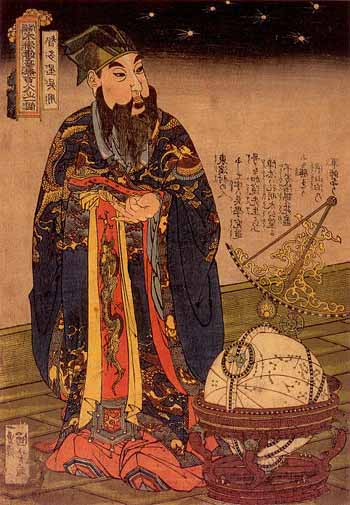
Chinese astronomer

In addition, older Chinese creation myths included details that accounted for the tilt of the earth and other astronomical facts.  Several existing, ancient Chinese applied mathematics texts prove the Chinese were the first to use some of the most basic and advanced mathematical principles and concepts utilized in modern times. Two of these texts are the Chou Pei and Chiu Chang.

Learn more about China’s first Emperor Qin Shi Haungdi by reading and watching this nine part series on his life.

____________________________

Lloyd Lofthouse is the author of the award winning novels My Splendid Concubine and Our Hart. He also Blogs at The Soulful Veteran and Crazy Normal.

Sign up for an RSS Feed for iLook China


Honoring the Dead

May 13, 2010

Ancestor worship may well be the oldest, unorganized religion in China. Take Tomb Sweeping Day for example. The practice that honors family ancestors started during the Zhou Dynasty and has been around for more than 2,500 years.

The first emperor Qin Shi Huangdi had not unified China yet. China was divided into several nation states governed by hereditary rulers and worshiping ancestors was important in maintaining a link with the past.

Today, many Chinese homes and businesses have a shrine set up to honor the ancestors. This shrine may have the name of the ancestor carved into wood or rock or there is a photo. Food is often left on the table for the ancestors. 

Honoring the Ancestors

Ancestor respect is also an important part of Confucianism and there is still an ancestor hall for Confucius in Chufu that is maintained by a direct descendant. Next time you are in a Chinese or Southeast Asian restaurant, look around and see if you can spot a shrine to the ancestors.

Confucianism and ancestor worship is not exclusive to China. After all, China was a super power in Asia for more than two thousand years and had a large influence over other cultures in the region.

Learn more about Confucius from this five-part series about the sage’s life.

______________

Lloyd Lofthouse is the award-winning author of the concubine saga, My Splendid Concubine & Our Hart. When you love a Chinese woman, you marry her family and culture too. 

If you want to subscribe to iLook China, there is a “Subscribe” button at the top of the screen in the menu bar.


Second China Quiz

May 8, 2010
The answers may be found anywhere in the first three hundred posts for this blog.  The first person to answer all the questions correctly will win a free copy of either My Splendid Concubine or Our Hart.

This prize will be open until the first person answers all the questions correctly. Write your answers in a comment to this quiz.  Make sure to number the answers so they match the questions and provide an e-mail address for me to contact you. Each question has a link that will take you to where you may find the answers.

China

1. What does the First of all Virtues mean?

2. What is the Chinese attitude toward health care?

3. What was the life expectancy for the average Chinese person before the Communists won China in 1949?

4. What was the debate on salt and iron about?

5. Chinese Internet users are _____________ as likely to have blogs as Americans. (fill in the blank)

6. (From Similar “Oily” Interests) What is Wahhabism and where does the money come from to pay for this?

7. What happened during Deng Xiaoping’s Beijing Spring?

8.  What happened to Deng Xiaoping’s son when he spoke out against the Cultural Revolution?

9. What vital key does China hold for humanity’s future?

10. How does Communist China treat its minorities compared to the way minorities have been treated in the United States?

11. Who was Faith Dremmer and what happened to her?

12.  What did Peter Hessler say about happiness?

13.  How many of the world’s smokers live in China?

14.  What is the name of China’s Oprah and how large is her audience?

15. What is the difference between China’s labor laws and United States?

16. What did Lin Yutang say about the Chinese and Christianity?

17. What did the first emperor of China consume that contributed to his madness and death? (This answer is in one of the nine linked posts in a series about Qin Shi Huangdi.) Why did Qin Shi Huangdi do this? (must answer both questions for # 17)

18. When the “Cult of the Dead Cow” gains access to your computer, what do they do?

19. Which issue of National Geographic magazine provides proof that Tibet was part of China for centuries before Mao’s invasion and reoccupation?

20. What is the name of the all-electric car being manufactured in a joint effort between Chinese and California partners?

____________________________

Lloyd Lofthouse is the author of the award winning novels My Splendid Concubine and Our Hart. He also Blogs at The Soulful Veteran and Crazy Normal.

Sign up for an RSS Feed for iLook China


The First Emperor: The Man Who Made China – Part 9/9

April 23, 2010

In the seventh month of 2010 BC, the first emperor’s search for immortality has ended. At the age of fifty, Qin Shi Huangdi is dead.

While China’s first emperor is being buried according to his wishes, a power struggle rages outside the tomb. By tradition, the oldest son should have become the emperor but several ministers want a younger son on the throne. The others are assassinated and there is a slaughter.

The emperor is also not going alone into the afterlife. While his chosen successors are being assassinated, hundreds of his favorite concubines will stay with their master and die with him. The tomb’s designers and builders will be sealed in the tomb too. Everyone who knows the way dies.

Qin Shi Huangdi left a legacy–a unified nation with a single written language and a system of administration that is still used today.

You may return to Part 8, or start with The Man Who Made China, Part 1

View as Single Page

_________________________

Lloyd Lofthouse is the award-winning author of the concubine saga, My Splendid Concubine & Our Hart. When you love a Chinese woman, you marry her family and culture too. 

To subscribe to “iLook China”, look for the “Subscribe” button at the top of the screen in the menu bar, click on it then follow directions.


The First Emperor: The Man Who Made China – Part 8/9

April 22, 2010

Chinese alchemists knew liquid mercury as the only substance that could dissolve gold. To the ancient mind, that meant mercury had power that might prolong life. However, the human body cannot absorb pure mercury so the Chinese alchemists made a compound the emperor could digest.

As the mercury is absorbed, it slowly destroyed his nervous system and brain. Emperor Qin Shi Huangdi becomes aggressive, argumentative and paranoid. He goes into hiding. Anyone revealing his location is killed. His kidneys’ are failing and he starts talking to the gods.

Thirty-five years after becoming the king of Qin at thirteen, he goes on another Imperial tour.  But this time, he does not see the nation that is bankrupt and near famine. All the emperor can think about is living forever.

He’s told that giant fish guards the island of the immortals. The emperor dreams that he is a sea god who will kill the giant fish. Near the end of 210 BC, he visits the ocean hunting the giant fish with a crossbow while wading in the surf.

His advisors plan what to do with China once the emperor dies. On the return to the capital, the emperor falls ill and the Imperial convoy stops.

Go to Part 9 for The Man Who Made China or return to Part 7

View as Single Page

______________

Lloyd Lofthouse is the award-winning author of the concubine saga, My Splendid Concubine & Our Hart. When you love a Chinese woman, you marry her family and culture too.

To subscribe to “iLook China”, look for the “Subscribe” button at the top of the screen in the menu bar, click on it then follow directions.