The Tang Dynasty did not discriminate against ethnic groups. All were treated the same, and people from minority groups held positions of great importance.
In fact, minorities became prime ministers, generals and members of the imperial garrison.
The mother’s of several Tang emperors were not from the Han majority.
Tang Emperor Taizong handled relationships with ethnic minorities skillfully.
One motto of his was, “In the past, Chinese emperors emphasized the Han people at the expense of minority groups, but I believe they are all from one family so they support me.”
Kehan means “emperor” and Tian Kehan means “the son of Heaven“.
In 755 AD, people in the Tang capital sang and danced to celebrate the 70th birthday of Emperor Taizong.
In October 1970, archeologists discovered more than a thousand Tang artifacts. One was a silver kettle featuring dancing horses with cups in their mouths, which matched the historical record for Emperor Taizong’s seventieth birthday.
Poetry flourished. Although the Tang Dynasty lasted less than 300 years, more than 50,000 poems had been produced— all of them published today in one collection of Tang poems.
Lloyd Lofthouse is the award-winning author of the concubine saga, My Splendid Concubine & Our Hart. When you love a Chinese woman, you marry her family and culture too.
To subscribe to “iLook China”, look for the “Subscribe” button at the top of the screen in the menu bar, click on it then follow directions.
During the Sui (589-617) and Tang Dynasties, China went through a period of cultural and spiritual development.
The country’s ethnic groups along with Confucianism, Buddhism and Taoism coexisted peacefully with foreign religions such as Islam.
Literature and the arts developed more than before.
The Han Dynasty (206 BC to 219 AD) opened the Silk Road for trade, and the civilizations of Rome, Ancient Egypt, of the Euphrates and Tigris Rivers and India continued trade with the Tang Dynasty.
According to Tang Dynasty records contact was maintained with more than 300 countries and regions across the known world, so the Silk Road was also known as the Envoy Road.
People from countries such as Japan, Korea, and India as well as Tehran came to China.
Many foreigners had positions in the central government of the Tang Dynasty, and they served both as civil officials and military officers.
The Tang Dynasty demonstrated respect for all foreign religions. During this time, Christianity was introduced to China.
The Imperial family of the Tang Dynasty had been a military family in Northwest China for generations and they made Taoism the national religion.
Laozi, the founder of Taoism, advocated harmony between people and nature, which was reflected in the beliefs of the first rulers of the Tang Dynasty.
Lloyd Lofthouse is the award-winning author of the concubine saga, My Splendid Concubine & Our Hart. When you love a Chinese woman, you marry her family and culture too.
To subscribe to “iLook China”, look for the “Subscribe” button at the top of the screen in the menu bar, click on it then follow directions.
The Temple of Heaven in Beijing is a tribute to the Rituals from the Zhou Dynasty.
What the Zhou Dynasty established is still embedded in everyday aspects of Chinese social life. Showing respect for family ancestors originated with the Zhou Dynasty and is practiced today all over China.
The Book of Songs was the first poetry collection in Chinese history. Among the poems is the Eulogy for the Zhou Dynasty.
Video: Chinese with English subtitles.
The Book of Changes, which also discusses military thought, came from the Zhou Dynasty.
The civilization established by the Zhou Dynasty influenced the cultures of Korea, Japan and Southeast Asia.
Duke Zhou, Emperor Wu’s younger brother, was regent for seven years when King Cheng was mature enough to assume the power of king. Duke Zhou stepped aside.
The Zhou Dynasty is also known for its bronze castings with history unscripted on them. Jade became important at this time too.
Zhou Dynasty at its greatest
The Zhou Dynasty attached great importance to agriculture and a large number of bronze farming tools were extensively used.
The Zhou Dynasty continued to expand as other states were slowly absorbed. The Zhou also fought the nomads to the north and northwest.
Lloyd Lofthouse is the award-winning author of The Concubine Saga. When you love a Chinese woman, you marry her family and culture too. This is the love story Sir Robert Hart did not want the world to discover.
To subscribe to “iLook China”, sign up for an E-mail Subscription at the top right-hand side of this page and then follow directions.
To defeat the Shang Dynasty, King Wu crossed the Yellow River and immediately marched his army toward the capital.
At the Battle of Muye, the Zhou army was outnumbered more than three to one with less than fifty thousand troops against one hundred and seventy thousand.
However, during the battle, many slaves and conscripted prisoners of war from other tribes in the Shang army changed sides to fight with the Zhou army.
Video: Chinese with English subtitles
The remaining Shang army offered little resistance after that. The Shang king fled to his capital leaving what was left of his army behind. Once he arrived at his capital, he set himself on fire.
To honor his father, King Wu named him the founder of the Zhou Dynasty (1126 – 222 B.C.). Now an Emperor, Wu established a feudal kingdom built on a patriarchal clan system.
The agricultural system of the time required peasants to not only farm the land they owned but also a plot of state land—this was called the “jing-fields” system.
Lloyd Lofthouse is the award-winning author of The Concubine Saga. When you love a Chinese woman, you marry her family and culture too. This is the love story Sir Robert Hart did not want the world to discover.
To subscribe to “iLook China”, sign up for an E-mail Subscription at the top right-hand side of this page and then follow directions.
Many outside China think of Mao Zedong (1893 – 1976) as a brutal dictator. Yet, he was fifty-six when he became the ruler of China and seventy-two at the beginning of The Cultural Revolution.
In fact, while commanding the Red Army during The Long March (1934-1935), we see a man who respected China’s peasants proving he was more of a nationalist than a Communist. Then there was the move away from Communist Russia after Nixon’s visit to China in 1972, when Mao said, “Our common old friend, Generalissimo Chiang Kai-shek, doesn’t approve of this.”
In 1935, Mao’s poem, “The Long March”, reveals an awareness of the sacrifice and the willingness to suffer to accomplish great things.
The Red Army fears not the trials of the March,
Holding light ten thousand crags and torrents.
The Five Ridges wind like gentle ripples
And the majestic Wumeng roll by, globules of clay.
Warm the steep cliffs lapped by the waters of Golden Sand,
Cold the iron chains spanning the Tatu River.
Minshan’s thousand li of snow joyously crossed,
The three Armies march on, each face glowing.
Mao was a complex man, and it wasn’t until after the failure of the The Great Leap Forward (1958 – 1961) that the fatal attraction and power of leadership corrupted him leading to the horrors of The Cultural Revolution (1966 – 1976), which Mao’s critics in the West use to define him.
Anyone who follows all of Mao’s life instead of relying on his last decade would understand that he cared deeply about the common people while punishing the landowners and wealthy, who abused them. On the other hand, his foe, Chiang Kai-shek, supported the landowners and wealthy while crushing the peasants and workers.
There is a post on About China.info that says, “Mao’s poetry exhibits a spirit of boldness and power, weaving together history, reality and commitment… Bold transformation of myth and literary quotations are a distinct feature of Mao’s poetry.”
At Mao Zedong Poems, Two Birds” A Dialogue (1965), reveals what Mao may have been thinking about as President Johnson increased America’s involvement in Vietnam. Was Mao also warning us of what he was about to do in 1966, when he launched The Cultural Revolution?
Two Birds: A Dialogue (1965)
The roc wings fanwise,
Soaring ninety thousand li
And rousing a raging cyclone.
The blue sky on his back, he looks down
To survey Man’s world with its towns and cities.
Gunfire licks the heavens,
Shells pit the earth.
A sparrow in his bush is scared stiff..
“This is one hell of a mess!
O I want to flit and fly away.”
“Where, may I ask?”
The sparrow replies,
“To a jewelled palace in elfland’s hills.
Don’t you know a triple pact was signed
Under the bright autumn moon two years ago?
There’ll be plenty to eat,
Potatoes piping hot,
Beef-filled goulash.”
“Stop your windy nonsense!
Look, the world is being turned upside down.”
Through Mao’s poetry, we learn more about the man—not the modern emperor.
Lloyd Lofthouse is the award-winning author of The Concubine Saga. When you love a Chinese woman, you marry her family and culture too. This is the love story Sir Robert Hart did not want the world to discover.
Subscribe to “iLook China”!
Sign up for an E-mail Subscription at the top of this page, or click on the “Following” tab in the WordPress toolbar at the top of the screen.


 Posted by Lloyd Lofthouse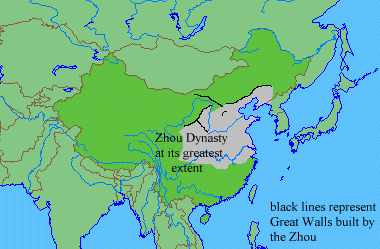
 iLook China