Mao Zedong, the Poet

July 27, 2010

Many outside China think of Mao Zedong (1893 – 1976) as a brutal dictator. Yet, he was fifty-six when he became the ruler of China and seventy-two at the beginning of The Cultural Revolution.

In fact, while commanding the Red Army during The Long March (1934-1935), we see a man who respected China’s peasants proving he was more of a nationalist than a Communist. Then there was the move away from Communist Russia after Nixon’s visit to China in 1972, when Mao said, “Our common old friend, Generalissimo Chiang Kai-shek, doesn’t approve of this.”

In 1935, Mao’s poem, “The Long March”, reveals an awareness of the sacrifice and the willingness to suffer to accomplish great things.

The Red Army fears not the trials of the March,
Holding light ten thousand crags and torrents.
The Five Ridges wind like gentle ripples
And the majestic Wumeng roll by, globules of clay.
Warm the steep cliffs lapped by the waters of Golden Sand,
Cold the iron chains spanning the Tatu River.
Minshan’s thousand li of snow joyously crossed,
The three Armies march on, each face glowing.

Mao was a complex man, and it wasn’t until after the failure of the The Great Leap Forward (1958 – 1961) that the fatal attraction and power of leadership corrupted him leading to the horrors of The Cultural Revolution (1966 – 1976), which Mao’s critics in the West use to define him.

Anyone who follows all of Mao’s life instead of relying on his last decade would understand that he cared deeply about the common people while punishing the landowners and wealthy, who abused them.  On the other hand, his foe, Chiang Kai-shek, supported the landowners and wealthy while crushing the peasants and workers.

There is a post on About China.info that says, “Mao’s poetry exhibits a spirit of boldness and power, weaving together history, reality and commitment… Bold transformation of myth and literary quotations are a distinct feature of Mao’s poetry.”

At Mao Zedong Poems, Two Birds” A Dialogue (1965), reveals what Mao may have been thinking about as President Johnson increased America’s involvement in Vietnam. Was Mao also warning us of what he was about to do in 1966, when he launched The Cultural Revolution?

Two Birds: A Dialogue (1965)

The roc wings fanwise,
Soaring ninety thousand li
And rousing a raging cyclone.
The blue sky on his back, he looks down
To survey Man’s world with its towns and cities.
Gunfire licks the heavens,
Shells pit the earth.
A sparrow in his bush is scared stiff..
“This is one hell of a mess!
O I want to flit and fly away.”
“Where, may I ask?”
The sparrow replies,
“To a jewelled palace in elfland’s hills.
Don’t you know a triple pact was signed
Under the bright autumn moon two years ago?
There’ll be plenty to eat,
Potatoes piping hot,
Beef-filled goulash.”
“Stop your windy nonsense!
Look, the world is being turned upside down.”

Through Mao’s poetry, we learn more about the man—not the modern emperor.

Discover China’s Privately Passionate Poetry

______________

Lloyd Lofthouse is the award-winning author of The Concubine Saga. When you love a Chinese woman, you marry her family and culture too. This is the love story Sir Robert Hart did not want the world to discover.

Subscribe to “iLook China”!
Sign up for an E-mail Subscription at the top of this page, or click on the “Following” tab in the WordPress toolbar at the top of the screen.

About iLook China


Accidental Discovery of Gunpowder

July 17, 2010

Sulfur is the main ingredient for gunpowder. It was first developed during the Tang Dynasty (618 – 907 AD). During the Northern Sung Dynasty, in 1044 AD, the book “Essentials of Military Art” published several formulas for gunpowder production. It is ironic that the Sung Dynasty (960 – 1276 AD) used a Tang Dynasty invention to defeat them.

Several ingredients for gunpowder were in wide use for medicinal purposes during the Spring and Autumn Period of China’s history (722 – 481 BC).

According to the famous book “Records of History”, Chang Sangjun, shared secret prescriptions with Pien Ch’iao (around 500 BC), who promised not to give the secret away then became famous as a doctor of Chinese medicine.

Gunpowder was discovered a thousand years ago by accident.  While mixing ingredients to find an elixir for immortality, Chinese scientists stumbled on the formula.  Fireworks and rockets came first to scare away evil spirits. The irony is that gunpowder, which has killed millions used as weapons, came about during the search for eternal life.

One theory says that the knowledge of gunpowder came to Europe along the Silk Road around the beginning of the 13th century, hundreds of years after being discovered in China. It is also ironic, that Britain and France used advanced gunpowder weapons to defeat China during the 19th century in the two Opium Wars.

For other Chinese inventions, see China Points the Way – the invention of the compass

_________________________

Lloyd Lofthouse is the award-winning author of the concubine saga, My Splendid Concubine & Our Hart. When you love a Chinese woman, you marry her family and culture too. 

To subscribe to “iLook China”, look for the “Subscribe” button at the top of the screen in the menu bar, click on it then follow directions.


The First Emperor: The Man Who Made China – Part 9/9

April 23, 2010

In the seventh month of 2010 BC, the first emperor’s search for immortality has ended. At the age of fifty, Qin Shi Huangdi is dead.

While China’s first emperor is being buried according to his wishes, a power struggle rages outside the tomb. By tradition, the oldest son should have become the emperor but several ministers want a younger son on the throne. The others are assassinated and there is a slaughter.

The emperor is also not going alone into the afterlife. While his chosen successors are being assassinated, hundreds of his favorite concubines will stay with their master and die with him. The tomb’s designers and builders will be sealed in the tomb too. Everyone who knows the way dies.

Qin Shi Huangdi left a legacy–a unified nation with a single written language and a system of administration that is still used today.

You may return to Part 8, or start with The Man Who Made China, Part 1

View as Single Page

_________________________

Lloyd Lofthouse is the award-winning author of the concubine saga, My Splendid Concubine & Our Hart. When you love a Chinese woman, you marry her family and culture too. 

To subscribe to “iLook China”, look for the “Subscribe” button at the top of the screen in the menu bar, click on it then follow directions.


The First Emperor: The Man Who Made China – Part 8/9

April 22, 2010

Chinese alchemists knew liquid mercury as the only substance that could dissolve gold. To the ancient mind, that meant mercury had power that might prolong life. However, the human body cannot absorb pure mercury so the Chinese alchemists made a compound the emperor could digest.

As the mercury is absorbed, it slowly destroyed his nervous system and brain. Emperor Qin Shi Huangdi becomes aggressive, argumentative and paranoid. He goes into hiding. Anyone revealing his location is killed. His kidneys’ are failing and he starts talking to the gods.

Thirty-five years after becoming the king of Qin at thirteen, he goes on another Imperial tour.  But this time, he does not see the nation that is bankrupt and near famine. All the emperor can think about is living forever.

He’s told that giant fish guards the island of the immortals. The emperor dreams that he is a sea god who will kill the giant fish. Near the end of 210 BC, he visits the ocean hunting the giant fish with a crossbow while wading in the surf.

His advisors plan what to do with China once the emperor dies. On the return to the capital, the emperor falls ill and the Imperial convoy stops.

Go to Part 9 for The Man Who Made China or return to Part 7

View as Single Page

______________

Lloyd Lofthouse is the award-winning author of the concubine saga, My Splendid Concubine & Our Hart. When you love a Chinese woman, you marry her family and culture too.

To subscribe to “iLook China”, look for the “Subscribe” button at the top of the screen in the menu bar, click on it then follow directions.


The First Emperor: The Man Who Made China – Part 7/9

April 22, 2010

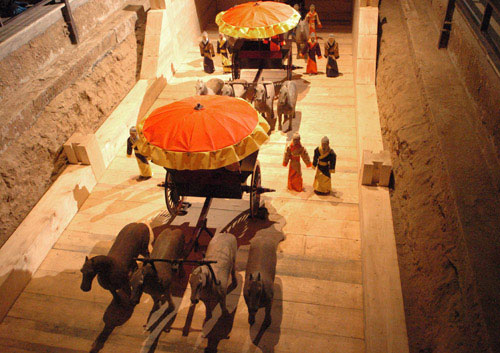
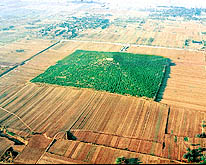
By 215 BC, Emperor Qin Shi Huangdi’s tomb is almost finished. The chamber where his body will rest is the size of a football field and will be hermitically sealed.  Then the tomb will be covered with a million tons of earth creating the hill we see today.

View of Qin Shi Huangdi's tomb

However, the Emperor doesn’t plan to die. Seeking advice from his doctor, he is given mercury capsules. At the time, it was believed that mercury would increase longevity.  Having lots of sex with multiple partners was also considered another way to increase life. The emperor follows the doctor’s advice and sends the doctor on an expedition to find an elixir for immortality.

The emperor isolates himself and delegates the power to rule the empire to those he trusts most. These men suppress free thought. Entire libraries are burned. Those who try to hide documents are branded on the face and sentenced to a life of force labor–mostly on The Great Wall. Anyone who resists is buried alive.

Professor Jeffrey Riegel, University of California, Berkeley, says that Chinese archeologists have no immediate plans to unearth the tomb, because there is no way to safeguard the contents from decay.

Go to Part 8 for The Man Who Made China or return to Part 6

View as Single Page

_________________________

Lloyd Lofthouse is the award-winning author of the concubine saga, My Splendid Concubine & Our Hart. When you love a Chinese woman, you marry her family and culture too. 

To subscribe to “iLook China”, look for the “Subscribe” button at the top of the screen in the menu bar, click on it then follow directions.