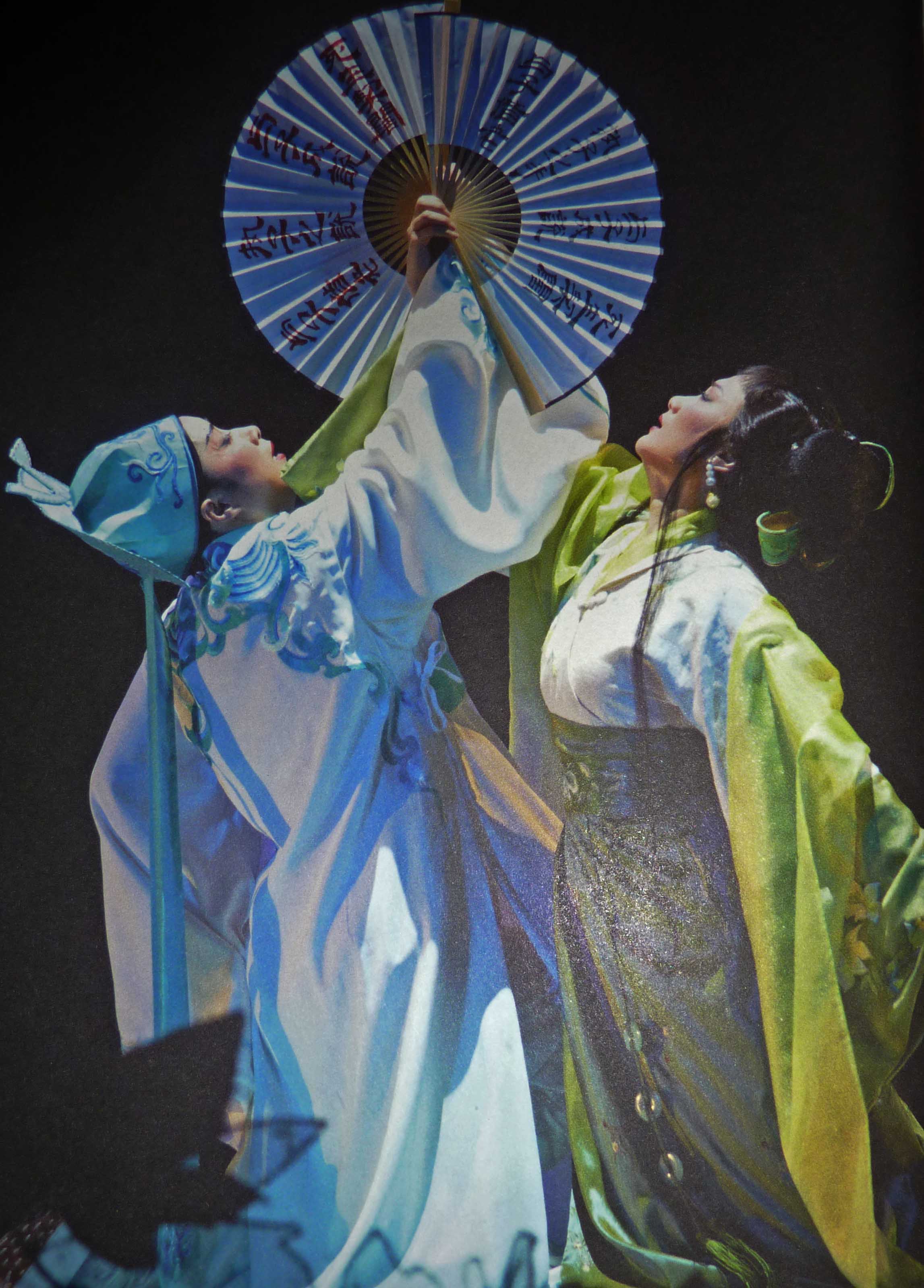
Jingyun Dagu, Beijing’s Story Telling Opera

September 21, 2010

Jingyun Dagu is a form of Chinese opera where stories are often sung in a Beijing dialect accompanied by a drum along with one or two other musical instruments. 

The stress is on singing and depicts the stories in short episodes.

Dagu was first popular near the end of the Qing Dynasty (1644-1911) and is still popular in China’s capital today.

One super star of Dagu is Luo Yusheng,who was born in 1914. Her stage name is Xiao Caiwu.  Even in her 90s, she emcees TV programs and occasionally performs.

This link, Happy Spring Festival, will take you to a video of Luo Yusheng performing for about 2.5 minutes in 1995, playing wooden clappers and drum while singing in a Beijing dialect.

Although this performance of Dagu is not her best known work, it was the only example I found on the Internet and I couldn’t embed the video in the post.

Well known by most of China, her fans call her the Queen of the Golden Voice. She studied Peking Opera at the age nine and switched to Dagu at 17. 

After the PRC was founded in 1949, Dagu singers were regarded as people’s artists or actors, who sang traditional stories and new operas with themes reflecting contemporary life such as patriotic Communist stories like Glorious Journey, Red Flag Over Mount Everest, and Patriotism and Roaring Waves.

The singer/drummer is often accompanied by the Sihu (a four-stringed instrument similar to an Erhu) and Pipa (lute) in addition to three-stringed lutes and wooden clappers. One of the sources for this post was China Culture.org.

See Peking Opera

______________

Lloyd Lofthouse is the award-winning author of the concubine saga, My Splendid Concubine & Our Hart. When you love a Chinese woman, you marry her family and culture too. 

If you want to subscribe to iLook China, there is a “Subscribe” button at the top of the screen in the menu bar.


The Falun Gong Machine

June 25, 2010

When I attended the 6th Asian Heritage Street Celebration in San Francisco, I stopped at a booth for Shen Yun Performing Arts staffed with attractive, college age girls. My wife loves dance, and I thought she might be interested. I asked if this dance troop was part of a local college or university. The girl who handed me the brochure said yes. She lied to me.

6th Annual Asian Heritage Street Celebration

That evening, when I arrived home, I handed the brochure to my wife, who said, “That is Falun Gong.” I’ve written about The Falun Gong and Costco, about A Visit from the Falun Gong, and the more I learn about this group, the more sinister they become.

Turning to the Internet and using Google, I learned that New Tang Dynasty Television, Shen Yun Performing Arts and The Epoch Times all appear to be part of Falun Gong. I also discovered that Falun Gong must buy lots of Internet AD words so Google searches lead to one of the gears in the Falun Gong machine.  In fact, I had trouble finding anything but Falun Gong propaganda and had to keep altering my search terms to get beyond the Falun Gong firewall.

In time, I discovered a piece published in the Buffalo News saying, “the promoters and creators of “Shen Yun,” who have picked up a reputation for misrepresentation and deception over the years, have adopted the questionable propagandist tactics of the very government they criticize in their productions.”

Digging further, the New York Times reported, “China’s decision to ban Falun Gong was made after 10,000 adherents staged a silent protest outside the gates of Zhongnanhai, the Communist Party’s leadership compound in Beijing, to complain about reports in the state-run media that the group said were defamatory. Security forces apparently had no advance knowledge of the demonstration, which took place on April 25, 1999. The Chinese government began treating the group as a threat to national security.”

How about visiting Belching About China

______________

Lloyd Lofthouse is the award-winning author of the concubine saga, My Splendid Concubine & Our Hart. When you love a Chinese woman, you marry her family and culture too. 

If you want to subscribe to iLook China, there is a “Subscribe” button at the top of the screen in the menu bar.


Peking Opera

April 1, 2010

Peking Opera is a combination of several styles of Chinese opera.

The metamorphosis started during the Qing Dynasty (1644-1911), about two hundred years ago.

Peking Opera focuses on historical events, legends about emperors, ministers, generals, geniuses and great beauties.

Performances are a combination of singing, dialogue, pantomime and acrobatic fighting and dancing.

Today, Peking Opera is considered the highest expression of Chinese culture.

The origins of Peking Opera did not begin in Peking (Beijing).  The opera had its start in the Chinese provinces of Anhui and Hubei.

Experts say the opera was born in 1790 and was originally staged for the royal family and then the public.

There are thousands of these operas that cover the history and literature of China. Peking operas can be divided into two categories.

“Civil” operas focus on singing while “Martial” operas feature acrobatics and stunts.  Some are a combination of both.

If Peking Opera interests you, see Chinese Yu Opera with Mao Wei-tao

______________

Lloyd Lofthouse is the award-winning author of The Concubine Saga. When you love a Chinese woman, you marry her family and culture too. This is the love story Sir Robert Hart did not want the world to discover.

Subscribe to “iLook China”!
Sign up for an E-mail Subscription at the top of this page, or click on the “Following” tab in the WordPress toolbar at the top of the screen.

About iLook China


Mao Weitao and Yue Opera

March 14, 2010

Mao Weitao is considered a living treasure in China. She imitates men in the opera roles she plays—a reversal from Imperial China when women were not allowed on stage so men played female roles.

Mao Weitao is on the left

I was introduced to Yue Opera in Hangzhou, Zhejiang Province about a decade ago. Mao Weitao and her husband have their own theater company near the shores of the famous Westlake. My wife translated while I watched the live-opera performance in fascination.

The costumes were lavish and the acting and opera was dramatic with a backdrop of classical Chinese music.

The challenge today is to keep this form of Chinese opera alive. The audience for opera is shrinking dramatically in China while remaining popular with the older generation. Television, movies and the Internet are claiming the shorter attention spans of the younger people.

Mao Weitao, considered an innovative genius on stage, adapts and works to keep the art form alive. According to her husband, no two performances are exactly alike.

Discover The Orphan’s Life

_______________

Lloyd Lofthouse is the award-winning author of My Splendid Concubine [3rd edition]. When you love a Chinese woman, you marry her family and culture too. This is the love story Sir Robert Hart did not want the world to discover.

His latest novel is the multiple-award winning Running with the Enemy.

Subscribe to “iLook China”!
Sign up for an E-mail Subscription at the top of this page, or click on the “Following” tab in the WordPress toolbar at the top of the screen.

About iLook China