On this trip, our hotel was outside of and in sight of Xian’s city walls. We had a view of the battlements that were centuries old. At night, the walls and towers were outlined with white Christmas lights.
I ached to get up there and walk those walls. It was 1999, and I’d wait more than nine years before that happened. One day I want to rent a bicycle and explore the entire wall.
This is a different restaurant from the one I mention.
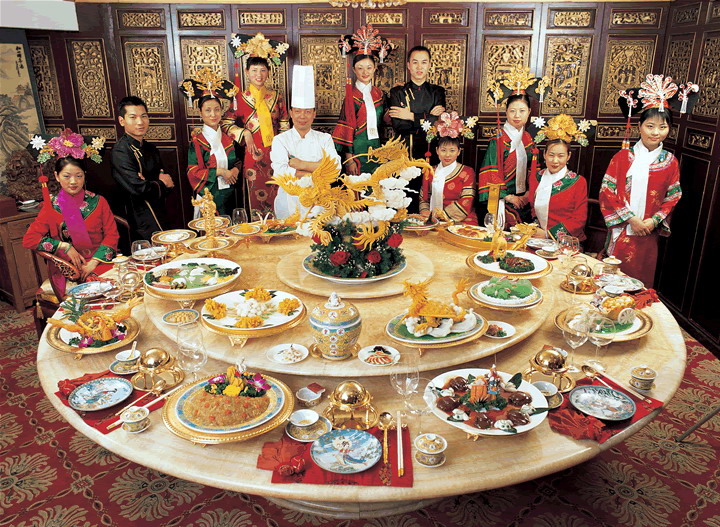
Our second day in the city, we walked from the hotel into the city to a Xian restaurant. I went in first and the hostess, who didn’t speak a word of English, handed me a menu written in English.
My wife, dressed more like a Chinese peasant than an American, walked in after me and she was handed a menu written in Chinese. Then she glanced at my menu before taking it out of my hands and giving it back to the hostess.
“We’ll use the Chinese menu,” she said.
The prices in Mandarin were less than half the English version. A stunned look appeared on the hostesses face. It was a Candid Camera moment, and it was all I could do to not laugh.
Lloyd Lofthouse is the award-winning author of The Concubine Saga. When you love a Chinese woman, you marry her family and culture too. This is the love story Sir Robert Hart did not want the world to discover.
Subscribe to “iLook China”!
Sign up for an E-mail Subscription at the top of this page, or click on the “Following” tab in the WordPress toolbar at the top of the screen.
This morning I awoke to discover two books printed in Mandarin, not English, that had been tossed on the floor. It seems my wife read both books in one night and didn’t get much sleep. She reads much faster in Mandarin than in English and can polish off books as if she were eating cookies.
When I asked about the two books, it turned out that one of the books was the biography of Wu Guanzhong (1919 – 2010), the father of Chinese Expressionism. This was the first I’d heard of him.
I learned he is considered the Chinese Cezanne. In fact, he is one of the fathers of expressionism.
Wu was born in Yixing, Jiangsu Province, China. He was a graduate of the National Art College in 1942, and then studied oil painting in Paris from 1947-1950.
When Wu returned to China in 1950, he taught Western art to his students at the Central Academy of Fine Art in Beijing to 1953. He then taught art at Tsinghua University in Beijing 1953 – 1964.
Due to criticism that Wu had been influenced by Western Bourgeois ideas, in 1966, during the beginning of Mao’s Cultural Revolution, Wu was told he could not paint or write about art. To avoid persecution and possibly execution by the rampaging teenage Red Guard, he burned many of his paintings.
In 1970, he was separated from his wife and spent three years working at hard labor in the countryside as part of Mao’s re-education program.
After Mao died in 1976 with China now led by Deng Xiaoping, Wu was allowed to paint again. He had his first professional solo exhibition in 1979, and succeed as a professional artist in the 1980s.
His painting of Shakespeare’s hometown was listed to sell for
RMB: 2 million ($US 318,878) – 2.5 million ($US 398,597).
During his life as an art teacher and a professional artist, his goal was to introduce French modernism to the Chinese world of art while preserving China’s cultural identity.
Wu combined his French training and Chinese background to develop a semiabstract style to depict scenes from the Chinese landscape. Before he died, Wu had solo exhibitions in major art galleries and museums around the world, including Hong Kong, Singapore, Tokyo, Taipei, Korea, England and the US.
In 1992, Wu was honored by the French Ministry of Culture. He died at age 90. You may see a sample of his art from the embedded video.
Lloyd Lofthouse is the award-winning author of The Concubine Saga. When you love a Chinese woman, you marry her family and culture too. This is the love story Sir Robert Hart did not want the world to discover.
Subscribe to “iLook China”!
Sign up for an E-mail Subscription at the top of this page, or click on the “Following” tab in the WordPress toolbar at the top of the screen.
One of the questions I hear the most is whether the Chinese people’s attitude toward sex is conservative or open-minded. And the answer is that it’s complicated.
First, there is more than one China: there’s rich China and poor China, urban and rural China, young China and older China.
Generalizations are tricky, and there always have to be qualifiers. It’s safe to say that in the larger cities like Beijing and Shanghai people are far less hung up than they were about sex twenty years ago.
Even in most of the second-tier cities you’ll find gay bars, sex shops, young couples holding hands and a lot of young people finding one-night stands over the Internet.
Sexologist Li Yinhe estimates that more than 50 percent of young urban Chinese have premarital sex, something that was unheard of thirty-five years ago. In the countryside that number is probably far lower, but most young people are leaving their rural hometowns to find work in the larger cities.
At the same time, however, traditional Chinese beliefs still hold sway over many of these young people.
For example, sex is not something you talk about openly.
In addition, when it comes time to choose a spouse, nearly all young Chinese will include their parents in the process, striving to make it a family decision.
Many if not most husbands still place a high premium on virginity and expect to see blood on the sheets the night of their honeymoon. This attitude is so fixed that every year hundreds of thousands of Chinese women have an operation to restore their hymens, or buy inexpensive artificial hymens that seep artificial blood.
This is an anomaly: more Chinese young people are having premarital sex yet men still expect their wives to be virgins.
China is in a tug of war between its conservative past and the lure of Western-style sexual freedom.
Looking at the trends and how quickly China’s sexual revolution has progressed, I would have to predict that sexual openness and tolerance will increase, and eventually China will shake off the vestiges of the sexual puritanism that prevailed under Mao.
However, for now, sex remains a touchy subject, even in the cities. Sex education, for example, is mandatory but often biology teachers who are supposed to teach it are too squeamish and simply skip to the next chapter. When they do teach this subject, the focus is on biology and anatomy, with little or no reference to contraception or sexual morality, such as the woman’s right to say no.
Here, too, there are signs of improvement in the larger cities, but it is very slow going. Sex remains a taboo subject that most Chinese are not comfortable discussing outside of their bedroom.
Subscribe to “iLook China”!
Sign up for an E-mail Subscription at the top of this page, or click on the “Following” tab in the WordPress toolbar at the top of the screen.
More than ninety percent of babies in Chinese orphanages are girls. Prior to 1949, it was common for parents to murder girl infants. From the 1950s to the end of the 1970s, due to Mao’s leadership and a tough stance for women’s equality, the death rate went down. Then in the 1980s, with the population growing too fast, a desperate government implemented the one-child policy.
After that, many girl babies went missing or were abandoned to state-run orphanages. To end this tragedy, the government eventually allowed rural families to have two children per family—hoping for a boy.
The conditions in these rural, state-run orphanages are often not ideal. Girls, who are not adopted, usually end up being the caregivers for the younger children. Since these orphan caregivers were raised without the love of parents and siblings, they may not be loving themselves creating a cold environment to grow up in.
abandoned at birth
It isn’t as if China’s government has done nothing to stop a practice that has been around for thousands of years. During the 90s, tougher laws were passed but often ignored. Government inspectors were sent to rural areas to enforce these laws, but it isn’t easy controlling a population of 1.3 billion scattered over a mountainous country almost the size of the United States.
I will not criticize the Chinese government for these conditions. I’ve been to China and understand the challenges.
What would you do if you had inherited a medieval country in 1949 that was bankrupt due to the Kuomintang looting the banks and treasury as they fled to Taiwan under American protection?
Then there is a culture reaching back thousands of years where girls were considered worthless. That is a lot to overcome.
Lloyd Lofthouse is the award-winning author of The Concubine Saga. When you love a Chinese woman, you marry her family and culture too. This is the love story Sir Robert Hart did not want the world to discover.
Subscribe to “iLook China”!
Sign up for an E-mail Subscription at the top of this page, or click on the “Following” tab in the WordPress toolbar at the top of the screen.
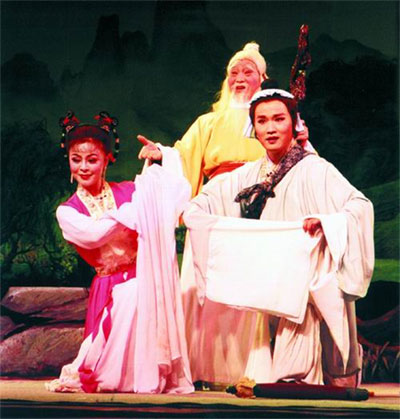
Anqing, in Anhui Province, is regarded as the hometown of Huangmei Opera and Hui Opera. Anqing was first built in 1217 and is almost eight-hundred years old, but Huangmei Opera first appeared about two centuries ago as a simple drama of song and dance.
Huangmei Opera Troupe
Huangmei opera did not involve the traditional opera gestures which often-used sleeves and step movements. The music is performed with a pitch that hits high and stays high and does not sound like the typical rhythmic Chinese opera.
The fairy tale of the Cowherd and the Weaving Girl is one of the four most famous folktales of ancient China. It is a classic love story between a fairy and a human being and has a widespread influence. The Qixi Festival is said to have something to do with the fairy tale, and the seventh day of every seventh month of the lunar calendar has become the Chinese Valentine’s Day.
Chinese opera together with Greek tragic-comedy and Indian Sanskrit Opera are the three oldest dramatic art forms in the world.
Lloyd Lofthouse is the award-winning author of The Concubine Saga. When you love a Chinese woman, you marry her family and culture too. This is the love story Sir Robert Hart did not want the world to discover.
Subscribe to “iLook China”!
Sign up for an E-mail Subscription at the top of this page, or click on the “Following” tab in the WordPress toolbar at the top of the screen.


 Posted by Lloyd Lofthouse


 iLook China