I’m sure that most people outside of China don’t think of love poems when they think of China. However, there has to be a reason for more than 1.3 billion people, other than the Great Wall of China, the Pacific Ocean and the biggest mountain range on the planet, the Himalayas, which helped shelter China from some of the violence that rocked the rest of the world for centuries—at least until the Opium Wars.
For poetry lovers, Chinese Love Poetry imparts a sense of the private passion that beats in the Chinese heart. The three arts of poetry, calligraphy and painting, the Triple Excellence, are represented on the pages.
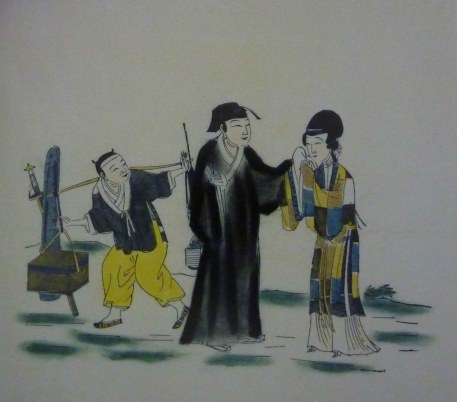
The following painting, lady weeping at parting from husband, 17th century, comes from the Qing Dynasty and the book says it is a color woodblock print on paper.
Chinese poetry is frequently personal and often linked to a particular occasion (page 9).
Deeply in love, but tonight
we seem to be passionless;
I just feel, before our last cup of wine
a smile will not come.
The wax candle has sympathy –
weeps at our separation:
Its tears for us keep rolling down
till day breaks.
by Du Mu (803-852 AD)
As you can see, the Chinese are a passionate people—they just don’t dramatize these passions publicly as many Westerners do—at least until the West invaded China to force—if possible—a different set of values on China’s collective culture.
_______________
Lloyd Lofthouse is the award-winning author of My Splendid Concubine [3rd edition]. When you love a Chinese woman, you marry her family and culture too. This is the love story Sir Robert Hart did not want the world to discover.
Subscribe to “iLook China”!
Sign up for an E-mail Subscription at the top of this page, or click on the “Following” tab in the WordPress toolbar at the top of the screen.
First, according to the Democracy Index, in 2012, there were only 25 full democracies in the world while there were 51 authoritarian regimes. There were also 54 flawed democracies and 37 hybrid regimes. The Democracy Index is compiled by the Economist Intelligence Unit that measures the state of democracy in 167 countries, of which 166 are sovereign states and 165 are United Nations member states.
With the so-called democracy demonstrations taking place in Hong Kong—a former colony of the British Empire that was never a democracy by any definition—I want to make a link between those demonstrations and the Nobel Peace Prize.
Back in 2010, the media in democratic countries sounded the charge against China when Liu Xiaobo was awarded the Nobel Peace Prize. The Western media splashed the news on the Internet, across the front pages of newspapers and repeatedly reported it on TV and radio.
For example, The Huffington Post reported, “Imprisoned Chinese democracy campaigner Liu Xiaobo on Friday won the Nobel Peace Prize, an award that drew furious condemnation from the authoritarian government and calls from world leaders including President Barack Obama for Liu’s quick release.”
I’m sure that Liu Xiaobo believes in his mission as many in the West do, but I have to agree with America’s Founding Fathers. For instance President John Adams (1735 – 1826), the second president of the U.S., who said, “That the desires of the majority of the people are often for injustice and inhumanity against the minority is demonstrated by every page of the history of the whole world,” and “Democracy … while it lasts is more bloody than either [aristocracy or monarchy]. Remember, democracy never lasts long. It soon wastes, exhausts, and murders itself. There is never a democracy that did not commit suicide.”
What about China soon after Mao’s death when Deng Xiaoping launched China’s economiccapitalist revolution, and in 1982, China wrote the first draft of a constitution designed to build an authoritarian republic—not a democracy?
Since then, China has been moving slowly down a road toward a more representative republic that fits China’s culture, which might never accept Western democracy activists like Liu Xiaobo. I wonder what America’s Founding Fathers would have done with Liu Xiaobo—probably ignored him as most Americans would, but we might find an answer with how the U.S. deals with treason.
“Whoever, owing allegiance to the United States, levies war against them or adheres to their enemies, giving them aid and comfort within the United States or elsewhere, is guilty of treason and shall suffer death, or shall be imprisoned not less than five years and fined under this title but not less than $10,000; and shall be incapable of holding any office under the United States.” 18 U.S. Code 2381 – Treason
What aboutChina’s Constitution? After all, China does have a Constitution of its own.
For instance, there is Article 35: Citizens of the People’s Republic of China enjoy freedom of speech, of the press, of assembly, of association, of procession and of demonstration.
But there are also Articles 51, 52, 53 and 54:
Article 51: Citizens of the People’s Republic of China, in exercising their freedoms and rights, may not infringe upon the interests of the State, of society or of the collective, or upon the lawful freedoms and rights of other citizens.
Article 52: It is the duty of citizens of the People’s Republic of China to safeguard the unification of the country and the unity of all its nationalities.
Article 53: Citizens of the People’s Republic of China must abide by the Constitution and other laws, keep State secrets, protect public property, observe labour discipline and public order and respect social ethics.
Article 54: It is the duty of citizens of the People’s Republic of China to safeguard the security, honour and interests of the motherland; they must not commit acts detrimental to the security, honour and interests of the motherland.
Nobel Prizes are awarded by the Norwegian Nobel Committee, which has been accused of having a political agenda. They have also been accused of Euro-centrism.
For the 2010 Nobel Prizes, there were five committee members, one man and four women—all white and old. Click the link and see for yourself.
In conclusion, I want to point out a few facts about China and its government that you probably will never hear from the mainstream Western media—especially in the United States.
Never before in China’s history has any government made an attempt to improve the lifestyles and welfare of its people. The World Bank reports that the CCP has lifted more than 600 million people out of poverty—90 percent of global poverty reduction in the last 30 years. Poverty in 1981 was 85 percent. In 2008, the World Bank reported it was 13 percent, lower than the poverty rate in the United States where poverty is increasing.
For more than two thousand years, China was known as the land of famines. In fact, Imperial records reveal that China had famines annually in one or more provinces, but under the CCP, the only famine was in 1958-1960—and the Western media has crucified the CCP repeatedly because of this famine and has never mentioned China’s annual history of famines.
In 1949, when the CCP came to power, average life expectancy in China was age 35. Today it is 75. When Mao died, only 20 percent of Chinese were literate. Today, literacy is 95.1 percent.
If China is ruled by a brutal authoritarian government with a dictator—which isn’t true because its president may only serve two, five-year terms and the president’s power is limited—explain why an average of more than 50 million Chinese travel the world annually as tourists (more than any other country) and why many Chinese are free to go to college in the United States, and other countries, as foreign students.
Did you know that Xi Jinping, China current president, sent his daughter to college in the United States? In addition, in 2011, China send the most foreign students—194,029—to the USA, up 23% from the previous year.
There are more than 2,000 McDonald’s restaurants in China. KFC has more than 4,600. Pizza Hut has more than 1,200. Walmart has been in China for 18 years and has about 90,000 employees. Starbucks is also in China and plans to have 1,500 stores by 2015.
Intel has research and manufacturing facilities in Beijing, Chengdu, Dalian, Shanghai and Shenzhen.
In 2012, 54 percent of urban Chinese were middle class and another 14 percent were upper middle class.
_______________
Lloyd Lofthouse is the award-winning author of My Splendid Concubine [3rd edition]. When you love a Chinese woman, you marry her family and culture too. This is the love story Sir Robert Hart did not want the world to discover.
Subscribe to “iLook China”!
Sign up for an E-mail Subscription at the top of this page, or click on the “Following” tab in the WordPress toolbar at the top of the screen.
Enough said about The Economist, Christianity and differences between dictatorships, democracies and republics, and back to the long history between China and Burma/Myanmar, which started during the Han Dynasty (206 B.C. – 220 A.D.).
Due to deposits of jade in Burma/Myanmar and that region, Chinese merchants have been involved in mining and trade there for more than two thousand years.
Then during the Qing Dynasty, there were four major invasions (1765-1769) of Burma by China’s Manchu leaders. In 1784, the long struggle between Burma and China ended and regular trade started up again.
In November 1885, Sir Robert Hart favored a proposal that China, as Burma’s overlord, stand aside and allow the British Empire to pursue her own course there provided that Britain allow Burma to continue her decennial tribute (once every ten years) missions to China. Source: The I. G. In Peking, Letters of Robert Hart, Chinese Maritime Customs 1868-1907, The Belknap Press of Harvard University Press, page 614, 1975.
Instead, the British Empire made Burma a province of India in 1886.
Since independence from the British Empire, Burma has generally been impartial to world affairs but was one of the first countries to recognize Israel and the People’s Republic of China.
Territories such as the autonomous regions of Tibet, Xinjiang and countries like North Korea, Manchuria, Mongolia, Burma, Vietnam and others along China’s long borders were considered vassal states by some Chinese dynasties, and these vassal states often sent lavish gifts and delegations to China’s emperors on a regular schedule.
Lloyd Lofthouse is the award-winning author of My Splendid Concubine [3rd edition]. When you love a Chinese woman, you marry her family and culture too. This is the love story Sir Robert Hart did not want the world to discover.
Subscribe to “iLook China”!
Sign up for an E-mail Subscription at the top of this page, or click on the “Following” tab in the WordPress toolbar at the top of the screen.
What does the Beijing based unnamed critic writing for The Economist expect—that China adopt America’s evangelical, neo-conservative/neo-liberal role to spread “democracy” and “Christianity” to the world through nation building?
Correct me if I’m wrong, but didn’t the critic writing in The Economist suggest that he or she expects China to spread “democracy” to countries like Burma and North Korea, which are by definition dictatorships, which the U.S. has a long history of supporting. See Cold War Origins of the CIA Holocaust to learn more.
If you haven’t read this opinion piece in The Economist, I suggest you do before going on to Part 3. Did you know that at the same time that the United States sells or gives weapons to dictatorships and authoritarian governments, it also has programs through the U.S. State Department to support religious freedom in many of the same countries?
For instance, Saudi Arabia, a country that prohibits any religion other than Islam and has a long history of human rights violations (Human Rights Watch World Report 2013) . On October 20, 2010, the US State Department notified Congress of its intention to make the biggest arms sale in American history—an estimated $60.5 billion purchase by the Kingdom of Saudi Arabia.
The IAGS says this about Saudi Arabia: “Much has been reported about the complex system of terrorist financing and the money trail facilitating the September 11 terror attacks. Individuals and charities from the Persian Gulf—mainly from Saudi Arabia—appear to be the most important source of funding for terrorist organizations like Al-Qaeda.”
Continued on November 13, 2014 in Part 3 or return to Part 1
Lloyd Lofthouse is the award-winning author of My Splendid Concubine [3rd edition]. When you love a Chinese woman, you marry her family and culture too. This is the love story Sir Robert Hart did not want the world to discover.
Subscribe to “iLook China”!
Sign up for an E-mail Subscription at the top of this page, or click on the “Following” tab in the WordPress toolbar at the top of the screen.
“Tinpot dictator” are the two key words in the title of this opinion piece, as if the United States or the UK has never hosted and/or supported “tinpot” dictators.
A well-written criticism of the U.S. government from Sri Lanka sets the record straight.
“I wish the spokesman of the (U.S.) State Department … would explain how Washington’s concern for democracy in Sri Lanka squares with US support for repressive regimes such as the one in Uzbekistan or the autocratic rule in Saudi Arabia, both countries in which the U.S. has military facilities.
“In post-World War II period, Washington has militarily propped up such dictators including several in South Korea, Ferdinand Marcos who was ousted by the Filipino people, Indonesia’s Suharto also thrown out by the people, Vietnam’s Dinh Diem, various military governments in Thailand, Singapore’s autocrat Lee Kwan Yew, the military dictators in Pakistan from Ayub Khan to Pervez Musharraf, all of them from our part of the world…” The Ugly Americans Once More (Lankaweb, Sri Lanaka’s first Social Media website)
The Economist only mentions a half century of history between China and Burma/Myanmar, yet, China’s history with Burma and then Myanmar goes back about two thousand years.
The opinion piece also does not mention that China, since 1982, has not been into nation building as the U.S. has since 9/11, when President G.W. Bush launched wars against Iraq and Afghanistan with threats to Iran and North Korea.
Lloyd Lofthouse is the award-winning author of My Splendid Concubine [3rd edition]. When you love a Chinese woman, you marry her family and culture too. This is the love story Sir Robert Hart did not want the world to discover.
Subscribe to “iLook China”!
Sign up for an E-mail Subscription at the top of this page, or click on the “Following” tab in the WordPress toolbar at the top of the screen.


 Posted by Lloyd Lofthouse
  iLook China