The Life of Confucius – Part 3/5

May 4, 2010

Confucius dreamed of becoming a great minister of state and putting an end to corruption and bloodshed. He spent much of his free time between the age of 19 to 30 in the libraries of Chufu reading.

He said, “When people are educated, the distinction between classes disappears…. If the sons of emperors and princes are without quality, they should be reduced to the ranks of the common people. If the sons of the common people have quality, they should be elevated to the ranks of the rulers.”

Confucius with students

Confucius was the first teacher in China to start a school that accepted students from every class.  The sons of peasants and powerful families mingled and formed friendships.

Confucius demanded absolute honesty, total self-control and unyielding virtue from his followers. “A superior man thinks about what is right. A small man thinks about what is profitable.  A superior man demands much of himself.  A small man demands much of others. A superior man accepts his lot in common.  A small man is full of complaints.”

One goal remained—a position of power. In 501 BC when Confucius was fifty, the young leader the Duchy of Lu begged Confucius to give up his teaching.

Confucius said, “Do unto others as you would have them do unto you.… You should give education and knowledge to the common people instead of ignoring or subjugating them.” The Duke made Confucius the governor of Lu and while Confucius governed, the streets were safe, crime almost vanished and merchants stopped cheating their customers.

Return to Part 2 of “The Life of Confucius” or go to Part 4

_______________

Lloyd Lofthouse is the award-winning author of My Splendid Concubine [3rd edition]. When you love a Chinese woman, you marry her family and culture too. This is the love story Sir Robert Hart did not want the world to discover.

Subscribe to “iLook China”!
Sign up for an E-mail Subscription at the top of this page, or click on the “Following” tab in the WordPress toolbar at the top of the screen.

About iLook China


The Power of Debate in China

April 29, 2010

“The news triggered a heated debate that was played out all over the Chinese-language media and on the Internet. Eventually, the government backed down, and it’s been left up to industry groups to figure out new guidelines.” Source: Gr-r-r-r! Why I hate China’s e-bikes

This quote from Adrienne Mong, an NBC News Producer, caught my eye. Gasp! Is this evidence from a Western Media source that the people of China have a voice and use it? I hope Adrienne doesn’t lose her job for this slip.

This sounds like America where public debates often have an impact on public policy even if that impact is negative since the majority rules—well, in theory, since in America the majority is often ignored while we constantly hear from “loud” minorities. Take the Tea Bag people, who represent less than 15% of the population, as an example. I wish they’d shut up.

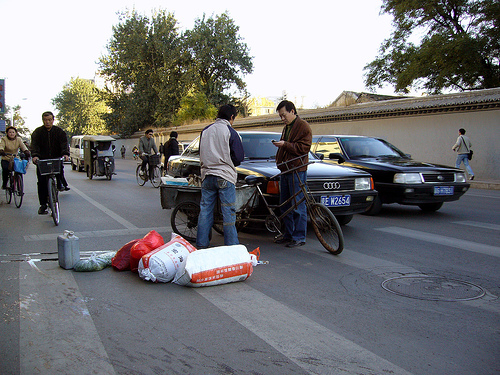
Every time I’ve been in China, we walk, take taxis or use the subways.  We don’t bike, but I have admired the electric bikes.  This is the first I’ve heard of an e-bike without lights.

bicycle and an Audi 80 collide in China

Considering that America loses about 45,000 people a year to highway deaths and, according to Adrienne Mong, China loses twice that with almost five times the population, I’m surprised the numbers for road kill in China are not higher. Many of the drivers in China are crazy. The busy streets look more like an NFL game in the Super Bowl. I’ve often observed that red lights are ignored and crossing any street and sometimes even using sidewalks is risky.

Also see, Where Did All that Pollution Come From?

______________

Lloyd Lofthouse is the award-winning author of the concubine saga, My Splendid Concubine & Our Hart. When you love a Chinese woman, you marry her family and culture too. 

If you want to subscribe to iLook China, there is a “Subscribe” button at the top of the screen in the menu bar.


A Story about Corruption

April 23, 2010

National Library Week was April 11 – 17.  Friday, I attended the Golden Leaves event at Cal Poly Pomona’s University Library. Afterwards, I joined a conversation about China, and one American Caucasian mentioned the corruption in China and how flawed their legal system was. He was adamant that China had to change and become more democratic like Taiwan was. He also said there were a lot of angry people in China who wanted change.

However, there are two sides to every coin, and there are times when I’m slow to respond.  I have to think about the issue first. Now, I’m ready.

“While the true extent and cost of white-collar crime (in the United States) are unknown, it is estimated to cost the United States more than $300 billion annually, according to the FBI.”

“According to experts, the actual amount investors gave to (Bernard) Madoff over the years is probably closer to $20 billion. But even that outlandish sum will never be found; it was chipped away year after year after year. That, after all, is the definition of a Ponzi scheme: Most of the cash put up by new investors went to pay the old ones.” Source: CNN.com

“Enron was the largest company ever to go bankrupt in U.S. history.… Enron gave over $5 million to campaigns since 1998. Out of the 248 elected officials investigating Enron’s collapse, 212 received campaign contributions from Enron or its accounting firm, Arthur Andersen.

“Enron donated money to George W. Bush’s campaign and Kenneth Lay was a close friend. This week, a congressional watchdog agency announced that it will sue Vice President Cheney to get records of meetings he had with Enron officials. The agency is investigating whether the company was able to influence the energy policies of the United States government.” Source: pbs.org

“WASHINGTON—The Securities and Exchange Commission suspected Texas financier R. Allen Stanford of running a Ponzi scheme as early as 1997 but took more than a decade to pursue him seriously, according to a report further tarring the agency that missed Bernard Madoff’s huge fraud.… Mr. Stanford was indicted last June and accused of orchestrating a Ponzi scheme that swindled investors out of $7 billion.

“The report by the SEC’s inspector general says SEC examiners concluded four times between 1997 and 2004 that Mr. Stanford’s businesses were fraudulent, but each time decided not to go further. It singles out the former head of the SEC’s enforcement office in Fort Worth, Texas, accusing him of repeatedly quashing Stanford probes and then trying to represent Mr. Stanford as a lawyer in private practice.” Source: Wall Street Journal

“The US sub-prime mortgage crisis has led to plunging property prices, a slowdown in the US economy, and billions in losses by banks. It stems from a fundamental change in the way mortgages are funded.”

“On Thursday, Sept. 18, 2008, the astonished leadership of the U.S. Congress was told in a private session by the chairman of the Federal Reserve that the American economy was in grave danger of a complete meltdown within a matter of days. “There was literally a pause in that room where the oxygen left,” says Sen. Christopher Dodd (D-Conn.)

“FRONTLINE then chronicles the disaster that followed. Within 24 hours, the stock market crashed, and credit markets around the world froze. “We’re no longer talking about mortgages,” says economist Gertler. “We’re talking about car loans, loans to small businesses, commercial paper borrowing by large banks. This is like a disease spreading.”
Sources:  BBC and PBS-Frontline

 What about China?

“For one thing, the Chinese trust their government more. According to a recent World Values Survey, 96.7 percent of Chinese expressed confidence in their government, compared to only 37.3 percent of Americans.

“Likewise, 83.5 percent of Chinese thought their country is run for all the people, rather than for a few big interest groups, whereas only 36.7 percent of Americans thought the same of their country. With this relatively higher trust, China’s government and enterprises are better able to enact and implement strict policies that promote saving and growth.” Source: The Economist’s View

I wonder if the corruption in China will ever threaten the world’s economies? I’ll let China speak for itself, Economists defend China’s high savings rate.

See Peter Hessler, an expatriate, on China http://wp.me/pN4pY-kI


Going through Customs in China

April 22, 2010

“Reach the head of the line at immigration at Beijing airport and you see something unexpected: On a little ledge just below the officer’s line of sight is a small machine showing an array of buttons. Atop the buttons is a legend inviting travelers to rate the work of the officer: very satisfactory / satisfactory / not satisfactory / slow or rude. As soon as the officer places his or her stamp in the passport, the buttons go active. The lines did move fast.” Source: Frum Forum

Beijing International Airport

I’ve pushed those buttons. Considering how rude the Chinese can be to each other (not foreigners like me­—we get the polite treatment), that was a good idea.

Beijing International Airport

Maybe rating systems like these also motivate China’s homeland security to be more efficient than what I’ve experienced in the US.  For example, I always carry a 16 GB USB thumb drive with me when I travel. All my backup files are on that drive. If the house burns down or is robbed, I won’t lose any of my computer files.

During our last trip to China, no one at San Francisco’s international airport asked to see the USB drive in my loose-change pocket. When I arrived in China, security at Pudong airport asked to see what I had in that pocket.

See “Dragon Air” http://wp.me/pN4pY-lD


Water – Two Countries Tell a Tale

April 19, 2010

The National Geographic special issue, “Water, Our Thirsty World” (April 2007) compares the world’s largest democracy, India, with China. In “The Big Melt” by Brook Larmer, we see a convincing reason why China’s mix of socialism and capitalism may be the world’s answer to avoid future calamities. Where Western style democracies stall due to partisanship, special interests, religious beliefs and political agendas, China’s government, ruled by engineers and scientists, appears to be planning decades ahead.

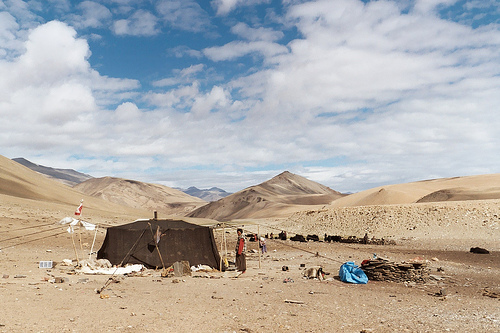
The claims by Tibetan separatists and their supporters that China rules over Tibet with an iron dictatorial fist also appears to be wrong when Larmer visits a family of Tibetan nomads. He writes, “There is no sign of human life on the 14,000 foot high prairie that seems to extend to the end of the world.” Larmer sees “the NOMADS’ tent as a pinprick of white against a canvas of brown.”

Tibetan Nomads

We meet Ba O, a Tibetan nomad. In Ba O’s tent, “there is a small Buddhist Shrine: a red prayer wheel and a couple of smudged Tibetan texts…” A few years earlier, Ba O had several hundred sheep and the grass was plentiful. Now the Tibetan nomad has about a hundred left and fears this way of life is ending.

Ba O says, “This is the way we’ve always done things. And we don’t want that to change.”

However, change is coming, and there is nothing Ba O can do to stop it. The change is not from China’s government. It is from global warming. The Tibetan grasslands are dying and a way of life that has existed for thousands of years may be dying too.

Tibetan girl tending sheep

To insure that the Tibetan nomads will have a place to live, China’s government has been building resettlement villages. The “solid built” houses are subsidized. When the Tibetan nomads can no longer survive on the open Tibetan prairie, it is the nomad’s choice to move into the new villages. The government does not force them to give up their old way of life. Nature does that.

Along with the house comes a small annual stipend for each family so they can eat as they find another way to earn a living. The home Larmer visited had a Buddhist shrine and a free satellite dish for a TV and maybe an Internet connection. In addition, the one child policy does not apply to the Tibetan people since they are a minority in China.

To make sure there will continue to be water to drink, China is planning to build 59 reservoirs in Tibet to capture and save glacial runoff.

In India, the young wife of a fortuneteller spends hours each day searching for water. She lives with her husband and five children in Delhi, India‘s capital. There are fights over water. In a nearby slum, a teenage boy was beaten to death for cutting into a water line.  The demand for water in Delhi exceeds the supply by more than 300 million gallons a day.

What happens to life when there is no water?

See Dictatorship Defined

______________

Lloyd Lofthouse is the award-winning author of the concubine saga, My Splendid Concubine & Our Hart. When you love a Chinese woman, you marry her family and culture too. 

If you want to subscribe to iLook China, there is a “Subscribe” button at the top of the screen in the menu bar.