
Eating Smoke — a question and answer with the author, Chris Thrall – Part 1/5

October 16, 2011

Guest-Post by Tom Carter
Interview with Chris Thrall, author of Eating Smoke

Tom Carter, author of “CHINA: Portrait of a People”, catches up with Chris Thrall to discuss his new book “Eating Smoke, a memoir about Thrall’s descent into drug psychosis in Hong Kong’s triad heartland.

In the fall of 2009, whilst traveling in India to create my next photography book, I was contacted via email by a British writer who had read Down and out in Hong Kong, one of my online travel articles, which described this poor, dusty backpacker’s real-time impressions of Asia’s wealthiest city.

Chris Thrall said he connected with my article’s conclusion that, in spite of my western heritage, and due to my personal circumstances, I ultimately had more in common with the destitute third-world inhabitants of the Chungking Mansions, the infamous immigrant ghetto of Kowloon, than I did with the rich white bankers et al who comprise the other half of Hong Kong’s multinational population.
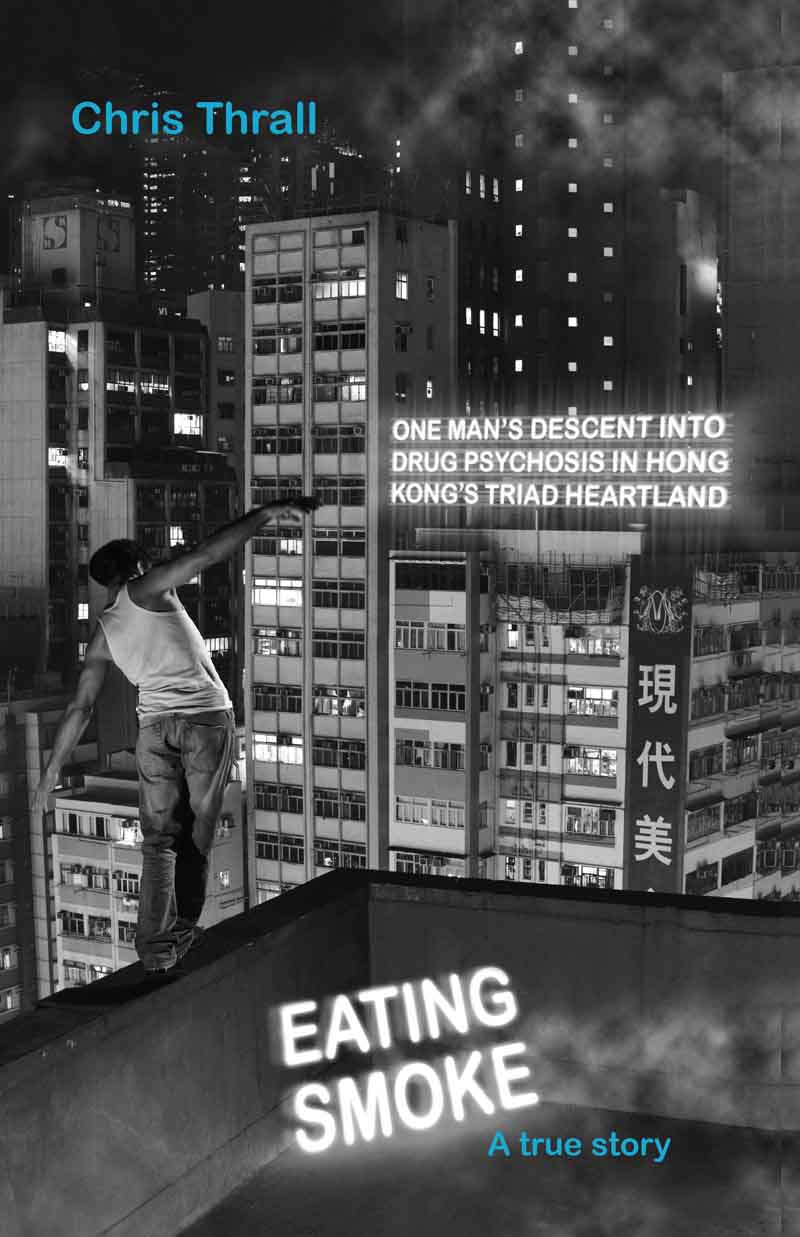
Chris went on to explain that he was writing a book about his own experiences living in Hong Kong, which was dramatically different from mine or any other expatriate I ever knew, and that he once worked for the 14K, the world’s largest Chinese crime family.

Attached to his email was the first chapter of his memoir, a gripping opening salvo that finds the narrator hiding from pursuing henchmen on a roof top—alongside two corpses, a disemboweled mother and child.

As a voracious reader, I know a bestseller when I see it.  I immediately forwarded Chris’s manuscript to my publisher in Hong Kong, Pete Spurrier, who runs the iconic Blacksmith Books, which specializes in Asian-themed literature.

Pete likewise was knocked off his feet by Chris’s incredible story; the next I heard, Chris was a fellow Blacksmith label mate with a book deal.

Chris Thrall was born in the UK. At eighteen, he joined the Royal Marine Commandos. Following active service in the Northern Ireland Conflict and training in Arctic warfare and survival, he earned his parachutist’s ‘wings’ and went on to serve as part of a high-security detachment onboard an aircraft carrier. In 1995, Chris moved to Hong Kong to oversee the Asia-Pacific expansion of a successful network-marketing operation he’d built, part-time, while serving in the Forces. Less than a year later, he was homeless, hooked on crystal methamphetamine and working for the 14K, Hong Kong’s largest triad crime family, as a doorman in Wanchai’s infamous red-light district.

Eating Smoke, a humorous yet deeply moving first book, is his account of what happened.

Continued on October 17, 2011 in Eating Smoke – Part 2, or if you have time and do not want to wait for the five-part series to finish posting daily, click View as Single Page.

__________________________

Travel photographer Tom Carter is the author of CHINA: Portrait of a People, a 600-page book of photography from the 33 provinces of China, which may be found on Amazon.com.

To subscribe to “iLook China”, sign up for an E-mail Subscription at the top right-hand side of this page and then follow directions.


A Snapshot of Democracy in Asia – Part 6/6

October 2, 2011

The last Asian democracy to shine a brief spotlight on is Taiwan, which isn’t really a country, since  the United States and most other significant nations recognize one China and thus include the boundaries of Taiwan as being part of the boundaries of (mainland) China.

In fact, China claims Taiwan as its province, and the international community does not want to contradict China, so Taiwan is not a member of the United Nations.

Although local elections were allowed in Taiwan as early as the 1950s, the Kuomintang (KMT) ruled Taiwan with martial law under Chiang Kai-shek (1887 – 1976), and repressed democracy advocates  for more than three decades.

After Chiang Kai-shek’s death, in 1976, the KMT held onto power until 2000. Then in direct elections, the Taiwanese people voted for a president in 1996, 2000, 2004 and 2008, but corruption reared its ugly head again.

In 2009, Time World reported on former President Chen Shui-bian‘s corruption trial. Chen was accused of taking $9 million dollars in personal kickbacks on a state-sanctioned land deal, embezzling over $3 million from a state fund and laundering millions to overseas accounts.

Then in 2010, the Taipei Times reported, “A former president (Chen Shui-bian) jailed for graft, a retired head of military police indicted for embezzlement, three top judges accused of taking bribes — the list goes on. Taiwan has a problem with corruption.”

In addition, New York Times reported, “Lee Teng-hui, a former president (served 1996 – 2000), who moved the self-governing island toward democracy, was indicted Thursday on charges of embezzling $7.79 million from a state fund, becoming the second former president of Taiwan to be charged with corruption.”

One good thing to say for Taiwan is a low poverty level similar to mainland China. However, in the world’s most powerful democracy, the U.S. 2010 Census says 15.7 percent of Americans live in poverty and that is 47.8 million people–more than twice the population of Taiwan.

After discovering the track record of  several so-called multi-party democracies in Asia, will mainland China’s growing middle class eventually demand a multi-party democracy?

For one answer, Professor Stephen Kobrin of the Wharton School of Knowledge at the University of Pennsylvania says, “We tend to assume all middle-class people have certain values. ”

Kobrin points to the common assertion that people rising into the middle class will press for democracy. However, that does not seem to be happening in China where he suggests that people may be willing to accept more autocratic regimes in return for stability and a middle-class lifestyle.

“The assumption has been that there’s a link between capitalism and democracy, that as incomes rise and people become educated, they will increase pressure for democracy and freedom and civil liberties,” notes Kobrin. “That may or may not be true.”

Return to A Snapshot of Democracy in Asia – Part 5 or start with Part 1

______________

Lloyd Lofthouse is the award-winning author of The Concubine Saga. When you love a Chinese woman, you marry her family and culture too. This is the love story Sir Robert Hart did not want the world to discover.

To subscribe to “iLook China”, look for the “Subscribe” button at the top of the screen in the menu bar, click on it then follow directions.


A Snapshot of Democracy in Asia – Part 5/6

October 1, 2011

Among the so-called Asian democracies, India is next.  The Guardian says of corruption in India “All your life you pay for things that should be free.”

The Guardian reported that “one ordinary man” had to pay at least a third of his income to survive. “Of the 40,000 rupees (£520) I earn a month from my restaurant, I pay at least a third in bribes,” Vishal, 26, said. But bribery also extends into his personal life. Vishal has two young children and to get the eldest into the best local school he paid a “donation” of 25,000 rupees (£340) in cash to the headmaster.”

Economy Watch.com said, “India’s underground economy is believed to be 50 percent of the country’s GDP – US$640 billion at the end of 2008,” and Janamejayan’s Weblog goes into detail of one scam that cost $40 billion, which is 3% of India’s GDP.


Poverty in India, 2011

In addition, there is confusion over how many live in poverty in India.

In 2009, the United Nations Development Programme reported that literacy in India was about 74 percent, while the CIA Factbook set the literacy rate at 61 percent (literacy and poverty are linked), which explains The World Bank’s estimates of poverty in India at 41.6 percent.

However, the Hindustan Times says for 2011 that there are 406 million poor in India, which is a third of the population—an increase of 8% since 2009.

In addition, a study by the Oxford Poverty and Human Development Initiative using a Multi-dimensional Poverty Index (MPI) found that there were 645 million poor living under the MPI in India

In 2009, India’s population was about 1.2 billion and the country had 6 nationally recognized political parties and about 46 recognized state/provincial parties. Source: List of Recognized Political Parties in India (Wiki)

India has been the world’s largest democracy since 1947, and although India claims to have reduced poverty from about 53% in 1973-74 to  25.6% in 1999-2000, the definition and difficulty in reporting the exact numbers casts doubt on this claim.


Poverty in Calcutta

However,  in the same time span, China reduced poverty from 64% to less than 3%, and China is not a multi-party democracy.

In addition, according to Time’s Global Spin, a blog about the world, its people and its politics, “The size of India’s middle class was 50 million in 2005, according to this report by McKinsey,” and McKinsey may be wrong and the number may be lower.

In contrast, Martin Trieu, President of Tourmaline Capital, estimates “there are at least 250-300 million people (in China) who now fall into this (middle class) category.”

Helen H. Wang of Forbes Magazine’s China Tracker agrees with Trieu, and says, “Today, China’s middle class is already larger than the entire population of the United States and is expected to reach 800 million in fifteen years.”

Continued on October 2, 2011 in A Snapshot of Democracy in Asia – Part 6 or return to Part 4

______________

Lloyd Lofthouse is the award-winning author of The Concubine Saga. When you love a Chinese woman, you marry her family and culture too. This is the love story Sir Robert Hart did not want the world to discover.

To subscribe to “iLook China”, look for the “Subscribe” button at the top of the screen in the menu bar, click on it then follow directions.


A Snapshot of Democracy in Asia – Part 4/6

September 30, 2011

The history of Thailand since 1973 saw an unstable period of democracy, with military rule after a bloody coup in 1976. (The previous military rulers had been removed due to a Revolution in 1973.

For most of the 1980s, Thailand was ruled by prime minister Prem Tinsulanonda, a democratically inclined strongman who restored parliamentary politics, and the country remained a democracy apart from a brief period of military rule from 1991 to 1992.

The populist Thai Rak Thai party, led by prime minister Thaksin Shinawatra, governed from 2001 until 2006. In 2006 mass protests against the Thai Rak Thai party’s alleged corruption, prompted the military to stage a coup in September.

However, a general election in December 2007 restored a civilian government.

The politics of Thailand after the 2006 coup still concerned the two fighting factions, supporters and opponents of the former premier Thaksin Shinawatra.

The anti-Thaksinists formed the People’s Alliance for Democracy (PAD), known as The Yellow Shirts, as they included the defense of the Crown as the symbol of the constitutional monarchy.

The pro-Thaksinists aimed at lessening the royal power; combined with anti-2006 coup activists, they formed UDD, known as The Red Shirts’, supporting the overthrow of the current constitution and an amnesty for Thaksin and his allies.

The United Nations Development Programme reported in 2006, that 13.6 percent of Thailand’s population lived in poverty, while the CIA reports the number of people living in poverty was 9.6 percent.

However, Stickman Bangkok.com says, “According to a United Nations report issued in 2000, Thailand has 9.8 million poor people, 5.8 million ultra poor people and 3.4 million almost poor people. The total figure is 19 million, or 29.9% of the population, and is concentrated in provinces along the borders in the West, North, and Northeast regions.”

In addition, “Presently, according to Thailand Government Public Health Department, there are approximately 75,000 prostitutes in Thailand, but several well-informed non-governmental organization (NGO) groups estimate that the number of prostitutes at any given time is closer to 2 million. This figure represents 9% of female adult population and 3.15% of total population.”

Continued on October 1, 2011 in A Snapshot of Democracy in Asia – Part 5 or return to Part 3

______________

Lloyd Lofthouse is the award-winning author of The Concubine Saga. When you love a Chinese woman, you marry her family and culture too. This is the love story Sir Robert Hart did not want the world to discover.

To subscribe to “iLook China”, look for the “Subscribe” button at the top of the screen in the menu bar, click on it then follow directions.


A Snapshot of Democracy in Asia – Part 3/6

September 29, 2011

The People’s Action Party (PAP)  of Singapore has been the dominant political party since 1959. The politics of Singapore take the form of a parliamentary republic and the Prime Minister is the head of the government.

On May 7, 2011, the election results for parliament resulted in 60.14 percent of the votes for the PAP,  and  they hold 81 of the 87 seats in Parliament.

Singapore has been accused of being a social democracy. The Economist Intelligence Unit says Singapore is a “hybrid” country, with authoritarian and democratic elements. Freedom House does not consider Singapore an “electoral democracy” and ranks the country as “partly free”.

Reporters Without Borders ranked Singapore 136 of  more than 178 countries listed in the 2010 Worldwide Press Freedom Index.

The ruling Party’s policies contain aspects of socialism as does mainland China, which includes government-owned public housing constituting the majority of real estate and the dominance of government controlled companies in the local economy.

For 31 years from 1959 to 1990, Lee Kuan Yew ruled Singapore as prime minister, and he still has much influence as a Senior Minister and as a Minister Mentor.

Chinese make up 76.8 percent of the population and according to a comment left for another post, the Chinese mostly vote for the PAP keeping Lee Kuan Yew’s party in power.

The CIA says unemployment is 2.2% (two point two) and there is no information from the World Bank, the CIA, the World Health Organization, or from  Global Edge on how many live in poverty in Singapore.

Mr. Biao.com says, “Singapore has no beggars, because they will be picked up by the police… We have no poverty, because Singapore has no official poverty line.”

Continued on September 30, 2011 in A Snapshot of Democracy in Asia – Part 4 or return to Part 2

______________

Lloyd Lofthouse is the award-winning author of The Concubine Saga. When you love a Chinese woman, you marry her family and culture too. This is the love story Sir Robert Hart did not want the world to discover.

To subscribe to “iLook China”, look for the “Subscribe” button at the top of the screen in the menu bar, click on it then follow directions.