China’s Ancient Opera still Alive with Mao Wei Tao

December 1, 2015

Mao Wei Tao is considered a living treasure in China—she has an estimated 20 million fans. She imitates men in the opera roles she plays—a reversal from Imperial China when women were not allowed on stage so men played female roles.

“In 1923, the training of female actors for this art form was set up. Since 1928, the Shaoxing opera troupes, consisting of solely female actors, began their performances in Shanghai. In a few years, females impersonating males had become the most important feature of this opera form, and at the same time the Yue opera became well known all over China.”

East China’s Zhejiang province gave China’s Shaoxing Opera Mao Wei Tao, who in her decades long career on the stage is best known as an outstanding male impersonator with a cult following of women.

I was introduced to Yue Opera in Hangzhou, Zhejiang Province more than a decade ago.

Mao Wei Tao and her husband have a theater company near the shores of the famous Westlake. My wife translated while I watched the live-opera performance in fascination.

The costumes were lavish and the acting and opera was dramatic while classical Chinese music played in the background.

The challenge today is to keep this form of Chinese opera alive, because the audience for opera is shrinking dramatically in China while remaining popular with the older generation.

Television, movies and the Internet are claiming the shorter attention spans of younger Chinese.
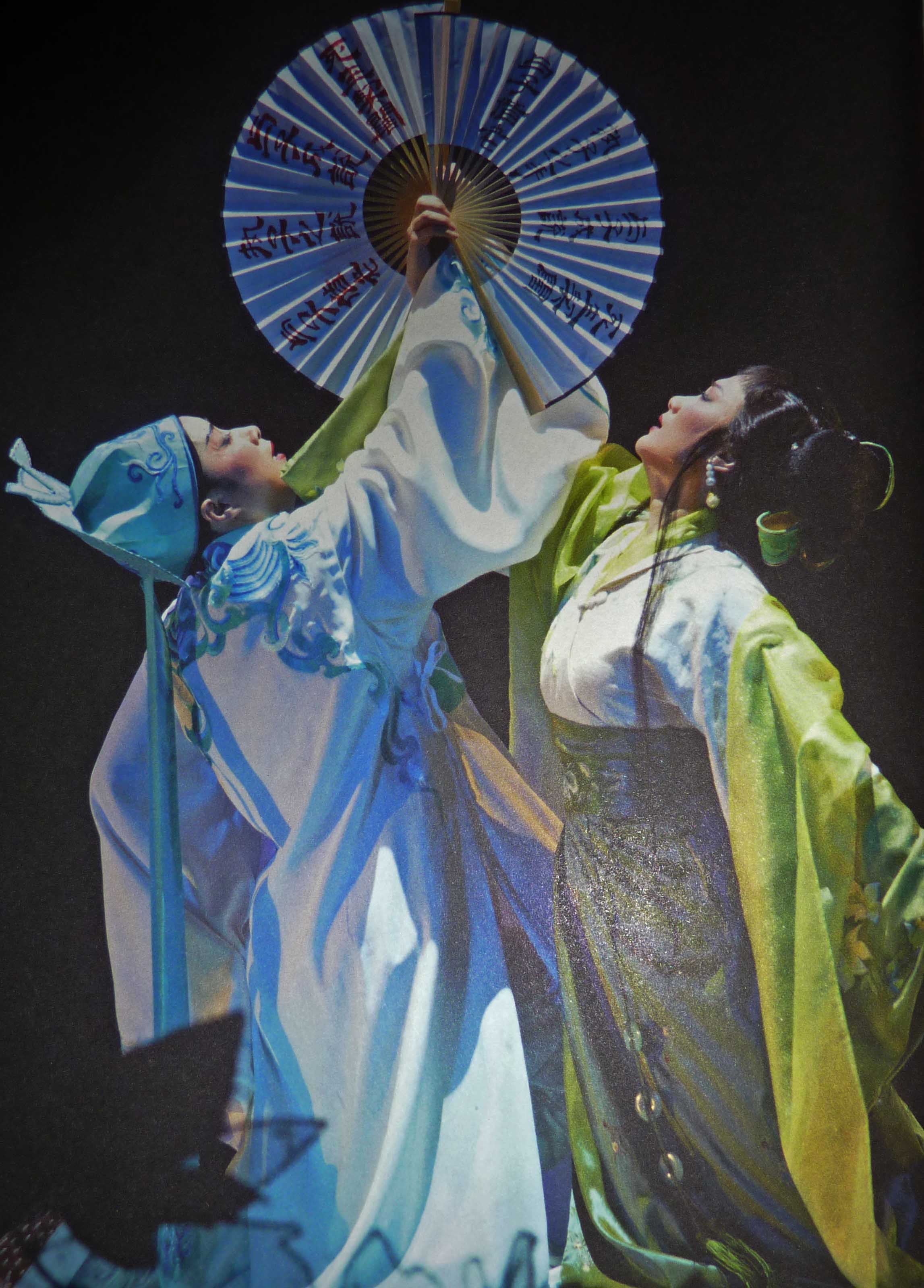
Mao Wei Tao, considered an innovative genius on stage, adapts and works to keep the art form alive. According to her husband, no two performances are exactly alike.

In November 2010, she performed in Taiwan as a cultural ambassador from the mainland. Today, “the company continues to tour and has staged productions in Paris, Hong Kong, Korea, Macau, Taiwan, the United States, Singapore, Spain, Holland, France, Belgium and Japan.”  – bangkokfestivals.com

______________________________

Lloyd Lofthouse is the award-winning author of My Splendid Concubine [3rd edition]. When you love a Chinese woman, you marry her family and culture too. This is the lusty love story Sir Robert Hart did not want the world to discover.

#1 - Joanna Daneman review posted June 19 2014

Where to Buy

Subscribe to “iLook China”!
Sign up for an E-mail Subscription at the top of this page, or click on the “Following” tab in the WordPress toolbar at the top of the screen.

About iLook China

China’s Holistic Historical Timeline


California’s Chinese during the Gold Rush: Part 2 of 2

November 25, 2015

Guest post by John Putnam

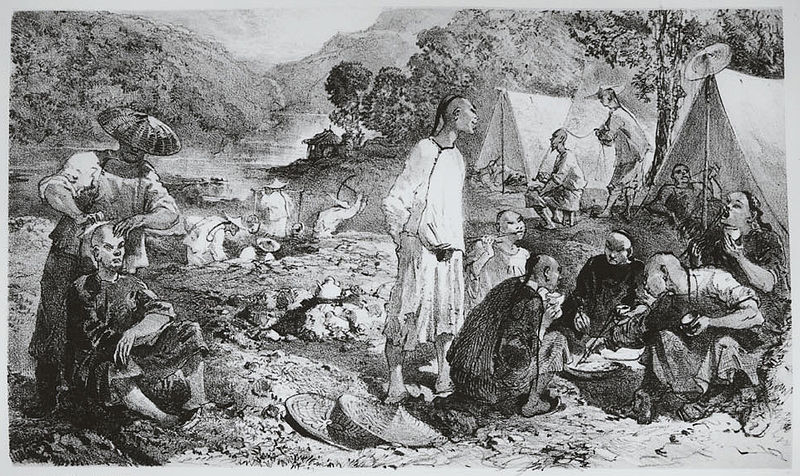
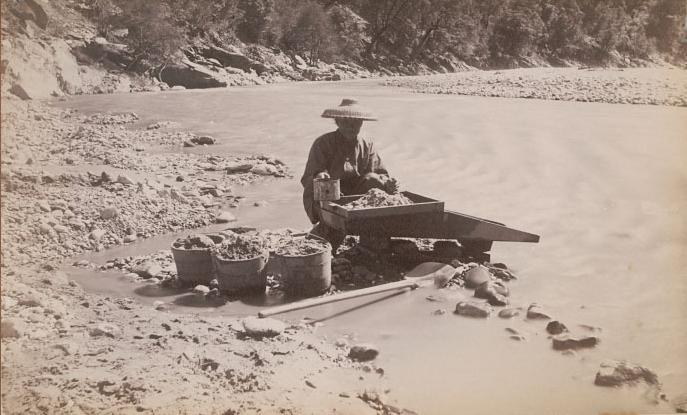
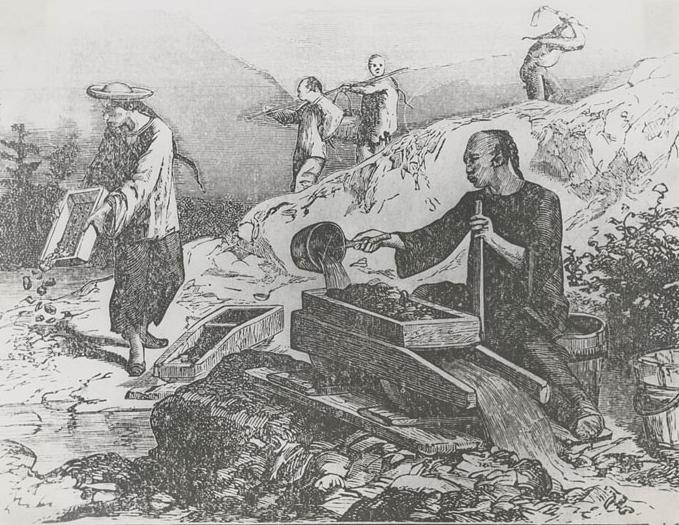
In the mines the Chinese were often forced to work sites that others had abandoned as no longer productive and, by hard work, made these claims pay.

As more men arrived in the gold fields and the amount of surface gold dwindled, tensions increased. Thirty-five Chinese showed up at Camp Salvado in 1849 where men from El Salvador had worked and here they found rich placer deposits.

White miners soon arrived and pushed the Chinese out, but they were taken in at another nearby site called Camp Washington where still more gold was found

Chinese flocked to a place where they were accepted and Tuolumne County’s Chinese Camp survives to this day.

But by 1850, a $20 per month tax on each foreign miner was imposed.

By 1852 Chinese were forced from Mormon Island and Horseshoe Bar along the American River, then from Colombia in the southern mines and Yuba City in the northern.

In 1856 Chinese paid $70,000 for the right to mine in Mokelumne Hill.

By 1868 almost all Chinese had left the mines to work on the transcontinental railroad or in Chinese operated businesses.

Return to or start with  Part 1

____________________

Reprinted by permission.
First published May 23, 2011 in My gold rush tales.
John Rose Putnam is the author of four novels.

The River of Corn

Where to Buy

To subscribe to “iLook China”, look for the “Subscribe” button at the top of the screen in the menu bar, click on it then follow directions.


California’s Chinese during the Gold Rush: Part 1 of 2

November 24, 2015

Guest post by John Putnam

Of all the diverse peoples that poured into California after the discovery of gold, none stood out more than the Chinese. Radically different in dress, language and culture these new men were first welcomed because of their willingness to work hard for low wages at any task presented them.

John McDougall, the 2nd Governor of California, described them as “one of the most worthy of our newly adopted citizens.”

At the start of 1849 only 54 Chinese were in California. By1852 there were nearly 12,000 living here and only seven of them women. Because of turmoil in Canton another 20,000 would arrive that same year.

A community of Chinese Americans quickly grew in San Francisco. They marched in Fourth of July parades and rejoiced at California’s statehood, but celebrated their lunar new year in their traditional way.

In 1852 a Cantonese opera was performed at the American Theater and in 1854 a Chinese language newspaper began publishing.

The Kong Chow Association formed to help the new arrivals adapt to their new home. Then another, the Chew Yick, elected Norman As-sing, an English speaking owner of the Macao and Woosung Restaurant as their leader. Soon there were six associations called tongs that combined to form the Six Companies to better represent Chinese interest.

Continued on November 25, 2015 in Part 2

____________________

Reprinted by permission.
First published May 23, 2011 in My gold rush tales.
John Rose Putnam is the author of four novels.


The River of Corn

Where to Buy

To subscribe to “iLook China”, look for the “Subscribe” button at the top of the screen in the menu bar, click on it then follow directions.


China versus the U.S. when it comes to Women in Positions of Power

September 29, 2015

According to Forbes.com, Canada is the best country in the world to be a woman, and India is the worst.  The U.S. was ranked #6 of the twenty countries surveyed. The members of the G20 are Argentina, Australia, Brazil, Canada, China, France, Germany, India, Indonesia, Italy, Japan, Republic of Korea, Mexico, Russia, Saudi Arabia, South Africa, Turkey, the United Kingdom, the United States and the European Union.

Starting with the I Ching, The Book of Changes, almost five thousand years ago, the central focus of Chinese philosophy has been how to live an ideal life and how best to organize society.

When the Communist Party of China gained power in 1949, previous schools of Chinese philosophy, except Legalism, were denounced as backward and purged during the Great Leap Forward and during the insanity of Mao’s Cultural Revolution.

Most Chinese think that true advancement and growth should only happen slowly, at a steady, measured pace, which means to grow but grow slow like an oak tree while following a well thought out plan to bring about change.

Even the United States doesn’t change that fast.

In fact, it took almost ninety years to free the slaves, and women first sought the right to vote in 1848 at the Seneca Falls Woman’s Rights Convention. Then seventy-two years later in 1920, American women finally earned the right to vote when the Nineteenth Amendment was adopted by Congress and was ratified by the states becoming a national law.

Global map showing womens rights

The last time women had relative freedom in China was in the seventh century during the Tang Dynasty when Emperor Wu Zetian, a woman, ruled the country.

Since 1982, when China ratified its Constitution, women in China have gained more freedom, power and rights than at any other time in China’s history including the Tang Dynasty when Wu Zetian ruled as the only female emperor in China’s history.

Anyone that does not consider this progress is stupid, blind and deaf.

Critics in the West have pointed out that under the Communists, no woman has ruled China, and I’d counter that no woman has ever ruled the United States—yet.

In 2013 Lin Yandong, a senior Party official responsible for winning over non-Communists, was elected Vice Primer of China, one of the country’s senor leaders. She’s now one of China’s four vice premiers making her not only the most powerful woman in China, but also one of the most powerful in the world. She is one of two women in China’s 25-member Politburo. The other woman is Sun Chunlan.

Chinese women’s participation in politics has grown since 1982. For instance, in 1952 only 12% of China’s National Congress (NPCC) was women. In 2014, of the 2,959 seats in the NPCC, more than 23% of the seats (699) were held by women compared to about 19% in the United States Congress. Out of 190 countries, China is ranked #58 versus the U.S. that’s ranked #76. – Women in national parliaments

“Chinese women leaders have much in common. They generally all have a good education background, being mainly science majors, and solid experience in government. They are of a caliber equal to that of their male counterparts,” an All-China Women’s Federation expert said. For the United States, I’m thinking of Sarah Palin—enough said.

If you hear anyone demanding faster change in China, be cautious. After all, China seems to be moving faster than the United States when it comes to women holding positions of power.

Why do so many of China’s critics in the West expect China to move faster than the United States?

______________________________

Lloyd Lofthouse is the award-winning author of My Splendid Concubine [3rd edition]. When you love a Chinese woman, you marry her family and culture too. This is the lusty love story Sir Robert Hart did not want the world to discover.

#1 - Joanna Daneman review posted June 19 2014

Where to Buy

Subscribe to “iLook China”!
Sign up for an E-mail Subscription at the top of this page, or click on the “Following” tab in the WordPress toolbar at the top of the screen.

About iLook China

China’s Holistic Historical Timeline


Diving Deep into China with Isham Cook “At The Teahouse Café”

September 8, 2015

At The Teahouse Cafe, 15 essays by Isham Cook, delves into East Asian Culture and a number of related issues and topics.

Isham Cook has been based in China since 1994, more than twenty years. Writing with the perspective of an American expatriate who has lived in East Asia that long offers readers a view from someone on the ground, and I think that Cook does not disappoint.

The topics of his 15 essay range, for instance, from China’s Great Firewall, the complexity and meaning of Chinese “face”, music, China’s education system to the aversive racism of the term “yellow fever”—something that I’ve also been accused of. Cook goes into detail of why men are attracted to specific women of any race, and I think he is right.

And for his essay on The Chinese University, I Hi-Lited: “The problem with the Chinese university is not the people, it is the system in control, which paralyzes, demotivates and demoralizes.”

The reason why I Hi-Lited that one phrase while reading the book was because it described what is happening in the United States. Since 2001 and President G. W. Bush’s No Child Left Behind Act, and then President Obama’s attempt to seize control of America’s public schools with the so-called Common Core State Standards and the high stakes test meant to rank teachers, fire them and close public schools, that quote describes what is happening in the U.S.

Isham Cook At The Teahouse Cafe

You have been gone too long, Isham. The U.S is under attack by a flock of oligarchs and autocrats that might even shock or impress the Chinese Communist Party because of their tactics to mislead and fool as many people as possible in the U.S. In fact, while China is struggling to lift as many of its people out of poverty as possible, what’s going on in the U.S. is increasing poverty at a frightening pace, especially among children.

Anyway, Isham Cook delves deep into many topics about China, it’s culture and people based on his own experiences living there and interacting with the Chinese. He discusses the bad and the good and doesn’t spare the United States either, and I think that is a good thing because far too many ignorant Americans think the U.S. can do no wrong.

My own interaction with the Chinese pales in comparison. My wife is Chinese, her family is Chinese—mostly born and raised in China during the Mao era—and I’ve been to China nine or 10 times but never lived or worked there, and my last trip was in 2008 when the air pollution in Shanghai contributed to a sinus and respiratory infection that sent me flying home several weeks earlier than planned to recover.

I recommend At The Teahouse Cafe for anyone who wants to get a serious, intellectual dose of the real China from an American who has lived and worked there as long as Isham Cook has. This book should open your eyes as long as your thinking isn’t a closed, dead-end street.

______________________________

Lloyd Lofthouse is the award-winning author of My Splendid Concubine [3rd edition]. When you love a Chinese woman, you marry her family and culture too. This is the lusty love story Sir Robert Hart did not want the world to discover.

#1 - Joanna Daneman review posted June 19 2014

Subscribe to “iLook China”!
Sign up for an E-mail Subscription at the top of this page, or click on the “Following” tab in the WordPress toolbar at the top of the screen.

About iLook China

China’s Holistic Historical Timeline