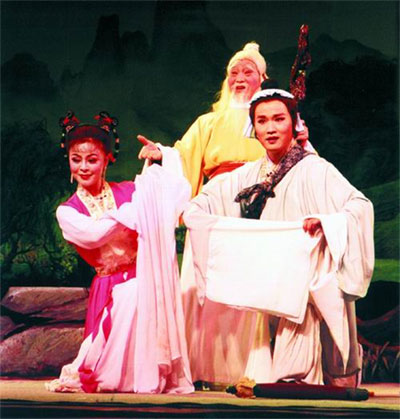
Anqing, in Anhui Province, is regarded as the hometown of Huangmei Opera and Hui Opera. Anqing was first built in 1217 and is almost eight-hundred years old, but Huangmei Opera first appeared about two centuries ago as a simple drama of song and dance.
Huangmei opera does not involve the traditional opera gestures which often-used sleeves and step movements. The music is performed with a pitch that hits high and stays high and does not sound like the typical rhythmic Chinese opera.
The fairy tale of the Cowherd and the Weaving Girl is one of the four most famous folktales of ancient China. It is a classic love story between a fairy and a human being and has a widespread influence. The Qixi Festival is said to have something to do with the fairy tale, and the seventh day of every seventh month of the lunar calendar has become the Chinese Valentine’s Day.
Huangmei Opera Troupe
Chinese opera together with Greek tragic-comedy and Indian Sanskrit Opera are the three oldest dramatic art forms in the world. During the Tang Dynasty (618 – 907 AD), the Emperor Taizong established an opera school with the poetic name Liyuan (Pear Garden). Over more than 800 years, Chinese opera evolved into many different regional varieties based on local traits and accents. Huangmei Opera is one of them.
中
Lloyd Lofthouse is the award-winning author of My Splendid Concubine [3rd edition]. When you love a Chinese woman, you marry her family and culture too. This is the unique love story Sir Robert Hart did not want the world to discover.

Subscribe to “iLook China”!
Sign up for an E-mail Subscription at the top of this page, or click on the “Following” tab in the WordPress toolbar at the top of the screen.
Jews settled in Kaifeng, Henan Province in 960 A.D. after arriving along the Silk Road. These Jews were welcomed by the Song Dynasty and encouraged to retain their cultural identity by building a synagogue that was finished in 1163 A.D.
The Kaifeng Synagogue had a Torah written on sheepskin. The architecture of the buildings reflects Jewish culture. Evidence indicates that the Kaifeng Jews were very traditional and obeyed kosher dietary laws and practiced circumcision for males.
The Jewish community in China thrived for centuries before it was assimilated into Chinese culture through intermarriage. By the middle of the 18th century little survived of the Jewish community.
In 1849, the Yellow River flooded causing what was left of the Jewish community to break apart. Today there are about 500 descendants of the Kaifeng Jewish community, who want to reclaim their Jewish tradition.
“Jews were not newcomers to China. Some had lived under Chinese rule from sometime after 92 CE, during the Han Dynasty (206 BCE- 220 CE), when they resided in what at the time was called the Western Region (roughly Xinjiang Province today) in special enclaves that were set aside by the Chinese for foreigners.” — The Sino-Judaic Institute
中
Lloyd Lofthouse is the award-winning author of My Splendid Concubine [3rd edition]. When you love a Chinese woman, you marry her family and culture too. This is the unique love story Sir Robert Hart did not want the world to discover.
Subscribe to “iLook China”!
Sign up for an E-mail Subscription at the top of this page, or click on the “Following” tab in the WordPress toolbar at the top of the screen.
There is a myth that the earliest version of the Cinderella story appeared in Egypt around the first century. If true, since Egypt didn’t have printing presses back then, this may have been an oral story told around camp fires.
However, in 850 AD during the Tang Dynasty, the first known literary version of Cinderella was published in China, and it was about a girl named Yeh-Shen set in the Qin and Han dynasties centuries before the birth of Jesus Christ.
Although there are claims the Chinese Cinderella, Yeh-Shen, had bound feet, foot binding didn’t appear in China until the Sung Dynasty (960-1276 AD), more than a century after this Chinese Cinderella story was first published. – Bound Feet Women
The French version of Cinderella wouldn’t be published by Charles Perrault until 1697 — more than eight centuries later.
Another version of Cinderella would appear in 1867 and again in 1894 in England.
In 1945, the Bolshoi Theatre in Moscow would present the premiere of Sergei Prokofiev’s ballet of Cinderella.
Walt Disney wouldn’t publish a version of Cinderella until 1946, more than a thousand years after Cinderella first appeared in China based on a story that is alleged to have taken place about 206 BC.
中
Lloyd Lofthouse is the award-winning author of My Splendid Concubine [3rd edition]. When you love a Chinese woman, you marry her family and culture too. This is the unique love story Sir Robert Hart did not want the world to discover.
Subscribe to “iLook China”!
Sign up for an E-mail Subscription at the top of this page, or click on the “Following” tab in the WordPress toolbar at the top of the screen.
In 1977, a discovery was made in China—a complete set of chime bellswas unearthed from the tomb of Marquis Yi, who lived during the Warring States Period (475 to 221 BC). These chimes were older than the Qin Dynasty’s famous Terra Cotta warriors (221 to 206 B.C.) that guard the tomb of Qin Shi Huangdi, the emperor that unified China.
When the chimes were discovered in Hubei Province (located in Central China), a plot of land was being leveled to build a factory. The Red Army officer in charge of the work had an interest in archeology.
The officer discovered that the workers were selling the ancient bronze and iron artifacts they were digging up. He convinced local authorities there might be an ancient tomb buried below the site.
When the tomb was unearthed, a set of chime bells was found. These musical instruments were an important part of ritual and court music dating. An American professor in New York City even called these chimes the eighth wonder of the ancient world.
The sixty-five chime bells weighed about 5 tons.
No other set of chimes like these had been discovered in China before, and this set was in excellent condition.
A project was launched in 1979 to duplicate four sets of these chimes. More than a 100 scientists and technicians were recruited. In 1998, twenty years after the discovery, the project was completed. One of the sets was sent to Taiwan as a gift.
中
Lloyd Lofthouse is the award-winning author of My Splendid Concubine [3rd edition]. When you love a Chinese woman, you marry her family and culture too. This is the unique love story Sir Robert Hart did not want the world to discover.
Subscribe to “iLook China”!
Sign up for an E-mail Subscription at the top of this page, or click on the “Following” tab in the WordPress toolbar at the top of the screen.
In the first 122 pages of Country Driving, Peter Hessler sets out to drive the entire length of the Great Wall in a rented Chinese made Jeep Cherokee, and he achieves his goal. In this section, I learned that the Wall was successful most of the time and not the failure historians claim it was. Yes, in several thousand years, the wall failed a few times but it served its purpose and did protect China’s heartland for centuries. Hessler says that there is no archaeologist in the world that has studied the history of the Great Wall but he wrote that there are amateur experts, and we meet a few in this section along with a unique view of rural China.
In Part II, Hessler takes us into a small village a few hours drive outside Beijing where he rents a house and becomes accepted by the insular-rural village community. Along the way, he makes friends and becomes involved personally with local families. The man that becomes his closest contact and friend in the village eventually joins the Chinese Communist Party (there are about 80 million CCP members in China) and uses this to his advantage as he continues to improve the quality of his family’s lifestyle.
In Part III, Hessler travels to the city of Winzhou in Southern China where he spends time developing relationships with factory bosses and workers. In this section, the Chinese people he meets are open and friendly. Hessler sees a side of China that few witness, and it is obvious that the factory workers are not victims because of low pay and long work hours. Instead, they see this new life as an opportunity.
Peter Hessler discussing his novel “Oracle Bones”
When I finished Hessler’s memoir, I walked away feeling as if I had experienced an in-depth taste of the dramatic changes that have taken place in China since Mao’s death in 1976. Since China’s critics mostly focus on the negative, which is the corruption and/or authoritarian one-party system, and never admit the good that the CCP has accomplished, most people would not understand what I discovered. To understand what I mean, one must compare China before 1949, by reading such books like those written by Hessler and his wife.
Before 1949, more than 90% of the people in China lived in severe poverty, more than 80% were illiterate, the average lifespan was 35, few people owned land, and the risk of death from famine had been an annual threat for more than two thousand years. In fact, most rural Chinese were treated as if they were beasts of burden and not humans.
Today, according to the CIA Factbook, about 6.1% of Chinese live in severe poverty (living on $400 or less annually), and they mostly live in remote, rugged, and difficult to reach areas of China. The average lifespan is now 75.4 years and Helen H. Wang writing for Forbes.com (February 2011) reported that China’s middle class is already larger than the entire population of the United States and is expected to reach 800 million in by 2026. In addition, no one has died of famine since 1959-1961.
I highly recommend Country Living for anyone that wants to learn more about today’s dramatically changing China from an unbiased and honest perspective.
Lloyd Lofthouse is the award-winning author of My Splendid Concubine [3rd edition]. When you love a Chinese woman, you marry her family and culture too. This is the unique love story Sir Robert Hart did not want the world to discover.
Subscribe to “iLook China”!
Sign up for an E-mail Subscription at the top of this page, or click on the “Following” tab in the WordPress toolbar at the top of the screen.