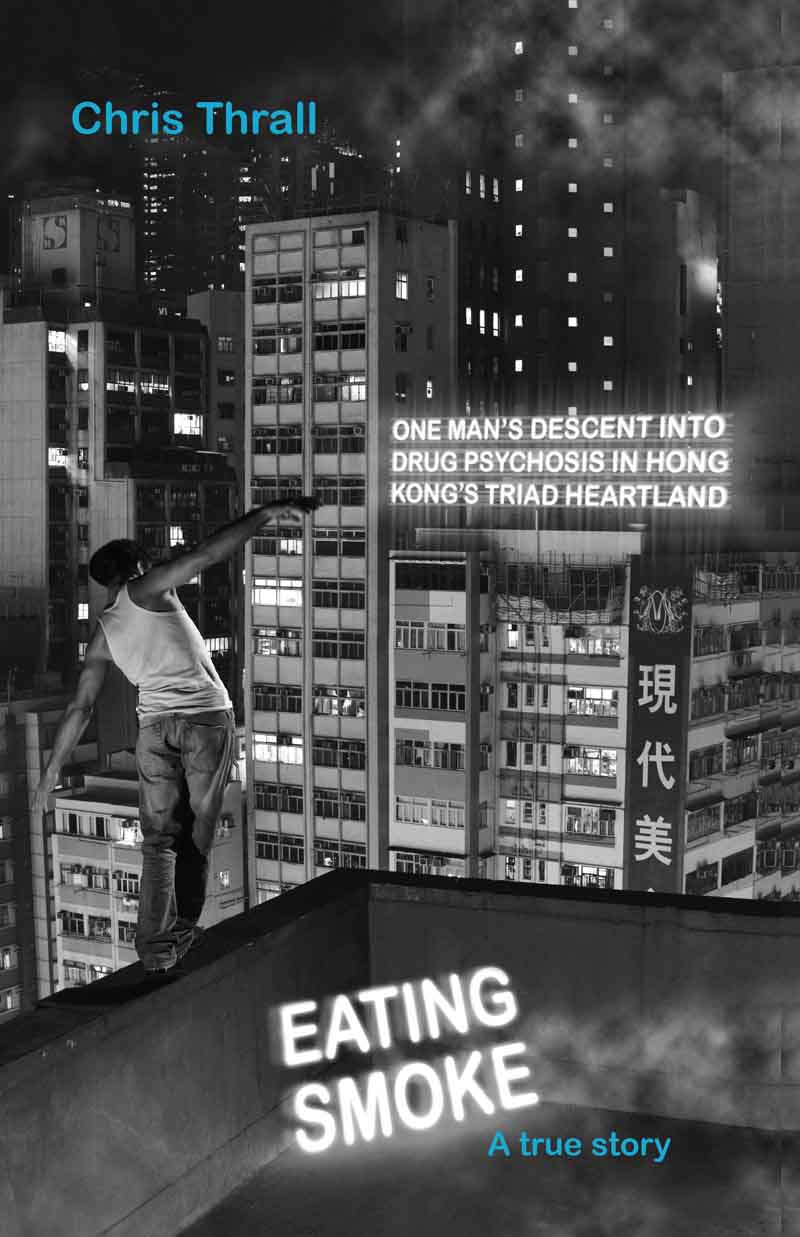
Eating Smoke — a question and answer with the author, Chris Thrall – Part 2/5

October 17, 2011

Guest-Post by Tom Carter
Interview with Chris Thrall, author of Eating Smoke continued…

On October 16, 2011, nearly two years since Chris Thrall originally contacted me, his long-awaited book, “Eating Smoke”, will be released in America and Amazon.com.

Advanced sales have already brought the title to the top of the Hong Kong bestseller list (patting my own back for my prediction) while Eating Smoke has achieved a massive cult following on Facebook.  Hailed as a “Sin – Shantaram” in a review by the South China Morning Post, and being compared by fans to Alex Garland’s The Beach for its drug-adelic theme, we can now confidently predict that Eating Smoke will, too, be optioned for film rights and follow those popular books to Hollywood.

Despite his past connections with Chinese triads, and in spite of his newfound celebrity as a bestselling author, Thrall remains one of the nicest and humblest people I have ever had the pleasure of knowing…even though I have yet to actually meet the man in person.  So it wasn’t too hard to twist his arm into putting my Q&A at the top of his to-do list of media interview requests (ah, the fame!).

TOM CARTER: My first and most pressing question, Chris, is if you are at all worried that the 14K will be hitting you up for a percentage of your book royalties once word of Eating Smoke’s success trickles up the Wan Chai gangland hierarchy?

CHRIS THRALL: Ha ha! The news from Hong Kong is that “serious players” are reading my book as we speak. But I’m not worried as it’s not a tell-all on Hong Kong organized crime. It’s more the story of a former Royal Marine Commando who thought he knew a bit about life, who then moves to Asia to run what was a successful business but spirals down into psychosis from drug addiction.

In that respect, Eating Smoke is unique. I’m not aware of any other book that gives the reader the opportunity to experience what it’s actually like to descend into mental illness through the eyes of someone as they do. I just happened to work for the 14K as a nightclub doorman – moreover, their “East-West go-between” – when it happened.

CARTER: Eating Smoke is about your decent into drug psychosis in Hong Kong’s triad heartland, but it’s also about the series of unfortunate, albeit hilarious, events that prevented you from ever finding your financial footing in Hong Kong, ironically Asia’s wealthiest city; a “testament to the stark reality and ephemeral nature of the relationship between people, drugs and profit,” as you wrote in the book.

Do you have anything to say to all those coked-out rich white bankers that Hong Kong is notorious for?

THRALL: No! I have nothing to say to anyone – coked-out rich white bankers included. If people truly enjoy what they do, they should carry on doing it.

Personally, I didn’t want to see my youth slipping away in a suit as I chased dollar signs at the expense of more fulfilling experiences. So having overcome addiction, I made an inventory of what I wanted to get out of life. Then I set out across six continents through seventy-five countries to get it. Writing a book was the last thing on my bucket list.

CARTER: China is adamantly anti-drugs, and the court system does not hesitate to execute drug traffickers, even foreigners.

In fact, China even blames foreigners for being responsible for a majority of its drug trade, a grudge no doubt held over from the Opium Wars.  Even though there are arguments to be made against the death penalty, the fact remains that, due to their zero-tolerance policy, China has one of the world’s lowest crime rates, a statistic that, all things considered, I’m sure America and the UK envy.

As a former drug user, what’s your take on criminalization of drugs, and do you think the west should follow China’s example?

THRALL: I don’t have a take on it. I’m not a spokesperson on substance use or the law surrounding it. I just told my own story.

However, research would likely show that mankind has always taken drugs in various forms and continues to do so (alcohol and cigarettes often cited as the most damaging), which might suggest that education on their usage and dangers is the way forward, in addition to harm-prevention strategies.

As for crime, a sociologist once said that a zero crime rate would make society a frightening place to be. I think Orwell’s 1984 was meant to imply this. I take no stance on drugs per se or cast judgment on people who choose to buy, sell, or use them.

It was addiction that I battled and that’s a separate issue. It’s a psychological condition that could relate to gambling, sex or food. It makes you wonder how prohibition could ever fix this.

Continued on October 18, 2011  in Eating Smoke – Part 3, return to Part 1, or if you have the time and do not want to wait for the five-part series to finish posting, click View as Single Page.

Chris Thrall was born in the UK. At eighteen, he joined the Royal Marine Commandos. Following active service in the Northern Ireland Conflict and training in Arctic warfare and survival, he earned his parachutist’s ‘wings’ and went on to serve as part of a high-security detachment onboard an aircraft carrier. In 1995, Chris moved to Hong Kong to oversee the Asia-Pacific expansion of a successful network-marketing operation he’d built, part-time, while serving in the Forces. Less than a year later, he was homeless, hooked on crystal methamphetamine and working for the 14K, Hong Kong’s largest triad crime family, as a doorman in Wanchai’s infamous red-light district. Eating Smoke, a humorous yet deeply moving first book, is his account of what happened.

__________________________

Travel photographer Tom Carter is the author of CHINA: Portrait of a People, a 600-page book of photography from the 33 provinces of China, which may be found on Amazon.com.

To subscribe to “iLook China”, sign up for an E-mail Subscription at the top right-hand side of this page and then follow directions.


Eating Smoke — a question and answer with the author, Chris Thrall – Part 1/5

October 16, 2011

Guest-Post by Tom Carter
Interview with Chris Thrall, author of Eating Smoke

Tom Carter, author of “CHINA: Portrait of a People”, catches up with Chris Thrall to discuss his new book “Eating Smoke, a memoir about Thrall’s descent into drug psychosis in Hong Kong’s triad heartland.

In the fall of 2009, whilst traveling in India to create my next photography book, I was contacted via email by a British writer who had read Down and out in Hong Kong, one of my online travel articles, which described this poor, dusty backpacker’s real-time impressions of Asia’s wealthiest city.

Chris Thrall said he connected with my article’s conclusion that, in spite of my western heritage, and due to my personal circumstances, I ultimately had more in common with the destitute third-world inhabitants of the Chungking Mansions, the infamous immigrant ghetto of Kowloon, than I did with the rich white bankers et al who comprise the other half of Hong Kong’s multinational population.

Chris went on to explain that he was writing a book about his own experiences living in Hong Kong, which was dramatically different from mine or any other expatriate I ever knew, and that he once worked for the 14K, the world’s largest Chinese crime family.

Attached to his email was the first chapter of his memoir, a gripping opening salvo that finds the narrator hiding from pursuing henchmen on a roof top—alongside two corpses, a disemboweled mother and child.

As a voracious reader, I know a bestseller when I see it.  I immediately forwarded Chris’s manuscript to my publisher in Hong Kong, Pete Spurrier, who runs the iconic Blacksmith Books, which specializes in Asian-themed literature.

Pete likewise was knocked off his feet by Chris’s incredible story; the next I heard, Chris was a fellow Blacksmith label mate with a book deal.

Chris Thrall was born in the UK. At eighteen, he joined the Royal Marine Commandos. Following active service in the Northern Ireland Conflict and training in Arctic warfare and survival, he earned his parachutist’s ‘wings’ and went on to serve as part of a high-security detachment onboard an aircraft carrier. In 1995, Chris moved to Hong Kong to oversee the Asia-Pacific expansion of a successful network-marketing operation he’d built, part-time, while serving in the Forces. Less than a year later, he was homeless, hooked on crystal methamphetamine and working for the 14K, Hong Kong’s largest triad crime family, as a doorman in Wanchai’s infamous red-light district.

Eating Smoke, a humorous yet deeply moving first book, is his account of what happened.

Continued on October 17, 2011 in Eating Smoke – Part 2, or if you have time and do not want to wait for the five-part series to finish posting daily, click View as Single Page.

__________________________

Travel photographer Tom Carter is the author of CHINA: Portrait of a People, a 600-page book of photography from the 33 provinces of China, which may be found on Amazon.com.

To subscribe to “iLook China”, sign up for an E-mail Subscription at the top right-hand side of this page and then follow directions.


History Counts – Part 2/2

October 14, 2011

Under Deng Xiaoping, the People’s Republic of China announced a policy of “socialism with Chinese characteristics.”

John Gittings in The Changing Face of China quoted Deng Xiaoping as saying, “Planning and market forces are not the essential difference between socialism and capitalism. A planned economy is not the definition of socialism, because there is planning under capitalism; the market economy happens under socialism, too. Planning and market forces are both ways of controlling economic activity.”

Soon after Mao died in 1976, Deng Xiaoping’s Beijing Spring was introduced. This was a brief period lasting from 1977 into 1978, and during that time, the public was allowed greater freedom to criticize the government, which wasn’t allowed under Mao.

An example of this may be seen in “The Awakening” (Su-Xing), a movie produced during this period starring Joan Chen (Chen-Chung) and Gau Fei. [ISBN: 978-7-88611-603-2]. There are no English subtitles so it helps to have someone that reads or speaks Mandarin watch the movie with you that can point out the subtle criticisms of the Party that appear in the film, which was considered controversial at that time.

There was also a new Beijing Spring between 1997 to November 1998 where the Chinese government relaxed some control over political expression and organization.

It was during this time that China signed the International Covenant on Civil and Political Rights.

The United States is not a member of the International Criminal Court (ICC). The ICC is a permanent international criminal court, founded in 2002 by the Rome Statute to “bring to justice the perpetrators of the worst crimes known to humankind – war crimes, crimes against humanity, and genocide”, especially when national courts are unable or unwilling to do so.

However, on May 2, 2002 the United States stated that it did not intend to be bound by its signature to the ICC and that is has no intention to ratify it. President Clinton signed the ICC, but President G. W. Bush and the Republican-led Senate refused to ratify it.

The United Nations Convention on the Law of the Sea (UNCLOS) also called the Law of the Sea Convention or the Law of the Sea Treaty is the international agreement that resulted from the third United Nations Conference on the Law of the Sea (UNCLOS III), which took place from 1973 through 1982. The Law of the Sea Convention defines the rights and responsibilities of nations in their use of the world’s oceans, establishing guidelines for businesses, the environment, and the management of marine natural resources.

The United States is one of seventeen countries that have signed but not ratified the UNCLOS. North Korea is also one of the seventeen countries that have not ratified this UN Convention on the Law of the Sea. However, China has signed and ratified it.

On December 18, 1979, the United Nations adopted The Convention on the Elimination of All Forms of Discrimination Against Women (CEDAW), which was the most comprehensive and detailed international agreement seeking the advancement of women.… The United States is the only industrialized country that has not ratified the treaty, putting the US in the company of countries such as Sudan, Iran and Somalia.


Slavery is not a thing of the past, as WFOR’s Jennifer Santiago discovered on a visit to West Africa. Over a million children are trafficked in the country of Benin alone. (CBS News)

The Convention on the Rights of the Child (CRC) was adopted by the UN in 1989, and is one of the most widely received conventions. The CRC has been accepted by 192 countries. The U.S. may soon be the only country in the world not to ratify the CRC.

Five years after the 1992 founding of the International Campaign to Ban Landmines, over 143 countries met in Ottawa, Canada and signed a ban on anti-personnel mines. The United States has still not signed the treaty.

The 1997 Kyoto Protocol legally bound industrialized countries by 2010 to reduce their collective emissions of six greenhouse gases by 5.2% compared to 1990 levels. One hundred forty-one (141) countries have signed the treaty, but the United States (the largest producer of greenhouse gases) has not.

There are more human rights treaties the US has not signed, and you may find this list at Feminist Majority.org.

In fact, No key human rights treaty has been ratified by the United States under the guidelines by which it was adopted and enforced by the UN General Assembly.

However, when there are alleged and unproven human rights violations in countries such as China, the US media is the first to accuse and complain causing an uproar of anger in America.

Do you believe history counts or do we ignore the past starting with yesterday? If you answer yes, shouldn’t other countries and/or cultures get the same privilege?

Return to History Counts – Part 1

______________

Lloyd Lofthouse is the award-winning author of The Concubine Saga. When you love a Chinese woman, you marry her family and culture too. This is the love story Sir Robert Hart did not want the world to discover.

To subscribe to “iLook China”, sign up for an E-mail Subscription at the top right-hand side of this page and then follow directions.


Note: This revised and edited post first appeared in February 2010 as An American Genocide, An American Shadow Over the Philippines, In a Dark Mirror Without Reflection, and After Mao.


History Counts – Part 1/2

October 13, 2011

Atrocities abound in the history books concerning treatment of Native American Indians during the sixteenth to nineteenth centuries. The Spanish destroyed the Aztec and Inca civilizations with disease and warfare, and the Catholic mission system in California enslaved Native American Indians.

After the Civil War, the United States military was sent west to drive North American native Indians from the land they had lived on for thousands of years and slaughtered men, women and children—millions died.

Today, many of the surviving American natives live in horrible poverty on reservations.

Then the American government grabbed Hawaii from the native Hawaiian people against their will. (There is a native Hawaiian nonviolent separatist movement asking for freedom from America.)

After the Spanish American War, America took possession of the Philippine islands and waged war against the native people killing
more than two hundred thousand. This went on until America entered World War II.

In fact, the treatment of American Indians has not changed much. The United States government might not wage brutal war against Native American Indians today as they did in the past, but in recent times billions of dollars slated to support Native American Indian tribes on reservations went missing, and no one seems to care where all that money went—except the native Indians.

It would appear that the era of lies and broken treaties has not ended.

If you want to learn more about native American Indians, I suggest you read what the New York Times said about the work written by Vine Deloria Jr., and check out Native American Literature worth reading.


Nearly a quarter of the Cherokee Nation froze or starved to death on the trail to Oklahoma Indian Territory. This video explores America’s darkest period: President Andrew Jackson’s Indian Removal Act of 1830 and the forced removal of the Cherokee Nation to Oklahoma in 1838.

It is best to stay away from Hollywood movies if you want to discover the truth.

When I brought this topic up in a 2010 E-mail conversation with a conservative, evangelical Christian friend, he said what happened in the past does not count today.

I disagree. History always counts. Jesus Christ said, “Let he who has no sin, cast the first stone,” and, “Go and sin no more”, and investigations in Iraq revealed that under President George W. Bush, the CIA was torturing prisoners.


Errol Morris examines the incidents of abuse and torture of suspected terrorists at the hands of U.S. forces at the Abu Ghraib prison.

Most in the West and America have heard about Tibet and the demands by Tibetans in exile that Tibet be free from China to rule itself. We hear claims of human rights violations taking place without much evidence to support the claims, and people that fear and hate Communism (the word not the reality) will believe anything.

The American media recently revealed that tens of thousands of illegal aliens in America (some seeking political asylum) were locked up in detention centers and were not getting proper medical care and were dying because of it.

Unlike Mao’s time, today’s Chinese leaders must answer to the seventy-million Party members scattered throughout China. These people listen to the 1.3 billion Chinese that do not belong to the party. The result: if an elected official is not doing his or her job, that person usually isn’t reelected.

Continued on October 14, 2011 in History Counts – Part 2

______________

Lloyd Lofthouse is the award-winning author of The Concubine Saga. When you love a Chinese woman, you marry her family and culture too. This is the love story Sir Robert Hart did not want the world to discover.

To subscribe to “iLook China”, sign up for an E-mail Subscription at the top right-hand side of this page and then follow directions.


Note: This revised and edited post first appeared in February 2010 as An American Genocide, An American Shadow Over the Philippines, In a Dark Mirror Without Reflection, and After Mao.


America’s Misguided Missionary Obligation

October 12, 2011

Tom Carter, the author of China: Portrait of a People, sent me a link to a New York Times (NYT) piece, In India, Online Retailers Take a New Tack.

Carter did not suggest a subject for this post, but he did ask that I include the promotional video for his next book with whatever I wrote, and it “rather” fits the topic I decided to write about, which is that most of America may learn something from those Americans that “really” want to do business in China and India.

Besides, Carter’s photos of India are as stunning as those he took of China are.

Vikas Bajaj wrote the NYT’s piece, and we learn that Amazon is moving into India and whatever Amazon’s plans are for entering India’s consumer market, Amazon is not talking.

However, “while dozens of electronic commerce firms have recently sprung up to capitalize on India’s growing Internet use” Bajaj wrote, “they have a problem. Indians are not yet comfortable with shopping on the Web. Many of them remain unwilling to use credit cards online. So the Indian retailers have gone to great lengths to gain customers. Customers may pay in cash on delivery, and the company fields delivery squads to ensure shipments get to customers quickly.”

What we learn from this quote is that cultural differences influence how people shop but culture goes deeper than shopping habits, which is a fact that many Americans do not understand.

In addition, a Blog at Stanford.edu says, “Approximately half of Amazon.com’s revenue comes from outside the United States, according to the company’s Senior Vice President of International Retail, Diego Piacentini. This makes global strategy a key component to the company’s continued success,” and “Amazon aims to be the ‘most customer-centric company on the planet’.”

Then Matt Harvey, who wrote the post for the Stanford Blog, asked, “But what do you build, and how do you act, to make this mean something?”

The answer may come from Amazon’s Diego Piacentini when he said, “When Amazon began doing business in China in 2004, some of the company’s core values came into conflict with traditional business practice.” Meanwhile, Goldman Sachs was quoted in 2010 saying Amazon has competition in China with Taobao.com.

Taobao.com, the Chinese equivalent of eBay, generates estimated annual sales of close to $60 billion—about 75% of all online retail sales in China while, according to Goldman Sachs, Amazon had only $750 million in annual sales in China in 2009 with estimates that Amazon sales in China would increase to $1 billion in 2010. Amazon has a long way to go to catch up with Taobao.

The moral of this story is that Western retailers such as Amazon must learn to do business in other cultures such as China and/or India without attempting to change the people.

They must “start with the customer and work backwards”, which isn’t what most of America’s politicians and religious leaders are doing and the best quote that explains why comes from a Henry Kissinger quote  that I have used before. “American exceptionalism is missionary. It holds that the United States has an obligation to spread its values to every part of the world.”

From what I understand, two of the world’s greatest conquerors, Alexander the Great and Genghis Khan, knew the key to hold an empire together was not to change other cultures but to allow those cultures to remain unchanged, so why can’t the rest of the West learn from them?

Discover The Importance of Guanxi to Chinese Civilization

______________

Lloyd Lofthouse is the award-winning author of The Concubine Saga. When you love a Chinese woman, you marry her family and culture too. This is the love story Sir Robert Hart did not want the world to discover.

To subscribe to “iLook China”, look for the “Subscribe” button at the top of the screen in the menu bar, click on it then follow directions.