China’s love affair with superstition, pseudoscience and the fantastical may be traced back over five millennia, whence some of history’s oldest myths and legends originated.
Journey to the West(Xi You Ji), published anonymously by scholar Wu Cheng’en in the 16th century Ming Dynasty, remains China’s most beloved fantasy story. Considered one of the “Four Great Classical Novels” of Chinese literature, the 100 chapters of ‘Journey’ are replete with monkey kings, flesh-eating demons, immortal sages and celestial battles.
When science fiction became all the craze in 1950’s America, Red China followed suit by founding its first sci-fi periodical.
However, unlike the west, where rapid advances in the tech sector fueled science fiction, China promoted sci-fi to help inspire its own dormant technological progress.
Conversely, about the same time during the 70s when American director George Lucas was preparing to film a little space opera called Star Wars, the Cultural Revolution was banishing all China’s scientists to hard-labor communes.
Indeed, where the Chinese have categorically failed in speculative fiction (programming on the Communist-controlled CCTV is evidence enough that future perspective is held in little regard here: of China’s 19 official television channels, all feature serials set in olden times, some in the present, none about the future), they remain masters of mythology and purveyors of the past.
Present-day PRC is seeing a renaissance of the fantasy genre. The wuxia-inspired Chinese film Crouching Tiger, Hidden Dragon was a critical and commercial success, generations of young, Chinese cyber-punks are hopelessly addicted to the virtual sorcery of World of Warcraft, and Harry Potter remains China’s “most pirated novel ever”.
Even so, no Chinese author has ever been able to replicate the success of Journey to the West; as a result, publishing houses in the Middle Kingdom prefer to translate western best-sellers such as Lord of the Rings and Narnia rather than take their chances on local fantasy fiction writers.
EnterZee Gorman(nee Yan Zi-hong) China’s response to J.K. Rowling.
Born in Guangdong province during the Cultural Revolution (both her parents were exiled to the countryside for being “intellectuals”), Zee was raised on a literary diet of propaganda and scar literature.
Rather than publish a clichéd daughter-of-the-Revolution memoir about her hardships, the aspiring author opted for the escapism of fantasy. Hence, her decades-in-the-making debut novel,The Altethlon Chronicles.
A high-fantasy fiction set in a parallel universe either far in China’s future or in its past,The Altethlon Chroniclesis a complex blend of military, history, romance and sorcery.
Leading the rich cast of green-eyed, purple-skinned characters is the royal yet rebellious teen Ximia (“what kind of princess are you anyway, running around like a wildcat?”) and her forbidden lover, Nikolas, the leader of a rival tribe – a tumultuous relationship most likely inspired by Zee’s own experience with cultural clash when she immigrated to the U.S. and married an American.
Ximia is misled into believing that Nikolas has been killed during an escape attempt, whereby the princess is married off by her father to a dastardly lord. The two young warriors go on to lead their respective armies until the day when destiny arranges for them to meet again in battle.
Lots of magic, weird names and epic battles of Tolkien proportions (note: this reviewer has never actually read a J. R. R. Tolkien book; I just thought it sounded cool to say that) ensue.
In creating this alternate world, Zee draws heavily on her Chinese heritage.
Kingdoms such as Manchuli, Dalong and Taklaman are each reminiscent of real regions in China.
Nonetheless, Zee, who is bi-lingual and holds dual degrees in English Literature, chose to writeThe Altethlon Chroniclesin her second language and self-publish in America rather than risk having it pirated in China’s nascent fantasy market.
German businessman Bernd Hagemann arrived in China in 2002 amidst media reports of China’s impending rise to global domination. “News outlets around the world,” he writes, “were warning us about… how fast China is developing, how competitive it is, and what a tense life the Chinese people must live.”
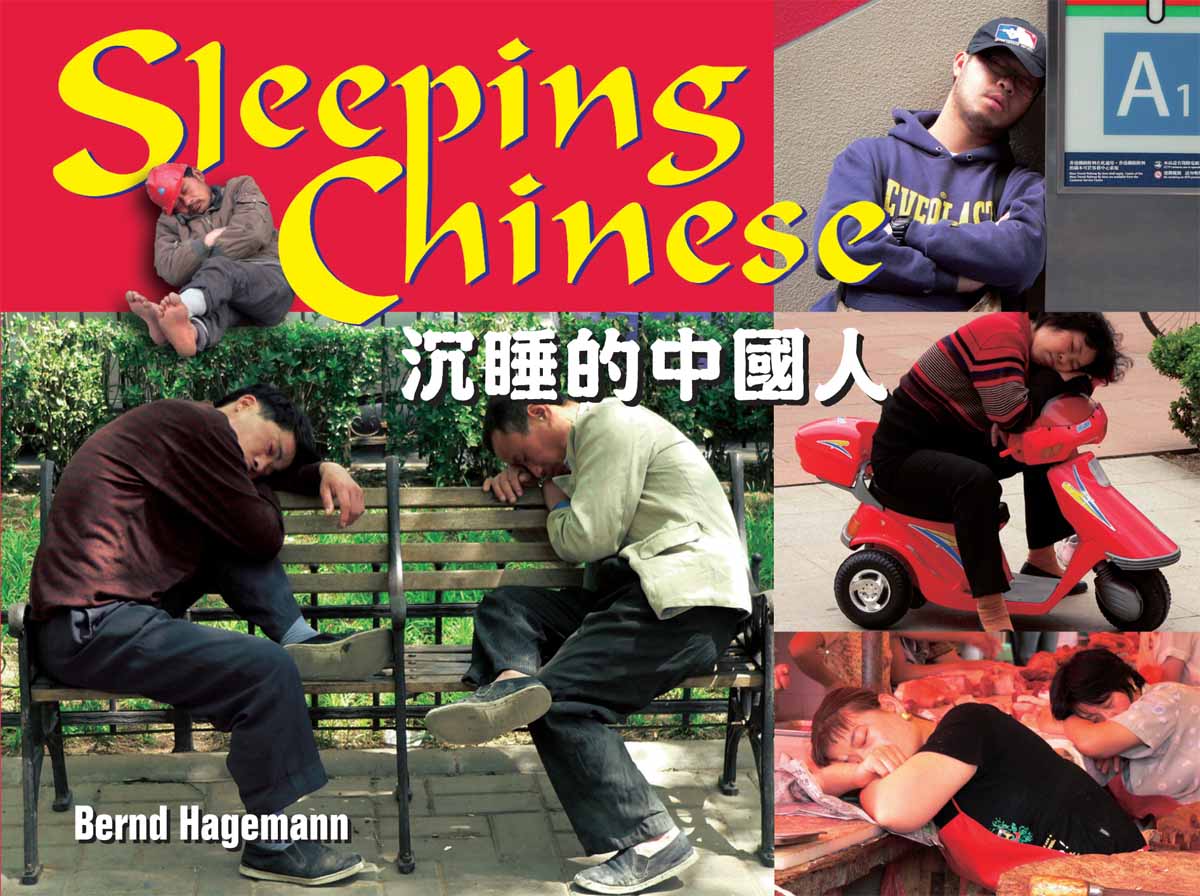
Casual strolls down the streets of China in between boardroom meetings and networking, however, soon revealed to Hagemann a far less threatening side of China. So he took out his point-and-shoot camera and documented what he saw all around him. In just 148 pages, Hagemann’s debut photography bookSleeping Chineseswiftly dispels 9 years of chest-pounding by the PRC propaganda machine.
Sleeping Chineseis a fun little novelty item the exact same dimensions as a postcard that will leave you either laughing out loud or scratching your head in perplexity. The pages are divided into 3 parts: Hard Sleepers, Soft Sleepers and Group Sleepers, a clever allusion to China’s train carriage classification system.
Hard Sleepers: “Those who snooze in hard and uncomfortable places can fall asleep anywhere – even on a pile of bricks in a construction site!” Hagemann defines.
Witness, then, the dozens of people who have drifted into deep slumber atop stones, wood, mortar blocks, concrete and even cold slabs of raw meat. The most comical of the chapter being the dozing shoe repair man balancing precariously on a saw horse with an extra 2×4 for a pillow.
Soft Sleepers: “A little more fussy than their hard sleeper comrades,” the chapter intro explains, “fussy” meaning in plastic wash bins, hammocks slung under freight trucks, sleeping lengthwise across a motor scooter and even a laborer using a tape measure to cover his eyes.
Group Sleepers: “A traveling family needs no pillows when they have each other’s knees.” Truly, the photo of the family of five all huddled together like newborn puppies gives greater meaning to ‘jiating,’ China’s family unit.
Some Chinese might take offense to Hagemann’s photographic agenda, but anyone with a sense of humor will see that the book was made out of affection.
“I’d like to express my appreciation of the hard work and effort put in by migrant workers who play a central role in China’s success story but seldom receive the attention they deserve,” writes Hagemann.
Indeed, anyone who has spent quality time in China knows that these laborers, more than anyone else, deserve their rest — anywhere they can get it.
None of the snapshots inSleeping Chinesewere staged. Any foreign tourist in China who bothers to stray from his package tour group or get out of his hotel for a jaunt off the tourist trail will see these exact same sights, and more.
Incidentally, taking and publishing photos of sleeping Chinese people will often land a foreign tourist in hot water if caught by the authorities (the subjects themselves tend not to mind).
People’s Dailynewspaper, the official mouthpiece of the Politburo, even attempted to put a socialist spin on Hagemann’s revealing imagery in an article aboutSleeping Chinese: “If (we) are tired, (we) lie down anywhere and anytime and sleep. This shows (our) society’s accepting attitude.”
Regarding the western media’s scare tactics of China’s “waking dragon,” this reviewer is reminded bySleeping Chineseof a particular song from old-school hip-hop artists Public Enemy (who I had occasion to watch perform during their 2007 tour through Beijing): Don’t Believe the Hype!
I was once an avid reader, but then I became a writer and eventually an author. I preface this exploration of Simon Winchester’s “The Man Who Loved China” with that opening sentence, because I want to make it clear that when I decided to become a writer back in 1968, I went from reading one or two paperbacks daily to reading maybe one or two a month. It takes time to learn the craft of writing and more time to write, edit and revise.
For that reason, I’ve been aware of “The Man Who Loved China” for several years, and put off buying and reading it due to how much time I actually have to read. Then, one recent Sunday, after eating at Herbivorein Berkeley, California, I walked to Half Price Books and also stopped at Pegasus Books where I found a used, unabridged copy of the audio book and bought it—9 hours on 8 compact discs.
I was on the last disc when I decided to buy the paperback and add it to my China collection.
To borrow the blurb on the cover of the paperback, I found this biography to be “The fantastic story of the eccentric scientist who unlocked the mysteries of the Middle Kingdom.” I was blown away with the story of Joseph Needham’s life—he was an incredible, free thinking genius who refused to conform.
I totally agree with this pull quote for the YouTube video above: “In sumptuous and illuminating detail, Simon Winchester, the bestselling author of The Professor and the Madman (“Elegant and scrupulous” —New York Times Book Review) and Krakatoa (“A mesmerizing page-turner”—Time) brings to life the extraordinary story of Joseph Needham, the brilliant Cambridge scientist who unlocked the most closely held secrets of China, long the world’s most technologically advanced country in THE MAN WHO LOVED CHINA.”
Because of what I learned about Joseph Needham and his Science and Civilisation in China (1954–2008), a series of books initiated and edited by this British biochemist and self-trained Sinologist (1900–1995), I want to share a hateful, ignorant, mean, trollish, biased, racist comment that arrived recently for one of the posts on this Blog. The reason I’m doing this is because this one comment represents the thinking of far too many ignorant fools outside of China and specifically in the United States.
“Tiger parenting is great if you want your child to be as dull-witted as the 1.4 billion people in the PRC. It is also great if your desire is to rear morally void sociopaths who walk by people dying on the streets rather than helping them. Those same people traded their children and ate them during the ‘great leap forward’. Any race which can feast on the flesh of their children should not be emulated. China has been around for 5000 years and to show for this they have ‘death by 1000 cuts’, infanticide and insolence.
“If tiger parenting is so great then what are the results? China is an innovation laggard, (sure they write patents but for the most part they are junk. See how many they write but fail to monetize those patents).
“Aside from this, where is China’s Einstein, Van Gogh, Davinci, Plato , Homer, etc. Five thousand years of history, twenty percent of the world’s population and two great thinkers. What a pathetic shit-stain. Have a great time there you sell out piece of shit.”
****
Science and Civilisation in China deals with the history of science and technology in China, and the series was on the Modern Library Board’s 100 Best Nonfiction books of the 20th century.
In 1954, Needham—along with an international team of collaborators—initiated the project to study the science, technology, and civilisation of ancient China. This project produced a series of volumes published by Cambridge University Press. The project is still continuing under the guidance of the Publications Board of the Needham Research Institute (NRI), chaired by Christopher Cullen.
If you visit this page at Cambridge.org, you will read: “Dr. Joseph Needham’s account of the Chinese achievement in science and technology will stand as one of the great works of our time. It has been acclaimed by specialists in both East and West and also by readers with wider and more general interests. The text, based on research of a high critical quality, is supported by many hundreds of illustrations and is imbued with a warm appreciation of China. … He begins by examining the structure of the Chinese language; he reviews the geography of China and the long history of its people, and discusses the scientific contacts which have occurred throughout the centuries, between Europe and East Asia.”
Needham left us with a question that he never answered, and real China experts—not the trollish fool who left that comment on my Blog I’m sharing only in this post—are still debating that answer today, an answer to the curious fact that after centuries of scientific and technological creativity, everything in China suddenly ground to a halt in approximately 1500 AD. Needham wanted to know what happened, but he never answered his own question.
Needham’s research on China discovered that the ancient Chinese who lived before Europe’s Christian era (Before the birth of Jesus Christ), the old Chinese living when Europe had its Dark Ages, and the medieval Chinese en masse of the twelfth and thirteenth European centuries—did essentially all the inventing (an average of 15 important innovations a century for a total of more than 1,500). Then came the sixteenth century, when the Renaissances was fully under way in Europe, and the creative passions of China suddenly seemed to dry up; the energy began to ebb away and die.
Some critics claim the reason for this is because China is not a democracy, but that can’t be right because China has never been a democracy—especially during the fifteen hundred years it was the wealthiest and most scientifically and technological advanced country on the planet. Starting with the brutal Qin Dynasty (221 BC—206BC), followed by the Han (206 BC – 220 AD), then the Tang (618 – 907 AD) and Song Dynasties (960-1127 AD), China was ruled by emperors and a rigid imperial bureaucracy with a brutal legal system. To discover more, I suggest reading Duhaime’s Timetable of World Legal History—“China has the oldest continuously operating legal system in the world.”
I think the answer to Needham’s question starts with the Mongols—the first ethnic minority to conquer and rule China—that founded the Yuan Dynasty (1271-1368), and that led to a revolt by a number of Han Chinese groups, including the Red Turbans in 1351. The Red Turbans were affiliated with the White Lotus, a Buddhist secret society. The first Ming emperor started out as a penniless peasant and a Buddhist Monk who joined the Red Turbans in 1352. As the first emperor of the Ming Dynasty (1368-1644), he established a network of secret police from his own palace guard. They were partly responsible for the loss of 100,000 lives in several purges over the three decades of his rule. In addition, it was under Ming rule that the first Europeans, the Portuguese, established trade with China and settled Macau in 1557 as a permanent trade base in China—and this would turn out to be a horrible mistake for China.
It didn’t help that in the early 17th century, because of unusually dry and cold weather that shortened the growing season—effects of a larger ecological event now known as the Little Ice Age—famine, alongside tax increases, widespread military desertions, a declining relief system, and natural disasters such as flooding and inability of the government to manage irrigation and flood-control projects properly caused widespread loss of life and normal civility. The central government, starved of resources, could do very little to mitigate the effects of these calamities. Making matters worse, a widespread epidemic spread across China from Zhejiang to Henan, killing an unknown but large number of people. In fact, the deadliest earthquake of all time, the Shaanxi earthquake of 1556, occurred during the Jiajing Emperor’s reign, killing approximately 830,000 people.
Then the Qing Dynasty (1644 – 1912 AD)—another minority from north of the Great Wall, the Manchu—swept aside the Ming, and the Manchu were very suspicious of the Han Chinese. To avoid a revolution like the one that rid China of the Mongols, the Qing Emperors and their Manchu armies brutally suppressed the Han Chinese and deliberately kept competent people from rising to vital position in government and the military. Before the Qing, the most common method used to promote Han Chinese from within was through meritocracy using a university exam system that dates back to the Han Dynasty.
But even suppressing the Han Chinese and keeping them from positions of leadership in almost every sector of the government—note that it was mostly Han Chinese who were responsible for all of the impressive scientific and technological innovations that Needham documented taking place in China for more than fifteen hundred years before the 16th century—didn’t stop the rebellions. Under the Qing Dynasty, China suffered a series of devastating rebellions that claimed more than 60 million lives. The most devastating was the Taiping Rebellion led by a Christian convert who claimed to be the younger brother of Jesus Christ—if European Christian missionaries had not forced their way into China following the first Opium War, this rebellion would have never happened. Then there were the two Opium Wars—started by Christian countries—the Boxer Rebellion, the 1st Sino-Japanese War (1894-1895) followed by the second and most devastating Sino-Japanese War (1937-1945) that alone caused more than 20 million deaths in China.
How can anyone expect a country to prosper and continue to lead the world in innovation during an era starting in the 16th century that was plagued by natural disasters, rebellions, and wars that culminated with the Civil War between the Communists and the Nationalists ending with Mao’s devastating Cultural Revolution that destroyed its business and education sectors?
When Mao died in 1976, China’s education system was all but gone and had to be rebuilt from scratch, and many of the country’s public school teachers were dead from suicide or execution. In addition, if you read “The Man Who Loved China,” you will also discover that during World War II, one goal of the Japanese was to destroy China’s educational system, and the Japanese armies did all they could to destroy China’s universities, burn China’s libraries, and execute China’s scholars whenever possible.
______________________________
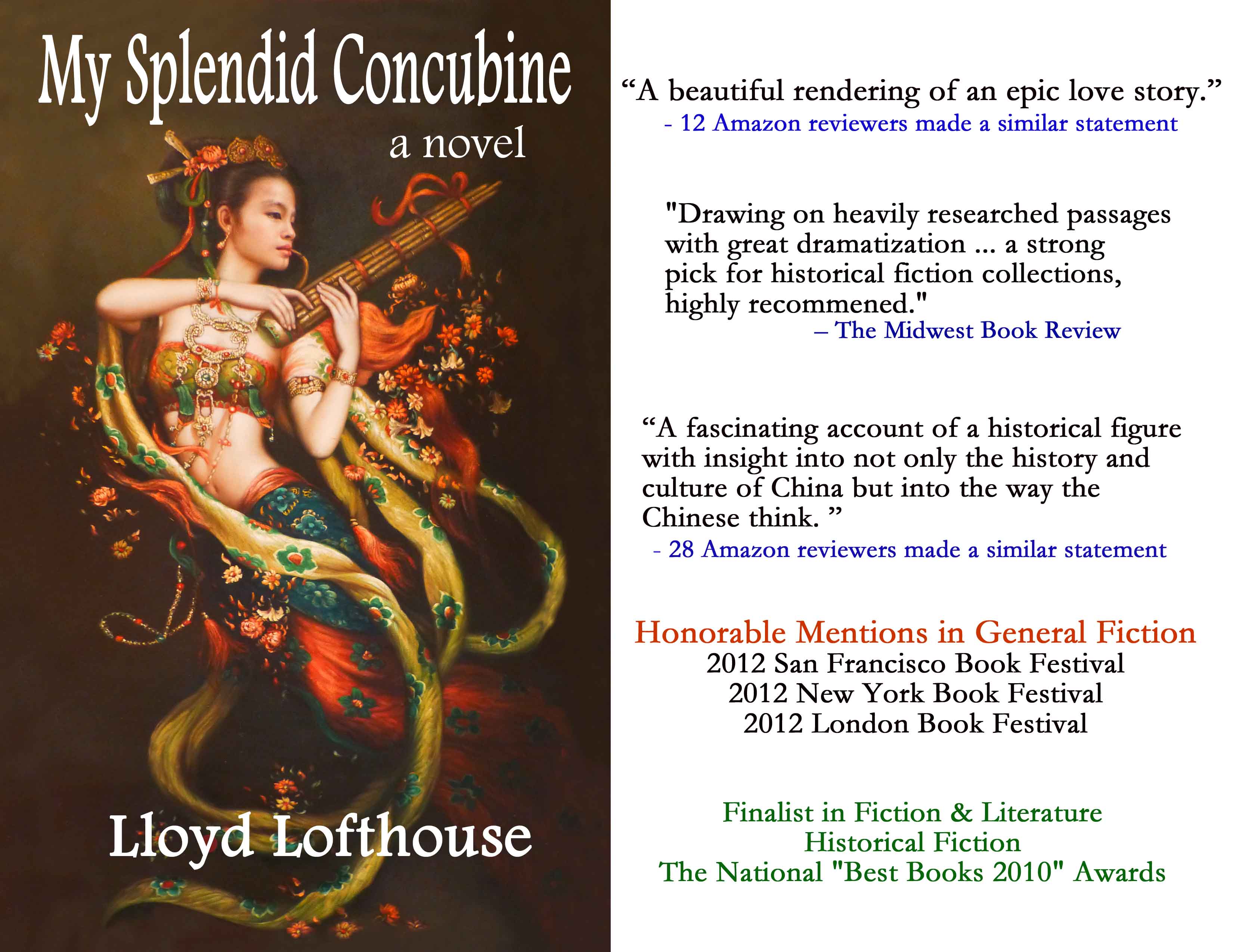
Lloyd Lofthouse is the award-winning author of My Splendid Concubine [3rd edition]. When you love a Chinese woman, you marry her family and culture too. This is the lusty love story Sir Robert Hart did not want the world to discover.
Subscribe to “iLook China”!
Sign up for an E-mail Subscription at the top of this page, or click on the “Following” tab in the WordPress toolbar at the top of the screen.
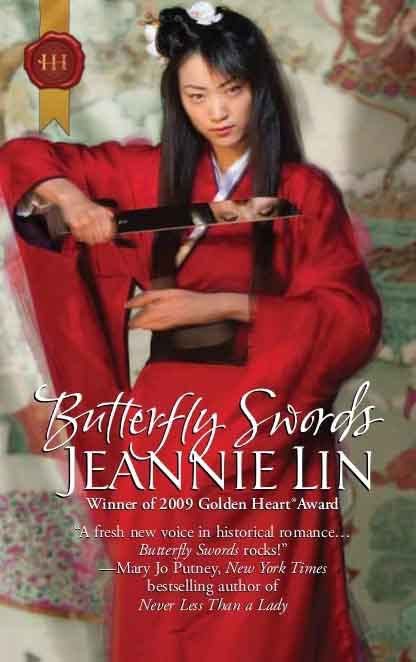
Enter Jeannie Lin, Harlequin’s rising red-star of romance writing. She isn’t the first author on Harlequin’s roster to set her books in China (that honor goes to Jade Lee and her infinite “Tigress” series).
However, Lin’s debut novel, Butterfly Swords, has been attracting a viral buzz louder than a summertime cicada not just for being the first Harlequin novel to NOT feature a man on the cover, but for using an Asian model as the cover girl, another Harlequin first.
The star of Butterfly Swords is a Chinese woman, yes. But to give American readers something that they can relate to, the male love interest of Lin’s novel is not Chinese but a wandering whiteboy from the west.
Ryam is drifting around the Tang (618-906 AD) empire begging for food (this sounds exactly like my own travels across China!) when he spots a disguised female being attacked by a pack of marauding bandits.
The swordsman, who evokes images of bare-chested, fur underwear-wearing Thundarr the Barbarian from the eponymous 80’s cartoon, rescues her, then agrees to escort her home.
Little does Ryam know that young Ai Li is really a princess on the run from an arranged marriage to a dastardly warlord. The two proceed on their journey together across the 7th-century frontier, getting in adventures and slowly but surely falling in love.
Pitting strength, courage and her fabulous butterfly swords against the forces of evil, Ai Li proves herself in the battlefield (“With Ai Li’s swords and determined spirit it was easy to forget that she was innocent”).
However, where the book has significant cultural crossover appeal is in author Jeannie Lin’s ability to keenly capture the multi-dimensional perspectives of both characters throughout their budding interracial relationship.
From Ryam’s course communicative abilities (“Where did you learn how to speak Chinese” Ai Li asks him, laughing. “You sound like you were taught in a brothel”) to his struggles with his inner-white demons as a big, bad bai gui (“It was so much easier to seduce a woman than talk to her”), the reader is introduced not to some empty-headed he-man but a complex male of the species who is genuinely torn between his biological needs and respecting Ai Li’s virtue.
“I don’t understand what she’s talking about half the time,” Ryam grumbles to himself. “Everything is about honor and duty.” Surely even expats living in present-day P.R.C. can relate to this dilemma.
Ai Li, meanwhile, finds herself attracted not only to Ryam’s “musky scent” and “sleek muscles” (Harlequin prerequisites; don’t blame the authoress), but his sincerity (“There was nothing barbaric about him. His manner was direct and honest. It was her own countrymen she needed to be worried about.”).
The protagonist does find herself frustrated with “this swordsman with blue eyes and the storm of emotions that came with him,” but, true to life, Ai Li comes with her own personality flaws as well (“she was being irrational and she knew it”).
Of course, it wouldn’t be a Harlequin without passionate love scenes, something my fiancée missed in the heavily censored Chinese versions.
This Jeannie Lin does in the poetic prose of a Tang Dynasty-era pillow book yet with just enough creatively-provocative language to keep sex-numbed westerners interested (“Ryam slipped his fingers into her silken, heated flesh…her body went liquid and damp in welcome.”). And thankfully without ever once resorting to the word “loin.”
Ryam proves himself to be an ideal lover for nubile Ai Li, “rough enough to make her breath catch, gentle enough to have her opening her knees,” though one can’t help but wonder how these two nomadic warriors can go so long without bathing nor brushing their teeth yet still manage to say things like “her mouth tasted just as sweet as he remembered.”
If only real life were as hygienic as a Harlequin novel.
One of the reasons why Harlequin is able to sell over 100 million units per year (the most profitable publishing company in the industry) is because every book is part of a series.
There are no individual Harlequin titles, which brilliantly leaves the reader yearning for more from the characters they have literally become so intimate with. In this respect, Butterfly Swords concludes with a wide opening that screams sequel, but thankfully lacks the typical Harlequin-happy ending of matrimonial bliss.
One familiar with Chinese culture can’t help but wonder, then, what kind of future Ai Li and Ryam actually have together: in reality, Ai Li would put on weight, cut her hair short and become a shrill nag; her parents and grandparents would all move into their cramped apartment, and a frustrated Ryam, now with beer-belly, would spend more and more time at card games and with karaoke parlor hostesses than at home.
But before the infuriating realties of interracial marriage set in, we hope Jeannie Lin has at least a few more of her trademark sword fights and steamy sensuality in store.
If God really thought sex was a mortal sin, why did He give young men so much testosterone? If you doubt, I suggest you visit Mayo Clinic.org to discover the facts. The Mayo Clinic says, “Testosterone is a hormone produced primarily in the testicles. Testosterone helps maintain men’s sex drive and sperm production.”
Warning, if you are an uptight, born-again Puritan, this mostly erotic collection of short stories might offend you.
The stories in Isham Cook’s collection, The Exact Unknown, reveal men driven by the often oppressed and censured libido. These stories are not an author’s sex fantasy as some Puritanical minds might claim, because many of the characters in these stories don’t achieve their goal—bedding down Chinese beauties that are not as easy to seduce as some think.
This collection is set in modern China where women are considered equal to men and are experimenting with that freedom and their sexuality. In case you are unaware of it, bound feet women in China and concubines as the property of men—you know, legal sex slaves—was officially ended by Mao after his famous liberating ‘Women hold up half the sky’ speech.
I think the best story in this 5-star collection of testosterone driven characters was Good Teacher, Bad Teacher starting on page 103 of the paperback. John Cobalt is from Los Angeles and he’s teaching English in Guangzhou, China to Chinese college students. “This strange six-foot-five American dressed in what struck his employers as pajamas … went barefoot both in class and out on the street. … If that wasn’t bad enough, some students complained to the department head they could make out Cobalt’s penis against the flimsy fabric of his pants, in its flaccid state to be sure, yet they considered this to be highly improper nonetheless.”
To discover how Cobalt ends up with a devout and loyal following of Chinese college graduates, who are mostly female, you’ll have to buy the book.
My second best choice would be The Curious Benefits of Neurosis starting on page 130 in the paperback that’s about a sex addict who sets out one night to visit as many massage parlors as possible—with some surprising results.
I must warn you though that there are a few well-written stories in this collection that have nothing to do with the out-of-control libidos of foreigners hoping to exploit the women of China.
The author sent me a complementary paperback copy of this book for my honest opinion that I’m sure modern, born-again Puritans will not approve of.
_______________
Lloyd Lofthouse is the award-winning author of My Splendid Concubine [3rd edition]. When you love a Chinese woman, you marry her family and culture too. This is the love story Sir Robert Hart did not want the world to discover.
Subscribe to “iLook China”!
Sign up for an E-mail Subscription at the top of this page, or click on the “Following” tab in the WordPress toolbar at the top of the screen.
 Guest review by Tom Carter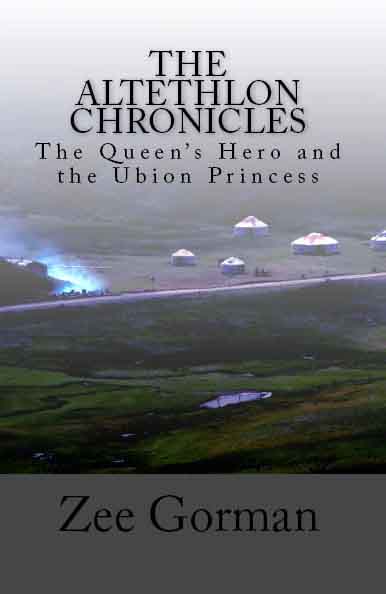


 Posted by Lloyd Lofthouse


 iLook China