The Fear of Mao Buying the World

November 22, 2010

The cover of The Economist’s November 13 issue plays on fear to sell magazines.

I haven’t read Buying up the world, The coming wave of Chinese takeovers yet, which is the feature piece. I’ll probably write another post about that once I do.

Instead, I’m writing about the magazine’s cover, which is taking advantage of the West’s PTCSD (Post Traumatic Chinese Stress Disorder) that has roots in the “history” of a fear of the word “Communist”, the Korean Conflict and the Cultural Revolution.

I’m sure most Sinophobes that see this cover will have flashbacks of the People’s Liberation Army (PLA) and the rest of China dressed in drab Mao jackets marching across the world to take possession of everything China buys.
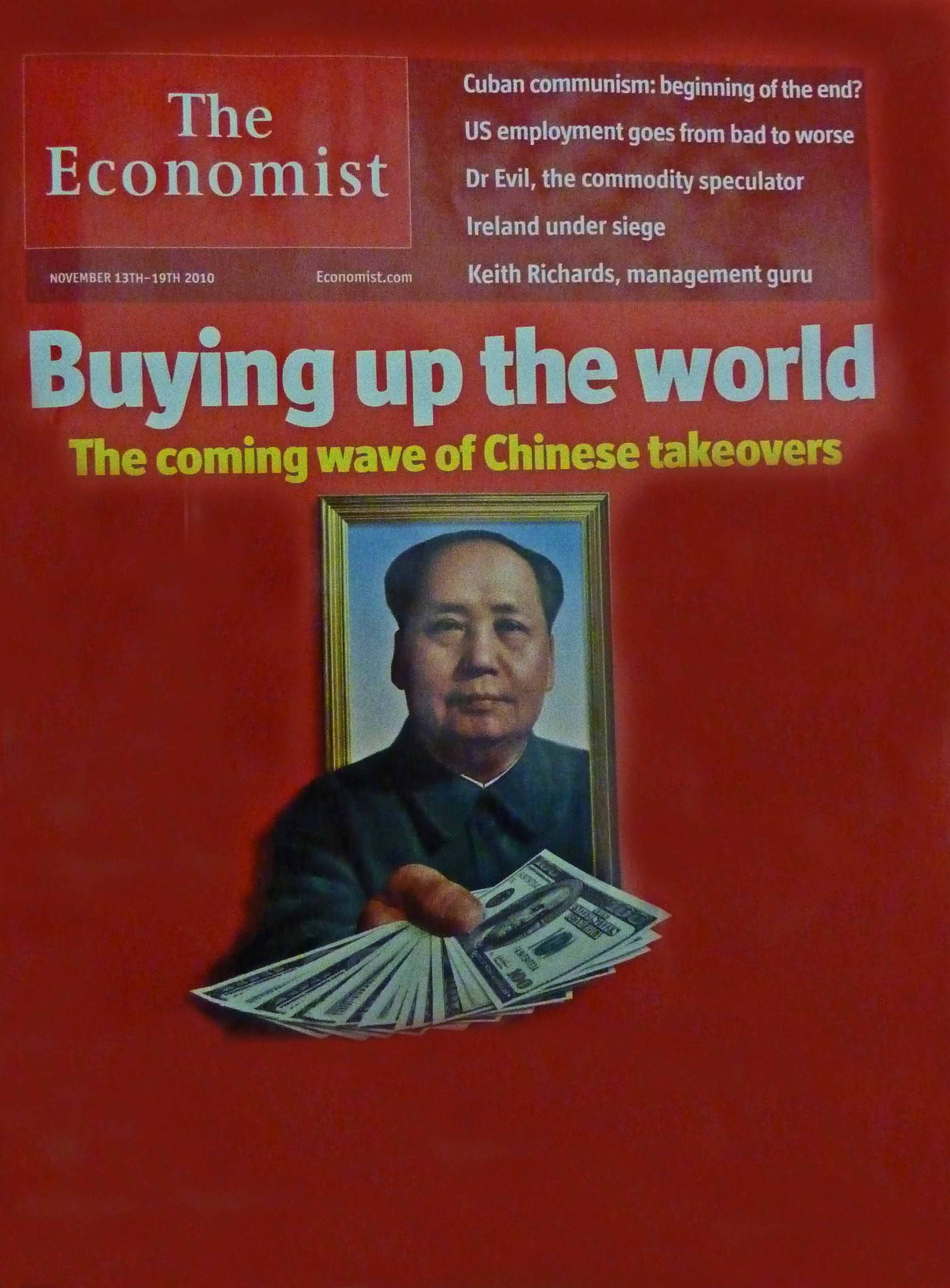
However, Mao isn’t the proper man to adorn The Economist’s cover.

Deng Xiaoping or one of China’s recent presidents (there have been four since the 1982 Constitution) would have been more appropriate.

Why? Because after Mao died in 1976, Deng Xiaoping and his allies rejected Maoist Revolutionary thought and embraced CAPITALISM in a very big way.

In fact, surviving Maoists consider the Party that rules China today to be traitors to Mao and the revolution.

Do you remember the 1980s, when wealthy Japanese spent billions buying property in America then a real estate bubble burst, Japan lost a lot of money, and its economy has been limping since?

If anyone should be afraid, it should be the Chinese fearing spending habits in the US, Canada and Europe where debt and plastic rule.

______________

Lloyd Lofthouse is the award-winning author of the concubine saga, My Splendid Concubine & Our Hart. When you love a Chinese woman, you marry her family and culture too.

To subscribe to iLook China, look for the “Subscribe” button at the top of the screen in the menu bar, click on it then follow directions


Eating turkey in China

November 22, 2010

Turkey is a fowl the Chinese seldom eat. However, eating duck and chicken is common. Duck is even considered a delicacy. In fact, the Unvegan says, “No trip to Beijing is complete without eating some Peking Duck.”

Since I am a vegan, I didn’t eat Peking Duck, but I watched my wife eat it at Quan Ju De (Peking Duck) in Beijing.

The Virtual Tourist says, “It is thought that Beijing roast duck, like the tradition of roast turkey in America and the UK, owes its origin to the roast goose that is still popular in Europe on festive occasions.”

Most Americans do not celebrate the Chinese New Year (the Spring Festival) and most Chinese do not celebrate Thanksgiving. After all, Thanksgiving is an American holiday that Canadians celebrate too but on the second Monday in October.


Thanksgiving in Beijing with Peking Duck

China.org says, “From 2001 to 2005, China imported 486,000 tons of turkey, with all of the whole turkeys and 90 percent of Turkey parts coming from the US…. Currently, 70 to 80 percent of the consumers are Westerners.” 

I’m assuming that Westerners eating turkey in China are there working, as tourists or are expatriates living in the Middle Kingdom and can’t do without turkey on Thanksgiving in October or November.

If you are from North America in China during Thanksgiving, you have a choice between Peking Duck, which is easy to find, and turkey.

Go China says, “Just head to your local international grocery store (Jenny Lu’s in Beijing, Cityshop in Shanghai) and stock up on all the fixings: frozen Butterball turkeys, cranberry sauce and pumpkin pie makings. But you better do it fast, there tends to be a run on these items so if you’re shopping on the last Thursday in November, you’ll be out of luck.”

Learn more about China’s Eating Culture

______________

Lloyd Lofthouse is the award-winning author of the concubine saga, My Splendid Concubine & Our Hart. When you love a Chinese woman, you marry her family and culture too.

If you want to subscribe to iLook China, there is a “Subscribe” button at the top of the screen in the menu bar.


Ming Dynasty (1368-1643 AD) – Part 1, 3/3

November 22, 2010

After moving the capital from Nanjing to Beijing, the Yongle Emperor ordered that a huge bell be made to commemorate his exploits.

The reason for moving the capital was to consolidate defenses in the north since the Mongols, Manchu and other nomads lived to the north and were a threat to an agricultural culture such as China.

In March of 1418, the master bell makers were called to Beijing. The Yongle Bell was to be 6.94 meters tall (almost 23 feet), 3.3 meters wide at the mouth (almost 11 feet) and weigh 46.5 tons.

Producing such a massive bell even today would be an extraordinary job. The master bell makers used the clay mould casting technique—a method used for three thousand years so the Chinese were experienced.

Since there wasn’t a furnace large enough to melt that much bronze, the bell makers used several furnaces at once — another example of an assembly line.

The bell was poured in one casting, which meant that the furnaces had to be coordinated to poor the molten bronze. To be successful, there could not be one mistake.

Because of the threats to China from northern nomads, the five thousand kilometer long Great Wall had been built as a first line of defense from invasion.

The Great Wall was high, long and solid since it was constructed of massive slabs of stone. Construction had started two thousand years earlier and work had continued up to the Ming Dynasty.

During the twenty-eight years between 1405 and 1433 AD, the fleet commanded by Zheng He made seven voyages to Southeast Asia, the Indian Ocean, the Red Sea and Africa’s east coast.

Ming navigators kept detailed charts and the fleet was never lost while at sea.

Return to Ming Dynasty (1368-1643 AD) – Part 1, 2/3

______________

Lloyd Lofthouse is the award-winning author of the concubine saga, My Splendid Concubine & Our Hart. When you love a Chinese woman, you marry her family and culture too.

If you want to subscribe to iLook China, there is a “Subscribe” button at the top of the screen in the menu bar.


Returning Lost Honor

November 22, 2010

I’ve been reading the news of the Qing Dynasty vase that sold for $85.9 million recently. That vase may have belonged to the Qianlong Emperor, who ruled China from 1735 to 1795.

Blogs and the Western media are gushing about the auction price as if that were all that counts.

The New York Times said, “The vase’s price exceeded the record for Chinese antiquities set just last month in Hong Kong, when another Qianlong vase sold for $34.2 million.”

Posh Stuff Online says the (bidding) at Bainbridge’s auction was a battle among Asians.

Instead of focusing on the price, we should understand the reason why Chinese buyers would spend so much for a piece of China’s history with an imperial seal on it.


One theory says that the vase may have been among the treasures looted by British troops when they sacked (and destroyed) the imperial palaces in Beijing during the second Opium War, from 1856 to 1860.

I think the theft of the 85.9 million dollar vase is a fact.

There is no other way to explain how an imperial vase from the Qianlong Emperor ended in England.

The Opium Wars, which started in 1839, were the beginning of a long dark period in China’s history that would not end until after 1976 when stability returned and China started rebuilding.

A once proud and powerful culture that has survived from the Qin Dynasty in 221 B.C. to 1839 (nineteen dynasties) was brought low and the Chinese were treated by the West as if they were second class savages to be indoctrinated (another word for brainwashed) into Western, Christian ways.

No, it wasn’t about the money. Whoever won the vases at those two auctions has returned some honor to a modern China discovering how to stand tall and proud again.

Why did the winning bidders do it? Because they can.

______________

Lloyd Lofthouse is the award-winning author of the concubine saga, My Splendid Concubine & Our Hart. When you love a Chinese woman, you marry her family and culture too.

If you want to subscribe to iLook China, there is a “Subscribe” button at the top of the screen in the menu bar.


Ming Dynasty (1368-1643 AD) – Part 1, 2/3

November 21, 2010

China had been developing shipbuilding technologies and seafaring skills since the Han Dynasty (206 BC – 219 AD). This meant China had been the world’s leader in shipbuilding and navigation for more than fifteen hundred years by the time of the Ming Dynasty.

The shipyard responsible for building Zheng He’s “treasure boats”, as they were called, was in Nanjing, Jiangsu province. What’s left of those shipyards may be seen on the video embedded in this post.

Those dry docks were used six hundred years ago to build China’s giant fleet. 

Since the Song Dynasty had invented the Pound lock in the 10th century to be used along the Grand Canal, China had the technology to build dry docks.

When the ships were ready, the Pound Lock would open and the dry dock would flood then the ship sailed into the Yangtze River.

Zheng He sailed from China in July 1405 with a fleet of about 300 ships.

Kong Yuanzhi, a professor at Peking University says, Compared with the ships of Western explorers during the 15th and 16th centuries, the size of Zheng He’s fleet was unmatched.

Christopher Columbus had just 88 men in three boats, Ferdinand Magellan had 260 in five boats and Vasco de Gama had 160 in 4 ships.

However, Zheng He had 27,000 for seven voyages. According to historical records, the largest ship was over 10 thousand tons —120 times larger than the largest of Vasco de Gama’s ships.

While the Ming Dynasty’s great fleet was sailing halfway around the world, the Forbidden City was being built — another marvel of architectural technology.

The dark-red palace walls and golden yellow tiles of the roofs set the Forbidden City apart from the rest of Beijing.

Return to Ming Dynasty (1368-1643 AD) – Part 1, 1/3

______________

Lloyd Lofthouse is the award-winning author of the concubine saga, My Splendid Concubine & Our Hart. When you love a Chinese woman, you marry her family and culture too.

If you want to subscribe to iLook China, there is a “Subscribe” button at the top of the screen in the menu bar.