China and India’s Mutual Collectivism and History – Part 1/2

September 10, 2010

There appears to be an obsession in the West that India, since it is a democracy, is the country that will counter China’s economic and military growth.

The American Interest published a piece in their May/June 2010 issue – The Return of the Raj, which points out that where G. W. Bush failed to build an Indo-U.S. defense pact, Secretary of State Clinton in a visit to India in July 2009 did open the door to significant arms transfers from the U.S. to India.

If the United States and India can together rediscover and revive the Indian military’s expeditionary tradition, they will have a solid basis for strategic cooperation not only between themselves but also with the rest of the world’s democracies. Source: The American Interest

In another piece, A Himalayan rivalry, The Economist focuses on the 1962 conflict between India and China saying, “Memoires of a war between India and China are still vivid in the Tawang valley…”

However, memoires aren’t everything. There is also knowledge, and China is not the same country it was in 1962.

In 1962, some of the factors that led to the war between India and China were linked to Mao’s policies, the Great Leap Forward and the Cultural Revolution.

The Maoists were removed from power in the 1980s, and China is not a socialist nation as it was then.

Go to Part 2

______________

Lloyd Lofthouse is the award-winning author of The Concubine Saga. When you love a Chinese woman, you marry her family and culture too. This is the love story Sir Robert Hart did not want the world to discover.

Subscribe to “iLook China”
Sign up for an E-mail Subscription at the top of this page.

About iLook China


The “What If” Housing Bubble in China

August 29, 2010

Charles Hugh Smith writes for the Daily Finance and claims that China’s Housing Bubble Will End Badly.

That’s not going to happen for several reasons. The first reason is that China’s economy does not depend on the housing market to survive. Most people in China still don’t own their homes even in the cities.

In the US, housing loans to GDP were 79% but in China, that number is about 15%, which means real estate in China doesn’t prop up the economy.

Let’s look at one fictional individual who loses his job in China and can’t make his mortgage payment.

If he always lived in the city and has family (even distant relations), he will move in with them and rent his home to make the payments. The family may even pitch in so he doesn’t lose the home.

If that fictional Chinese man came to the city to work from a village, he returns home.  The peasants in rural China don’t have to worry about losing those homes.  In fact, it’s as if China had two economies: rural and urban.

If the government needs to develop the land the peasant’s home sits on, a new home is provided. More than seven hundred million Chinese live in villages owned by collectives and the central government. Those peasants don’t have a mortgage payment, pay rent or property tax.

Even in urban China, people only pay property tax once when they buy the home they live in.  Property tax for your home isn’t an annual burden as in the US.

Another factor is that the average savings rate in China is 40% and the wealthiest Chinese own about 40% of urban real estate.

See Betting Against China’s Housing Market

______________

Lloyd Lofthouse is the award-winning author of The Concubine Saga. When you love a Chinese woman, you marry her family and culture too. This is the love story Sir Robert Hart did not want the world to discover.

To subscribe to “iLook China”, look for the “Subscribe” button at the top of the screen in the menu bar, click on it then follow directions.


Conclusion to Sun Tzu’s The Art of War

August 25, 2010

As I finished the series on Sun Tzu’s The Art of War, I thought of President Lyndon Johnson who invaded Vietnam (1950 to 1975)—a war where a super power lost to a third-world country as Chu did to Wu about twenty-five hundred years ago.

Nations that fought with the United States lost more than 300 thousand troops with almost 1.5 million wounded.  North Vietnam and the Communists lost almost 1.2 million troops and more than 4 million civilian dead.  Source: Vietnam War – Wiki

President G. W. Bush rushed into a war in Iraq and Afghanistan on faulty evidence, which may have been based on lies. For these wars, the casualties and losses continue.


Learn more at the War Resisters League

Several American presidents ignored Sun Tzu’s The Art of War.

Since World War II, America has spent more than 23 trillion dollars fighting wars and in defense. The U.S. won the Cold War against Soviet Russia without fighting.

Too bad the citizen of the US, Presidents Johnson and G. W. Bush did not learn from Sun Tzu’s The Art of War.

China’s Sun Tzu said, “Sometimes, the best way to win is not to fight.”

Start with Sun Tzu’s The Art of War (HQ) – Part 1 or return to Part 10

______________

Lloyd Lofthouse is the award-winning author of The Concubine Saga. When you love a Chinese woman, you marry her family and culture too. This is the love story Sir Robert Hart did not want the world to discover.

Subscribe to iLook China — there is an “E-mail Subscription” link at the top of the screen.

About iLook China


Sun Tzu’s “The Art of War” – 3/10

August 20, 2010

Sun Tzu liked the enemy to maneuver and respond to his moves. This way he was in charge of the battlefield.

A US report after the Vietnam War revealed that 80% of the time, it was the North Vietnamese and Vietcong who decided where and when to fight.

Sun Tzu said, “Once you know the enemy’s strengths and weaknesses, you can avoid the strengths and attack the weaknesses.” At the beginning of the war, almost 80% of Americans supported it.

As the Vietnam war continued with mounting US causalities, that support at home shifted against the war, which achieved another of Sun Tzu’s rules, “The skillful leader subdues enemy’s troops without any fighting. One does not win wars by winning battles.”

Although the North Vietnamese and Vietcong did not win battles, they won the war by turning the American people against it. To achieve this goal, the North Vietnamese commander was willing to lose ten men for every American killed.

In the end, the US lost 53 thousand troops and the North Vietnamese and Vietcong more than a million with several million more noncombatants killed as collateral damage to the American bombing.

Sun Tzu felt spies were important, and he devoted one chapter to spies.  He said, “Use your spies for every kind of business,” and the North Vietnamese and Vietcong followed that advice.

Sun Tzu said, “An accurate knowledge of the enemy is worth ten divisions.”

He also said, “Let your plans be as dark as night – then strike like a thunderbolt.”  The Tet Offensive in January of 1968 was that thunderbolt.

Go to Sun Tzu’s “The Art of War” – Part 4 or return to Sun Tzu’s “The Art of War” (HQ) – Part 2

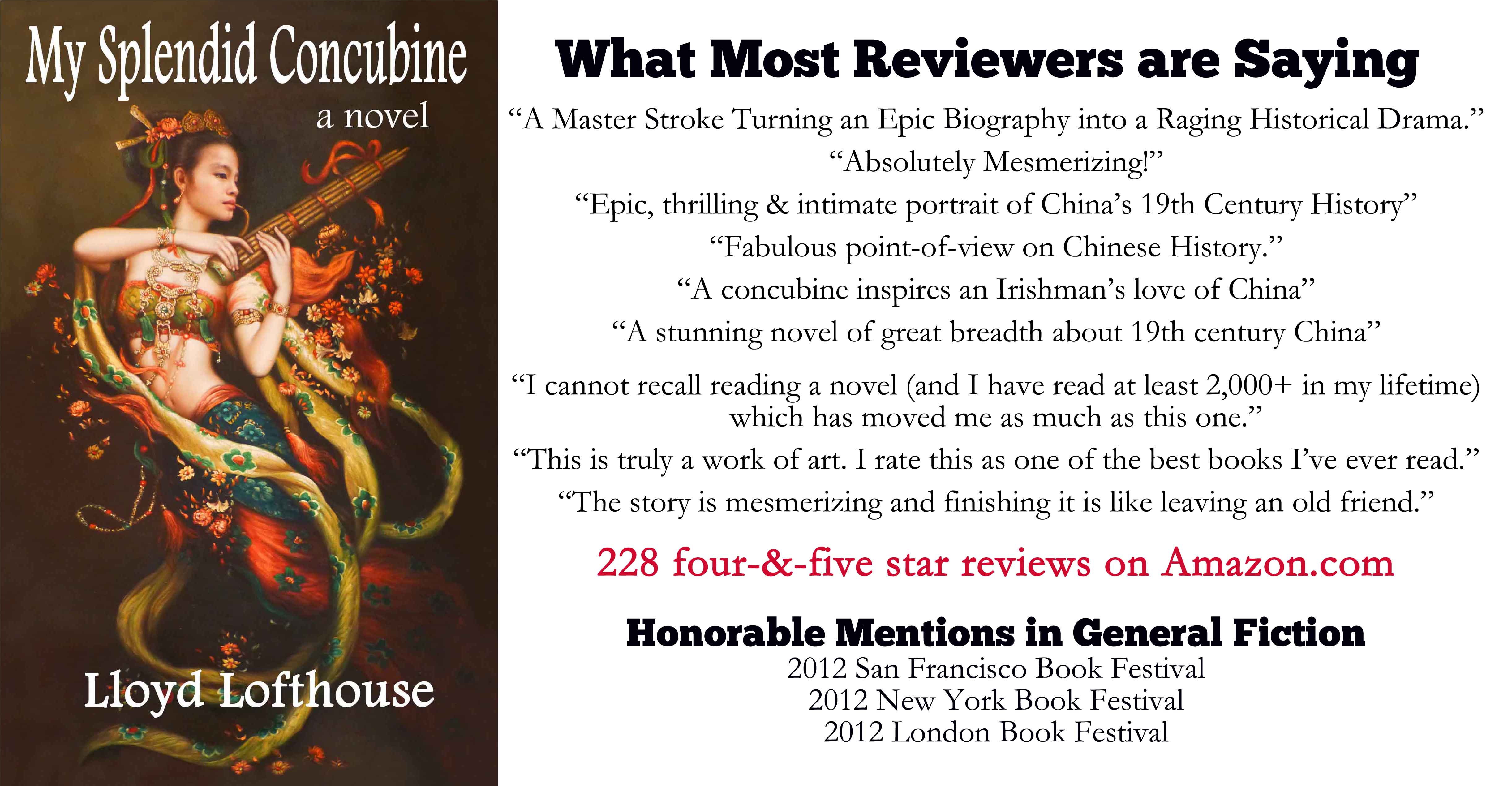
Lloyd Lofthouse is the award-winning author of My Splendid Concubine [3rd edition]. When you love a Chinese woman, you marry her family and culture too. This is the unique love story Sir Robert Hart did not want the world to discover.

A1 on March 13 - 2016 Cover Image with BLurbs to promote novel

Where to Buy

Subscribe to “iLook China”!
Sign up for an E-mail Subscription at the top of this page, or click on the “Following” tab in the WordPress toolbar at the top of the screen.

About iLook China

China’s Holistic Historical Timeline


Sun Tzu’s “The Art of War” – 2/10

August 19, 2010

The state of Wu has only 33,000 troops while Chu can field a force of 300 thousand.

Outnumbered ten to one, Sun Tzu could build his defenses and wait for the attack. However, he does the unexpected. He invades Chu.

He doesn’t attack Chu’s main army. Instead, he attacks outposts and weaker targets. When Chu sends an army to fight, Sun Tzu slips away emphasizing maneuver, surprise and deception.

After every battle, Sun Tzu learns more about his enemy.

During another war more than two thousand years later, Sun Tzu’s ultimate secret becomes more evident. In the mid 1960s, the world’s largest super power is fighting in Vietnam—a country smaller than the state of Montana.

The American general sees the battlefield like a chessboard where armies stand and fight. However, Vietnam has no clear objectives to attack and destroy.

The Communist general understands Sun Tzu and uses the Viet Cong in hit and run attacks against fixed US positions.

Sun Tzu said, “It is more important to outthink your enemy than outfight him. In war, numbers alone confer no advantage. Do not advance relying on sheer military power.”

The US commander breaks these rules.

Go to Sun Tzu’s “The Art of War” – Part 3 or return to Sun Tzu’s “The Art of War” – Part 1

Lloyd Lofthouse is the award-winning author of My Splendid Concubine [3rd edition]. When you love a Chinese woman, you marry her family and culture too. This is the unique love story Sir Robert Hart did not want the world to discover.

A1 on March 13 - 2016 Cover Image with BLurbs to promote novel

Where to Buy

Subscribe to “iLook China”!
Sign up for an E-mail Subscription at the top of this page, or click on the “Following” tab in the WordPress toolbar at the top of the screen.

About iLook China

China’s Holistic Historical Timeline