Modern Chinese Parents and Children – Part 3/3

May 31, 2011

Guest post from Hannah in China

In fact, in China, children should not argue with their parents and the child must do what the parents say.

When the child is good at studying, it means “Guang Zong Yao Zu”, (bring honor to your ancestors).

When you get the low score (100% score is best. 60% means you barely passed the exam. 90% is good. However, even just 1% lower and the child gets the “cold face”).

This not only means teachers calling parents endless times for meetings and punishment from the parents but it embarrasses your ancestors too.

This means when children are doing the homework, parents watch them until they finish to insure no mistakes.

Another recent review from Amazon.US points out an interesting thought. “The (Amy Chua) book raises an important question: Is America’s assumed educational mediocrity really the fault of our public schools (as some believe) or is it the fault of an epidemic of indulgent parenting (as others believe)? Asian kids seem to do remarkably well in the public schools… and raising little complaint about the quality of the schools.”

As for myself, Hanna writes, I think I’m the lucky one born in a family offering more freedom. Luckily I was a good student so my parents didn’t have to pay as much attention to me.

Did they spoil me? Sure. Did they care about my feelings? Yes, because they allowed me talk and argue with them.

If your child is no good at school, you must still love them. However, being strict so they have a good future is not worth it if they hate you later. No matter what kind of family you live in – strict or spoiled – the important thing is to love. Then the world can be better place.

(From the Blog’s host) Amy Chua was heard from again recently when she wrote for USA Today, Tiger Mom: Here’s how to reshape U.S. education.

Chua says, “My memoir — seen in the West as a story about “extreme” parenting — is being marketed the opposite way in China, as a story about the importance of giving kids more freedom. Amusingly, the book’s title in China is Parenting by a Yale Professor: Raising Kids in America, and I was asked by one Chinese women’s magazine to give its readers tips on “how to be friends with your kids.”

Return to Modern Chinese Parents and Children – Part 2 or start with Part 1

View as Single Page

Discover Hannah’s review of Red Mansion, a Chinese TV series, or visit her Blogs at Hannah Travel Adventure (Chinese) or Hannah China Backpacker (English)

______________

To subscribe to “iLook China”, look for the “Subscribe” button at the top of the screen in the menu bar, click on it then follow directions.


Modern Chinese Parents and Children – Part 2/3

May 30, 2011

Guest post from Hannah in China

In addition, modern Chinese are also having many new chances but this still won’t change the way most Chinese parents raise children, because China now has the “Gaokao”, which is the high school examination to get into a university or college.

Because of the competition, parents can’t afford or wouldn’t dare to let the child just play and have fun. Children don’t know what is best for them.

Parents must force them to study but spoil them at the same time. When the child gets the great score, that means everything to parents. The kids don’t have to do anything else in life but study. Therefore, the story is the boy went into a famous college but didn’t know how to peal the eggshell.

Note from Blog host: Another review from Amazon.UK supports what Hanna is saying. The reviewer wrote, “I know how appalling some of those things sound to many. Not me, since I am Chinese myself and I have been brought up that same way, if not more strict.…. However when I grow up (now 40), I see the vast difference of parenting among other people in different countries (I live in UK now with my English husband), and what repercussions it has on the kids when they grow up. I am glad I was brought up the way I was.”

Hanna says, “Chinese parenting is not about ‘feelings’, but it’s not to say that the parents do not care.”

The child has to finish the school homework to 10 pm at night five days a week. Then after school, the child goes to the special training to develop other skills such as piano. This is not about what the the child is interested but it’s what the parents decided based on what they believe is necessary. What we learn in China is that the children have to attend eight different hobbies classes. There’s no free time.

Continued on May 31, 2011 with Modern Chinese Parents and Children – Part 3 or return to Part 1

View as Single Page

Discover Hannah’s review of Red Mansion, a Chinese TV series, or visit her Blogs at Hannah Travel Adventure (Chinese) or Hannah China Backpacker (English)

______________

To subscribe to “iLook China”, look for the “Subscribe” button at the top of the screen in the menu bar, click on it then follow directions.


Modern Chinese Parents and Children – Part 1/3

May 29, 2011

A Guest post from Hannah in China

Before I start to talking about Chinese parents and children, first let us have a look of the currently pretty hot arguing book, Battle Hymn of the Tiger Mother, which is a Chinese-American Yale law professor mom that wrote about how she was strict with her two daughters by making a lot of can’t doing rules, and she was acting like a wicked witch to push them to study.

I will not comment on which parenting method is better, Chinese or Western.

What I want to say is the book’s author Amy Chua’s way of parenting is typically Chinese though she is 4th-generation American.

Note from Blog host: Evidence of this may be found among reviews and comments on Amazon.UK. Rosie in the UK wrote, “I am Chinese now living in the UK and I admit I was outraged when I first read the WSJ excerpt of her (Amy Chua’s) book. My first thoughts were I can’t believe anyone would do something like that to their children. However, as I thought more about it and I guess living out here in the UK I’ve been so used to the numbing and dummying of our children’s perceived fragile self esteem and always making sure that their feelings and wants are met for fear of damaging them emotionally, I forgot that, hey, I was brought up pretty much the same way.”

Hanna says, “We Chinese have a long history of parents being strict with their children. From old days, the Ke Ju Kaoshi (official examination) was the only chance for people to change their fate and life.

“To achieve this, they must study really hard. We have an old saying about this “Shi Nian Han Chuang Ku Du Ri, Jin Chao Jin Bang Ti Ming Shi”, which means “Ten years of study at a cold window only for the day of passing the examination.”

“To study, students must be pushed even by using the stick.”

Continued on May 30, 2011 with Modern Chinese Parents and Children – Part 2

View as Single Page

Discover Hannah’s review of Red Mansion, a Chinese TV series, or visit her Blogs at Hannah Travel Adventure (Chinese) or Hannah China Backpacker (English)

______________

To subscribe to “iLook China”, look for the “Subscribe” button at the top of the screen in the menu bar, click on it then follow directions.


China’s Future Political Divide Revealed

May 24, 2011

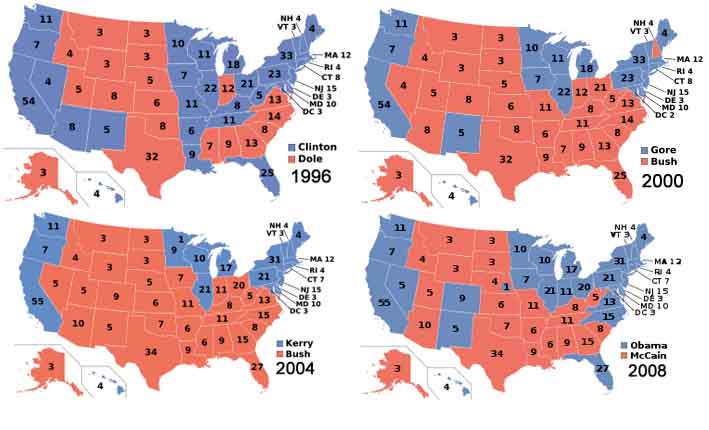
A report by Melissa Chan for Al Jazeera reminded me of America’s political divide between red (Republican) and blue (Democratic) states.

If we look at the four US presidential elections between 1996 – 2008, we discover the political divide in America, and it is mostly between large urban population centers and rural/middle America as if America were two countries — not one.

A similar split may be growing in China, and Melissa Chan’s report, “China’s Youth Divided over Superpower Status” reveals the divide that parallels America’s split between old-world conservative values and new-world, compassionate idealism.

Chan reported from Beijing April 8, 2011 revealing China’s (middle-class urban) youth were living the wild life dancing the nights away as North American and European youth have been doing for decades.

For China’s form of new-world idealism, the music is heavy metal. “Stand up!” the musician sings. “Stand up! You are Chinese! Rise Up! You are the descendents of the dragon!”

“However,” Melissa Chan says, “this euphoria is qualified by a sense of duty missing in the West.”

Hu Song, the lead singer of Yakso, a popular heavy metal group, told Chan, “China most certainly has emerged as a power. But I hope with great power…people’s spirits will also rise up or else it is a problematic power.”

After watching the Al Jazeera news report, it was obvious that many rural youths do not agree with the middle-class urban youths that have the luxury to spend nights dancing to heavy metal, a lifestyle imported from the West along with American fast food, which brought an epidemic of diabetes and heart disease to urban China.

For some (mainly among China’s 700 million rural Chinese) this is expressed in pride and patriotism.

Others (mainly middle-class urban youth) are more skeptical of their leaders, raising their voices through the medium of a dynamic youth counterculture such as heavy metal music with long nights of dancing accompanied by increased drug use as in the West.

There is another difference between rural and urban China. The one-child policy, which focused mainly in urban areas while many peasants on farms in rural China were allowed to have more than one child so there were more hands to work the field. This helped most of rural China avoid raising little emperor/empresses — another explanation for the growing division in thought.

______________

Lloyd Lofthouse is the award-winning author of the concubine saga, My Splendid Concubine & Our Hart. When you love a Chinese woman, you marry her family and culture too.

To subscribe to “iLook China”, look for the “Subscribe” button at the top of the screen in the menu bar, click on it then follow directions.


After Centuries of Neglect, China’s Forests Renewed

May 20, 2011

I was aware that China was planting trees but I had no idea how many until I read The Great Tree Survey in the May 2011 National Geographic Magazine, which said, “Huge tree-planting programs, especially in China, reduced the net loss of (global) forest even further.”

This triggered my curiosity so I did some “digging” [pun intended].

I already knew from posts I’ve written comparing China to India, China had reduced poverty more than any county on earth while poverty is increasing in countries such as the US and not changing much in India.

The Guardian in the UK reported, “China’s Great Green Wall was launched in 1978… The (Chinese) government has tightened logging restrictions and increased reforestation efforts, including aerial seeding of remote areas.


China planted about 60 billion trees in the last three decades.

 “If the plan is completed as scheduled in 2050, trees will cover over 400 million hectares (about one billion acres) or 42% of China’s landmass…”

By comparison, US forests cover about one-third of the nation, which is currently about 747 million acres down by 300 million acres since the mid-1600s. Source: National Atlas.gov

In 2009, Xinhua News Agency reported, “China would spend 60 billion yuan (8.77 billion US dollars) annually on its greening or tree planting campaigns….”

According to Worldwatch.org, “Nourishing China’s Forests is creating millions of Green jobs.”

New research from the Worldwatch Institute shows that over the next 10 years…planting forests (in China) where there were none could lead to the creation of more than 1 million “green jobs” in 2020 alone. If indirect employment opportunities in related sectors are also included, China’s investment in its forestry sector could generate as many as 2.5 million green jobs in 2020.

______________

Lloyd Lofthouse is the award-winning author of the concubine saga, My Splendid Concubine & Our Hart. When you love a Chinese woman, you marry her family and culture too.

To subscribe to iLook China, look for the “Subscribe” button at the top of the screen in the menu bar, click on it then follow directions.