I’ve heard that it was Confucianism that caused China to fall victim to Western Imperialism in the 19th century, and the reason Mao started the Cultural Revolution his last decade was to correct this imperfection.
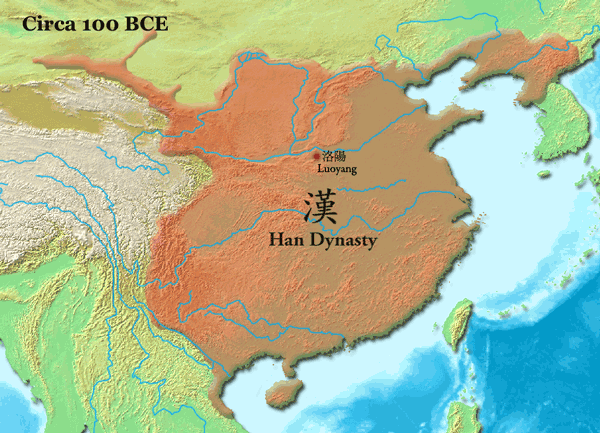
However, I believe that the collective culture created in China by Emperor Han Wudi (156-87 BCE), considered one of the most influential emperors in Chinese history, is the reason that China’s civilization survived for thousands of years without suffering the fate of Europe after the Roman Empire collapsed.
Han Dynasty 100 BC
The problem is not from Confucianism but a flaw in the way an element of Confucianism has been interpreted over the centuries. In fact, this flaw is buried so deep in the Chinese psyche that Mao’s disastrous Great Leap Forward and the tragic Cultural Revolution were not stopped because of it.
There were powerful individuals in the Communist Party who did not agree with what Mao was doing but did not speak out when they could have. Some of those individuals even suffered during the Cultural Revolution but still kept silent due to the power of piety.
It wasn’t until after Mao’s death that those same people acted and Deng Xiaoping came to power stopping the madness of the Cultural Revolution.
To criticize an elder in China, even when that individual is power hungry, senile or maybe a bit crazy, is considered similar to Christian heresy during the Spanish Inquisition. Piety means elders must be treated with respect as if they can do no wrong. There must be a way to find a balance.
Lloyd Lofthouse is the award-winning author of the concubine saga, My Splendid Concubine & Our Hart. When you love a Chinese woman, you marry her family and culture too.
I find it interesting and amusing to read this obsession in the West about China’s labor practices. Most of what I read in the media and comments to Blog posts have a superior tone as if these people come from a culture that is paradigm of virtue.
No one in the West has earned a seat to sainthood. In an Associated Press piece by Elaine Kurtenbach, we see Western corporate greed dripping dollar signs from hungry vampire fangs in these quotes about China, “Many companies are striving to stay profitable by shifting factories to cheaper areas farther inland or to other developing countries, and a few are even resuming production in the West.… I have 15 major clients. My job is to give the best advice I can give. I tell it like it is. I tell them, put your helmet on, it’s going to get ugly,” said Goodwin…”
From BindApple.com comes this statement as if no one else in the world works these hours, “Foxconn and Inventec are two powerful brands that not many of you heard of. When Apple signed a partnership with these manufacturers, the average worker, lived and worked in the factory, doing more than 60 hours of work in a week.”
America and most Western nations are not paradigms of virtue. Labor in the West didn’t get where it is today without a struggle. All one has to do is look at history to discover what it took to earn more for less hours and be treated with “some” respect in the workplace.
If you spend time at the AFL-CIA’s Labor History Timeline in America, you will discover that in 1791, the first labor strike in the building trades took place in Philadelphia demanding a 10-hour workday bill of rights. In 1835, there was a general strike for a 10-hour workday in the same city.
When there was a national uprising of railroad workers in 1877, ten Irish coal miners were hanged in Pennsylvania and later nine more were hanged. Then in 1914, there was the Ludlow Massacre of 13 women and children and 7 men in a Colorado coal miners’ strike. In 1934, during the Great Depression, there was an upsurge in strikes, including a national textile strike, which failed.
Click on the Child Labor Public Education Project and you will learn that “Forms of child labor, including indentured servitude and child slavery, have existed throughout American history.” In fact, “(American) factory owners viewed them (children) as more manageable, cheaper, and less likely to strike.”
This situation in the US didn’t change until, “Child labor began to decline as the labor and reform movements grew and labor standards in general began improving, increasing the political power of working people and other social reformers to demand legislation regulating child labor.” Even then, it wasn’t until 1938 that child labor laws were enacted to protect America’s children from exploitation.
So, if you are one of those paradigms of virtue who feels the need to criticize what is going on in China today, consider America’s labor history before you open your mouth or finger dance your computer keyboard.
It took more than two-hundred years for the US to reach the place it is today with a standard 40-hour workweek with benefits and overtime pay for many workers, while removing child labor from the workplace.
China didn’t start until 1950, when Mao created laws that made women equal to men. Progress stopped during Mao’sGreat Leap Forward and his Cultural Revolution, which went on for almost thirty years.
Since 1980, China has had about thirty years to evolve, while in America the income gap between the rich and poor widens as if the US is taking backward steps while union membership shrinks.
In fact, Chinese manufactures may be building plants in the US to take advantage of cheaper labor. After all, Japanese companies like Toyota and Honda have already done that.
Lloyd Lofthouse is the award-winning author of the concubine saga, My Splendid Concubine & Our Hart. When you love a Chinese woman, you marry her family and culture too.
To subscribe to “iLook China”, look for the “Subscribe” button at the top of the screen in the menu bar, click on it then follow directions.
Why did Mao cause so much suffering with his failed Great Leap Forward and The Cultural Revolution? Yes, the power Mao held was a corrupting factor in the decisions he made, but fear of repeating history was also a factor.
Mao's Little Red Book of Quotations
How many millions of Chinese were addicted to Western opium forced on China by Great Britain and France during two Opium Wars?
Historians say that 20 to 30 million were killed due to the Taiping Rebellion. If Christian missionaries had not been forced on China because of the Opium Wars, would that rebellion have taken place?
Another 115,000 Chinese were killed during the Boxer Rebellion, which was a popular peasant uprising against Christian missionaries, foreign meddling and exploitation.
After 1911 when the Qing Dynasty collapsed, chaos and anarchy ruled China, while foreigners—Americans included— lived in luxury in the treaty ports protected by modern foreign military forces. A Century of Madness chronicles this time.
Mao survived Chiang Kai-shek‘s crack down on the labor movement led by the Communist Party. During World War II, Mao’s army not only fought Chiang Kai-shek’s troops but also the Japanese, who killed between 10 to 20 million Chinese in their attempt to conquer China. The peasants trusted Mao’s troops but did not trust Chiang Kai-shek’s army. Why?
Mao believed that socialism would create a better life for the Chinese. His failures were attempts to make China strong enough to defend the country against foreign meddling and invasions. He failed, but Deng Xiaoping didn’t. What happened in Tiananmen Square in 1989—where a few hundred demonstrators were killed—was nothing compared to what China suffered starting with the First Opium War.
______________
Lloyd Lofthouse is the award-winning author of the concubine saga, My Splendid Concubine & Our Hart. When you love a Chinese woman, you marry her family and culture too.
To subscribe to “iLook China”, look for the “Subscribe” button at the top of the screen in the menu bar, click on it then follow directions.
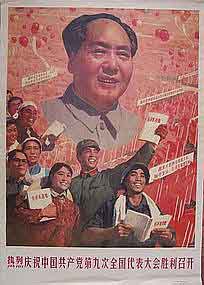
In 1966, Mao’s Red Book of quotations was used as a textbook in the schools. Shao Ailing, a head teacher in Shanghai said, “The pupils began to realize that all the changes taking place in their families, in school, in Shanghai and China were brought about by Chairman Mao.”
Mao encouraged students to attack authority and the leadership of the Communist Party. This advice came from the “George Washington” of China, the man who had delivered on his promises to the peasants and brought them medicine and land reforms—something the emperors and Chiang Kai-shek had never done.
Tourist Attraction in Today's China
Zhang Baoqing, an early Red Guard member in Beijing, said, “Chairman Mao started the Cultural Revolution to keep up the momentum for change. We thought if we followed Mao, we could not go wrong.”
Mao motivated millions of students from speeches in Tiananmen Square. This time it wasn’t the rural peasants. It was China’s urban youth, who were too young to remember Mao’s mistakes from the Great Leap Forward.
Student anger focused on Mao’s rivals, President Liu Shaoqi and Deng Xiaoping. Even small children were taught to denounce Liu. Then anyone in power was denounced. The structure of the Communist Party collapsed. Schoolteachers were attacked and tortured by their students. Up to a million were killed or driven to suicide.
Lloyd Lofthouse is the award-winning author of the concubine saga, My Splendid Concubine & Our Hart. When you love a Chinese woman, you marry her family and culture too.
If you want to subscribe to iLook China, there is a “Subscribe” button at the top of the screen in the menu bar.
Steel production had to double in one year. Instead of producing steel from industry, Mao wanted the peasants to build small furnaces. Again, there was competition between teams of peasants. Forests were cut down to fuel the crude peasant furnaces.
All over China, people were neglecting their other jobs to produce steel because the people had to obey Mao. All metal was melted—including cooking woks. The steel produced was useless.
While the peasants were producing steel, the crops rotted in the fields. In 1960, there was a drought and food production fell more than 25%. Twenty million or more died from the resulting famine.
Village in Southeast China
Having failed, Mao stepped aside to let someone else run the nation. The large communes were abandoned. The peasants returned to their villages and were given land again.
Fearing the return of capitalism, Mao’s supporters printed a book with his slogans. Mao wanted to break the thinking and attitudes of old China. Using film, a propaganda campaign was launched so Mao could regain power. Then in 1966, he launched the Cultural Revolution.
Lloyd Lofthouse is the award-winning author of the concubine saga, My Splendid Concubine & Our Hart. When you love a Chinese woman, you marry her family and culture too.
If you want to subscribe to iLook China, there is a “Subscribe” button at the top of the screen in the menu bar.


 Posted by Lloyd Lofthouse


 iLook China