Four Equals One China—Minority China Continued (Part 6 of 7)

May 16, 2010

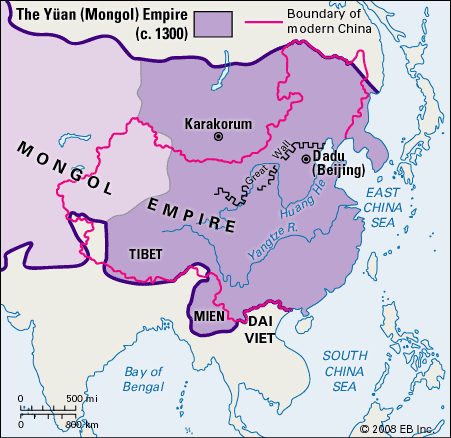
The Mongol minority and the Manchu both conquered and ruled China for a time. The Mongols were the Yuan Dynasty (1277-1367) and the Manchu were the Qing Dynasty (1644-1911). China’s largest expansion took place under the Yuan and the Qing. The Yuan occupied Tibet followed by the Ming Dynasty (1368-1643) and then the Qing.

If you are one of the skeptics who believe Tibetan separatists whom claim China never ruled Tibet, I direct you to the October 1912 issue of “National Geographic Magazine” or “The I.G. In Peking, Letters of Robert Hart, Chinese Maritime Customs, 1868 – 1907” where Sir Robert Hart mentioned Tibet in more than fifty of his letters in two volumes published by Belknap Press of Harvard University Press, ISBN 0-674-44320-9.

Since I wanted to see the original, I bought a copy of the October 1912 issue of National Geographic Magazine on e-bay, and it cost $20 plus shipping.

Go to Four Equals One China: Part 7 or discover China’s 56 minorities

_______________

Lloyd Lofthouse is the award-winning author of My Splendid Concubine [3rd edition]. When you love a Chinese woman, you marry her family and culture too. This is the love story Sir Robert Hart did not want the world to discover.

Subscribe to “iLook China”!
Sign up for an E-mail Subscription at the top of this page, or click on the “Following” tab in the WordPress toolbar at the top of the screen.

About iLook China

a


Four Equals One China—Minority China (Part 5 of 7)

May 16, 2010

There are 56 ethnic Chinese minorities with about 100 million people among them. These minorities have their own languages and cultures. The majority, the Han Chinese, have seven languages. There is one written language in China.

Learning Mandarin and English are mandatory in the public schools. It is expected and mandatory that “all” students will spend 11 years in school.

Until the 11th, Five-Year Plan, urban schools were much better than China’s rural schools.  It’s too early to see the results yet. After all, it took more than three decades to achieve what China has already accomplished.

Uighurs in Xinjiang province

The two minorities best known outside China are the Tibetans (4.6 million) and the 8 million Uighurs in China’s northwest Xinjiang province. Few of the province’s Uighurs speak the national language of Mandarin. They are educated in their own tongue in Uighur schools, and they are treated in Uighur hospitals that they claim are sub-par.

The Uighurs have a history of insurrection with the Qing Dynasty (1644-1911). There were several rebellions during the 19th century that were put down ruthlessly by the Manchu.

Go to Four Equals One China: Part 6

_______________

Lloyd Lofthouse is the award-winning author of My Splendid Concubine [3rd edition]. When you love a Chinese woman, you marry her family and culture too. This is the love story Sir Robert Hart did not want the world to discover.

Subscribe to “iLook China”!
Sign up for an E-mail Subscription at the top of this page, or click on the “Following” tab in the WordPress toolbar at the top of the screen.

About iLook China


Heaven Grants the Right to Rule

April 15, 2010

The Mandate of Heaven is based on four principles:

1. The right to rule is granted by Heaven
2. There is only one Heaven therefore, there can be only one ruler.
3. The right to rule is based on the ‘virtue’ of the ruler.
4. The right to rule is not limited to one dynasty

When the Ch’ing Dynasty fell in 1912, and the Nationalists stepped in, a claim could be made that this change occurred because The Mandate of Heaven made it so. After all, history tells us that the Manchu of the Ch’ing Dynasty were brutal rulers. In addition, during the nineteenth century, China suffered through droughts, famines and rebellions that cost millions their lives.

The principals from the Mandate of Heaven and Confucius’s Five Great Relationships must be on the minds of the members for China’s central government. That’s why, after Mao, China’s government revised the constitution and built-in term limits (two five-year terms) unlike the United States and other Western democracies. There is also an age limit in China set at sixty-seven. In China, we will not see deaf men nearing ninety falling asleep in their senate seats.

See Power Corrupts http://wp.me/pN4pY-40

Sign up for an RSS Feed for  iLook China


Tibet Inside China – 1/5

April 11, 2010

In 2008, I wrote a post about Tibet on another forum. Someone with a Tibetan sounding name left a comment in crude English calling me a “Communist rabbit”.

Name-calling seems to be popular these days. In America, people like Glenn Beck (FOX network), Rush Limbaugh (600 radio stations) and the Tea Baggers have developed name-calling into an art form—not much substance but colorful and angry.

The Tibetan government in exile’s Prime Minister Samdhong Rinpoche was quoted in “Good” magazine’s May/June 2008 Issue that six-million Tibetan Buddhists still lived in Tibet. He also said that Tibet has never historically been part of China. That isn’t true. Tibet was ruled by three of China’s Imperial Dynasties.

Yuan (Mongol) Dynasty 1277 – 1367

Tibet was first ruled by China during the Yuan Dynasty (1277-1367). Then, when the Ming Dynasty (1368-1643) reclaimed China, a Ming Imperial army was sent to Tibet to drive out the last of the Mongols–holdovers from the Yuan Dynasty. The Ming emperor ordered his army to stay.

When the Ch’ing (Manchu) Dynasty (1644-1911) came to power, the Chinese empire expanded further and Tibet remained in China. Later, I’ll provide evidence from a 1912 National Geographic magazine as proof.

Discover Wearing China’s Shoes or go to Tibet Inside China – Part 2

View as Single Page

_______________

Lloyd Lofthouse is the award-winning author of My Splendid Concubine [3rd edition]. When you love a Chinese woman, you marry her family and culture too. This is the love story Sir Robert Hart did not want the world to discover.

Subscribe to “iLook China”!
Sign up for an E-mail Subscription at the top of this page, or click on the “Following” tab in the WordPress toolbar at the top of the screen.

About iLook China