The Yangqin

April 7, 2010

The yangqin, the Chinese Hammered Dulcimer, probably did not originate in China. It came from either Europe or Persia about five centuries ago and was adapted to fit Chinese music.

One theory says that the yangqin came to Chinese on the Silk Road. A second theory says it arrived in China with Portuguese traders in the 1500s.  A third theory says the instrument was developed in China without foreign influence from an ancient stringed instrument called a Zhu.

However, it is a young instrument by Chinese standards, and was first heard during the Ming Dynasty (1368 to 1644).  Later, it was commonly used in Chinese Operas. In Modern China, the yangqin is a major discipline in the College of Music.

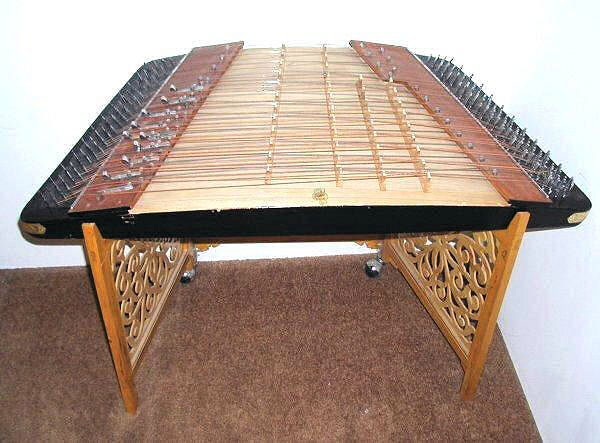
A Yangqin or Chinese Hammered Dulcimer

The yangqin has over 100 strings that are struck with thin bamboo sticks that have rubber tips on one end.  When struck with the rubber end, a soft sound is heard.  When the strings are struck with the other end of the stick, without the rubber tip, a crisper sound is heard.

Around the world, there are many versions of the hammered dulcimer all designed and played in a similar fashion, but each country has its own distinct sound influenced by culture.   

If you enjoyed learning about and listening to the yangqin, see The Pipa

_________________________

Lloyd Lofthouse is the award-winning author of the concubine saga, My Splendid Concubine & Our Hart. When you love a Chinese woman, you marry her family and culture too. 

Sign up for an RSS Feed for iLook China 


Dictatorship Defined

April 7, 2010

There is so much misleading information on the Internet and from the Western media regarding China that it boggles the mind. For example, China’s President is listed as a dictator but by definition, he cannot be a dictator.

Dictatorship: 1) government by a ruler who has complete power 2) a country that is ruled by one person who has complete power (source: Longman Advanced American Dictionary)

Chinese Constitution: Article 1

Article 1. The People’s Republic of China is a socialist state under the people’s democratic dictatorship led by the working class and based on the alliance of workers and peasants. The socialist system is the basic system of the People’s Republic of China. Sabotage of the socialist system by any organization or individual is prohibited. Source: Chinese Constitution

I asked my wife, “How can China use the term dictatorship in Article 1 if China isn’t ruled by a dictator?”

She replied, “In Chinese, ‘people’s democratic dictatorship‘ means the people have the power. It’s a translation error.”

I then Googled dictatorship and discovered Parade’s Annual list of…the World’s 10 Worst Dictators.

Parade’s definition of a dictator says, “A ‘dictator‘ is a head of state who exercises arbitrary authority over the lives of his citizens and who cannot be removed from power through legal means.” Hu Jintao, China’s president, was number six on Parade’s list, but the claims used to include Hu Jintao are wrong.
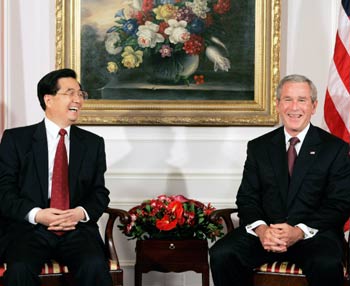
Presidents Hu Jintao and George Bush

For example, Parade claims that at least 400,000 residents of Beijing were forcibly evicted from their houses prior to the 2008 Olympics. That’s not true—the people sent from Beijing before the 2008 Olympics was transient labor and did not have residence cards and could not own property in Beijing. They were not legal residents and many transient laborers in China rent rooms shared with others in a communal environment crowded with bunk beds crammed in every possible space—like a military barracks. I know, because I’ve seen places like this in Shanghai. I also learned that the government paid for the transportation costs.

The reason Beijing sent those people away was because some were from Tibet and Xinjiang and may have been separatists, who might have staged protests to embarrass China—something the Chinese government avoids like the plague. The truth is, those people were sent home to their villages and were allowed to return to work after the Beijing Olympics. For them, it was like a vacation. Most also return to their villages during the Chinese New Year to be with their families because that’s where their homes are.

Since the Chinese Constitution rules China, Hu Jintao does not exercise arbitrary authority over the lives of his citizens. In fact, I doubt if he makes any legal decisions since the Chinese Constitution puts that power in the hands of China’s legal system. Discover more at China Law and Justice System

Parade is also wrong that China’s president cannot be removed from power through legal means.

Article 79 says, “The term of office of the President and Vice-President of the People’s Republic of China is the same as that of the National People’s Congress, and they shall serve no more than two consecutive terms.”

Article 59. The National People’s Congress is composed of deputies elected by the provinces, autonomous regions and municipalities directly under the Central Government, and by the armed forces.

Article 63. The National People’s Congress has the power to recall or remove from office the following persons:

(1) The President and the Vice-President of the People’s Republic of China;

(2) The Premier, Vice-Premiers, State Councillors, Ministers in charge of Ministries or Commissions and the Auditor-General and the Secretary-General of the State Council;

(3) The Chairman of the Central Military Commission and others on the commission;

(4) The President of the Supreme People’s Court; and

(5) The Procurator-General of the Supreme People’s Procuratorate.

Discover Stereotypes and/or The Failure of Multiculturalism in the United States

______________

Lloyd Lofthouse is the award-winning author of The Concubine Saga. When you love a Chinese woman, you marry her family and culture too. This is the love story Sir Robert Hart did not want the world to discover.

To subscribe to “iLook China”, look for the “Subscribe” button at the top of the screen in the menu bar, click on it then follow directions.

Three Hundred Years – Part 5 of 5

April 7, 2010

When I read the Chinese Constitution, Article 35 does say, “Citizens of the People’s Republic of China enjoy freedom of speech, of the press, of assembly, of association, of procession and of demonstration.”

However, there are resitrictions to Article 35 when other articles in the Constitution are considered.

Article 1. The People’s Republic of China is a socialist state under the people’s democratic dictatorship led by the working class and based on the alliance of workers and peasants. The socialist system is the basic system of the People’s Republic of China. Sabotage of the socialist system by any organization or individual is prohibited.

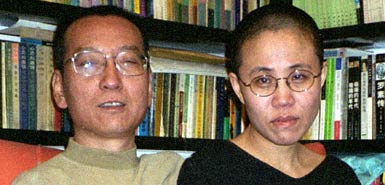
Liy Xiaobo and his wife

Regardless of how many in the West sympathize with Liu Xiaobo’s prison sentence, he was sent to prison according to Article 28 of China’s Constitution. Liu had to know what the potential consequences were. After all, the Chinese Constitution is taught in the public schools.

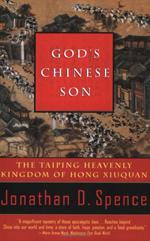
There will always be individuals in China like Hong Xiuquan, Liu Xiaobo and other Chinese activists who would fit better in a Western culture than in China.

The only way to change China is if the West fought an apocalyptic war killing more than a hundred million Chinese then spent three hundred (or more) years brainwashing future generations to adopt Western ways.

This should please American neo-conservatives, since it would create a world they advocate.

See American Genocide http://wp.me/pN4pY-6S


Three Hundred Years – Part 4 of 5

April 6, 2010

I’m sure that Liu Xiaobo spoke he did not remember the Boxer Rebellion when many Chinese became angry due to the foreign influence and Christian missionaries converting an increasing number of Chinese to an alien religion that did not fit the culture.

Hundreds of thousands of Chinese took part in the Boxer Rebellion at the end of the 19th century. Their goal was to drive the foreign influence from China even if they had to kill them all. Tens of thousands died while only a few hundred foreign Christians were killed. Western troops, once again, poured into China to suppress this uprising by Chinese peasants who wanted to reclaim their culture and rid the country of foreign influences.

Liu Xiaobo's Grieving Wife

This leads me back to Liu Xiaobo’s wife, who (after her husband was sentenced to eleven years in prison) said, “The constitution says citizens have the right to free speech. But in 20 years in China, Xiaobo has never enjoyed that freedom. The words he wrote were only published outside.”

Wait a minute!  If Liu Xiaobo does not live in the United States, does the Constitution of the United States have an influence on legal decisions in China?

Since Liu may have violated the rule of law in China, the Chinese courts interpret what their constitution means—not the United States or any Western nation/citizen.

To understand the Chinese Constitution, one should read it carefully. If one article mentions a freedom, another article may partially restrict it. The American Constitution is no different. There are restrictions on freedom of speech even in America—they just aren’t the same as those in China.

See Foreign Devils and Barbarians http://wp.me/pN4pY-6h


Three Hundred Years – Part 3 of 5

April 6, 2010

After the Opium Wars, Christian missionaries flooded China. Hong Xiuquan, a failed student of Confucian doctrine, found success after converting to Christianity. Hong claimed that he was the younger brother of Jesus Christ and started the Taiping Rebellion that lasted more than a decade and cost more than twenty million people their lives.

Hong Xiuquan - God's Chinese Son

Hong’s goals were to replace the Ch’ing Dynasty and rid China of Opium. After achieving that goal, he was going to convert China to a Christian nation and he would be the first Christian emperor.

Since the English and French did not want the opium trade stopped, these Christian nations helped the Ch’ing Dynasty defeat the Taipings even though the rebellion was a Christian uprising. I wonder if Liu Xiaobo had this in mind when he said what it would take to change China to be as Hong Kong is today.

See When in Rome, Do as the Romans http://wp.me/sN4pY-354