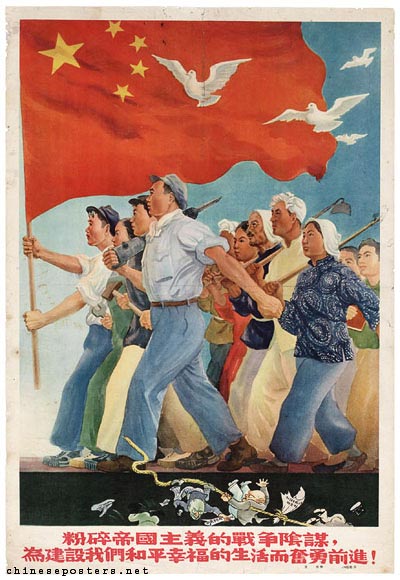
China: The Roots of Madness – Parts 7 & 8 of 8

June 12, 2010

In Part 7, it is 1948 and Mao attacks. His army leaves the caves and captures Manchuria. When Chiang Kai-shek’s northern army surrenders, modern American weapons and equipment fall into Mao’s hands. Mao demands total surrender, but Chiang’s army boards ships for Taiwan taking China’s wealth and historical treasures. In fear, western businessmen and missionaries flee China.

By 1967, when this documentary was produced, Mao had ruled China for 18 years. Protected by America, Chiang was still in Taiwan serving as president for life. He also had six-hundred thousand Kuomintang troops, and the island people lived under martial law.

Theodore H. White says America does not understand Communist China. America could not predict the “Great Leap Forward” or the purges that followed. He says the quality of life for the peasants had not improved. They still worked like beasts as they always had.

Part 7 ends with words of fear for the world’s future because China has nuclear weapons. There is no mention that America has enough nuclear weapons to destroy the earth a hundred times over. In Part 8, White concludes the documentary in about two minutes.

Return to Part 6, The Roots of Madness or start with The Roots of Madness-Part 1

View as Single Page

______________

Lloyd Lofthouse is the award-winning author of the concubine saga, My Splendid Concubine & Our Hart. When you love a Chinese woman, you marry her family and culture too.

If you want to subscribe to iLook China, there is a “Subscribe” button at the top of the screen in the menu bar.


China: The Roots of Madness – Part 3/8

June 9, 2010

In Part 3, death claims Sun Yat-sen (1866 – 1925) after he has accepted support from Soviet Russia. Soon, General Chiang Kai-shek (1887 – 1975), with help from the Communists, consolidates power in southern China.

Chiang is known to Westerners as a fiery nationalist and revolutionary.  He mobilizes an army under Sun Yat-sen’s flag and marches north with a few divisions. Meanwhile, the warlords have gathered a half-a-million troops to stop him. Outnumbered, Chiang sends an advance group of nationalists and communists to call the peasants and workers to join his army.

Among those peasants and workers is Mao Tse-tung (1893 – 1976).  While moving north, Chiang’s army raids foreign concessions, burns foreign buildings and tears down foreign flags.  Leftist leaders of the Kuomintang start to distrust Chiang Kai-shek and some want to assassinate him but others disagree.

In Shanghai, Chiang Kai-shek, now a dictator, strikes first on April 12, 1927. His troops kill anyone suspected of being a Communist. In December, there is a Communist uprising in Canton. A battle rages for two days between the Communists and Kuomintang ending in the executions of most of the Communists, but Mao escapes and goes into hiding.

Continued in Part 4, The Roots of Madness or return to Part 2, The Roots of Madness.

View as Single Page

______________

Lloyd Lofthouse is the award-winning author of the concubine saga, My Splendid Concubine & Our Hart. When you love a Chinese woman, you marry her family and culture too.

If you want to subscribe to iLook China, there is a “Subscribe” button at the top of the screen in the menu bar.


2-28 Massacre in Taiwan

June 1, 2010

By accident, I stumbled on a Blog about the “2-28 Massacre” in Taiwan in 1947 when Kuomintang soldiers under orders from Cheng Kai-shek, an American ally, slaughtered about 30,000 Taiwanese citizens. It was the first time I’d heard of this incident. Source Blog: Patrick Cowsill

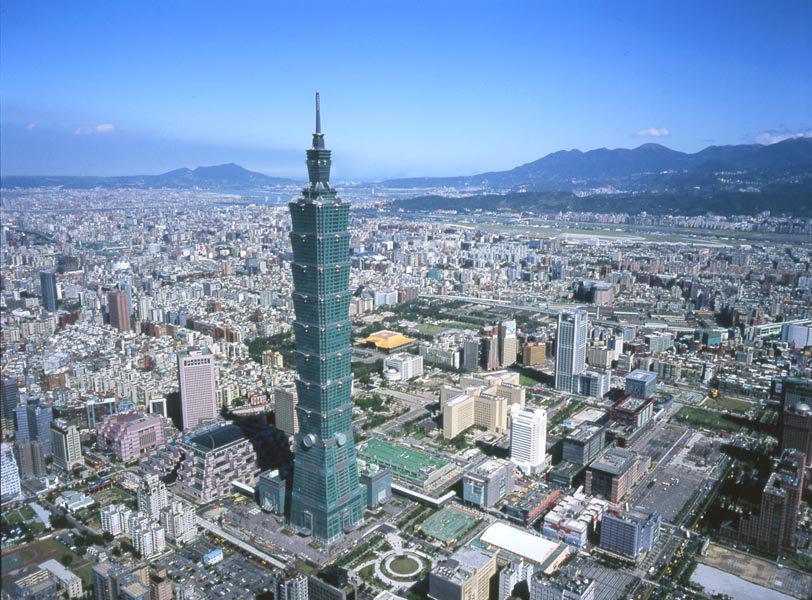
Taipei, Taiwan

When I typed into Google “Tiananmen Square protest”, 1 million 260 thousand (1,260,000) hits came back condemning the 1989 Massacre in Tiananmen Square. “Several hundred civilians have been shot dead by the Chinese army during a bloody military operation to crush a democratic protest in Peking’s (Beijing) Tiananmen Square. Source: BBC

Then I typed a similar question about the massacre in Taiwan by an American ally and 21,200 hits came back.

Here’s what the BBC had to say about the Taiwan incident, “The event was an uprising sparked by the beating of a female vendor by authorities for selling untaxed cigarettes. Between 18,000 and 28,000 people are said to have been killed in riots and a subsequent crackdown.” Source: BBC

Compare the language.  When it was about the Communists, it was a “bloody military operation to crush a democratic protest” but when the killings were committed by an American ally, it was “an uprising…sparked by the beating of a female vendor by authorities….”

Of course, we will always remember the man standing in front of the tanks in Tiananmen Square. Have you forgotten what happened in Taiwan yet?

______________________________

Lloyd Lofthouse is the award-winning author of My Splendid Concubine [3rd edition]. When you love a Chinese woman, you marry her family and culture too. This is the lusty love story Sir Robert Hart did not want the world to discover.

IMAGE with Blurbs and Awards to use on Twitter

Where to Buy

Subscribe to “iLook China”!
Sign up for an E-mail Subscription at the top of this page, or click on the “Following” tab in the WordPress toolbar at the top of the screen.

About iLook China

China’s Holistic Historical Timeline


American Grasshoppers and Chinese Ants

May 26, 2010

In The Ant and the Grasshopper, as retold from Aesop’s fable and illustrated by Amy Lowry Poole, the grasshopper plays, while the ants work and save diligently gathering grain for winter. The ants urge the grasshopper to prepare for hard times, but the grasshopper will not be bothered.

After all, under Confucianism, absolute obedience to authority, a strict family structure and hard work have been valued for more than two millennia so the ants keep working while grasshoppers play.
In Time to Defriend China, Elizabeth Economy (Is that really Liz’s last name—Economy?) and Adam Segal say we should stop negotiating with China. This post at the “Foreign Policy” Blog, like the grasshopper in Aesop’s fable, is self-centered and out of touch.

Liz and Adam say China isn’t cooperating globally as if China has an obligation. They say, “The sticking points in U.S.-China relations are mirrored in China’s relations with much of the rest world. The European Union and Japan, for example, find it no easier to negotiate with China on issues such as trade, climate change, cyber conflict and the Dalai Lama.”

Really— climate change and cyber conflict? Didn’t China recently announce they were going to cut carbon emissions by 40% or more in the next few years while President Obama thought the US might reach 17%? As for cyber conflict, that’s a two-way street, and the Dalai Lama’s claims are a mix of big lies and small truth.

Meanwhile, China has its hands full with a greater challenge—the 1.2 billion Chinese outside the Communist Party who expect a better life.

In 1950, China was generating 0.005 kilowatts of electricity and much of the country was without.  Under Mao, there was the tragedy of The Great Leap Forward and The Cultural Revolution costing tens of millions of lives. It wasn’t until Mao was gone that China started modernizing and improving the lifestyles of hundreds of millions of people.

Today, China is breaking records building modern cities and growing the second largest economy in the world and with a savings account. However, China still has 750 million people without proper medical care, electricity or modern connivances. In addition, they have problems with Tibet and with the Uyghurs in Xinjiang Province, who want to break free with support from Hollywood and maybe the CIA.

Then there is the Taiwan issue. If the US had not interfered in 1949, that issue would not exist. Taiwan would be part of China today and America would have a larger Chinese population.  Don’t forget that the Kuomintang until the 1980s, was a dictatorship that America supported and the Taiwanese were burdened with martial law for more than thirty years.

When China meets its goals at home, then “maybe,” China will be willing to help the West.
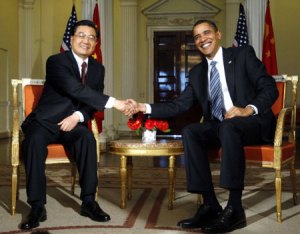
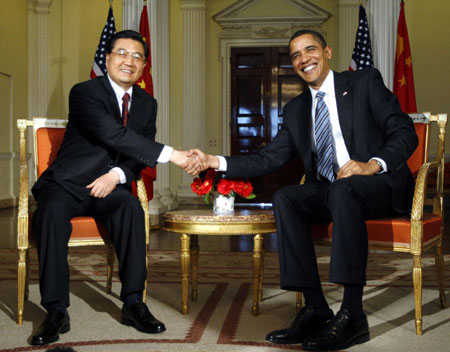
Hu Jintao and Obama shaking hands

Instead of walking away from negotiations as Liz and Adam suggest, the US and the rest of the developed world should find ways to offer a win-win situation that helps China meet its internal goals. How will China do that if they allow the global exchange rate for their currency to fluctuate putting millions of Chinese out of work? If America wants to grow jobs, the US must find ways to do so without hurting the Chinese worker any more than these people have already been hurt. Since the 2008 global economic crises caused by American greed, more than 20 million Chinese workers lost their jobs and 70,000 factories went out of business.

Like those ants in the fable, don’t expect the Chinese to come running to rescue nations that squandered their future while China is still building one. A better opinion on this topic might be this one from Martin Wolf in the Financial Times.

____________________________

Lloyd Lofthouse is the author of the award winning novels My Splendid Concubine and Our Hart. He also Blogs at The Soulful Veteran and Crazy Normal.

Sign up for an RSS Feed for iLook China
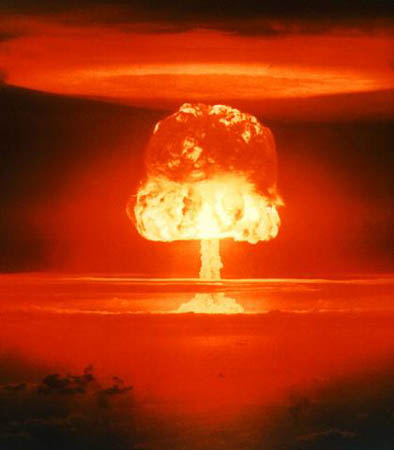

Freedom’s Evolution

May 11, 2010

A debate took place on Left of the Right, not by Devin Barber, the Blog’s host, but between me and another person who called him or herself Timothy. This person made comments calling me an asshole and a propaganda spewing scumbag among other insults, because he disagreed with my opinions regarding China even though I supported most or all of my opinions with facts. You may read the entire debate by clicking on the above link to see an example of Timothy’s conservative beliefs.

One of my last responses was a comparison between America and China and the trail to freedom that both counties have followed and are still traveling. What follows is a slightly edited version.

In 1781, the American War for Independence from the British Empire ended, but there was still slavery in the Southern States.

American Revolution

In 1861 to 1865, (eight-four years after America’s revolution) America divided and fought a bloody Civil War that ended slavery. More than six hundred thousand Americans died in that conflict. 

However, women still could not own property or vote. Women were considered chattel.  The women’s rights movement started in 1848. In 1920 (seventy-two years later), the 19th Amendment to the US Constitution granted women the vote.

American history is full of facts about how people of color were discriminated against and were second-class citizens until the Civil Rights Movement between 1955 to 1968.  It took one-hundred-and-three years after the end of slavery to end discrimination against people of color—at least legally.

_________________

The bloody and painful evolutionary trail to freedom in China started in 1913 when warlords ended Imperial rule.  Eventually a dictatorship replaced the warlords.  The Kuomintang under Chiang Kai-shek was a dictatorship under martial law even in Taiwan until the 1980s when the first election was held there.

Another step back was World War II with the Japanese invading China that cost about 30 million Chinese their lives. That ended in 1945, followed by the revolution between the Communists and Kuomintang dictatorship.  Soon after Mao won that revolution in 1949 and took over China to become China’s modern emperor for twenty-seven years, he declared that women were equal to men.  Then there was the Great Leap Forward, which was more like two leaps back followed by the Cultural Revolution that cost another thirty-seven million Chinese their lives.

Chinese Revolution

After Mao died in 1976, the Communist Government under Deng Xiaoping’s guidance rewrote their constitution, repudiated Marxist, Maoist revolutionary doctrine and opened China to the world launching a market economy, which is on steroids today.

Since that new start, amendments have been added to the Chinese Constitution. Read it carefully and you will see that freedom of speech in China is limited by a constitution that is taught in the schools and in the factories. Although some Chinese dissidents have been arrested for speaking and jailed with other criminals, 98.8% of the population remains free and appears to have no problem obeying that law.

America’s journey to become a nation where ALL citizens are protected by the Bill of Rights took one-hundred-and-eight-seven years from 1781 to 1968.

China, after Mao, has had only thirty-four years to evolve.  Who knows where China will be in another century and a half. Timothy sees the glass half-empty. Since I watch China, I’ve seen the small steps that China has been taking, and I see the cup half-full and improving with time. I hope I’m right, because Timothy seems to believe that China is evil and will invade the United States in a few decades. What do you think?

____________________________

Lloyd Lofthouse is the author of the award winning novels My Splendid Concubine and Our Hart. He also Blogs at The Soulful Veteran and Crazy Normal.

Sign up for an RSS Feed for iLook China