Not One Less (1999)

May 8, 2010

In the movie Not One Less, a thirteen-year-old girl is asked to be the substitute teacher in a small Chinese village.  The teacher tells her that when he returns, if he finds all the students there, he will pay her ten yuan—less than two American dollars.

Although money is involved, it isn’t much. When one student, Zhang Huike, stops coming to school, Wei Minzhim, the thirteen-year-old substitute, follows him to the city.

There are several themes in this movie. The most powerful to me were the value of an education and not losing face. If Wei loses Zhang, she will fail the responsibility the teacher gave her. To succeed, she must keep all the students and teach them.

Confucius taught the Chinese that an education was the great equalizer and the key to leaving poverty behind. Most Chinese believe this with a passion.

Zhang Yimou was the director. He says, “Chinese culture is still rooted in the countryside. If you don’t know the peasant, you don’t know China.” Because of this, there is a strong message in this movie about the urban–rural divide, which is being addressed as China sews the nation together with high-speed rail and electricity.

This a powerful movie about children, education, and poverty that shows the challenges China faces in lifting the lifestyles of almost eight hundred million Chinese, who don’t live in the cities. The challenge is to do this without losing the values that made China what it is.

_______________

Lloyd Lofthouse is the award-winning author of My Splendid Concubine [3rd edition]. When you love a Chinese woman, you marry her family and culture too. This is the love story Sir Robert Hart did not want the world to discover.

His latest novel, Running with the Enemy, was awarded an honorable mention in general fiction at the 2013 San Francisco Book Festival.

Subscribe to “iLook China”!
Sign up for an E-mail Subscription at the top of this page, or click on the “Following” tab in the WordPress toolbar at the top of the screen.

About iLook China


Where Does the Money Go?

May 6, 2010

“China doesn’t keep all the money paid for products made in China. Everyone in the supply chain shares.” I heard Zachary Karabell say this at the 2010 Los Angeles Times Festival of Books.

Today, I read a post in Bind Apple that emphasized the fact that Apple products are made in China but didn’t mention that Apple also manufactures in the United States, Malaysia and Indonesia and other countries. The post also emphasized the sixty-hour workweek and low pay as if it were a bad thing.

In fact, Apple says, “Their products and components are manufactured by a wide variety of suppliers around the world.  The final assembly of most products occurs in China.”

Most Chinese do not mind working sixty-hour weeks and the money earned may be low by American standards but is higher than most rural Chinese earn. 

These factory workers also send money home and manage to save, since China’s average saving rate is 40%. China’s culture is based on Confucianism, which focuses on collective rights instead of the individual.  Those workers are not working for themselves. They are working for their family and that includes parents and grandparents, who are contributing too.

Learn more about who Confucius was, or see what was going on at Apple’s Foxconn facility in Guanlan, China.

Lloyd Lofthouse is the author of the award winning novels My Splendid Concubine and Our Hart. He also Blogs at The Soulful Veteran and Crazy Normal.

Sign up for an RSS Feed for iLook China


The Life of Confucius – Part 5/5

May 5, 2010

In 484 BC, a former student convinced the rulers of Lu to call Confucius home.  He returned to Chufu still believing he would find a ruler who would listen to him.  The ruling warlords asked him how to find honest officials.

Confucius replied, “Be honest yourself.”

He was ignored and retired to edit the poetry and books he loved. From his study, he watched the powerful leaders fight horrible wars among themselves and witnessed the Chinese people suffering. His daughter was married. His son, who died young, was lazy and hated learning.

In his old age, his students were his family. Claims say that he had about three thousand followers but only seventy-two were devoted to him. One student was his favorite.  Yen Hui reminded Confucius of his own youth. He believed that Yen Hui would carry on his work but at forty-one, Yen Hui died. Confucius wept saying, “Heaven has turned against me.”

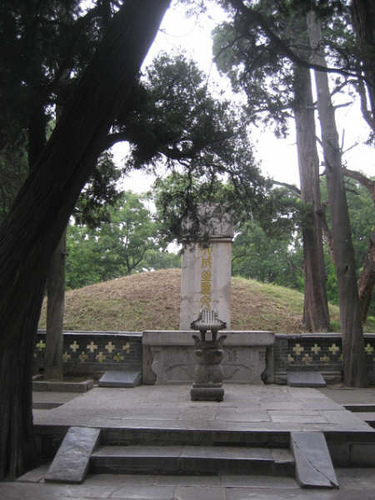
Confucious grave for tourists

Depressed, Confucius thought, “Now I know that heaven has a will of its own.” In 479 BC, Confucius died. His last words were bitter. “Will no ruler come forward and take me as his master.”  He saw himself as a failure. He had no idea that his thoughts would become the dominate philosophy of China for centuries.

Today, billions work hard, value an education and believe that every person has a chance at success.

Return to Part 4 of “The Life of Confucius” or go here to learn more about The influence of Confucius.

_______________

Lloyd Lofthouse is the award-winning author of My Splendid Concubine [3rd edition]. When you love a Chinese woman, you marry her family and culture too. This is the love story Sir Robert Hart did not want the world to discover.

Subscribe to “iLook China”!
Sign up for an E-mail Subscription at the top of this page, or click on the “Following” tab in the WordPress toolbar at the top of the screen.

About iLook China


The Life of Confucius – Part 4/5

May 4, 2010

His success and radical ideas were making him dangerous enemies.  The three warlords of Lu formed an alliance to get rid of Confucius.

They found the most beautiful girls in the state and sent them to the young ruler, who spent his days and nights with the beauties, and Confucius was forgotten.  Stunned and humiliated, Confucius took his loyal students and left the state of Lu to find another ruler to support his ideas.

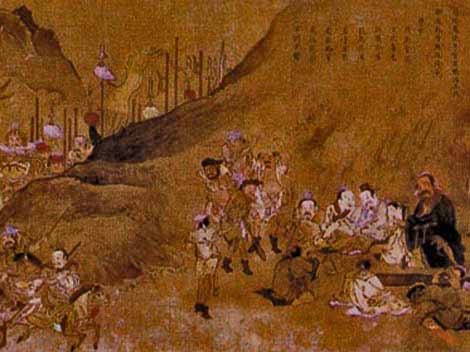
Confucius traveling with his students.

At fifty-four, Confucius was tough. From 497-484 BCE, he walked great distances from state to state.

During this journey, he and his students witnessed the suffering of the peasants. He knew that only the nobility could end the suffering, but none of the rulers would listen to him.

It was during this time that Confucius met the philosopher Lao Tse, who warned him to keep quiet or he was going to be killed.

Return to Part 3 of “The Life of Confucius” or go  to Part 5

_______________

Lloyd Lofthouse is the award-winning author of My Splendid Concubine [3rd edition]. When you love a Chinese woman, you marry her family and culture too. This is the love story Sir Robert Hart did not want the world to discover.

Subscribe to “iLook China”!
Sign up for an E-mail Subscription at the top of this page, or click on the “Following” tab in the WordPress toolbar at the top of the screen.

About iLook China


Chinese Poetry

May 3, 2010

Traditional Chinese Poetry is very similar to Western poetry.  Lines in Chinese poetry may have a fixed number of syllables and rhyme was required, so ancient Chinese poetry resembles traditional English verse and is not at all like the free verse in today’s Western culture.

Modern Chinese poets have written in free verse, but many still write with a strict form.

In the end, the form is not as important as what the poem says. Western poetry often focuses on love while painting an image of the poet as a lover.

Influenced by Confucius and Taoism, the ancient Chinese poet shows he or she is a friend—not a lover and often paints a picture of a poet’s life as a life of leisure without ambitions beyond writing poetry and having a good time.

Chinese Dragon Boat Races

According to legend, this Chinese poet killed himself to protest the corruption of the time, and it is said that the Dragon Boat Festival was named to honor his sacrifice.

Battle
By Qu Yuan (332-295 B.C.)

We grasp our battle-spears: we don our breastplates of hide.
The axles of our chariots touch: our short swords meet.
Standards obscure the sun: the foe roll up like clouds.
Arrows fall think: the warriors press forward.
They menace our ranks: they break our line.
The left-hand trace-horse id dead: the one on the right
is smitten.
The fallen horses block our wheels: they impede the
yoke-horses?”

Translated by Arthur Waley 1919

If interested in Chinese art and/or opera, see Peking Opera.