Bald Eagle Capitalism

April 24, 2011


The Economist’s
cover for the March 12, 2011 issue of what the British call a newspaper disguised as a magazine had a cover with Bamboo Capitalism splashed in big print over a picture of a bamboo forest with people riding red butterflies.

The Economist says, “China’s success owes more to its entrepreneurs than its bureaucrats.”

 True, but The Economist also says China’s economic success has often been vaguely attributed to “capitalism with Chinese characteristics”… taken to mean, “Bureaucrats with heavy, visible hands have worked much of the magic.”

Hmm, I never saw it that way. I don’t think the Party in Beijing sees it that way either or cares what anyone in the West thinks.

Although The Economist goes on to point out that government bureaucrats have less to do with China’s success than most think, it is a fact that government intervention in China’s economy helped China survive the 2008 global financial crises caused by America’s obese, debt ridden, diabetic, cancerous capitalist economy, which I have termed Bald Eagle Capitalism.

Bamboo Capitalism is a good term to identify China’s “capitalism with Chinese characteristics”.  In China, bamboo is considered a symbol of luck. It is flexible. People may eat part of it. It stays green most of the time. It is used in construction, to cook food, make floors, furniture, etc. In ancient times, warriors used bamboo as armor.

The flexible way Chinese entrepreneurs are allowed to do business is the primary reason for China’s economic success, but the central government’s control over property values and banking also deserves credit — an area the US government turned a blind eye to, which led to the 2008 global financial crises and about 64 trillion dollars in global losses along with tens of millions of lost jobs around the world.

The documentary Inside Job revealed the infamous Wall Street architects of the 2008 global financial crises and how they are still in charge at the same jobs where they caused the crash in the first place.

If these same men and women had lived in China, China’s bureaucrats may have quickly executed them so the same crises might not happen again as soon as it may repeat in the West.

In fact, Bald Eagle Capitalism is a fit term to describe the US economic system.

The Bald Eagle is not only the national bird, it is a bird of prey and although it will eat fresh fish, its primary source of food is from carrion, which vultures (a term to describe the people behind the 2008 global financial crises) feed on too.

The Bald Eagle’s diet is opportunistic and varied. The Bald Eagle will also eat the garbage from campsites, picnics and dumps.

Bald Eagles are an endangered species, as is the American economy.

Discover how High-Tech Entrepreneurs Thrive in China

______________

Lloyd Lofthouse is the award-winning author of the concubine saga, My Splendid Concubine & Our Hart. When you love a Chinese woman, you marry her family and culture too.

If you want to subscribe to iLook China, there is a “Subscribe” button at the top of the screen in the menu bar.


Mostly Free to be Poor

February 15, 2011

Riz Khan hosts a program for Al Jazeera English and in this twenty-two minute segment, he leads a discussion about the possibility that democracy hinders economic growth.

Khan asks, “Is a centralized system, such as China’s one party, better than democracy for growth?”

Both India and China became countries about the same time.  In 2008, India’s GDP was $1.16 trillion and China’s was about three times larger at $4.33 trillion.

There is a debate in India that China’s one party political system has allowed China to modernize and improve lifestyles easier and faster than India’s democracy.

His first guest speaker is Tarun Khanna, a professor of the Harvard School of Business, who does not agree with the argument that India’s democracy is the cause of slow growth.

His opinion is that democracy may be a faulty option but it is the best of the faulty options we have. However, he says it is true that India’s democracy has underperformed.

Then MIT Professor Yasheng Huang says in the last thirty years, the leadership in China has improved its decision-making and made many correct decisions regarding productivity.

A listener to the program sends a message from Facebook.  “All a country needs is purposeful leadership, security, vision, and justice for all. China has demonstrated all this, unlike India.”

Professor Huang disagrees with the Facebook comment.

Kahanna says that China’s strong leadership has been an asset and that even in the Communist Party there is a meritocracy of sorts, which is a system of advancement based on individual ability or achievement—something that India’s political system lacks at this time.

Regarding a dictatorship, Huang says a dictatorship wouldn’t work in India. The culture is too complex.

Kahanna agrees that a dictatorship wouldn’t work in India and says India has to improve its democracy.

Huang feels if China doesn’t change its economic structure and put more emphasis on private companies, India will be the better place to do business in regards to long-term growth.

Kahanna says India’s biggest challenge is to include as many people as possible to share in the economic growth and more than half of its population has been left in poverty.  He says the biggest challenge will be basic health care and education and there has to be more opportunities in India for more people. The caste system in India is also a problem. India’s politicians must stop politicizing the cast system.

Professor Huang then says that democracy is not a solution to solve all of society’s problems. There has to be more than free elections. However, an authoritarian system is also not the answer. He says, take the strengths of both India and China and figure a way to take advantage of them—to make them work.

Learn more at India Falling Short

______________

Lloyd Lofthouse is the award-winning author of the concubine saga, My Splendid Concubine & Our Hart. When you love a Chinese woman, you marry her family and culture too.

If you want to subscribe to iLook China, there is a “Subscribe” button at the top of the screen in the menu bar.


The India, China battle to eliminate poverty and illiteracy

November 2, 2010

Chris Devonshire-Ellis wrote a convincing piece at China Briefing that India‘s economic growth would speed past China in the near future. 

He says, “It (India’s) growth rate could overtake China’s by 2013… Some economists think India will grow faster than any other large country over the next 25 years.”

However, there are flaws in that opinion.

Once again, the foundation of this prediction is based on India being a democracy “where entrepreneurs are all furiously doing their own thing” while China is a culture of secrecy and censorship. Chris mentions a few of China’s other flaws too, which China is struggling to overcome.

What Chris doesn’t mention is the difference in poverty and illiteracy between India and China.

India and China both became independent about the same time—China in 1949 and India in 1947.  Due to Chairman Mao’s policies, China suffered horribly from 1949 to 1976 and little progress was made.

For China, most of the progress has taken place in the last three decades. India, on the other hand, has had more than 60 years to solve its problems.

Let’s see what each has accomplished.

The World Bank says, “that China’s record of poverty reduction and growth is enviable. Between 1981 and 2004 the fraction of the population consuming less than a dollar-a-day fell from 65% to 10% and more than half a billion people were lifted out of poverty.”

For India, the World Bank says, “poverty remains a major challenge. According to the revised official poverty line, 37.2% of the population (about 410 million people remains poor, making India home to one-third of the World’s poor people.” UNICEF shows the poverty in India to be 42%.

World Bank studies also established the direct and functional relationship between literacy and productivity on the one hand and literacy and the overall quality of human life on the other.

India’s literacy rate was about 12% when the British left in 1947. Today, literacy is 68%.

In China, literacy is more than 93% with a goal to reach 99% in the next few years.

This means that India has about 800 million literate people competing with 1.2 billion in China.

As for India succeeding, MeriNews.com says, “At a time when we (India) are poised on the threshold of becoming a superpower, the rampant malnutrition and prevalence of anemic children and women to the extent of 48 per cent of the population is a definitive indicator that we have failed as a democracy in ensuring the fundamental requirements of our citizens.”

It appears that China—with its censorship, secrecy and socialist government—has done a much better job of taking care of its citizens.

See the other posts on this topic at India Falling Short and Comparing India and China’s Economic Engines

______________

Lloyd Lofthouse is the award-winning author of the concubine saga, My Splendid Concubine & Our Hart. When you love a Chinese woman, you marry her family and culture too. 

If you want to subscribe to iLook China, there is a “Subscribe” button at the top of the screen in the menu bar.


Democracy’s Economic Roller Coaster

October 22, 2010

In a Brief History of Economic Downturns, Business Intelligence says, “At the amusement park that is the American economy, capitalism is a lot like that roller coaster, a never-ending ride with lots of twists, turns, ups, and downs – or booms and busts…”

Nine major economic crashes were listed.

There was the Panic of 1819, which lasted five years.

The Panic of 1826 went for six years.

In 1857, a single major company went out of business and dragged the entire US economy down.

In 1873, Jay Cooke & Company, the largest US bank at the time failed triggering a recession that lasted six years.

The next serious crash was the panic of 1907, causing massive job losses and many business failures.

In 1918, hyperinflation in Europe and the end of US wartime production caused a brief but severe downturn in the American economy.

The Great Depression imploded in 1929 with the collapse of the stock market and the American banking system and wouldn’t end until the beginning of World War II.

In 1973, the price of gas at the pump soared leading to long lines to fill gas tanks.

Then the Dot–Com Bubble burst in combination with 9/11/2001.

When the sub-prime mortgage bubble exploded in the U.S. in 2008, about 80,000 private owned businesses in China went out of business and 15 to 20 million workers lost jobs – much bigger numbers than the U.S. suffered.

However, within a few weeks, those who had lost their jobs in China were back at work or had returned to rural China to the collective farm.

Why should China cave in to pressure from America and Europe and turn its economy into another Wild West show?

Also see The Reasons Why China is Studying Singapore

______________

Lloyd Lofthouse is the award-winning author of the concubine saga, My Splendid Concubine & Our Hart. When you love a Chinese woman, you marry her family and culture too. 

If you want to subscribe to iLook China, there is a “Subscribe” button at the top of the screen in the menu bar.


Comparing India and China’s Economic Engines

October 13, 2010

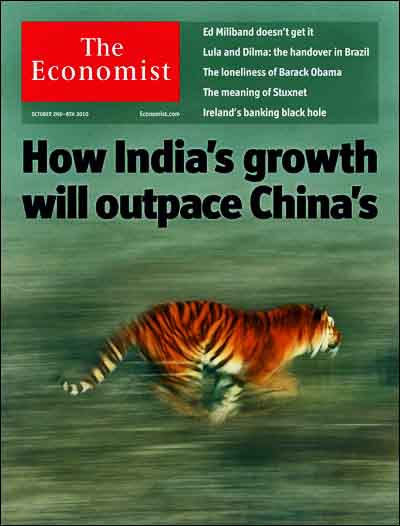
The cover for The Economist of October 2 – 8, 2010, is betting on a race that cannot be won by India.


I opened the magazine and read the two pieces that the cover was about.  One is about India’s surprising economic miracle and the second piece was A bumpier but freer road.

On page 11, I read, “many observers think China has done a better job than India of curbing corruption…”

On page 77, a Western banker was quoted saying, “It’s much easier to deal with the well-understood ‘org chart’ of China Inc than the freewheeling chaos of India.”

After reading both pieces comparing China with India, it was obvious that India would never beat China economically.

The Economist wants India to win this race, because it is called a democracy as is the U.S., but what isn’t mentioned is that China is becoming a republic with a Chinese twist, which is what Dr. Sun Yat-sen wanted.

The reason The Economist is wrong about India is because America’s Founding Fathers hated democracy and they had a good reason.

The Live Journal goes into detail on this topic.  To quote the Live Journal, “It would be an understatement to say that the (U.S.) Founding Fathers hated democracy. They warned against it vehemently and relentlessly. They equated it – properly – with mob rule.

“in a democracy, two wolves and a sheep take a majority vote on what’s for supper, while in a constitutional republic (which China is becoming), the wolves are forbidden on voting on what’s for supper and the sheep are well armed.…

“The Founders, who hated democracy, gave us a free country (a republic). Our (meaning many Americans) ignorance of history, which has lead to a love of democracy, is causing us to surrender our freedoms at an alarming rate.”

Dr. Sun Yat-sen (1866 – 1925), known as the father of modern China, said he wanted to model China’s government after America but by combining Western thought with Chinese tradition.

When he said this, it was 1910, and America, by definition, was still a republic. Once you read the two pieces in The Economist, you may understand why India’s democracy cannot beat China’s evolving republic.

This topic is continued (with more details and facts) at India Falling Short

_______________

Lloyd Lofthouse is the award-winning author of My Splendid Concubine [3rd edition]. When you love a Chinese woman, you marry her family and culture too. This is the love story Sir Robert Hart did not want the world to discover.

Subscribe to “iLook China”!
Sign up for an E-mail Subscription at the top of this page, or click on the “Following” tab in the WordPress toolbar at the top of the screen.

About iLook China