Democracy and Freedom – A Difference of Opinion

December 19, 2010

I’m sure that most Americans (as well educated as they are, and I’m being sarcastic) think all democracies are the same.

They aren’t.

The World Atlas lists 192 countries on the globe and according to Made in Democracies.org, there are 58 democracies. If correct, that means 134 countries are not democracies. This list excludes countries that claim they are democracies but are sanctioned tax havens for secret bank accounts or allow child prostitution.

If you read the entry for Democracy at Wikipedia, you will discover there are many different types of democracies.

The Economists Democracy Index has four categories. The next index from Freedom House has three.

In fact, Freedom House has another chart for Electoral democracies, which shrinks the list further.

There is another for Parliamentary democracies.

The smallest category may be for “liberal democracy” where elections should be free and fair, and the political process should be competitive. Even liberal democracies are divided into categories.

The United States is labeled as a federal republic along with India, Germany and Brazil.

The United Kingdom is listed as a constitutional monarchy along with Japan, Canada and Spain.

The biggest difference between China and most democracies is that China’s republic has one political party, which controls the state-owned media. Yet there are city and regional media in China that often publish opinions that do not appear in the national media. In addition, China’s Blogosphere is very active when it comes to expression and opinions.

In the US, six huge corporations own most of the so-called free media and an American corporation owns only one. Foreign corporations own the other five.

In America, freedom of the press means that conservative talk radio may manipulate public opinion and influence voters through lies and exaggeration, which it often does. We just saw that happen in the 2010 election.


This video explains how America became a democracy dominated by religion
.

In America, corporate lobbyists or special interest groups such as Evangelical Christians may influence elected officials to vote on bills that may not benefit the majority of the population such as confusing debates over abortion, global warming and the recent American health bill.

In China, the only way to influence a government official is by bribing him or her. If caught, that official may end up going to prison or face execution, which seldom happens in the US where bribed officials often go unpunished.

Although many call China a dictatorship, it is not. See Dictatorship Defined

Today, China is a one party republic, which is what the United States was under its first two presidents, George Washington and John Adams. In China, only Communist Party members may vote as part of a consensus and there are more than 70 million Party members.

In the American Republic created by the Founding Fathers in 1776, only white men that owned property were allowed to vote, which was about 10% of the population.

Critics of China claim that China’s 1982 Constitution allows for freedom of speech and religion. However, the truth is that there are limits on freedom of speech and religion that we never hear about from the Western media or politicians.

The US Constitution says, “Congress shall make no law respecting an establishment of religion, or prohibiting the free exercise thereof; or abridging the freedom of speech, or of the press; or the right of the people peaceably to assemble, and to petition the Government for a redress of grievances.”

The Chinese Constitution says, “Citizens of the People’s Republic of China enjoy freedom of speech, of the press, of assembly, of association, of procession and of demonstration…”

Nowhere does it say in the Chinese Constitution, “the Party will make no law prohibiting the “free exercise of freedom of speech or of the press” as it does in the US Constitution.

In fact, the same article that says “Citizens of the People’s Republic of China enjoy freedom of religious belief” also says, “No one may make use of religion to engage in activities that disrupt public order, impair the health of citizens or interfere with the educational system of the state.”

The Chinese Constitution also says, “The exercise by citizens of the People’s Republic of China of their freedoms and rights may not infringe upon the interests of the state…” and “they must not commit acts detrimental to the security, honour and interests of the motherland.”

That is why the Tibetan Dalai Lama lives in exile in India, the Falun Gong religious cult was banned in China in 1999 and Liu Xiaobo, the 2010 Nobel Peace Prize winner, is in jail. They all refuse to abide by the 1982 Chinese Constitution.

______________

Lloyd Lofthouse is the award-winning author of the concubine saga, My Splendid Concubine & Our Hart. When you love a Chinese woman, you marry her family and culture too.

If you want to subscribe to iLook China, there is a “Subscribe” button at the top of the screen in the menu bar.


Growing Cautiously Into a Modern Republic – Part 4/7

October 24, 2010

In Part 3, I talked about the differences between the Constitutions of the United States and China.

Another sign of China becoming a more open society comes from the Global Integrity Report, which shows America’s overall score in 2009 as 85 compared to China’s overall score of 60.

China legal system had an integrity score of 76.

Consider that China didn’t have a legal system when Mao died— it was a shambles. China had to build a legal system from zero and make it fit the Chinese culture.

I doubt that China will end the death penalty, and I’m sure that China will lead the world in executions for many years to come.

However, recently, several crimes that led to the death penalty were removed from that list and the law was changed so only China’s highest court could hand out a death sentence to a convicted criminal.

Business law was developed first because of world trade and China’s entrance in the WTO.

China integrity score also has inched upward on an annual basis.

In 2007, China’s score was 55, which is considered very weak. However, in 2008, the score was 59 — up 4 points and in 2009, it improved a bit more to 60.

Progress with a country of 1.3 billion people takes time. It doesn’t happen overnight.

Return to Growing Cautiously Into a Modern Republic – Part 3

______________

Lloyd Lofthouse is the award-winning author of the concubine saga, My Splendid Concubine & Our Hart. When you love a Chinese woman, you marry her family and culture too. 

If you want to subscribe to iLook China, there is a “Subscribe” button at the top of the screen in the menu bar.


Growing Cautiously Into a Modern Republic – Part 3/7

October 23, 2010

In Post 2, I talked about the importance of literacy in a democracy or republic.

To fix this problem, China leaders planned ahead fifty to a hundred years with this question in mind—what would it take to successfully modernize China and educate the people for a republican government?

In 1982, China wrote a new Constitution with term limits and age limits so there would not be another modern emperor like Mao.

That constitution has been amended several times.

Although Western critics claim the Party hasn’t implemented the freedom of press and religion mentioned in the Chinese Constitution, what isn’t said is that there are other articles that give the central government and the courts the power to stop anyone deemed a threat to the stability of China’s government and economic growth.


This video is outdated but accurate in some of its facts.  In Fact, China is now the world’s 2nd largest economy.

Article 5 says, “All acts in violation of the Constitution and the law must be investigated. No organization or individual may enjoy the privilege of being above the Constitution and the law.”

Article 28 says, “The state maintains public order and suppresses treasonable and other counter- revolutionary activities; it penalizes actions that endanger public security and disrupt the socialist economy and other criminal activities, and punishes and reforms criminals.”

Article 35 says, “Citizens of the People’s Republic of China enjoy freedom of speech, of the press, of assembly, of association, of procession and of demonstration.”

Notice that the language in Article 35 does not guarantee this freedom but says, “enjoy“, whatever that means.

China’s Constitution is not America’s Constitution. Yet China is often judged by Western critics as if it were.

Return to Growing Cautiously Into a Modern Republic – Part 2

______________

Lloyd Lofthouse is the award-winning author of the concubine saga, My Splendid Concubine & Our Hart. When you love a Chinese woman, you marry her family and culture too. 

If you want to subscribe to iLook China, there is a “Subscribe” button at the top of the screen in the menu bar.


If China government isn’t a Monarchy or a Dictatorship, what is it—Viewed as a Single Page

January 30, 2010

Three times George Washington acted in a way that would insure the newly born US Republic would survive.

His first act was in 1782, when Colonel Lewis Nicola wrote a letter to Washington suggesting that Washington should set up a constitutional monarchy because of the inefficiency of the Continental Congress.

Washington was offended at such a suggestion and wrote to Nicola telling him to banish such thoughts from his mind. George Washington – Legends and Myths

His second act took place in 1783, when he stepped in and saved the republic by ending the Newburgh Conspiracy, a plot in the military to seize power and create a military dictatorship. Source: Early America

The third act was when Washington stepped down as President (1789 – 1797) and returned to his farm.

When King George III asked his American painter, Benjamin West, what Washington would do after winning independence, West replied, “They say he will return to his farm.”

“If he does that,” King George said, “he will be the greatest man in the world.” Cato Institute

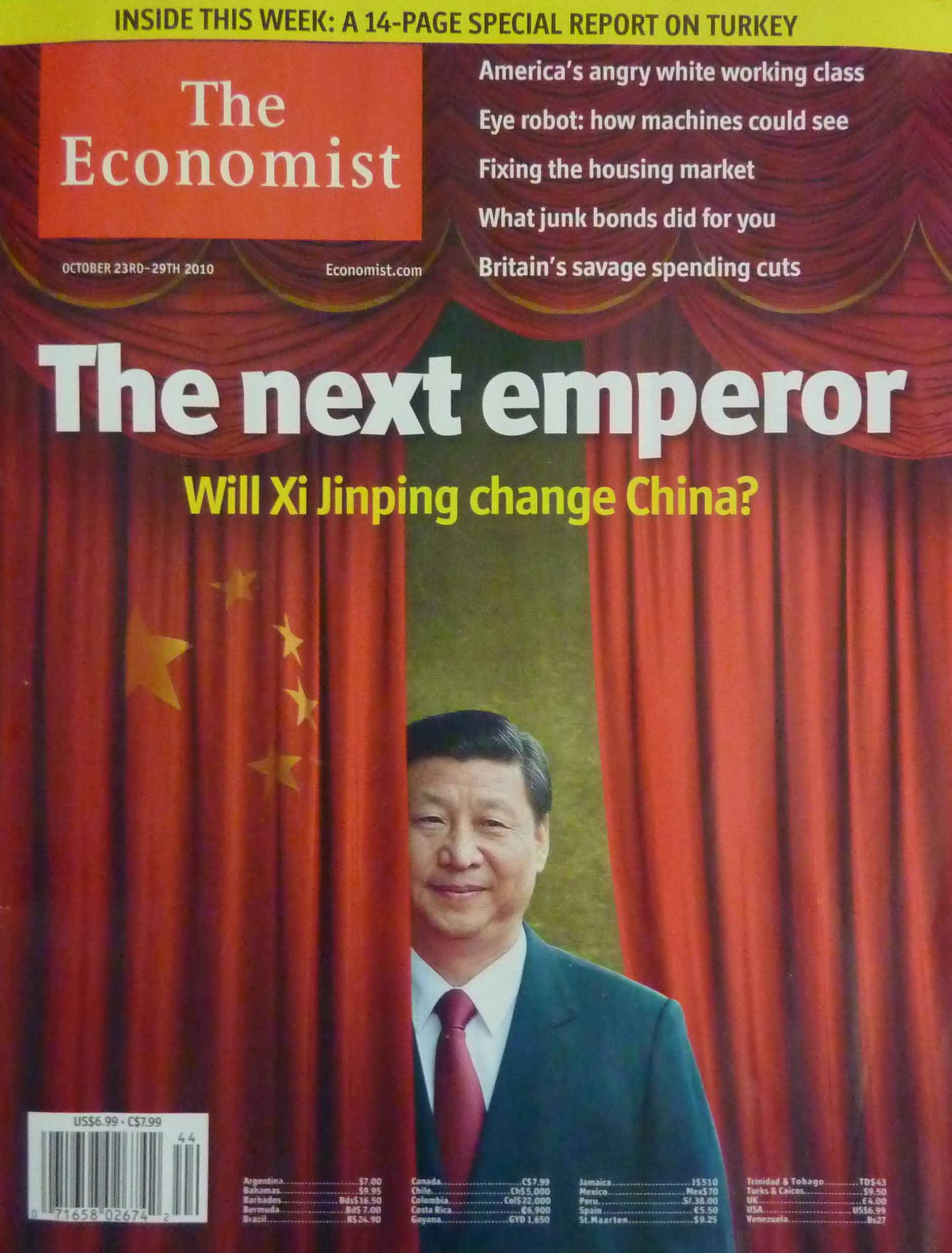
The cover of The Economist for October 23, 2010—in the best tradition of biased and Yellow Journalism— SHOUTED: “The next emperor – Will Xi Jinping change China?”

As I read the feature article on page 13, I laughed when I saw, “Mr. Xi’s appointment was eerily similar to the recent anointment of Kim Jong-un in North Korea.”

The reason I saw humor in this absurd statement was that there is nothing similar. Kim Jong Un inherited his for-life position as Supreme Leader of North Korea. He is the son of Kim Jong-il, and the grandson of Kim Il-sung, the founder of North Korea.

The Economist implied in the October 23, 2010 issue of the magazine, that China is a monarchy.

However, China is not a monarchy as the Kim Dynasty in North Korea has become or a dictatorship-monarchy as many in the West think.

In North Korea, what started as a Socialist Dictatorship modeled on Maoism has become a Socialist Maoist Monarchy.

China, on the other hand, started as a Socialist Dictatorship under Mao (1949 to 1976) and is becoming a fledgling republic with Western critics looking for cockroaches and slugs under rocks.

In fact, Dr. Sun Yat-sen, the father of China’s Republic, wrote that he wanted to model China’s government after America but by combining Western thought with Chinese tradition.

He didn’t say he wanted China to be a clone of America’s Republic.

America was still a Republic prior to World War II. The US wouldn’t become a full-fledged democracy until the 1960s.

Unfortunately, Dr. Sun died in 1925 before he could finish what he started.

It wouldn’t be until after Mao died in 1976, that the leaders of the Communist Party under Deng Xiaoping would start the long journey to implement Sun’s dream of a Republic against great pressure from Western democracies to copy them.

Before we move on, let’s take a brief look at the Athenian democracy that was developed around the 5th century B.C. in the Greek city-state of Athens. Even though there is evidence that democratic forms of government existed before the 5th century, ancient Athens is generally believed to be the first democracy.

What did that democracy look like? Athens had a system of direct democracy, in which participating citizens voted directly on legislation and executive bills. But participation was not open to all residents: to vote, one had to be an adult, male citizen, and the number varied between 30,000 and 50,000 out of a total population of around 250,000 to 300,000—about 150,000 were slaves.

In comparison, the membership of the Chinese Communist Party (CCP) is now 86.7 million—men make-up 77 percent of CP’s membership, while woman make up 23 percent—making the CCP the world’s largest political party representing more than 6 percent of China’s population, and slavery is illegal just like it is in the U.S.

Regardless of what critics claim, China is becoming more like the republic Dr. Sun Yat-sen might have imagined by combining Western thought with Chinese traditions.

After Mao died, The Communist Party worked for several years to draft the 1982 Constitution, which included term limits of two five-year terms for elected government officials.

If you have read the Chinese Constitution carefully, it is obvious that the U.S. Constitution was used as a model. However, these two documents are not the same.

If the Party leadership is not happy with China’s president, he can be removed after one five-year term. There is even an article of impeachment in China’s Constitution.

China’s first president was Li Xiannian (1983 to 1988). He served one, five-year term, and then he stepped down.

From 1988 to 1993, Yang Shangkun would be China’s president for one five-year term. Deng Xiaoping (born 1904 – died 1997) was the Chairman of the Communist Party from 1983 to 1993, which was ten years—what China’s 1982 Constitution calls for, but Deng never served as the country’s president.

Due to how the Tiananmen Square incident in 1989 was handled, President Yang had to step down at the end of his first, five-year term. The only other way to remove him would have been through impeachment.

In 1993, Jiang Zemin became President and Chairman of the Communist Party. Then in 2003, Hu Jintao became President and Chairman of the Party. His term ended in 2012 when Xi Jinping became president of China.

Deng Xiaoping was China’s George Washington. What he did was what Dr. Sun Yat-sen wanted. China is a republic that combines Western thought with Chinese tradition.

However, the task to create China’s Republic fell to the Communist Party so China is a Socialist Republic with capitalist tendencies.

In China, Piety is important and advice from elders is often followed as if it is the law. Due to this, elder statesmen such as Jiang Zemin have great power in the government even after he no longer has a political title. After all, this is a Chinese tradition.

The Economist mentioned disagreements within the CCP among China’s leaders over what the country’s priorities should be—both on the economy and on political reform.

Whatever the final decisions will be, the consensus of the CCP will be guided by Chinese tradition and not Western thought.

The changes that “some” want to see take place in China will probably not arrive in a hurry if the wisdom of the I-Ching, The Book of Changes, is followed, which says change should come slowly.

In fact, China has proven it is a republic because none of China’s first four presidents are the sons of previous presidents and eventually death removes the elders. China’s presidents did not inherit that title due to heredity as kings do or the leader of North Korea did.

_______________

Lloyd Lofthouse is the award-winning author of My Splendid Concubine [3rd edition]. When you love a Chinese woman, you marry her family and culture too. This is the love story Sir Robert Hart did not want the world to discover.

Kindle_LR_e-book_cover_MSC_July_25_2013

Subscribe to “iLook China”!
Sign up for an E-mail Subscription at the top of this page, or click on the “Following” tab in the WordPress toolbar at the top of the screen.

About iLook China

China’s Holistic Historical Timeline