The Ugly Face of Intolerance – Part 2/3

July 4, 2011

I first ran into this particular wall of intolerance on the Amazon Forum where Amy Chua’s critics left reviews and comments about her parenting methods in a hate fest that had mostly nothing to do with the memoir.

What these critics write are attacks on Chua accusing her of being a child molester, a sociopath, or a narcissist, etc.  Often, these critics do not know what they are talking about and the biased ignorance runs deep.

One claim I have been struggling to disprove was the one that said, “Amy Chua does not represent the average mainland Chinese parent and had no right to claim that her parenting methods were Chinese.”

After more than four months, the evidence I have been looking for appeared in China when the China Daily published Tiger Moms’ Popular in China on April 14, 2011.

The China Daily said, “The strict parenting style advocated by Amy Chua, the Yale law professor, in her latest book, Battle Hymn of the Tiger Mother, is still popular in the country today, according to a recent survey.”
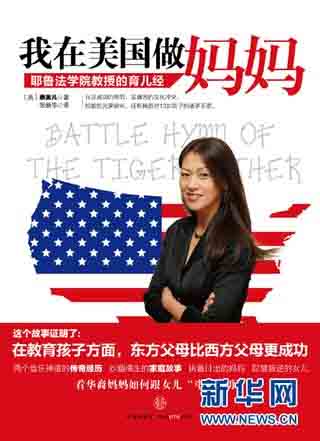
“Among 1,795 people polled online by China Youth Daily‘s social research center, 94.9 percent said they know women who are strict mothers, and 55.1 percent said they see merit in Chua’s parenting.…”

“A Beijing high school teacher, surnamed Liu, was quoted as saying that his wife had enrolled their daughter in violin and ballet classes at an early age and had resorted to scolding and spanking when the girl refused to go.

“Strict parenting is also a tradition in other Asian countries, such as Japan and South Korea,” Liu said. “It has merits in raising smarter children and preparing them better for harsh competition in the future.”

In addition, a critic of Chua’s on the Amazon Forum referred to an opinion piece posted on the Psychology Today Blog where Peter Gray, a research professor of psychology at Boston College claimed that 42 one-star reviews from anonymous people that identified themselves as Chinese was enough to conclude that the majority of Chinese (there are more than 1.3 billion Chinese and almost four million are in the US) were critical of Amy Chua’s parenting methods.

When we compare Peter Gray’s opinion in the Psychology Today Blog with information from almost 2,000 people polled online in China, which source do you think is more credible?

Continued on July 5, 2011 in The Ugly Face of Intolerance – Part 3 or return to Part 1

______________

Lloyd Lofthouse is the award-winning author of the concubine saga, My Splendid Concubine & Our Hart. When you love a Chinese woman, you marry her family and culture too.

To subscribe to “iLook China”, look for the “Subscribe” button at the top of the screen in the menu bar, click on it then follow directions.


The Ugly Face of Intolerance – Part 1/3

July 3, 2011

Recently an an expatriate American living in China sent me a link to a piece published in the  China Daily on June 3, 2011. The author was Amy Chua, who is known as the Tiger Mother.

What I read revealed (once more) that after decades of struggling to get rid of intolerance in America, that this ugly beast is very much alive in chat rooms, Internet Forums and Blogs.

As a noun, intolerance means an unwillingness or refusal to tolerate or respect contrary opinions or beliefs. As an adjective, it means lacking respect for practices and beliefs other than one’s own.

Terrorism is an example of intolerance as is racism.

The ugly face of intolerance appeared soon after an essay was published in the January 8, 2011 Wall Street Journal of Why Chinese Mothers are Superior.

A few days later, Amy Chua’s memoir, Battle Hymn of the Tiger Mother was released and a firestorm of intolerance spewing hate, ignorance and opinions expressed as facts appeared as if a volcano had erupted.

Then Amy Chua’s July 3 piece, The real hymn of the tiger mother (mentioned in the first paragraph) appeared in the China Daily.

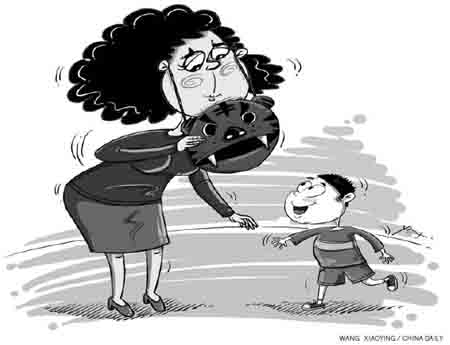
Cartoon from China Daily

Chua wrote, “For a while, I was getting 500 emails a day. Some were vicious, but many others were extremely positive and inspiring.”

It has been reported that Amy Chua also received death threats.

The problem is that often what we read on Internet Forums and Blogs are opinions written as if they are the truth, which may influence a few that cannot see the difference to react violently since the Virtual World, without the filters used by the traditional media, quickly spreads hate and lies.

Lest we forget, this sort of intolerance where opinions are expressed as facts may have encouraged Jared Lee Loughner to shoot Rep. Gabrielle Giffords of Arizona in the head, kill six (one of the dead was six years old) and wound thirteen.

“Ironically,” Chua wrote in the China Daily, “compared with many parents in China, I might not even be considered very strict. My husband is Jewish-American, and he always insisted that my daughters got a lot of fun and freedom.”

Interestingly,” Chua says, “when it comes to child rearing I think the East and the West have opposite problems. So perhaps what the Chinese can learn from my book is the opposite of what Westerners can.

“In general, I think Western parenting gives children too much freedom at too young an age. The average American child spends almost 70 percent more time watching television than attending school.”

Continued on July 4, 2011 in The Ugly Face of Intolerance – Part 2

______________

Lloyd Lofthouse is the award-winning author of the concubine saga, My Splendid Concubine & Our Hart. When you love a Chinese woman, you marry her family and culture too.

To subscribe to “iLook China”, look for the “Subscribe” button at the top of the screen in the menu bar, click on it then follow directions.


Keeping Mao Alive in the West – Part 4/4

July 2, 2011

As for Bo Xilai, the so-called darling of the Maoists according to The Economist, the weekly rag failed to mention that last year when this Chinese “Maoist” splinter of the Communist Party thought they had a leader in Bo Xilai, he had thirty Maoist hard core leaders arrested and locked up. Source: Serve the People

Bo Xilai may be a leader among Chinese conservatives but those conservatives are not Maoist revolutionaries dreaming of a return to the upside down world of The Cultural Revolution, which would turn China into a train wreck, and most Chinese have worked too hard building a modern, capitalist China to throw all that away.

Maoists have followers as well as critics in modern China. While these supporters of Mao claim that it was during his era that China witnessed mass development in terms of economy, industry, healthcare, education, and Infrastructure, his critics (that have ruled China since 1976 leading to a middle class of about 400 million) hold a different view.

According to them, the history of Maoist China was marked with uncountable deaths, and an extreme economic crisis that damaged China’s cultural heritage.

What is the difference between the Maoists in China that are a minority in the Communist Party and the American Nazi Party in the US? Do we read pieces in the Western media criticizing the US for having an American Nazi party after what the Nazis did during World War II?

In fact, in 2006, NPR.org reported, “New schoolbooks were about to be introduced in Shanghai that were moving a bit further away from the traditional communist ideology. And in them Mao was actually only mentioned once, and very fleetingly, as part of a lesson on the custom of lowering flags to half mast at state funerals.”

In that interview at NPR, Louisa Lim said, “The official verdict on Mao that the Party came to in 1981 was that he was 70% good and 30% bad. And their mythology about Mao was really that he was a great national hero who unified the country. He sort of threw off the yoke of Japanese imperialism and freed people from poverty, and that any later mistakes were made when he was older and should be weighed up against his great contributions to China.”

If Bo Xilai sounds as if he wants to bring the Maoism of The Cultural Revolution back, he is probably doing what all “good” politicians do (even in the US), and that is telling people what they want to hear to gain support. After all, in 2012, China’s leaders are changing and Bo wants to get as close to the top as possible. That is not a secret.

Start with Keeping Mao Alive in the West – Part 1 or return to Part 3

______________

Lloyd Lofthouse is the award-winning author of the concubine saga, My Splendid Concubine & Our Hart. When you love a Chinese woman, you marry her family and culture too.

To subscribe to “iLook China”, look for the “Subscribe” button at the top of the screen in the menu bar, click on it then follow directions.


Keeping Mao Alive in the West – Part 3/4

July 1, 2011

When Mao Zedong‘s Great Leap Forward failed and millions died of famine (1959-1961 — no one knows exactly how many died), most estimates by mainstream Western sources are usually high. Henry Kissinger in his latest book, On China, says over 20 million. Other Western sources claim as high as 60 million while some say 10.

This tragedy was not caused by a Nazi or Stalinist purge where people were executed or sent to concentration camps to die in gas chambers by the millions. It was a famine caused by flawed agricultural policies leading to crop failures. Most of these deaths were caused by starvation.

In fact, a few experts argue that the famine was not all caused by those flawed policies but severe weather played a role in the crop failures too and there is evidence that this may have been a fact since China has a history of famines. Records show that between 108 BC and 1911 AD there were no fewer than 1,828 major famines in China, or one nearly every year in one or another province. For example, there were four famines in China in 1810, 1811, 1846 and 1849 that caused 45 million deaths. Source: List of Famines

However, during this time of famine, China’s population increased from 563 million in 1950 when Mao first ruled China to more than a billion by 1980. Mao encouraged families to have many children.


Raymond Lotta says Mao’s Great Leap Forward was not the cause of 30 million deaths.

Even with those deaths from starvation during The Great Leap Forward, we discover from this chart, that China’s population has never stopped growing.

As for the Cultural Revolution, which is credited for another two or three million deaths (mostly from suicide due to depression), Mao Zedong put his wife in charge.  At her trial, when she had a chance to speak in her defense, she said, “I was Mao’s dog. When Mao told me to bite, I bit.”

Mao Zedong was 73 when the Cultural Revolution was launched, and he spent little time outside of the Forbidden City where he lived mostly in isolation with limited contact with others, which could also be seen as another sign of someone suffering from PTSD.

His wife, Jiang Qing (twenty-one years younger than Mao) was the architect of the Cultural Revolution since her husband put her in charge, and she was planning to take over and rule China after Mao’s death.  In fact, during his last few years, he was not that healthy.

Continued on July 2, 2011 in Keeping Mao Alive in the West – Part 4 or return to Part 2

______________

Lloyd Lofthouse is the award-winning author of the concubine saga, My Splendid Concubine & Our Hart. When you love a Chinese woman, you marry her family and culture too.

To subscribe to “iLook China”, look for the “Subscribe” button at the top of the screen in the menu bar, click on it then follow directions.


Keeping Mao Alive in the West – Part 2/4

June 30, 2011

Another fact that The Economist left out of Boundlessly loyal to the great monster was that Mao was not in charge of The Cultural Revolution. He started the movement to retain power then put his wife in charge. While she was busy dismantling the nation, Mao was hanging out inside the walls of The Forbidden City.

His wife put students in charge of the schools and made teachers victims.

Before that, Mao turned butchers and peasants into doctors without any medical education to guide them in the healing arts. These untrained doctors were known as bare-foot doctors with little to no training, which I wrote about at China’s Health Care During Mao’s Time.

However, as crazy as it may sound, the bare-foot doctors worked.  Life expectancy was about 35 when Mao launched this program and by the time Mao died, life expectancy had increased by twenty years.

The people that Mao liberated from feudalism know that Mao Zedong was also a poet long before he ruled China. The years of Civil War from the early 1920 to 1949, assassination attempts and broken promises by Chiang Kai-shek , and fighting the brutal Japanese during World War II must have changed Mao. For sure, The Long March was a bloody influence that possibly led to a bad case of Post Traumatic Stress Disorder (PTSD), which tends to make one paranoid.

After all, fighting a Civil War for almost 25 years and living in caves had to have an impact on Mao.  If US soldiers come home with PTSD after one tour of combat, imagine more than two decades living a life of combat.

The Maoists that The Economist mentions mostly want to have the power back but not necessarily the purges and/or denunciations of The Cultural Revolution.

With nostalgia, this minority of Maoists remembers a different time from a different perspective since they may have been the peasant leaders of the adolescent Red Guard.

Many in the West probably do not know that the Red Guard and the People’s Liberation Army (PLA) were two different forces and the PLA for the most part was not involved in The Cultural Revolution.  In fact, several times the PLA stopped the rampaging Red Guard from some of its destruction of all things old in China.

Continued on July 1, 2011 in Keeping Mao Alive in the West – Part 3 or return to Part 1

______________

Lloyd Lofthouse is the award-winning author of the concubine saga, My Splendid Concubine & Our Hart. When you love a Chinese woman, you marry her family and culture too.

To subscribe to “iLook China”, look for the “Subscribe” button at the top of the screen in the menu bar, click on it then follow directions.