Separation of Church and State — Part 1/3

January 6, 2011

In 1998, something dire happened in Washington DC while President Clinton was in the White House and the GOP controlled both houses of Congress.

Clinton must have made a compromise with the GOP since in the 105th Congress, the GOP held 55 seats in the Senate and Newt Gingrich was the Speaker of the House with 228 GOP votes of 435.

I have no idea what Clinton got out of the deal, but what happened was a huge victory for America’s conservative evangelical Christians. It also created a threatening situation for most of the world’s population.

These evangelicals are the same people who want to control women’s reproductive rights in the US and the same people who fight to block sex education designed to combat the spread of HIV AIDS.  These evangelicals are the same people that managed, while President G. W. Bush was living in the White House, to limit stem cell research possibly leading to many early deaths and much suffering among the living. 

To explore more on this topic, see Christian Today Australia – US evanglical engagement in politics is too partisan, say authors or Religion Gone Bad: The Hidden Dangers of the Christian Right.

What President Clinton and the GOP majority in Congress did was turn the U.S. Department of State into a global advocate for organized religion.

For many in China, this blending of government with religion in the US may be of a particular concern since China has a history with Christianity that has often ended badly.

When the treaty was signed ending the First Opium War (1840-1842), the British Empire included a clause that forced China to open its doors to Christian missionaries.

A decade later, the Taiping Rebellion (1851-1864) was led by a Christian convert that wanted to turn China into a Christian nation. In fact, Jonathan D. Spence wrote about this Christian convert in God’s Chinese Son.

In the end, more than twenty million were killed.  Ironically, Hong Xiuquan called the part of China he controlled the Kingdom of Heavenly Peace.

Then in 1900, there was the Boxer Rebellion (Righteous Harmony Society Movement), which was a popular peasant uprising to rid China of meddling Christian missionaries and foreigners.

An armed force made up of military from mostly Christian nations invaded China and ended the Boxer movement. The Christians stayed.

In Part 2, we will see why it is dangerous to allow a government to use taxpayer dollars to get into the business of spreading organized religion across the world.

______________

Lloyd Lofthouse is the award-winning author of the concubine saga, My Splendid Concubine & Our Hart. When you love a Chinese woman, you marry her family and culture too.

If you want to subscribe to iLook China, there is a “Subscribe” button at the top of the screen in the menu bar.


The Qing Dynasty (1644 – 1911) – Part 2/2

December 14, 2010

The Yongzheng Emperor ruled from 1722 to 1735. He was frugal like his father, the Kangxi Emperor.

Yongzheng created an effective government and used military force to preserve the dynasty’s position as his father had. Under his leadership, he continued the era of peace and prosperity by cracking down on corruption and waste while reforming the financial administration of the empire.

The Qianlong Emperor (birth/death 1711 – 1799) ruled China for much of the 18th century (1735 – 1796). He subdued about ten rebellions known as the “ten successful campaigns”, which drained the Qing Dynasty’s treasury. These rebellions stretched from 1747 to 1792.

However, when the Qianlong Emperor died, China was unified, at peace and strong. He was a brilliant military leader and expanded the empire further into Mongolia and Tibet.

During the rule of the Qianlong Emperor, Manchu and Chinese armies proved the Qing sovereignty over Burma and Nepal.

Chinese settlers in Yunnan, Guizhou, Sichuan and Taiwan dealt with rebellions of the aboriginal tribes that could only be subdued by military force. Muslim people also resisted the Qing regime in Gansu and Xinjiang.

During the 19th century, the two Opium Wars started by Britain and France weakened the Qing Dynasty.

Besides the Opium Wars, there was also the Taiping Rebellion, which lasted more than a decade and cost about 20 million lives.

In 1900, The so-called Boxer Rebellion (known as “I-ho Chuan” or the “Righteous and Harmonious Fists”) was originally started against the Manchu Qing Dynasty but the Qing government managed to redirect this rebellion against the foreigner invaders that had defeated China during the earlier Opium Wars.

This ended in a worse defeat after the foreign powers formed an alliance and marched on Beijing slaughtering the rebels.

The driving force behind the revolution of 1911 that ended the Qing Dynasty was Dr. Sun Yat-sen.

However, once the Qing Dynasty fell, warlords tore China apart and it would take years of struggle to reunify China under one government in 1949 after the Communist Party defeated the Nationalists, who fled to Taiwan with much of China’s imperial treasures and gold.

Return to The Qing Dynasty (1644 – 1911) – Part 1

______________

Lloyd Lofthouse is the award-winning author of the concubine saga, My Splendid Concubine & Our Hart. When you love a Chinese woman, you marry her family and culture too.

If you want to subscribe to iLook China, there is a “Subscribe” button at the top of the screen in the menu bar.


Mao’s Motives

June 24, 2010

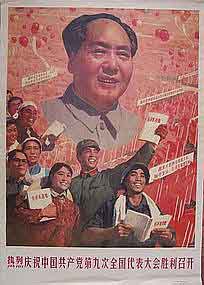
Why did Mao cause so much suffering with his failed Great Leap Forward and The Cultural Revolution? Yes, the power Mao held was a corrupting factor in the decisions he made, but  fear of repeating history was also a factor.

Mao's Little Red Book of Quotations

How many millions of Chinese were addicted to Western opium forced on China by Great Britain and France during two Opium Wars?

Historians say that 20 to 30 million were killed due to the Taiping Rebellion. If Christian missionaries had not been forced on China because of the Opium Wars, would that rebellion have taken place?

Another 115,000 Chinese were killed during the Boxer Rebellion, which was a popular peasant uprising against Christian missionaries, foreign meddling and exploitation.

After 1911 when the Qing Dynasty collapsed, chaos and anarchy ruled China, while foreigners—Americans included— lived in luxury in the treaty ports protected by modern foreign military forces. A Century of Madness chronicles this time.

Mao survived Chiang Kai-shek‘s crack down on the labor movement led by the Communist Party. During World War II, Mao’s army not only fought Chiang Kai-shek’s troops but also the Japanese, who killed between 10 to 20 million Chinese in their attempt to conquer China. The peasants trusted Mao’s troops but did not trust Chiang Kai-shek’s army. Why?

Mao believed that socialism would create a better life for the Chinese. His failures were attempts to make China strong enough to defend the country against foreign meddling and invasions. He failed, but Deng Xiaoping didn’t. What happened in Tiananmen Square in 1989—where a few hundred demonstrators were killed—was nothing compared to what China suffered starting with the First Opium War.

______________

Lloyd Lofthouse is the award-winning author of the concubine saga, My Splendid Concubine & Our Hart. When you love a Chinese woman, you marry her family and culture too.

To subscribe to “iLook China”, look for the “Subscribe” button at the top of the screen in the menu bar, click on it then follow directions.


Belching about China

June 20, 2010

I sometimes read opinions about China from individuals who should stay quiet.  Leo Hindery wrote one for The Huffington Post, which  is an example of an American castigating China from a Western cultural point-of-view.

These biased voices bother me and probably bother many Chinese too. Of course, Hindery has a right to voice his opinions, but most Chinese don’t understand that the American government has no control (at least we like to think so) of what appears in the American media.

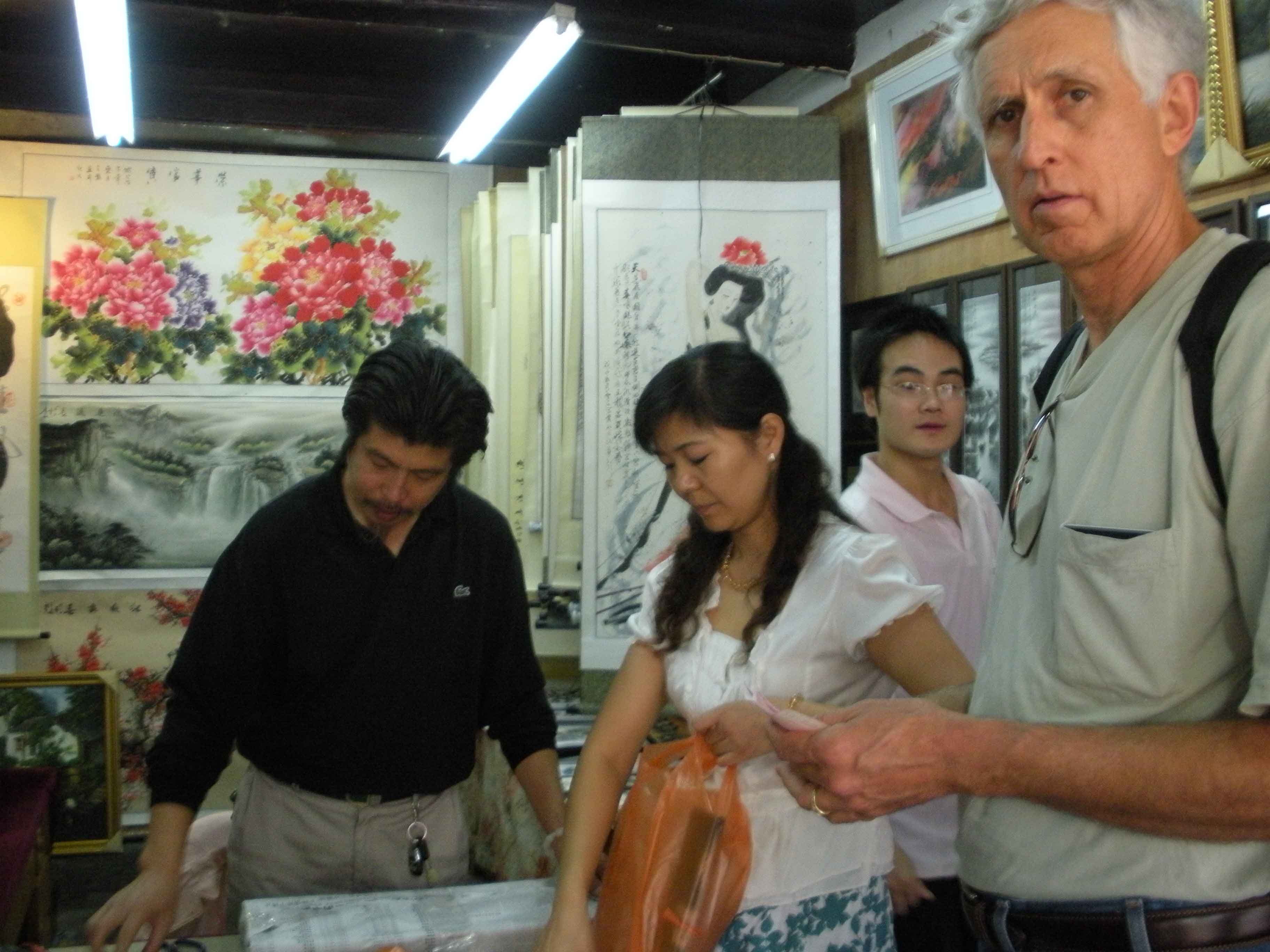
Xu Xiao-dong, in Zhouzhuang, China, an artist in his shop earning a living without help from the American labor movement.

Since the media in China is the official voice of the government, many in China see the Western media the same way. Hindery says he is eager to see the “American labor movement smartly and creatively provide all the help to China’s workers that it can responsibly offer” to help Chinese workers earn more money along with better benefits. Considering what the American labor movement did for the US auto industry, that is a bad idea.

Due to Western meddling in China  during the 19th century, there were two Opium Wars  forcing British, French and American opium into the country along with Christian missionaries, which led to the Taiping Rebellion started by a Christian convert ending in 20 to 100 million killed. Then there was the Boxer Rebellion, a peasant uprising caused by meddling Christian missionaries, greedy Western businessmen and pompous politicians.

In fact, due to the West forcing China to open its doors, more than two-thousand years of Imperial rule ended leading to four decades of chaos and anarchy between 1913 and 1950 where millions more were killed.

My opinion is to let the Chinese fix China and leave the American labor movement out of it.

See China’s Labor Laws

______________

Lloyd Lofthouse is the award-winning author of the concubine saga, My Splendid Concubine & Our Hart. When you love a Chinese woman, you marry her family and culture too. 

If you want to subscribe to iLook China, there is a “Subscribe” button at the top of the screen in the menu bar.


Change Mandated by Heaven

April 15, 2010

To many Chinese, the Taiping and Boxer rebellions failed because they were not blessed by Heaven. After World War II, when Mao’s Communists defeated the Nationalists, who— protected by America—fled to Taiwan, a case could be made that it was the Mandate of Heaven that brought about this change since World War II caused many in China to lose their lives demonstrating the Kuomintang’s inability to protect the Chinese people.

Chang Kai Shek - Leader of the Kuomintang

When Mao died, the new chairman of China’s Communist Party, Hua Guofeng, ordered the arrest of the Gang of Four. Almost everyone connected to the Gang of Four, which included Mao’s wife, Jian Qing, became non-persons. Some went to prison and died like Mao’s wife. Others were pushed aside and ignored. Since millions died due to the Cultural Revolution, they had lost the Mandate to rule.

Deng Xiaoping repudiated the Cultural Revolution and in 1977 launched the ‘Beijing Spring’, leading to a market economy and China’s prosperity today. The suffering that occurred during much of Mao’s twenty-seven year rule was criticized openly making if official that Mao had lost the Mandate of Heaven. After all, more than thirty-million Chinese died horrible deaths due to the Great Leap Forward and the Cultural Revolution.

See Deng Xiaoping’s 20/20 Vision http://wp.me/pN4pY-2o

Sign up for an RSS Feed for  iLook China