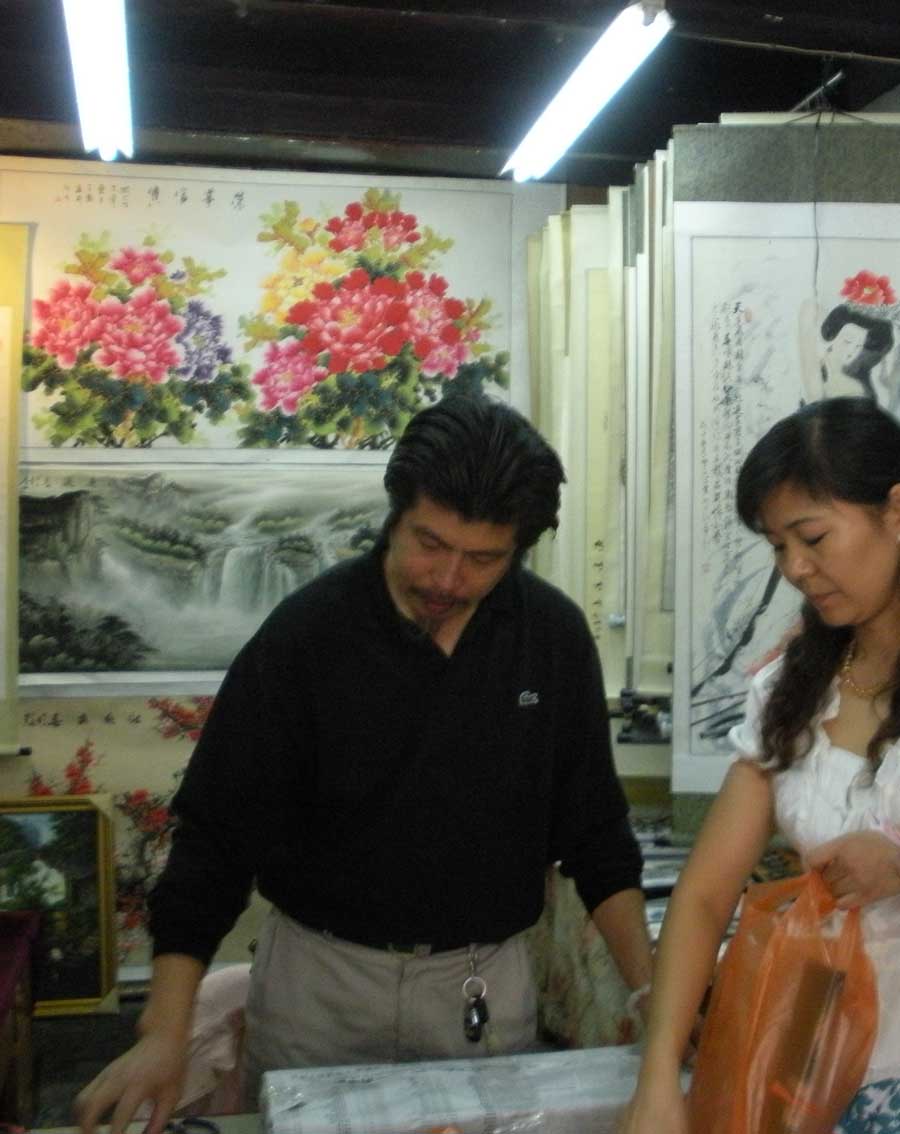
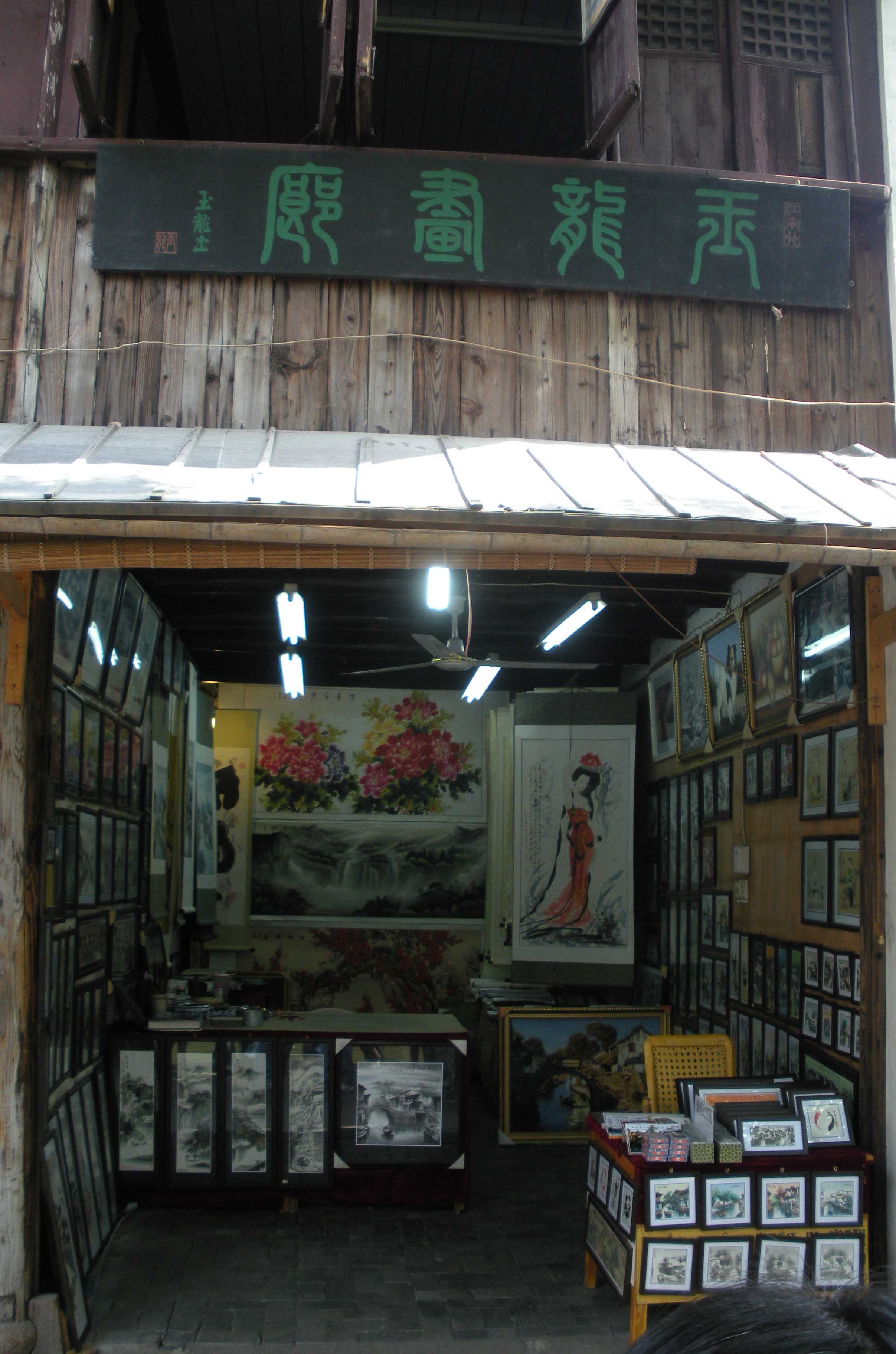
In 2008, while visiting Zhouzhang, China’s #1 Water Town for Tourists, we stopped at Xu Xiao-dong’s gallery and art studio.
Xu-Xiao-dong
The artist trained under a master and keeps a newspaper clipping that mentions it.
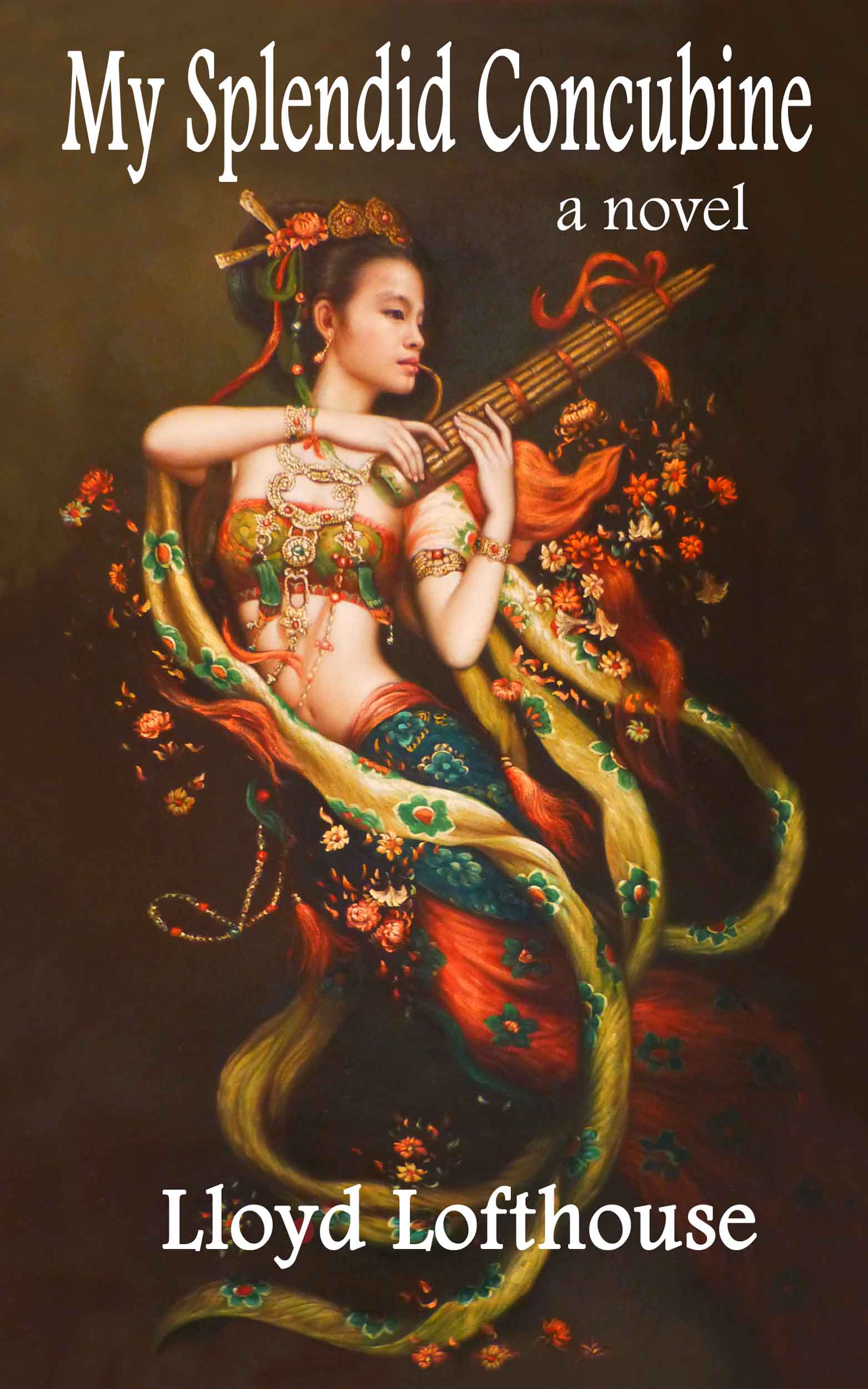
We bought several watercolors from Xu Xiao-dong, and he gave me written permission to use his art for the cover of My Splendid Concubine’s 2nd edition. The 3rd edition has a dancer on the cover (you can see it below this post).
Xu Xiao-dong’s gallery
There’s a narrow, steep stairway in the back (left) that goes to another floor and more art. The artist also paints his art on the second floor.
Zhouzhang, near Shanghai, is almost a thousand years old—built in 1086. Unlike most tourist attractions in America, this town is still occupied with 138,000 people, and they make their living from the tourists who cannot enter unless they pay a fee.
A boat ride through the town costs about RMB 100 (US$16). Traditional Chinese folk songs sung by gondoliers are free.
At least they were when we visited.
_______________
Lloyd Lofthouse is the award-winning author of My Splendid Concubine [3rd edition]. When you love a Chinese woman, you marry her family and culture too. This is the lusty love story Sir Robert Hart did not want the world to discover.
Finalist in Fiction & Literature – Historical Fiction
The National “Best Books 2010” Awards
Honorable Mentions in General Fiction
2012 San Francisco Book Festival
2012 New York Book Festival
2012 London Book Festival
2009 Los Angeles Book Festival
2009 Hollywood Book Festival
Subscribe to “iLook China”!
Sign up for an E-mail Subscription at the top of this page, or click on the “Following” tab in the WordPress toolbar at the top of the screen.
Peter Hessler arrived in China with the Peace Core in 1996 and taught English for two years. After leaving the Peace Corps, Hessler freelanced for The Atlantic Monthly, The Wall Street Journal, National Geographic and The New York Times before becoming the Beijing correspondent for The New Yorker until 2007. He lived in China about fifteen years.
Today, Hessler is better known for his books on China: River Town: Two Years on the Yangtze (2001), Oracle Bones (2006), and Country Driving: A Journey Through China From Farm to Factory(2010). His latest work is Strange Stones: Dispatches from East and West (2013).
I agree with Hessler when he said in a CNNGointerview, “People in China are not forthcoming like Americans; they don’t like to tell you their personal story. It’s a type of modesty, I think, in a culture where people are not encouraged to see themselves as the center of the universe.”
I have a born-again Christian friend—a white American—who boasted about Christianity being the fastest growing religion in China. I wonder what he’d say if he’d read what Hessler thinks: “The Chinese relationship with religion is pragmatic and fluid; people often change their faith very quickly. And I don’t see them following religion to a degree where it’s clearly not in their self-interest.”
And I also wonder what my old fundamentalist Christian friend would think if he knew the results of the CFPS 2012 survey of 25 of the provinces of China that found only 10% of the population belonged to organized religions—specifically, 6.75% were Buddhists (87.8 million), 2.4% (31.2 million) were Christians (of which 1.89% Protestants and 0.41% Catholics), 0.54% were Taoists, 0.46% were Muslims, and 0.40% declared to belong to other religions. Although 90% (1.17 billion) of the population declared to not belong to any religion, the authors of the survey estimated that only 6.3% were atheists neither believing nor worshipping gods and ancestors.
On happiness, Hessler says, “At this particular moment I think that Americans … might be less happy than Chinese people. The Chinese can roll with the punches. … Everybody in China has seen ups and downs; if they get laid off from the factory, they just go back to the village and play mah-jong.”
_______________
Lloyd Lofthouse is the award-winning author of My Splendid Concubine [3rd edition]. When you love a Chinese woman, you marry her family and culture too. This is the lusty love story Sir Robert Hart did not want the world to discover.
Finalist in Fiction & Literature – Historical Fiction
The National “Best Books 2010” Awards
Honorable Mentions in General Fiction
2012 San Francisco Book Festival
2012 New York Book Festival
2012 London Book Festival
2009 Los Angeles Book Festival
2009 Hollywood Book Festival
Subscribe to “iLook China”!
Sign up for an E-mail Subscription at the top of this page, or click on the “Following” tab in the WordPress toolbar at the top of the screen.
Twenty-six years after the alleged 1989 Tiananmen Square incident—and three Chinese Presidents later: Jiang Zemin (1993-2003), Hu Jintao (2003-2013), and now Xi Jinping (2013 – )—the U.S. media continues to annually remind the world of what might have happened.
I’ve heard from several Chinese American friends (now US citizens), who lived in China in 1989, that the student leaders behind the Tiananmen Square protest/massacre (April 14 – June 4, 1989) were supported by the CIA, and I asked myself if this was another conspiracy theory.
However, my curiosity was stirred, so I spent hours hunting the internet for clues that this might be true, and I discovered several coincidences that raised an eyebrow.
The U.S. Ambassador in China at the time, James Lilley (April 20, 1989 to 1991), was a former CIA operative who worked in Asia and helped insert CIA agents into China. President H. W. Bush (1989-1993) served as Chief of the U.S. Liaison Office in Beijing (1974 – 1976), who then went to serve as Director of the CIA (1976 – 1977).
Why did President H. W. Bush replace Winston Lord as ambassador to China (1985-1989) during the early days of the Tiananmen Square incident with a former CIA agent? After all, Lord spoke some Chinese and was a key figure in the restoration of relations between the US and China in 1972. Wasn’t he the best man for the job during a crisis like this one?
I returned to my friends and asked, “How do you know the CIA helped the student leaders of the protest?”
“It’s obvious,” was the answer. The reason, my friends explained, was the fact that it was very difficult, almost impossible, for anyone in China to get a visa to visit the United States before the 21st century. Yet most of the young student leaders of the Tiananmen Square incident left China quickly after the event and prospered in the West without any obvious difficulty. In addition, after these student leaders came to the West, many were successful and became wealthy.
I returned to my investigation to verify these claims. Let’s Welcome Chinese Tourists was one piece I read from The Washington Post documenting how difficult it was to get a visa back then to visit the United States from China. I read another piece in The Chicago Tribune on the same subject. And my wife told me her brother and two sisters were denied visas to the U.S.
After more sleuthing, I learned that Wang Dan, one of the principal student organizers of the Tiananmen incident, went to jail because he stayed in China when most of the other student leaders fled. Today, Wang lives in the West and cannot go back. Two others went to Harvard and a third went to Yale. Where did they get the money—it’s expensive to attend these private universities?
How about the other leaders who fled to the West? Time Magazine reported, “Some have reincarnated themselves as Internet entrepreneurs, stockbrokers, or in one case, as a chaplain for the U.S. military in Iraq. Several have been back to China to investigate potential business opportunities.”
Official figures of the dead during the incident ranged from 200 to 300. At the Chinese State Council press conference on June 6, spokesman Yuan Mu said that “preliminary tallies” by the government showed that about 300 civilians and soldiers died, including 23 students from universities in Beijing, along with a number of people he described as “ruffians”. Yuan also said some 5,000 soldiers and police along with 2,000 civilians were wounded. On June 19, Beijing Party Secretary Li Ximing reported to the Politburo that the government’s confirmed death toll was 241, including 218 civilians (of which 36 were students), 10 PLA soldiers and 13 People’s Armed Police, along with 7,000 wounded.
Chinese government officials have long asserted that no one died in the Square itself in the early morning hours of June 4, during the ‘hold-out’ of the last batch of students in the south of the Square. Initially foreign media reports of a “massacre” on the Square were prevalent, though later journalists acknowledged that most of the deaths occurred outside of the Square in western Beijing.
Several people who were situated around the square that night, including Jay Mathews, former Beijing bureau chief of The Washington Post, and Richard Roth, CBS correspondent, reported that while they heard sporadic gunfire, they could not find enough evidence to suggest that a massacre took place on the Square itself.
If the U.S. media annually reminds the world of the alleged Tiananmen Square massacre, why don’t they also remind us of another massacre that took place in Taiwan in 1947 where about 30,000 Taiwanese citizens were slaughtered during the2-28 Massacre by troops of America’s ally Chang Kai-shek?
Can anyone explain why the deaths of a few hundred Chinese in Communist China in 1989 are more important than the slaughter of 30,000 civilians in 1947 by an American ally?
Thanks to a comment, I learned about another slaughter of citizens demanding democracy that took place in South Korea in 1980.
_______________
Lloyd Lofthouse is the award-winning author of My Splendid Concubine [3rd edition]. When you love a Chinese woman, you marry her family and culture too. This is the lusty love story Sir Robert Hart did not want the world to discover.
Finalist in Fiction & Literature – Historical Fiction
The National “Best Books 2010” Awards
Honorable Mentions in General Fiction
2012 San Francisco Book Festival
2012 New York Book Festival
2012 London Book Festival
2009 Los Angeles Book Festival
2009 Hollywood Book Festival
Subscribe to “iLook China”!
Sign up for an E-mail Subscription at the top of this page, or click on the “Following” tab in the WordPress toolbar at the top of the screen.
The use of herbal medicines in China has been traced to the Zhou Dynasty, late Bronze/early Iron Age, about 2500 to 3000 years ago.
In 1596, hundreds of years before the age of modern Western medicine, Li Shizhen spent decades documenting the vast knowledge of herbal lore.
His book, the Ben Cao Gang Mu (1596), has been used as a pharmacopoeia, but it was also a treatise on botany, zoology, mineralogy and metallurgy.
The Ben Cao Gang Mu mentions 1,892 different herbs and is divided into 6 sections, 52 scrolls and 60 different categories.
It has been reported that Darwin had a copy of the Ben Cao Gang Mu with him on his voyage of discovery in 1831.
The World Health Organization says, “Traditional herbal medicines are naturally occurring, plant-derived substances with minimal or no industrial processing that have been used to treat illness within local or regional healing practices.”
I think that today’s profit-based corporations that produce modern medicine probably don’t want people to be free to use herbal medicine. because it cuts into their profits, but—if given a choice—I’d rather use herbal medicine first and modern medicine as a last resort.
_______________
Lloyd Lofthouse is the award-winning author of My Splendid Concubine [3rd edition]. When you love a Chinese woman, you marry her family and culture too. This is the lusty love story Sir Robert Hart did not want the world to discover.
Finalist in Fiction & Literature – Historical Fiction
The National “Best Books 2010” Awards
Honorable Mentions in General Fiction
2012 San Francisco Book Festival
2012 New York Book Festival
2012 London Book Festival
2009 Los Angeles Book Festival
2009 Hollywood Book Festival
Subscribe to “iLook China”!
Sign up for an E-mail Subscription at the top of this page, or click on the “Following” tab in the WordPress toolbar at the top of the screen.
“Tom Carter is an extraordinary photographer whose powerful work captures the heart and soul of the Chinese people.” – Anchee Min, author of “Red Azalea”.
Most tourists travel by jet or bus and spend nights in four-or-five star hotels sleeping on plush beds. They eat at only the best restaurants. A rare few visit countries like Sir Richard Francis Burton, the famous nineteenth century explorer and adventurer. Tom Carter is one of the rare few. Imagine backpacking for two years and walking 35,000 miles to capture the heart and soul of a nation. That’s whatTom Carterdid to create China: Portrait of a People.
The consensus among ‘backpackers’ is that China is probably the single most challenging country in the world to visit on foot. That by itself says a lot.
There are more than 1.3 billion people in China. Besides the majority Han Chinese, the population includes fifty-six ethnic groups numbering over one hundred million. Carter saw it all from the teenage girl living in Chengdu dressed like an American punk rocker to the soot covered coal miner in Southern Shanxi. Carter’s camera lens captured the complexity and diversity of China.
Tom Carter is a guerrilla hit-and-run photojournalist with a camera instead of a grenade launcher. To take the up-close-and-personal pictures in ‘Portrait of a People’, Carter risked jail; almost froze on his way to Tibet; faced exhaustion and hunger; was beaten by drunks; plagued by viral infections, and risked being shot by North Korean border guards. The hundreds of photos in ‘Portrait’ are priceless. I doubt if there will ever be another book about China like this one. From Inner Mongolian nomads to newlyweds in Hong Kong, Carter captured it all with his photography.
There is an old saying that a picture is equal to a thousand words. Great pictures tell stories.
In ‘China: Portrait of a People’, each picture is worth ten thousand words or maybe more. Carter’s photojournalist study of China stands alone in its genre as it focuses expressly on the Chinese people. Carter backpacked to remote areas to visit China’s minorities like the thousand year old Phoenix Village perched over the Tuo Jiang River or the seventy-five year old Pai Yao minority farmer in his red turban.
To reach some locations, Carter had to travel on foot into some seriously rugged terrain. To get an idea what I’m talking about, consider that China, almost the size of the United States, has only sixteen percent of its land for growing crops. The rest is either mountains or deserts.
Between the covers of ‘Portrait’, you will see what happens when a modern day Sir Richard Francis Burton spends two years backpacking through China’s thirty-three provinces and autonomous regions, not once but twice. During his odyssey, Carter discovered that the Chinese are a friendly, open hearted people.
If you plan to visit China, buy this book before you go. On the other hand, if you are an armchair tourist that never strays far from home, Carter’s Rembrandt ‘Portrait’ of China will not disappoint. You will chuckle when you see the young, twin boys walking out of the river after a swim or watch the eight-year-old acrobat student at Wuqiao bending herself like a folded sheet of paper.
Between the covers of ‘Portrait’, you will start a vicarious journey visiting China like few have done even among the Chinese. You will travel on this 35,000 mile journey without leaving your house, bus or jet seat.
The Christian Science Monitor said, Tom Carter shows us that there are actually dozens of Chinas. The American photojournalist spent two years traveling 35,000 miles through every province of China by bus, boat, train, mule, motorcycle, and on foot. – August 27, 2010
The San Francisco Chronicle said, Getting a full picture of China – a vast country with an enormous population, a place that is experiencing sweeping cultural and economic changes – is, of course, impossible. But Tom Carter comes close. … It’s a remarkable book, compact yet bursting with images that display the diversity of a nation of 56 ethnic groups. – September 26, 2010
As you might see, there is no way this review does justice for ’China: Portrait of a People’. To try might require a million words—seeing is believing. What are you waiting for?
_______________
Lloyd Lofthouse is the award-winning author of My Splendid Concubine [3rd edition]. When you love a Chinese woman, you marry her family and culture too. This is the lusty love story Sir Robert Hart did not want the world to discover.
Finalist in Fiction & Literature – Historical Fiction
The National “Best Books 2010” Awards
Honorable Mentions in General Fiction
2012 San Francisco Book Festival
2012 New York Book Festival
2012 London Book Festival
2009 Los Angeles Book Festival
2009 Hollywood Book Festival
Subscribe to “iLook China”!
Sign up for an E-mail Subscription at the top of this page, or click on the “Following” tab in the WordPress toolbar at the top of the screen.
 Xu Xiao-dong’s gallery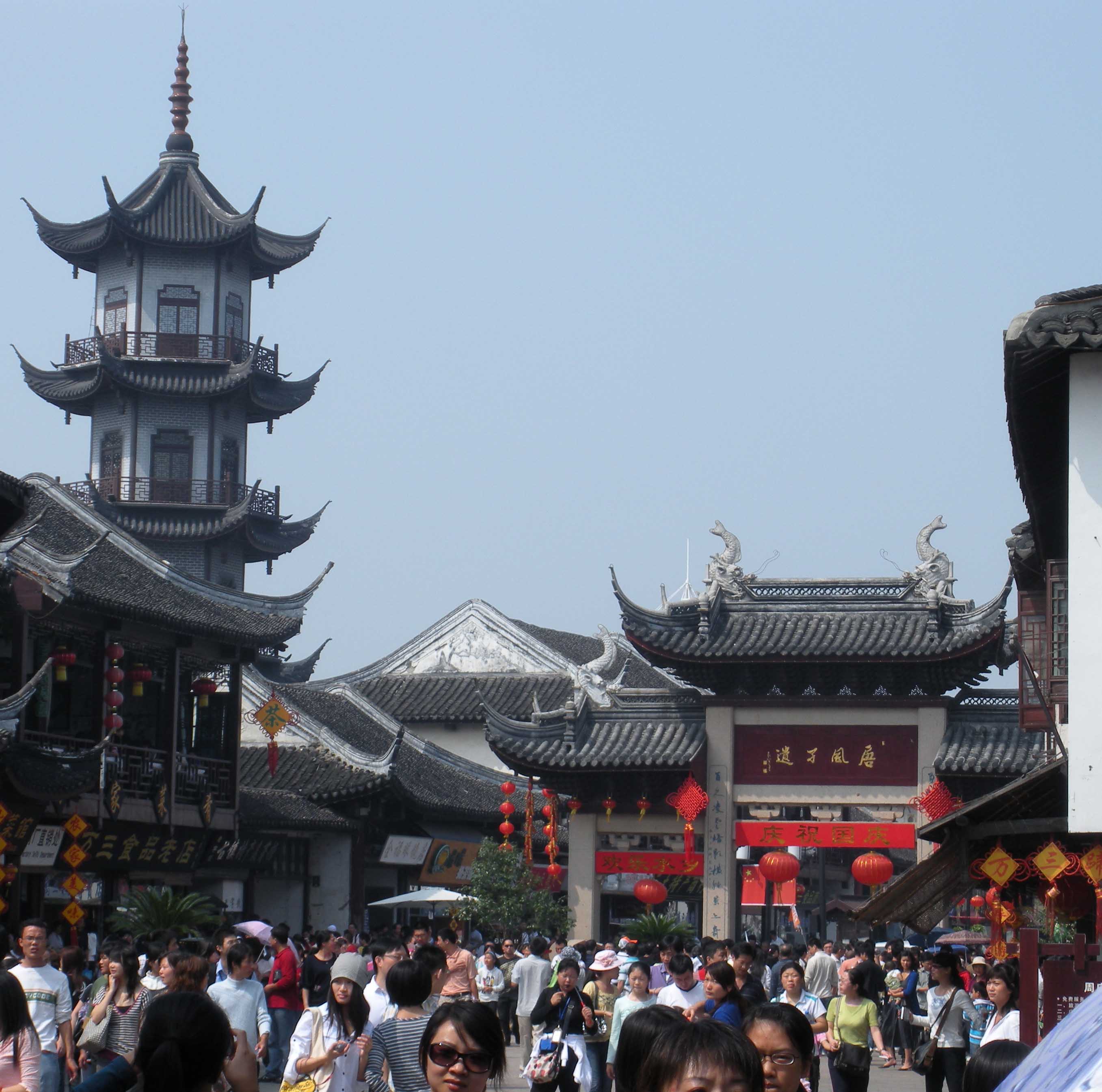


 Posted by Lloyd Lofthouse
 iLook China