Shanghai Scams, Beggars and/or Cell phone Scam – Part 2/3

January 27, 2011

Serpentza relates a story of having had a few drinks and being in a good mood. While walking down the street, a middle-aged woman told him she had come to Shanghai looking for work and was hungry. She asked him to buy her something to eat.

He decides to buy something inexpensive at a local store. Then she asks him to phone her relatives in her rural hometown to let them know she couldn’t find work.

He says if a stranger asks you to phone someone for him or her, never give away your phone. The odds are the beggar will run away with it.

I have also had incidents in China of beggars approaching me. Since I know begging is illegal in China, I ignore them.

The Shanghai Scams Website says, “Tourists are sometimes approached by beggars or see them with small children on the street. Large underground networks sometimes take kids from villages, then put them on the street to beg, and will even physically deform a child in the hope of generating more sympathy money. So don’t feed this negative cycle by giving them money.

“Beggars may also approach tourists in outdoor dining areas on Nanjing Road (for example, outdoor bars, coffee shops, cake shops etc). These children may not really be poor but are just looking for an easy way to make money. These kids will often beg by standing near a table, then get down on one knee to beg, and as a last resort, will ask for food instead of money. The quickest way to get rid of these kids is to inform the restaurant staff, or to call the police.”

In fact, while shopping in an upscale shopping area near our home in California, I’ve been approached by an entire family of US beggars.

In Berkeley, if I walk several blocks, I’ll always run into several beggars. Some have even become nasty when I wouldn’t give them money. However, in China, days may go by without sight of a beggar.

Due to my experiences in the US, I learned to ignore beggars first in the US—not China.

From what I’ve read and been told, beggars in India are much worse and there are actually beggar cartels where the beggars are crippled and maimed to elicit sympathy.

Return to Shanghai Scams Part 1

______________

Lloyd Lofthouse is the award-winning author of the concubine saga, My Splendid Concubine & Our Hart. When you love a Chinese woman, you marry her family and culture too.

If you want to subscribe to iLook China, there is a “Subscribe” button at the top of the screen in the menu bar.


Shanghai Scams – Assisted Shopping – Part 1/3

January 26, 2011

While researching another topic, I discovered the Shanghai Scam Series produced by a 30-year-old expatriate that goes by the on-line name of Serpentza.

Although I’ve been to China many times, I’ve never experienced the scams the narrator of this series talks of.

However, to be fair, the reason I haven’t experienced these scams is that I don’t drink (gave it up years ago) and do not frequent the popular nightclubs and bars.

In fact, my wife is Chinese and usually warns me of suspicious behavior. It also helps that I’m the distrusting sort.

In Serpentza’s video, he takes us for a walk in the rain in Shanghai to show us how the”assisted shopping scam” works.

He says, while shopping, you will be approached by a number of people who speak English that will tell you where the best bargains are.

Hmm, this has never happened to me. Do I look that forbidding? While in China, my wife isn’t always with me. I have gone shopping alone and no one has asked if I needed help and I do not buy anything from street vendors.

However, I have been approached by street vendors selling watches, which Serpentza warns of, but I don’t wear a watch and don’t want one.

On one trip, a Shanghai street vendor followed me for several blocks trying to sell me watches, wallets, dark glasses, etc.  He didn’t know what the word “NO” meant even when I used the word in Mandarin my wife taught me. Maybe he didn’t speak Mandarin. After all, there are about 60 different, spoken languages in China.

Had to go into a bank to get him to leave me alone.

I even found a trip advisor Website warning of Shanghai Scams, which says, “The majority of these scams happen at tourist spots around People’s Square, on Nanjing Pedestrian Street and at the Bund.”

General rule: Shanghainese are very friendly and always willing to help if you ask them, but they would seldom approach a foreigner without being asked (as probably anywhere in the world).

On his Blog, Serpentza calls himself “forever an expatriate”.

Discover Shanghai

______________

Lloyd Lofthouse is the award-winning author of the concubine saga, My Splendid Concubine & Our Hart. When you love a Chinese woman, you marry her family and culture too.

If you want to subscribe to iLook China, there is a “Subscribe” button at the top of the screen in the menu bar.


Dozing Dragon

January 19, 2011

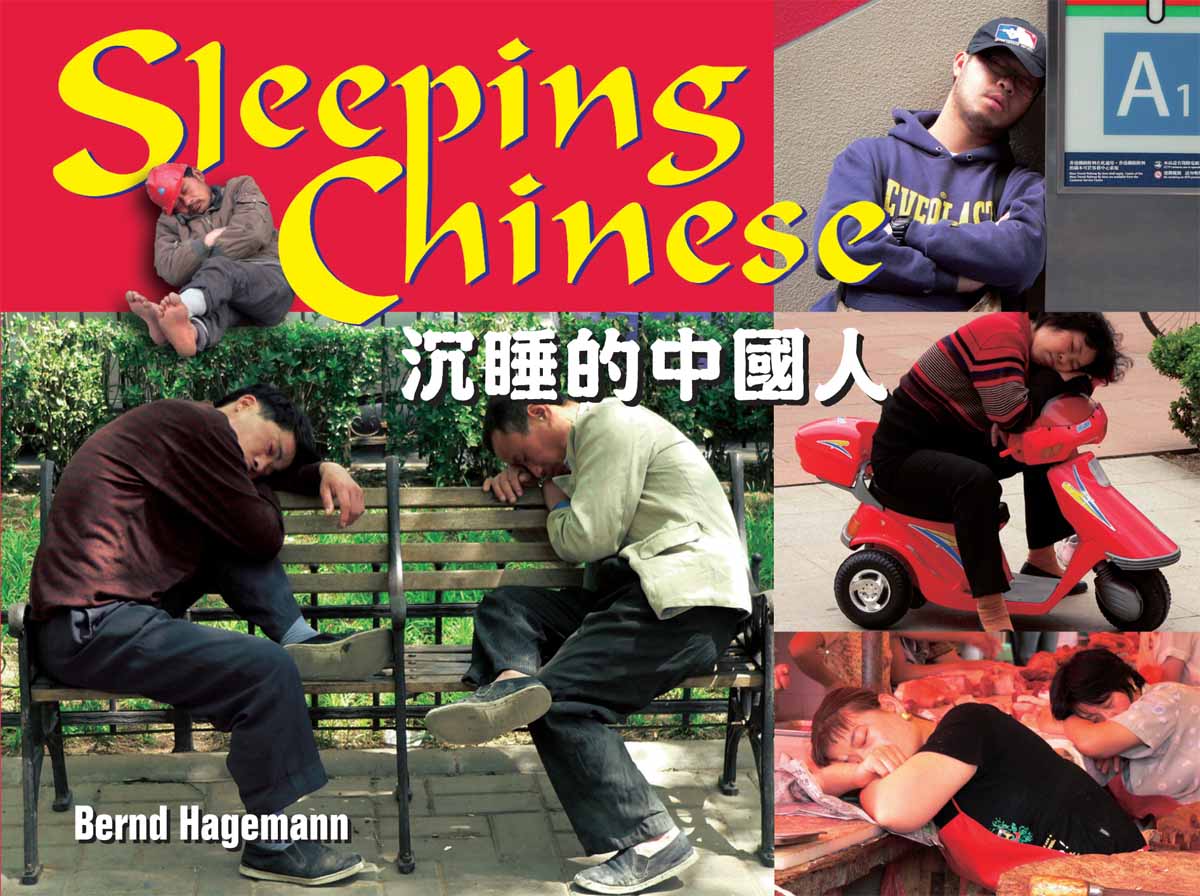
 a guest post by Tom Carter of Bernd Hagemann’s Sleeping Chinese

German businessman Bernd Hagemann arrived in China in 2002 amidst media reports of China’s impending rise to global domination. “News outlets around the world,” he writes, “were warning us about… how fast China is developing, how competitive it is, and what a tense life the Chinese people must live.”

Casual strolls down the streets of China in between boardroom meetings and networking, however, soon revealed to Hagemann a far less threatening side of China. So he took out his point-and-shoot camera and documented what he saw all around him. In just 148 pages, Hagemann’s debut photography book Sleeping Chinese swiftly dispels 9 years of chest-pounding by the PRC propaganda machine.

Sleeping Chinese is a fun little novelty item the exact same dimensions as a postcard that will leave you either laughing out loud or scratching your head in perplexity. The pages are divided into 3 parts: Hard Sleepers, Soft Sleepers and Group Sleepers, a clever allusion to China’s train carriage classification system.

Hard Sleepers: “Those who snooze in hard and uncomfortable places can fall asleep anywhere – even on a pile of bricks in a construction site!” Hagemann defines.

Witness, then, the dozens of people who have drifted into deep slumber atop stones, wood, mortar blocks, concrete and even cold slabs of raw meat. The most comical of the chapter being the dozing shoe repair man balancing precariously on a saw horse with an extra 2×4 for a pillow.

Soft Sleepers: “A little more fussy than their hard sleeper comrades,” the chapter intro explains, “fussy” meaning in plastic wash bins, hammocks slung under freight trucks, sleeping lengthwise across a motor scooter and even a laborer using a tape measure to cover his eyes.

Group Sleepers: “A traveling family needs no pillows when they have each other’s knees.” Truly, the photo of the family of five all huddled together like newborn puppies gives greater meaning to ‘jiating,’ China’s family unit.

Some Chinese might take offense to Hagemann’s photographic agenda, but anyone with a sense of humor will see that the book was made out of affection.

“I’d like to express my appreciation of the hard work and effort put in by migrant workers who play a central role in China’s success story but seldom receive the attention they deserve,” writes Hagemann.

Indeed, anyone who has spent quality time in China knows that these laborers, more than anyone else, deserve their rest — anywhere they can get it.

None of the snapshots in Sleeping Chinese were staged. Any foreign tourist in China who bothers to stray from his package tour group or get out of his hotel for a jaunt off the tourist trail will see these exact same sights, and more.

Incidentally, taking and publishing photos of sleeping Chinese people will often land a foreign tourist in hot water if caught by the authorities (the subjects themselves tend not to mind).

People’s Daily newspaper, the official mouthpiece of the Politburo, even attempted to put a socialist spin on Hagemann’s revealing imagery in an article about Sleeping Chinese: “If (we) are tired, (we) lie down anywhere and anytime and sleep. This shows (our) society’s accepting attitude.”

Regarding the western media’s scare tactics of China’s “waking dragon,” this reviewer is reminded by Sleeping Chinese of a particular song from old-school hip-hop artists Public Enemy (who I had occasion to watch perform during their 2007 tour through Beijing): Don’t Believe the Hype!

____________________

Travel photographer Tom Carter is the author of CHINA: Portrait of a People, a 600-page China photography book, available through Amazon.com

If you want to subscribe to iLook China, there is a “Subscribe” button at the top of the screen in the menu bar.


Sexy Beijing’s a Jew Brew

December 29, 2010

If you haven’t heard of it, Sexy Beijing (produced by Goldmines Film and Video Production since 2006) is an Internet TV station run by an in-house production team.

Sexy Beijing says “Our shows have also aired on NBC in Los Angeles, Hunan TV, China Educational TV, and many other stations around China as well as conferences around the world.”

I dare all Westerners that believe the Chinese are depressed and heavily censored to watch Sexy Beijing regularly to learn the truth of China.

Any censorship that exists in the media in China focuses on only a few topics such as the Dalai Lama and Tibetan or Islamic separatists that are considered the same as Islamic terrorists are to the United States.

In this episode of Sexy Beijing, Su Fei tries to please her mother and go for one of her own kind.

Sue Fei, the Jewish host of this segment, says, “Most people are surprised to find out just how multi-cultural Beijing is. And when it comes to a husband search, I could just as easily be bringing home an African or Muslim suitor to meet my Jewish mother as I could a Chinese one.”

Sue Fei then heads for the new Chabad Jewish community center in Beijing to find out what it would be like to become an Orthodox Jew.

Learn about Deep Family Roots

______________

Lloyd Lofthouse is the award-winning author of the concubine saga, My Splendid Concubine & Our Hart. When you love a Chinese woman, you marry her family and culture too.

If you want to subscribe to iLook China, there is a “Subscribe” button at the top of the screen in the menu bar.


Christmas in China

December 24, 2010

I don’t read Mandarin and a few days ago an e-mail arrived that was in Mandarin with an attachment.

I’ve learned the hard way that you don’t open e-mails when you don’t know where there from, so I waited until my wife read the Mandarin and told me it was from our daughter’s grandfather in China.

Inside the attached file were twelve virtual Christmas cards in English with flashing Christmas lights in winter settings. Grandpa lives in Shanghai.

Shanghai shopping malls are decorated for Christmas.

Many Shanghai Chinese have adopted the Christmas holiday and take it seriously even giving gifts.

One Chinese man in the embedded video says, “Perhaps because Shanghai is quite an international city, we attach much importance to this festival and celebrate it in a grander manner compared to other cities in China.”

A young Chinese woman says, “If you live overseas for a long time, you will know that this is the time to reunite with your friends and exchange Christmas presents with those you know.”

The expat owner of a German restaurant even set up a stall outside offering blue wine, a type of warm wine popular among Germans during Christmas.

The twelve virtual Christmas cards our daughter’s grandfather attached to his e-mail said, “Remember… Through the year, be thankful for what you have…”

2. “If you have food in the refrigerator, clothes on your back, a roof overhead and a place to sleep… You are richer than 75% of the world.”

3. “If you have money in the bank, in your wallet, and spare change in a dish some place, you are among the top 8% of the world’s wealthy.”

 4. “If you woke up this morning with more health than illness… You are more blessed than the million who will not survive this week.”

5. “If you have never experienced the danger of battle, the loneliness of imprisonment, the agony of torture, or the pangs of starvation… You are ahead of 500 million people in the world.”

6. “If you can attend a church meeting without fear of harassment, arrest, torture, or death… You are more blessed than three billion people in the world.”

7. “If your parents are still alive and still married… You are very rare, even in the United States.”

8. “If you hold up your head with a smile on your face and are truly thankful… You are blessed, because the majority can, but most do not.”

9. “If you can hold someone’s hand, hug them or even touch them on the shoulder… You are blessed because you can offer healing touch.”

10. “If you can read this message, you just received a double blessing that someone was thinking of you, and furthermore… You are more blessed than over two billion people in the world that cannot read at all.”

11. “Have a good day, count your blessings, and pass this along to remind everyone else how blessed we all are. You are wished a Merry Christmas.”

12. “Remember… throughout the year, be thankful for what you have been blessed with…”

A grandfather that fought on the winning side of China’s Civil War (1925 – 1949) then held an important position in Chinese Communist Party until he retired at 67 (as the 1982 Chinese Constitution requires) sent these twelve virtual Christmas cards.

In fact, he was born during the Civil War about 1930 and was nineteen when it ended.

Discover the Top Five Restaurants Expats Love in Shanghai

______________

Lloyd Lofthouse is the award-winning author of the concubine saga, My Splendid Concubine & Our Hart. When you love a Chinese woman, you marry her family and culture too.

If you want to subscribe to iLook China, there is a “Subscribe” button at the top of the screen in the menu bar.