“Peking to Paris” – more than a book review: a journey

May 6, 2013

This is the real life story of Dina and Bernard Bennett driving in a road rally from Beijing to Paris in 2007—starting in Beijing, China to the desert sands of Mongolia, braving the potholes of Russia to reach Eastern Europe and eventually Paris, France with endless break downs and repairs to keep an almost 70-year-old car running.

The closest books I can compare this reading experience with is Paul Theroux’s “The Great Railway Bazaar: By Train Through Asia” and Tom Carter’s “China: Portrait of a People“.

The big difference is that Theroux rode the rails, and Carter walked for most of two years across China. In Peking to Paris, Dina and her husband drove a 1940 Cadillac-LaSalle 52 Coupe that Dina named Roxanne.

On page 79, Dina says, “China is full of surprises.” Then she dives into a description of a café that specializes in Mongolian hotpot. She says, “Behind me is a full wall of shelves and bins stuffed with vegetables, fish, poultry, pork, lamb and beef.  I count four sections, each easily five feet wide, divided by eight shelves reaching the ceiling. Every shelf is crammed with ingredient bins …”

With this description, Bennett shows us that China is an eating culture.  Food is important to the Chinese—very important.

In another chapter, she discovers that the Chinese and Americans have more in common than she had thought when they stay the night at a rustic Chinese dude ranch where urban Chinese come to rough it on vacations spending time with Mongolian herders.

In China, the ride seemed smooth and easy, but once they cross the border into Mongolia, a band of boys exercising their democratic freedoms throw rocks at the car and shatter the driver’s side windshield.

However, when they were still in an undemocratic China ruled by one party, the CCP, no one threw rocks at them. Instead, while driving down remote country roads police officers in fancy dress uniforms wearing white gloves waited at intersections to guide them in the right direction.

A few hundreds yard into Mongolia, the paved roads they had enjoyed in China suddenly end and the rest of the trek across this landlocked country is mostly on dirt and sand taking a heavy toll on the mechanical health of the LaSalle. Then they reach Russia’s paved roads where the challenge becomes avoiding horse-trough sized potholes capable of swallowing cars whole.

Because of this experience from Peking to Paris, Dina and Bernard are bitten by the travel bug and they have now completed more than a dozen road trips all over the world—after you read this memoir, you may want to follow them by visiting  the author’s Blog at Dina Bennett.net

I’m planning to.

Oh, and lest I forget, I was contacted by Dina’s publicist and agreed to accept a complementary uncorrected proof, which I read in record time. I have never met or talked to Dina and her husband online or in person.


The LaSalle in the above video is not the one that Dina and Bernard drove in the 2007 rally from Beijing to Paris, but the video gives you an idea of the car they drove 7,800 miles across China to Mongolia, then Russia to Eastern Europe and eventually Paris, France—thirty-five grueling days.

It has been some time since I read a book that I wanted to wake up early in the morning to read and eagerly waited to read before I slept. For me, reading Peking to Paris was an adventure, and I highly recommend it.

Discover Country Driving with Peter Hessler


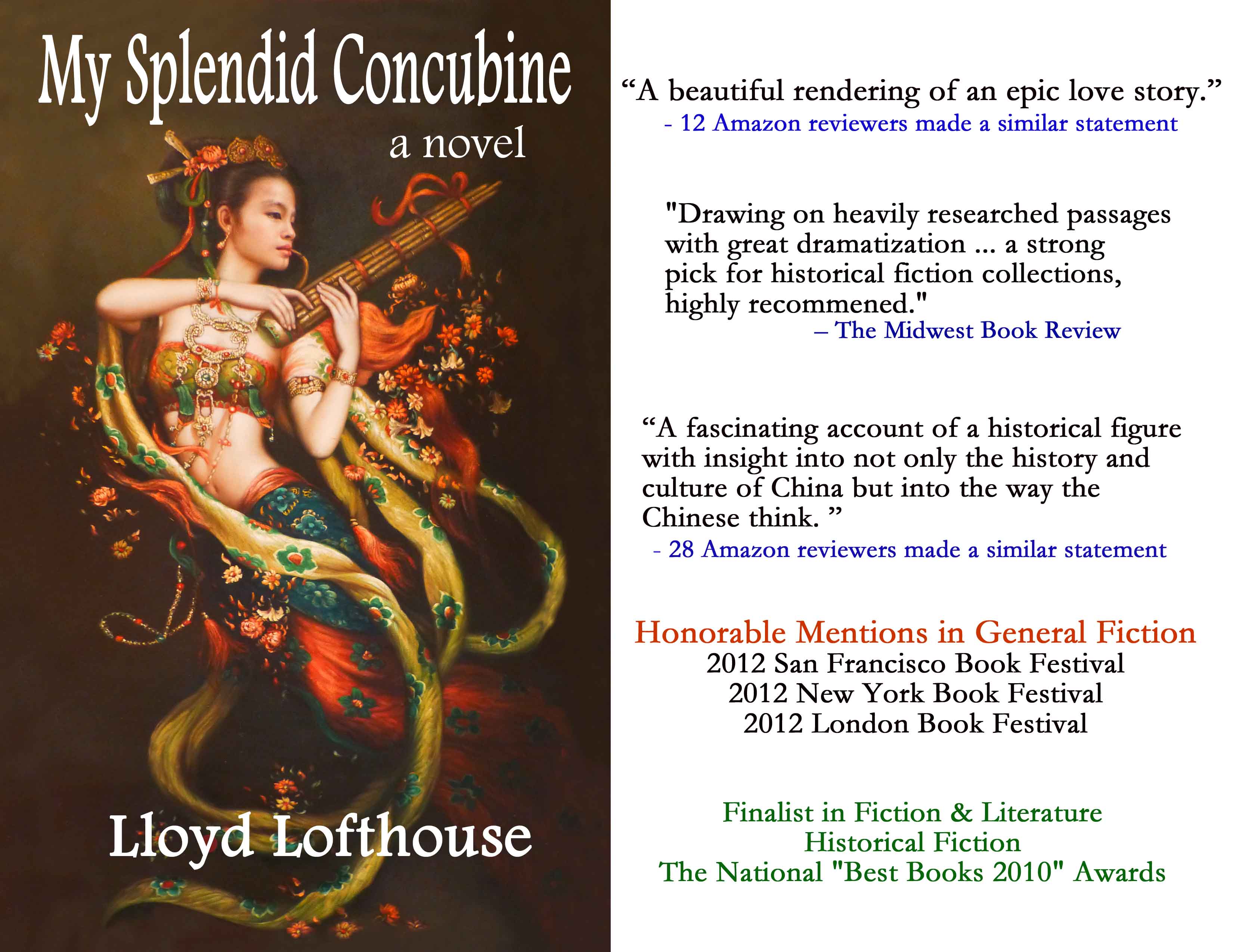
Lloyd Lofthouse is the award-winning author of My Splendid Concubine [3rd edition]. When you love a Chinese woman, you marry her family and culture too. This is the love story Sir Robert Hart did not want the world to discover.

Subscribe to “iLook China”!
Sign up for an E-mail Subscription at the top of this page, or click on the “Following” tab in the WordPress toolbar at the top of the screen.

About iLook China


Impressions of Liu Sanjie

March 5, 2013

While visiting China in September/November of 2008, we went to Guilin, went underground to the Reed Flute Cave, hiked the Dragon’s Back, cruised the Li River and spent two days in Yanghsuo.

Then we saw Zhang Yimou’s breathtaking staged production, the Impressions of Liu Sanjie, that I recommend to anyone visiting Southeast China.

Zhang Yimou, the director, is an internationally acclaimed Chinese filmmaker. He made his directorial debut in 1987 with the film “Red Sorghum”.

In the 1990s, Zhang Yimou directed “Raise the Red Lantern”—nominated for Best Foreign Language Film at the 1991 Academy Awards.

The “Impressions of Liu Sanjie” is performed on the river at night. However, you may be more familiar with Zhang Yimou’s opening and closing ceremonies for the 2008 Beijing Olympics.

The “Impressions of Liu Sanjie” is performed with the Karst Mountains and the Li River as the setting.

 The cast comes from the local Guangzi Zhuan Autonomous Region  and many may be fishermen by day and actors at night and are from the Zhuang and Yao minority groups, who live in that region.

_______________

Lloyd Lofthouse is the award-winning author of My Splendid Concubine [3rd edition]. When you love a Chinese woman, you marry her family and culture too. This is the love story Sir Robert Hart did not want the world to discover.

2015 Promotion Image for My Splendid Concubine

Subscribe to “iLook China”!
Sign up for an E-mail Subscription at the top of this page, or click on the “Following” tab in the WordPress toolbar at the top of the screen.

About iLook China


The Seven Wonders of China: Part 5/5

February 15, 2013

To protect the Shibaozhai temple, the Chinese government had a six-hundred foot high, thirty-three foot thick dike built to protect it. When completed, the dike will surround the temple and cliff.

7. Forbidden City, Beijing

The Forbidden City is the largest, ancient palace in the world and is one of the most visited tourist sites on the planet. This palace covers more than 7 million square feet in central Beijing next to Tiananmen Square. That is the size of eighty football fields and the palace is surrounded by a moat.

In the early fourteen hundreds, the emperor moved the capital of China to Beijing to establish better control over the country. It took a million laborers and artists fourteen years to build. The Forbidden City has 9,999.5 rooms—as close as man can get to the palace of the gods, which is supposed to have ten-thousand rooms.

Before the Forbidden City became a tourist attraction, the penalty for sneaking inside was death usually by being beheaded. Once the empresses and concubines of the emperor moved into the Forbidden City, none were allowed to leave. Twenty-four emperors ruled China from inside the walls of this palace.

Return to the The Seven Wonders of China: Part 4 or start with Part 1

______________

Lloyd Lofthouse is the award-winning author of The Concubine Saga. When you love a Chinese woman, you marry her family and culture too. This is the love story Sir Robert Hart did not want the world to discover.

Subscribe to “iLook China”!
Sign up for an E-mail Subscription at the top of this page, or click on the “Following” tab in the WordPress toolbar at the top of the screen.

About iLook China


The Seven Wonders of China: Part 4/5

February 14, 2013

Mount Wudang is home to eight palaces, seventy-two temples in caves, thirty-nine bridges, thirty-six nunneries, twelve pavilions, and two temples.

During the Ming Dynasty (1368 – 1643 AD), Mt. Wudang was known as a grand spectacle of all ages and is one of the best examples of ancient-religious architecture anywhere.

The Golden Hall, a temple built on Mt. Wudang in the 15th century is the largest copper building in China. The ninety-ton structure was plated in Gold in Beijing before being moved to the mountain.

6. Shibaozhai (Precious Stone Fortress)

Near the banks of China’s Yangtze River, a twelve story, five-hundred year-old Buddhist temple made of wood clings to a cliff without the support of a single nail. Before the temple was built, devout Buddhists climbed the cliff risking their lives to worship the Buddhist statutes on the mountain.  The temple was built to resist high winds and remedy this problem.

To protect and save the temple against rising water due to construction of China’s Three Gorges Dam, the Chinese government had a radical and ambitious solution.

Continued on February 15, 2013 in The Seven Wonders of China: Part 5 or return to Part 3

______________

Lloyd Lofthouse is the award-winning author of The Concubine Saga. When you love a Chinese woman, you marry her family and culture too. This is the love story Sir Robert Hart did not want the world to discover.

Subscribe to “iLook China”!
Sign up for an E-mail Subscription at the top of this page, or click on the “Following” tab in the WordPress toolbar at the top of the screen.

About iLook China


The Seven Wonders of China: Part 3/5

February 13, 2013

4. Leshan Buddha

Everything about this Buddha is BIG. More than a thousand years old, it took almost a century to carve the Leshan Buddha from the solid rock cliff. The Buddha looks out over a river and legend says the rugged, unpredictable river sunk many boats drowning people until the Buddha was carved from the cliff.

It is thought that the rocks cut from the cliff while the Buddha was being constructed tumbled into the river and calmed the currents. However, today, air pollution as in acid rain from industry is threatening the Buddha. Maintaining the Buddha has become a challenge. About two million people visit each year.

5.Mount Wudang

To the Chinese, Mt. Wudang is the first mountain under heaven. Ornate palaces may be found on the mountains slopes. Temples, pavilions and bridges are all designed to harmonize with the landscape. This mountain is also the home of Wudang Kung Fu. A martial art that is still active today after seven hundred years. In Chinese terms, Wudang is a small town of 20,000 people that is a fascinating mix of tradition and modernity.

Continued on February 14, 2013 in The Seven Wonders of China: Part 4 or return to Part 2

______________

Lloyd Lofthouse is the award-winning author of The Concubine Saga. When you love a Chinese woman, you marry her family and culture too. This is the love story Sir Robert Hart did not want the world to discover.

Subscribe to “iLook China”!
Sign up for an E-mail Subscription at the top of this page, or click on the “Following” tab in the WordPress toolbar at the top of the screen.

About iLook China