Learning what Win-Win Really Means from China

February 12, 2011


Living With Evolution or Dying Without It by K. D. Koratsky
Publisher: Sunscape Books
ISBN: 978-0-9826546-0-6
Reviewed by Lloyd Lofthouse

Koratsky’s book is a heavily researched, scholarly work that gathers what science has discovered since Darwin’s discoveries and fills in the gaps explaining why evolution has something to teach us if humanity is to survive.

The other choice is humanity going the way of the dinosaurs into extinction.

I started reading in early 2010 and took months to finish the 580 pages. The Flesch-Kincaid Readability level would probably show this book to be at a university graduate level leaving at last 90% of the population lost as to the importance of its message.

For months, it bothered me that so many in the United States do not have the literacy skills to understand an important work such as this (the average reader in the US reads at fifth grade level and millions are illiterate). This is certainly not a good foundation to learn how precarious life is if you do not understand how brutal the earth’s environment and evolution has been for billions of years.

As I finished reading Living With Evolution or Dying Without It, I realized that it would only take a few key people in positions of power to understand the warnings offered by Koratsky and bring about the needed changes in one or more countries so humanity would survive somewhere on the planet when the next great challenge to life arises.

On page one, Koratsky starts 13.7 billion years ago with the big bang then in a few pages ten billion years later, he introduces the reader to how certain bacteria discovered a new way to access the energy required to sustain an existence.

By the time we reach humanity’s first religion on page 157, we have discovered what caused so many species to die out and gained a better understanding of what survival of the fittest means.

To survive means adapting to environmental challenges no matter if they are delivered by the impact of a monster asteroid to the earth’s surface, global warming (no matter what the reason) or by competition with other cultures or animals competing for the earth’s resources.

In fact, competition is vital to the survival of a species for it is only through competition that a species will adapt to survive.

The book is divided into two parts.  The first 349 pages deals with where we have been and what we have learned, and the two hundred and eleven pages in Part Two deals with current ideas and policies from an evolutionary perspective.

I suspect that most devout Christians and Muslims would dismiss the warnings in this book out-of-hand since these people have invested their beliefs and the survival of humanity in books written millennia ago when humanity knew little to nothing about the laws of evolution and how important competition is to survival.

Koratsky is optimistic that the United States will eventually turn away from the political agenda of “Cultural Relativism” that has guided America since the 1960s toward total failure as a culture.

The popular term for “Cultural Relativism” in the US would be “Political Correctness”, which has spawned movements such as race-based quotas and entitlement programs that reward failure and punish success

Even America’s self-esteem movement is an example of “Cultural Relativism”, which encourages children to have fun and praises poor performance until it is impossible to recognize real success.

The current debate started by Amy Chua’s essay in The Wall Street Journal is another example of “Cultural Relativism” at work.

After reading Living with Evolution or Dying Without It, it is clear that Amy Chua’s Tiger Mother Methods of parenting are correct while the soft approach practiced by the average US parent is wrong and will lead to more failure than success.

Koratsky shows us that the key to survival for America is to severely curtail and eventually end most US entitlement programs. While “Cultural Relativism” is ending, competition that rewards merit at all levels of the culture (private and government) must be reinstituted.

He points out near the end of the book that this has been happening in China and is the reason for that country’s amazing growth and success the last thirty years.

In the 1980s, merit was reinstituted at the bottom and most who prosper in China today earned the right to be rewarded for success by being more competitive and adapting. Even China’s state owned industries were required to become profitable or perish.

The earth’s environment does not care about equality or the relativists’ belief that everyone has a right to happiness even if society must rob from the rich and give to the poor.

This book covers the evolution of the universe, the planet, all life on the planet including the reasons why most life that lived on the earth for hundreds of millions of years before humanity is now gone; the beginnings of the human species; religion in all of its costumes; the growth of civilizations and the competitions that led to the destruction and collapse of so many such as the Roman Empire and the Han Dynasty two millennia ago.

The environment and evolution says that all life on the planet is not equal and no one is born with a guaranteed right to success, happiness and fun. To survive means earning the right through competition and adaption.

If you don’t believe Koratsky’s warning, go talk to the dinosaurs and ask them why they are gone.

______________

Lloyd Lofthouse is the award-winning author of the concubine saga, My Splendid Concubine & Our Hart. When you love a Chinese woman, you marry her family and culture too.

If you want to subscribe to iLook China, there is a “Subscribe” button at the top of the screen in the menu bar.


Nixon in China – Part 3/3

February 6, 2011

While in China, President Nixon gave a speech in the Great Hall of the People in Beijing.

This was the first time a U.S. president had visited the People’s Republic of China (PRC), and China was considered one of America’s greatest enemies.

While in China, Nixon would meet with Zhou Enlai, who was the first Premier of the PRC. Zhou Enlai (along with Deng Xiaoping) played an important role in the future development of the Chinese economy and restructuring Chinese society leading to the China of today. 

In fact, Zhou Enlai not only avoided the purges of high-level Chinese Communist Party officials during the Cultural Revolution, but he also attempted to contain the damage caused by the teenage Red Guard and to protect others from them. This made him very popular with the people near the end of the Cultural Revolution.

Zhou Enlai supported peaceful coexistence with the West.  He would die eight months before Mao.

It is ironic that one of the main reasons Richard Nixon became the vice-president of President Eisenhower was due to his strong anti-communist stance.

If you listen to Nixon’s speech in Beijing carefully, you will hear how he managed to slip in a veiled criticism of the fact that the media was free to report what they wanted in the US.

Nixon says of his visit to the Great Wall, “As I walked along the Wall, I saw the sacrifices that went into building it. I saw what is showed about the determination of the Chinese people to retain their independence throughout their long history. I thought about the fact that the Wall tells us that China has a great history and that the people who built this wonder of the world also have a great future.”

I wonder if Nixon realized how true his statement was.

The embedded video then shows Nixon and Zhou Enlai in Hangchow, China, which is southwest of Shanghai.

Could it be possible that Nixon’s trip to China provided Deng Xiaoping the support needed to reject revolutionary Maoism and launch China’s capitalist revolution a few years later?

Return to Nixon in China – Part 2

______________

Lloyd Lofthouse is the award-winning author of the concubine saga, My Splendid Concubine & Our Hart. When you love a Chinese woman, you marry her family and culture too.

If you want to subscribe to iLook China, there is a “Subscribe” button at the top of the screen in the menu bar.


Nixon in China – Part 2/3

February 5, 2011

When President Nixon went to China, he met with Chairman Mao.  At the time, Mao was already suffering from illnesses. In four years, he would be dead and Nixon would be the only president in US history to resign while in office due to the Watergate Scandal.

After Nixon resigned as the US president, the Chinese offered him a home in China where he would be allowed to live in peace away from his political enemies.

Two months before his meeting with Mao in Beijing, Nixon had approved a bombing operation in North Vietnam.

Many called it the Christmas bombings since it took place over the holidays. It was the first continuous bombing in Vietnam since President Lyndon Johnson had halted bombing in 1968.

Over 20 thousand tons of bombs were dropped during the campaign. That’s forty million pounds of explosives.

Ironically, Nixon ran for election as the “Peace Candidate” in 1968. Can you think of other US politicians that have used similar lies to win elections?

Because of Nixon’s record of being anticommunist, no one would have thought that he would have unexpectedly gone to China to meet with Mao and the Party’s other leaders.

A recent report from AOL News revealed, “Newly released audiotapes and secret documents from the Richard Nixon Presidential Library show a president obsessed with controlling the media and his public persona during the latter stages of his doomed administration.” 

I find it ironic that this comes from a former president of a country that often criticizes China’s control of its media. Is it possible that US politicians are jealous?

Return to Nixon in China – Part 1

______________

Lloyd Lofthouse is the award-winning author of the concubine saga, My Splendid Concubine & Our Hart. When you love a Chinese woman, you marry her family and culture too.

If you want to subscribe to iLook China, there is a “Subscribe” button at the top of the screen in the menu bar.


Nixon in China – Part 1/3

February 4, 2011

In 1969, the Soviet Union was planning a nuclear attack on China. The USSR only backed down when President Nixon’s administration warned Moscow that such a move would start World War Three since the US would bomb Russia in retaliation.

The United States, under President Nixon (1969-1974), clearly indicated that China’s interests were closely related to America’s. Source: Free Republic

At the time, I’m sure President Nixon had no idea how close those relations would become.

Thirty-nine years ago this month, in February 1972, President Richard Nixon went to China and changed the course of history a second time. His motives may not have been meant to encourage China to become the economic powerhouse it is today.

However, if it weren’t for Nixon, the odds say the Soviet Union would have bombed China with nuclear weapons and China would have retaliated.

While flying to China, President Nixon made notes. Here are a few.

What they (China) want? Build up their world credentials, Taiwan, and get the U.S. out of Asia (In 1968, Nixon ran for President promising to get the U.S. out of Vietnam).

What we (the US and China) both want? Restraint on USSR

The BBC reporter in the embedded video says that Nixon’s trip to Beijing wasn’t to see if China would help get the US out of Vietnam. Instead, the trip was designed to put pressure on the USSR with a goal to make them agree to strategic arms limitations.

Soon after Nixon’s China trip, the Soviets were forced to negotiate and within three months signed two arms control agreements.

What I find interesting is how often US Presidents (and politicians) have been wrong about China.

In 1961, President John F. Kennedy said if China had nuclear bombs, it would swallow Southeast Asia. That never happened and today China has more than three hundred nuclear bombs with the missiles to deliver them to targets thousands of miles distant.

In 1965, China successfully tested its first nuclear bomb. President Lyndon Johnson said it was “the blackest and most tragic day for the free world”.

How was that day the “blackest and most tragic day for the free world”?

After all, China has never used a nuclear weapon on another country as the US did on Japan to end World War II by bombing Hiroshima and Nagasaki killing about a quarter million people.

In fact, about 25 American POWs were also killed in the first blast. Most of the Japanese dead were noncombatants—the elderly, women and children.

Di Text.com reports that the US firebombed (with napalm) 67 Japanese cities in World War II.  More than half of Tokyo (one of the 67 cities) was destroyed. Estimates of the number killed in Tokyo range between 80,000 and 200,000.

Robert S. McNamara was reported to have said, “If we’d lost the war, we’d all have been prosecuted as war criminals.”

Question — In modern times, has Communist China inflicted that many casualties on another nation’s civilian population? Don’t forget that Japan killed about 30 million Chinese during World War II.

Discover what it took to survive Mao’s Long March.

______________

Lloyd Lofthouse is the award-winning author of the concubine saga, My Splendid Concubine & Our Hart. When you love a Chinese woman, you marry her family and culture too.

If you want to subscribe to iLook China, there is a “Subscribe” button at the top of the screen in the menu bar.


The Economist on China – Seriously – Part 4/4

January 13, 2011

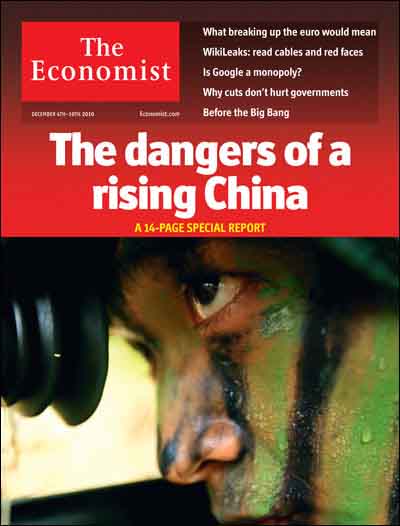
Although I feel that some of the advice from The Economist (ET) of The dangers of a rising China is flawed, the most important advice for America is to abide by its own rules — and if it must break them, it should factor in the real cost of doing so.

I say that the problem here is the fact that every few years, the leadership of America changes and the new leadership (depending on political agendas and promises made to win votes) often does not respect agreements made by previous administrations.

However, China’s central government tends to be much more stable than that of the US. This may help.

Since the US has a history of breaking rules (and treaties), The Economist (TE) does offer valuable advice but I doubt if the US government will listen. The nature of US politics and much ignorance of China among many American voters increases the risk of making a costly mistake.

In fact, there are political factions in the US that do not care how many die or suffer to achieve their political/religious goals.

TE also offers important advice for the Chinese Communist Party to stop using censors… and to draw less on historic grievances.

I suspect that as long as life in China continues to improve, the majority of Chinese could care less about the censored topics.

However, what TE means by historic grievances is more important and a larger challenge for the Chinese to overcome. There are 19th century invasions of China by Western powers that led to the Opium Wars; the devastation of the Taiping Rebellion caused by a Christian convert; the results of the Boxer Rebellion and what happened in World War II when Japan invaded China slaughtering millions of innocent people.

In the 18th and 19th century, China wanted to avoid contact with the West but the West due to its politics and religious beliefs refused and forced China to open its doors to trade resulting in much suffering in China.

Forgetting those grievances, which smashed China’s “collective” pride, may be difficult for many Chinese to do now that the pride that was lost has been found again.

In fact, do not forget that many in China feel a serious connection to the ancestors who suffered at the hands of Western countries and Japan between the Opium Wars and the conclusion of World War II.

It may be difficult and even impossible for people in an “individualist” culture such as the US to understand why many Chinese may have difficulty letting go of these historic grievances.

After all, in America, it is easy to forget about the ancestors, the past and history. Many even believe it is a waste of time to learn of history.

Return to The Economist on China – Seriously – Part 3

______________

Lloyd Lofthouse is the award-winning author of the concubine saga, My Splendid Concubine & Our Hart. When you love a Chinese woman, you marry her family and culture too.

If you want to subscribe to iLook China, there is a “Subscribe” button at the top of the screen in the menu bar.