The Economist on China – Seriously – Part 4/4

January 13, 2011

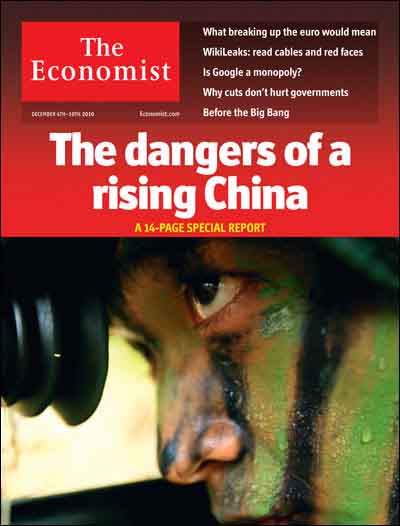
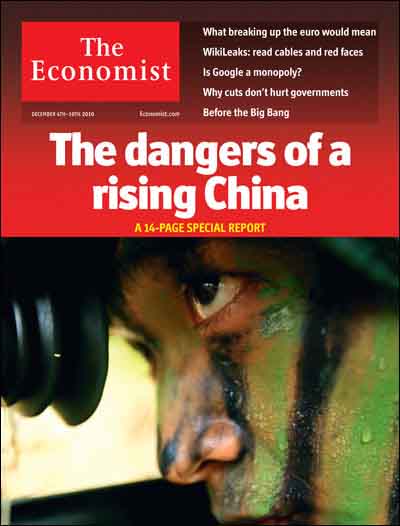
Although I feel that some of the advice from The Economist (ET) of The dangers of a rising China is flawed, the most important advice for America is to abide by its own rules — and if it must break them, it should factor in the real cost of doing so.

I say that the problem here is the fact that every few years, the leadership of America changes and the new leadership (depending on political agendas and promises made to win votes) often does not respect agreements made by previous administrations.

However, China’s central government tends to be much more stable than that of the US. This may help.

Since the US has a history of breaking rules (and treaties), The Economist (TE) does offer valuable advice but I doubt if the US government will listen. The nature of US politics and much ignorance of China among many American voters increases the risk of making a costly mistake.

In fact, there are political factions in the US that do not care how many die or suffer to achieve their political/religious goals.

TE also offers important advice for the Chinese Communist Party to stop using censors… and to draw less on historic grievances.

I suspect that as long as life in China continues to improve, the majority of Chinese could care less about the censored topics.
However, what TE means by historic grievances is more important and a larger challenge for the Chinese to overcome. There are 19th century invasions of China by Western powers that led to the Opium Wars; the devastation of the Taiping Rebellion caused by a Christian convert; the results of the Boxer Rebellion and what happened in World War II when Japan invaded China slaughtering millions of innocent people.

In the 18th and 19th century, China wanted to avoid contact with the West but the West due to its politics and religious beliefs refused and forced China to open its doors to trade resulting in much suffering in China.

Forgetting those grievances, which smashed China’s “collective” pride, may be difficult for many Chinese to do now that the pride that was lost has been found again.

In fact, do not forget that many in China feel a serious connection to the ancestors who suffered at the hands of Western countries and Japan between the Opium Wars and the conclusion of World War II.

It may be difficult and even impossible for people in an “individualist” culture such as the US to understand why many Chinese may have difficulty letting go of these historic grievances.

After all, in America, it is easy to forget about the ancestors, the past and history. Many even believe it is a waste of time to learn of history.

Return to The Economist on China – Seriously – Part 3

______________

Lloyd Lofthouse is the award-winning author of the concubine saga, My Splendid Concubine & Our Hart. When you love a Chinese woman, you marry her family and culture too.

If you want to subscribe to iLook China, there is a “Subscribe” button at the top of the screen in the menu bar.


The Economist on China – Seriously – Part 3/4

January 12, 2011

Part 3 continues the coverage of The Economist’s special report of China.

4. In the balance, The Economist (TE) says, “Their wealth (all of Asia) depends on China, their security on America. Which way should Asian countries face?”

In conclusion, TE says, “Either way, American and China are likely to compete to win the loyalty of the region. That, too, could poison the most important relationship of all—the one between China and America.”

I say that the rest of Asia will be tempted to play America against China to gain more from the rivalry and this will increase the danger of a conflict between the US and China.

5. In Friends, or else, TE says, “Living with China’s rise will test America’s diplomacy as never before.”

In Conclusion, TE says, “Not since the 19th century have they (diplomats) had as great a task as managing the relationship between China and America…”

I say this is an area where the US is weak due to political partisanship in the US.

It doesn’t help when different political agendas in the US such as that of conservative evangelical Christians or the neoconservative movement is manipulating the votes of millions of Americans.

Groups such as these believe they have more to gain by making China an enemy and a scapegoat than a friend.

In the end, if such groups win, we all lose.

The political atmosphere in the US will make the job of American diplomats almost impossible to accomplish since most mainland Chinese believe that what they hear from the US media is the voice of America’s government as the Chinese media is the voice of China’s central government.

6. In “Strategic reassurance“, TE says, “Many things could worsen relations between China and America.”

Then TE offers ten ways to make relations between China and the US better. In Part 4 of this series, I will offer a conclusion along with what TE has to say.

Return to The Economist on China – Seriously – Part 2

______________

Lloyd Lofthouse is the award-winning author of the concubine saga, My Splendid Concubine & Our Hart. When you love a Chinese woman, you marry her family and culture too.

If you want to subscribe to iLook China, there is a “Subscribe” button at the top of the screen in the menu bar.


The Economist on China – Seriously – Part 2/4

January 11, 2011

In Part One, I wrote about “The Dangers of a Rising China”.  In part two, we shall explore The Economist’s Special Report.

1. In Brushwood and gall, China insists that its growing military and diplomatic clout pose no threat. Edward Carr says, “The rest of the world, and particularly America, is not so sure.”

In conclusion, The Economist (TE) says, “American arms remain vastly superior, but in China’s coastal waters they would no longer confer such an easy victory.”

The message is clear— a military conflict with China would not be worth the price.

2. The fourth modernisation focuses on China becoming a military force to reckon with in the western Pacific and how America should respond.

The conclusion says, “Perhaps China does not mean ever to use its weapons aggressively. But American defense planners cannot rely on that, so they must respond.”

In addition, because of this, TE predicts relations between China and America will probably sour.

However, I feel if America acts the bully, China will respond in kind, which puts the ball in America’s court. China might bluff but America may be the bully.

3. In Less biding and hiding, The Economist says, “China is becoming more nationalistic and more assertive. How will other countries react?”

In conclusion, TE says, “Asian security will be determined not just by how China uses its new strength but by how other countries react to it.… Other countries will relax if they are reassured that China does not pose a threat.…”

Therefore, only the future will show us if China plans to be an aggressor (something I doubt will happen unless China is provoked and feels insulted first).

In Part 3, we will continue to summarize The Economist’s special report of China.

Return to The Economist on China – Seriously – Part 1

______________

Lloyd Lofthouse is the award-winning author of the concubine saga, My Splendid Concubine & Our Hart. When you love a Chinese woman, you marry her family and culture too.

If you want to subscribe to iLook China, there is a “Subscribe” button at the top of the screen in the menu bar.


The Economist on China – Seriously – Part 1/4

January 10, 2011

The wind is blowing and it is raining. When I started writing this post, the Internet and phone had been out for several days. I thought the storm had caused it, but it turned out vandals broke into several junction boxes and cut the lines to thousands of homes. It took several days before being reconnected.

Until you lose your connection to the Internet, you do not realize how much your life has been taken over by the virtual beast.

I have The Economist’s (TE) December 4th issue in front of me. It has a fourteen page, six-part, special report on The dangers of a rising China.

Don’t read much into that title. After reading the report, you will realize the danger comes more from the US than China. One sentence says, “The best way to turn China into an opponent is to treat it as one.”

There’s a message in this sentence the US government should heed.

In fact, as China expands into the world economically and militarily, what happens in the future is up to America more than China.

In Half a cheer for China, which comes before the 14 page report, TE quoted Antonio Chiang, a political analyst and former editor-in-chief of the Taipei Times, as saying, “The point of no return (for Taiwan rejoining the mainland sometime in the future) has already passed”.

Chiang believes that President Ma Ying-jeou’s administration’s goal is to unify with China. If this happens, this will not go over well in the US after selling billions of high-tech weapons to Taiwan.

After all, if Taiwan unites with China, all of those US weapons may belong to China.

This topic will be continued in Part 2. Meanwhile, learn of the 2/28 Massacre in Taiwan

______________

Lloyd Lofthouse is the award-winning author of the concubine saga, My Splendid Concubine & Our Hart. When you love a Chinese woman, you marry her family and culture too.

If you want to subscribe to iLook China, there is a “Subscribe” button at the top of the screen in the menu bar.


Separation of Church and State – Part 3/3

January 8, 2011

It is a fact that the phrase “separation of church and state” does not appear anywhere in the Constitution.

However, Thomas Jefferson wrote that the 1st Amendment erected a “wall of separation” between the church and the state

James Madison said it “drew a line,” but it is Jefferson’s term that sticks with us today.

The phrase is commonly thought to mean that the government should not establish, support, or otherwise involve itself in any religion. The Religion Topic Page addresses this issue in more detail.

However, because Thomas Jefferson advocated a separation between church and state, he drafted a bill in 1785 designed to end any attempt to provide taxes for the purpose of furthering religious education.

Jefferson’s bill was passed making it the law of the land. His bill has also been challenged more than once in the Supreme Court and was upheld.

In Everson Versus Board (330 US 1 [1947]), the US Supreme court in a  close 5-4 vote ruled “The ‘establishment of religion’ clause of the First Amendment means at least this: Neither a state nor the Federal Government can set up a church. Neither can pass laws, which aid one religion, aid all religions, or prefer one religion over another.… Neither a state nor the Federal Government can, openly or secretly, participate in the affairs of any religious organizations or groups and vice versa. In the words of Jefferson, the clause against establishment of religion by law was intended to erect ‘a wall of separation between Church and State.”

Again in 1971, in Lemon versus Kurtzman (403 US 602 [1971]), the US Supreme Court ruled “In the absence of precisely stated constitutional prohibitions, we must draw lines with reference to the three main evils against which the Establishment Clause was intended to afford protection: sponsorship, financial support, and active involvement of the sovereign in religious activity.…  the statute must not foster an excessive government entanglement with religion.”

I’ve written before that the Founding Fathers despised democracy and created a Republic to protect Americans from the democratic mob.

Now, what the Founding Fathers fears has come to pass. The US has now become a democracy and the mob has been revealed and they are evangelical Christians — that segment of the population that helped vote George W. Bush into the White House for his second term.

The wall that Thomas Jefferson established to protect US citizens from the tyranny of religion has been breached and nations such as India, Russia, China and all Islamic countries have taken notice.

Although China’s Constitution was written in 1982, it is obvious that China’s leaders took care to protect China from the same tyranny that now threatens the US and the globe.

Return to Separation of Church and State – Part 2

______________

Lloyd Lofthouse is the award-winning author of the concubine saga, My Splendid Concubine & Our Hart. When you love a Chinese woman, you marry her family and culture too.

If you want to subscribe to iLook China, there is a “Subscribe” button at the top of the screen in the menu bar.