Who would win in a fight: Mulan or Emmajin Beki or Teenage Angst, Mongolian-style? “Can you imagine, a mere girl fighting on the battlefield?”
The role of females in combat is a debate as timeless as war itself, and one that remains divisive and unresolved to this century.
While present-day arguments for and against allowing women in the military revolve around psychological and biological issues, back in olden times, one needed only cite “tradition” and “familial roles” to silence the detractors.
The teenaged heroine of Dori Jones Yang’s new 13th-century historical fiction novel, Daughter of Xanadu, is one such detractor, albeit immutable.
Often imagining herself on the battlefield, “the son my father never had,” Emmajin Beki, the granddaughter of Mongolian king (and emperor of China’s Yuan Dynasty) Khubilai Khan (1215-1294), learned to ride a horse before she could walk and can outshoot all her cousins in archery. She confidently and outspokenly aspires to emulate her female ancestors who assisted Chinggis Khan in conquering Asia (“the blood of all these earlier strong women flowed in my veins”).
Unfortunately, for this princess, “the days of strong women had ended once luxurious court life had begun.”
The Mongols, fattened, lazy and resting on their laurels, now prefer to tell stories of battles-past over lavish “orgies of excess” rather than engage in new wars, much to Emmajin’s restless discontent.
When she makes known her desire to “become a legend” like real-life women warriors Aiyurug Khutulun and Hua Mulan of China, the great Khan placates her by sending her on a secret mission to spy on a family of foreign merchants currently visiting the Mongol court.
The merchants’ young son turns out to be one Marco Polo, the now-legendary Venetian journeyer credited for introducing Asian culture to the west.
To Emmajin, however, he is just another “colored-eye man,” a court curiosity from Christendom whose gallantry and romantic gestures are as ridiculous to the manly Mongolians as his facial hair (“his beard was so thick I could imagine food sticking in it”).
Try as she might, however, Emmajin, caught in the peak of puberty, is unable to resist Marco’s western charm, and quickly finds herself enamored by his worldly vision (“I had learned to see the world through Marco’s eyes”) as well as his pelt.
“What would the hair on his arm feel like?” she often fantasized about at night.
But she was a Mongolian first, and reluctantly sacrifices her blossoming relationship with the foreigner to complete her spy mission (“He was not a friend but a source of information.”).
Authoress Dori Jones Yang is a Caucasian American, yet she is no stranger to writing from the perspective of conflicted adolescent Chinese girls, as evinced in her previous, award-winning novel, The Secret Voice of Gina Zhang.
In Daughter of Xanadu, she hones in even deeper into the physiological confusion and emotional conflictions that make youth such a joy, turning Emmajin into such a hormonal wreck that this male reviewer often found himself gritting his teeth in frustration at such contradictive revelations as, “if he had pursued me, I would have rebuffed him. By holding himself aloof, he challenged me to win back his esteem.”
Daughter of Xanadu is not all-teenage angst. As our protagonist matures, so does the content of the story.
Emmajin eventually persuades Khubilai Khan to allow her to train for war against the Burmese at the Battle of Vochan (present-day Yunnan province), where the embarrassment of getting her period in front of the all-male troops is a bloody omen for what’s to come.
Upon seeing her cousin slain, innocent Emmajin is transformed into a “mindless killer.”
Bloodlust unleashed, the young princess swings her sword indiscriminately (“the hatred pounded in my ears…killing him felt good”), resulting in hundreds of men dead by her hand alone.
One can only imagine all the Mulan vs. Emmajin fan fiction that this novel will inspire!
By story’s conclusion, Messer Polo, who witnessed and wrote about the Mongols’ real-life battle against the Burmese in his book, The Travels of Marco Polo, has elevated “Emmajin the Brave” into the living legend she wanted to be, though she now regrets it.
“These men needed a hero, but I no longer needed to be one.” She resigns her sword and rank, and departs with Polo back to Europe as the Khan’s emissary of peace, leaving the literary door wide open for a sequel.
Dori Jones Yang, who also penned the best-selling Pour Your Heart Into It: How Starbucks Built a Company One Cup at a Time, is a skilled historian.
In researching Daughter of Xanadu, Yang, fluent in Putonghua, traveled all the way to the ruins of Xanadu in remote Inner Mongolia, which this itinerant backpacker can personally attest is no easy journey.
The short chapters and brief sentences, edited with razor precision for a younger audience, along with a helpful glossary for ESL students, make reading Daughter of Xanadu a breeze, though adults will admittedly want to beg this book back afterwards from their tweens.
This post first appeared as a four-part (guest author) series starting April 17, 2011 at Daughter of Xanadu – Part 1
In 2008, I wrote a post about Tibet on another forum. Someone with a Tibetan sounding name left a comment in crude English calling me a “Communist rabbit”.
Name-calling seems to be popular these days. In America, people like Glenn Beck (FOX network), Rush Limbaugh (600 radio stations), Ann Coulter and the Tea Baggers have developed name-calling into an art form—not much substance but disguised racism, colorful and angry.
The Tibetan government in exile’s Prime Minister Samdhong Rinpoche was quoted in “Good” magazine’s May/June 2008 Issue that six-million Tibetan Buddhists still lived in Tibet. He also said that Tibet has never historically been part of China. That isn’t true. Tibet was ruled by three of China’s Imperial Dynasties.
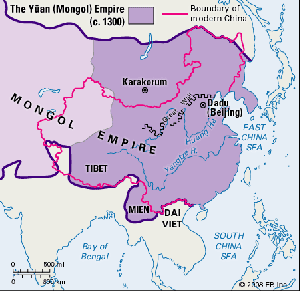
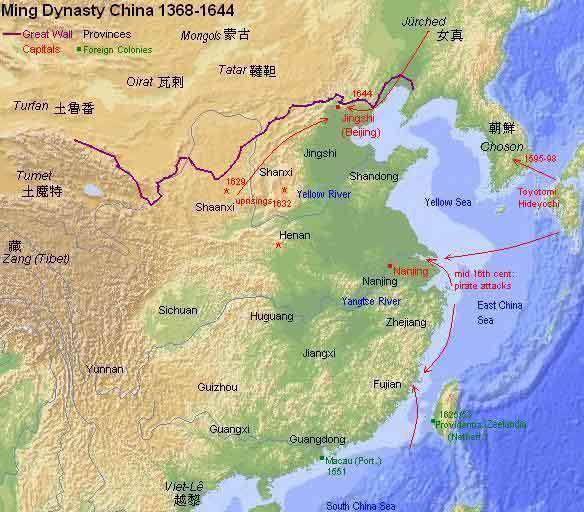
Tibet was first ruled by China during the Yuan Dynasty (1277-1367). Then, when the Ming Dynasty (1368-1643) reclaimed China, a Ming Imperial army was sent to Tibet to drive out the last of the Mongols–holdovers from the Yuan Dynasty. The Ming emperor ordered his army to stay.
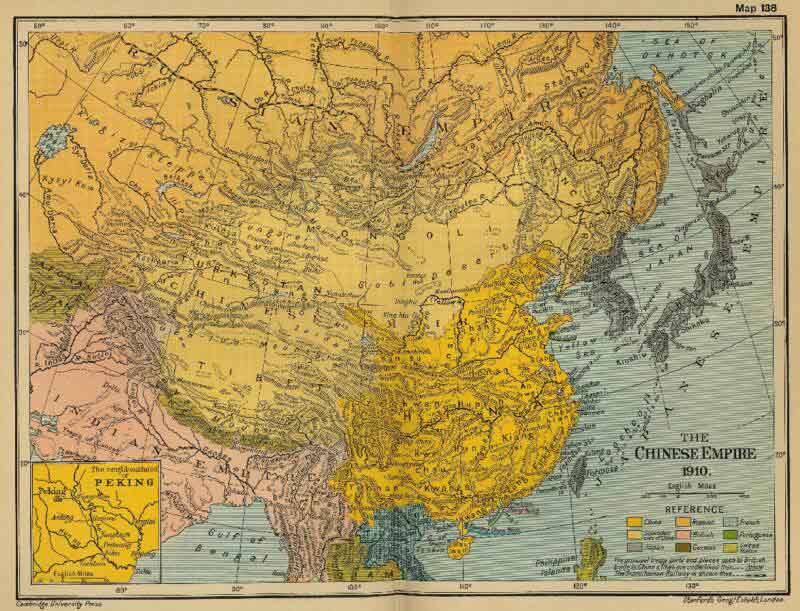
When the Ch’ing (Manchu) Dynasty (1644-1911) came to power, the Chinese empire expanded further and Tibet remained in China. Later, I’ll provide evidence from a 1912 National Geographic magazine as proof.
I previously quoted the Tibetan government in exile’s Prime Minister Samdhong Rinpoche claiming that six million Tibetan Buddhists still lived in Tibet.
China, on the other hand, reports that Tibet’s population was 2.84 million at the end of last year, 31,500 more than at the end of 2006. Among its permanent residents, more than 2.5 million, or 95.3 percent, were Tibetans. (Tibet’s population was 1.14 million in 1951.)
More evidence that is interesting comes from the CIA World Factbook. It seems that there are about 80,000 Tibetan refugees living outside Tibet/China. Wikipedia estimates about 5,000 to 9,000 live in the United States. The rest live closer to the Tibetan government in exile.
There were no Tibetans in America prior to the 1950s. Chinese first immigrated to America in the 18th century, and Chinese Americans make up the largest Asian population in America today—more than three million.
The most damaging evidence against Rinpoche’s claims come from the October 1912 issue of The National Geographic Magazine (I have a copy—it cost me $20 on e-bay). Since the earliest evidence of Communists in China was about 1920, and it wasn’t until 1949 that the Communists came to power under Mao, there is no way the Chinese doctor who wrote that 1912 piece could have lied for the Communists.
In the 1912 issue of The National Geographic Magazine on page 979, Dr. Shaoching H. Chuan wrote, “Tibet is governed by the Dalai Lama as politco-religous head and two “Ambans” as the political dictators. The Ambans are appointed by the Chinese Emperor every four years. All governmental affairs have to undergo examination by the two Ambans, and all government policy must be sanctioned by them before it can be put into operation. Literally, the Dalai Lama is under the authority of the two Ambans…” (Page 979)
From recent news, it appears that rough times may be ahead for the People’s Republic of China (PRC). In China sees US as hedge for Taiwan, Tibet (Asia Times) by Peter Lee, the author says, “After the Dalai Lama is gone, there is a strong possibility that motivated and organized pro-independence activists (militants) will be able to win power in the Tibetan government in exile.”
Militant Tibetan separatist groups have not been happy with the Dalai Lama’s call for autonomy talks with China instead of calling for a fight to gain independence. Tibetan militant groups want Tibet to break from China even if it means taking a violent path—one the Dalai Lama does not advocate.
What would Tibet be like if the separatists had their way and broke free from China?
Would they return to the system of landowners and serfs (slaves)?
Would the Tibetan Buddhists require that every family send at least one son to become a Buddhist monk as before?
Would mandatory schooling (as we have in the United States) be shut down so the literacy rate would plummet from the high 90% back to a single digit like it was prior to 1950?
Would the wealth and the land be returned to the one percent that had it all before Mao’s troops occupied Tibet?
Regardless of the evidence that proves the Tibetan government in exile is not telling the truth about Tibet being part of China for centuries before declaring independence in 1913 (when the Ch’ing Dynasty was collapsing and the British Empire urged Tibet to break free for political reasons), the Dalai Lama and his Prime Minister represents less than 100,000 Tibetans outside China.
If Rinpoche’s figure of six million is correct, that means the Tibetan government in exile represents about 1% of the Tibetan population. If China’s 2.5 million is correct, the percentage goes up to 3.2%. Not much of a base to wage a violent rebellion. There are more troops in the PRC’s army than the entire Tibetan population inside and outside of China.
I also wonder if that 1% in exile were the Tibetan landowners. Did they leave most of the serfs/slaves behind when they fled?
Maybe the Tibetan separatists/rebels (whatever term you like), with help from the CIA, should join the American Tea Bagger movement and gain the support from the likes of Ann Coulter, Glenn Beck and Rush Limbaugh.
They could sit around the campfire during protests and sing hymns about marching into battle to take back the wealth and return to the good-old-days, which would be the opposite of Robin Hood. In this case, the landowners that fled old Tibet (1% of Tibet’s population) would take back what they owned when they left and restore Tibet to the way it was.
In fact, The steady improvement of health care and living standards has raised the average life expectancy of Tibetans from 36 years in the old Tibet to the present 65 years.… It is recorded that during the 150 years before Tibet was (returned to China) there were four pandemic outbreaks of smallpox, one of which, in 1925, killed 7,000 people in the Lhasa area alone. Outbreaks of typhoid fever in 1934 and 1937 carried off some 5,000 people in Lhasa. Source: China-un.ch, which is supported by the facts in the 1912 piece published in the National Geographic Magazine.
Here is a suggested slogan for the Tibetan separatists (former landowners) living in India. “Freedom for landowners, illiteracy for serfs and life expectancy of 36 again!”
Lloyd Lofthouse is the award-winning author of My Splendid Concubine [3rd edition]. When you love a Chinese woman, you marry her family and culture too. This is the love story Sir Robert Hart did not want the world to discover.
Subscribe to “iLook China”! Sign up for an E-mail Subscription at the top of this page, or click on the “Following” tab in the WordPress toolbar at the top of the screen.
We visited General Yue Fei’s tomb in Hangzhou, and hundreds of Chinese tourists were there. It was early October 2008. This was our third trip to the city in a decade, and I was watching people spitting on the kneeling, life sized metal statues of men dead for more than eight centuries. Those metal effigies with their hands tied behind their backs had been traitors.
It may be difficult to understand what honor means to most of the Chinese if one isn’t Chinese. One way to possibly understand the importance of this concept is to examine two of China’s historical heroes.
General Yue Fei died on January 27, 1142. He was a famous Chinese patriot and military general who fought for the Southern Song Dynasty against the Jurchen armies of the Jin Dynasty.
Several jealous Song ministers lied to the emperor saying that Yue Fei was planning to kill him and take over. The emperor believed these lies and had General Yue Fei executed. When the truth came out, Yue Fei became a model for loyalty in Chinese culture. By spitting on those statues of those ministers who lied, the Chinese honor Yue Fei’s memory.
Although the Communist Chinese government has made it illegal to spit on those statues for public health reasons, hundreds defy the law on a daily basis, and continue to insult those traitors while honoring Yue Fei.
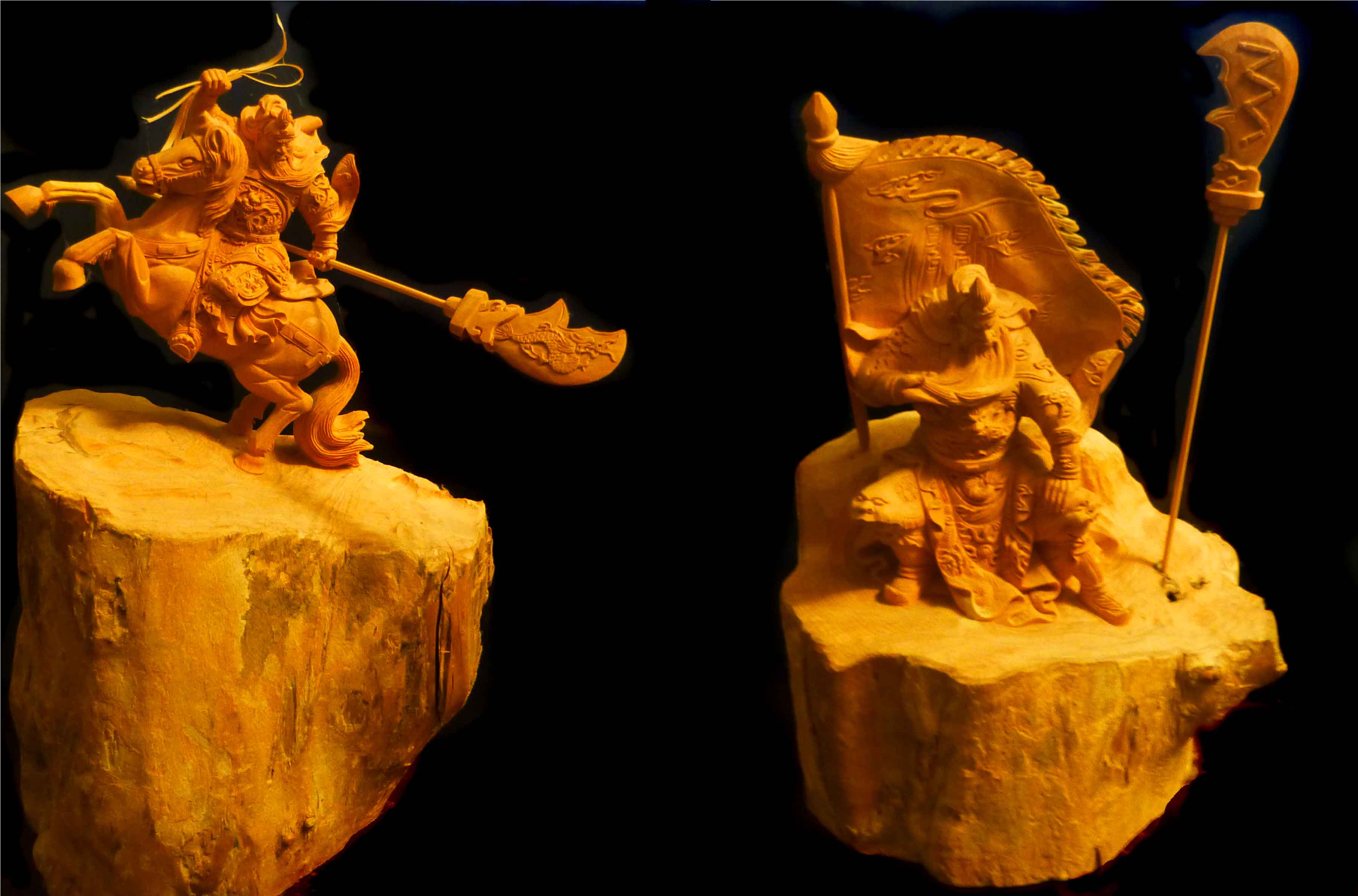
There is another moral hero from China’s history. During the Three Kingdoms era (220-265 A.D.) after the fall of the Han Dynasty, there was a period of civil war. Out of this era came the story of Guan Yu, who was another moral model of loyalty and righteousness.
Guan Yu lived almost eighteen hundred years ago, but it is easy to find carvings and statues of him in China. In fact, I have several hand carved in wood. Here are two of them.
It doesn’t matter if one is a member of the Communist Party, because role models like Yue Fei and Guan Yu still play an important part in how many Chinese behave and what they think. Anyone in China holding a position of power is measured against men like Yue Fei and Guan Yu.
To help gain a better understanding of what honor means to the Chinese, here’s a link to a piece published in theLos Angeles Times.
In 1935, Lin Yutang said, “Face cannot be translated or defined. It is like honor and is not honor. It cannot be purchased with money, and gives a man or a woman a material pride. It is hollow and is what men fight for and what many women die for.
“It is invisible and yet by definition exists by being shown to the public. It exists in the ether and yet can be heard, and sounds eminently respectable and solid. It is amenable, not to reason but to social convention.
“It protracts lawsuits, breaks up family fortunes, causes murders and suicides, and yet it often makes man out of a renegade who has been insulted by his fellow townsmen, and it is prized above all earthy possession.”
“It is more powerful than fate and favor,” Lin Yutang said, “and more respected than the constitution. It often decides a military victory or defeat, and can demolish a whole government ministry. It is that hollow thing which men in China live by.” (Lin Yutang, My Country and My People, Halcyon House, New York, NY, 1938, page 200)
Chinese like Yue Fei and Guan Yu were honorable men and gained much face/respect because of their beliefs and behavior.
When anyone in China reacts to anything, politically or personally, honor plays a large role. It doesn’t matter if one is a member of the Communist Party, a farmer or a factory worker or one of the wealthiest members of the new capitalist elite.
Most Chinese measure what is important in life by a different standard than the rest of the world.
_______________
Lloyd Lofthouse is the award-winning author of My Splendid Concubine [3rd edition]. When you love a Chinese woman, you marry her family and culture too. This is the lusty love story Sir Robert Hart did not want the world to discover.
Finalist in Fiction & Literature – Historical Fiction
The National “Best Books 2010” Awards
Honorable Mentions in General Fiction
2012 San Francisco Book Festival
2012 New York Book Festival
2012 London Book Festival
2009 Los Angeles Book Festival
2009 Hollywood Book Festival
Subscribe to “iLook China”!
Sign up for an E-mail Subscription at the top of this page, or click on the “Following” tab in the WordPress toolbar at the top of the screen.
In America and the rest of the West, most people believe that Mao was a monster worse that Adolf Hitler or Stalin and is responsible for killing at least 30 to 60 million people during what is known as China’s Great Famine.
In fact, many Chinese also believe that millions died of starvation during The Great Famine (1958 – 1961) due to Mao’s demanding agricultural production goals during China’s Great Leap Forward.
Until recently, I also believed this without doubt since that is all I have ever heard.
The details that may have caused this famine are not common knowledge and it appears that no attempt by the Western media has been made to reveal them.
However, after discovering what happened in China and the world during Mao’s Great Leap Forward, what was once a certainty (at least to me) is now a mystery and possibly another hoax equal to the hoax that Tibet was never part of China before 1950 and there was a massacre in Tiananmen Square in 1989, which Wiki Leaks recently proved wrong.
No mention of drought, floods and severe weather that cut crop yields, and the number of deaths quoted in the video cannot be supported with evidence. In addition, evidence that does exist supports far fewer deaths.
Why Mao may have become scapegoat or victim of a hoax is worth examining.
The reason I say this is because in 1949 when Mao came to power, life expectancy in China was about 35, and then in 1960 life expectancy improved to about 60 or almost double what it had been in 1949, while the population of China increased by 19.5% with child mortality rates improving dramatically.
If Mao’s policies were responsible for these improvements in life expectancy and population growth, how could he also be the monster responsible for causing a famine that may have killed millions?
If a famine did occur, my research revealed that other factors may have contributed to the deaths and all but one of those factors did not deliberately cause people to die of starvation.
After learning of these other factors and completing the puzzle, it is obvious (at least to me) that Mao and the Communist Party did not order the deaths of 15 to 70 million people (the numbers quoted in the West vary widely because different people have made different claims without valid evidence to support those claims. There is evidence that supports the lower number.).
Before I started researching this post, I believed that Mao’s agricultural reform policies were mostly responsible for the famine, and then I learned that drought and severe weather also played a role in the famine.
The other factors that may have contributed to China’s so-called Great Famine will be listed in order of influence with the most damaging factor listed first and the least damaging last.
The first factors that may have contributed to the famine were droughts, floods and general bad weather.
In 1959 and 1960, the weather was less favorable, and the situation grew considerably worse, with many of China’s provinces experiencing severe famine.
Droughts, floods, and bad weather caught China completely by surprise, and in July 1959, the Yellow River flooded in East China and directly killed,either through starvation from crop failure or drowning, an estimated 2 million people.
In fact, droughts and famine are common in China. Between 108 BC and 1911 AD, there were no fewer than 1,828 major famines in China or one nearly every year in one or another province.
In the West, most if not all of what we hear about Mao is that he was a brutal monster responsible for the deaths of about 30 million people during the Great Leap Forward as if he pulled the trigger and ordered others to deliberately kill people by the millions as Hitler and Stalin did.
However, the facts do not support this claim.
The first time I heard that droughts and extremely bad weather also played a role in the so-called Great Famine was early July 2011 while I was researching another topic for this Blog and stumbled on that mostly unknown fact by accident.
Then I discovered another more insidious factor when I started working on this post, which may have contributed significantly to the early deaths of millions in China and no one in China was responsible for this one.
This factor was influenced by both American and Chinese paranoia generated by the Korean War (1950 – 1953), America’s involvement in Vietnam (1955 – 1975), McCarthyism‘s Red Scare (1947 – 1957) and the Cold Warwith Communist Russia (1945 – 1991).
The War in Korea (1950 – 1953), Vietnam (1955 – 1975), McCarthyism (1947 – 1957) and the Cold Warwith the USSR (1945 – 1991) set the stage for what may have contributed to mass deaths by starvation in China during the Great Leap Forward.
During the McCarthy era (1947 – 1957), thousands of Americans were accused of being Communists or communist sympathizers and became the subject of aggressive investigations and questioning before government or private-industry panels, committees and agencies.
In 1950, since China fought alongside North Korea against allied UN forces under the leadership of the US, the United States implemented a “complete embargo” that forbade all financial transaction with Communist China.
The US also convinced many of its allies to join this “complete embargo” to cut China off from the world.
After the Korean war, the United States did not lift this embargo for the next twenty years (1949-1969), with a goal to disrupt, destabilize, and weaken China’s communist government by causing the people to suffer and this “complete embargo” was one of the tools to achieve this.
The US embargo on China was a “complete embargo”, whch certainly must have contributed to the death toll of the Great Famine, a factor never mentioned before.
High American government sources have admitted that the objective of the economic warfare was aimed at causing a breakdown of Communist China. The idea was that problems in the Chinese economy would lead to loss of support from the people causing the collapse of the Communist Republic. Source: China for all.info and Asia for Educators – Columbia.edu
This embargo was lifted in 1969, when Richard Nixon was President. Source: Washington Post.com
However, while people were starving in China and US officials were waiting for Communist China to collapse, Washington D.C. had no idea how much suffering the Chinese people were capable of enduring and that even with the drought and famine, most Chinese were better off than they had been in centuries.
The evidence that the quality of life was improving was the fact that in 1949 when Mao came to power, life expectancy in China was 35, and by 1960 life expectancy had improved to age 60 or almost double what it had been in 1949, while the population of China increased by 19.5% with child mortality rates improving dramatically.
Field-studies in the 1930s revealed that in all parts of China, large numbers of landless laborers lived in tremendous poverty, and their situation had not changed since the sixteenth century. Source: China for all.info
If you want more evidence, I refer you to Pearl S. Buck’s “The Good Earth”.
We may never know how much of an impact America’s “economic warfare” against China crippled its ability to import food to feed its starving people in a time of drought and famine. In fact, this may have also influenced Mao’s decisions since he wanted the world to see China as strong and capable of feeding itself.
If anyone pulled a trigger on China’s people, it was not Mao. It was Washington D.C. fueled by fear of everything Communist caused by the Korean War, Vietnam, McCarthyism’s Red Scare and the Cold War with Communist Russia.
The last damaging factors that may have led to millions of deaths due to famine and starvation was the statistical lies of rural farmers and local party bosses reporting crop yields in rural China and Mao’s impossible goals to create a miracle in five years.
Mao’s five-year plan for the Great Leap Forward set quotas (goals) to develop agriculture and industry so China would catch up to America and the other Western nations that had invaded China during the 19th century (England, France, Japan, Germany, Russia, America, etc.)
Mao believed that both agriculture and industry had to grow to allow the other to thrive.
Industry could only prosper if the workers were well fed, while the agricultural workers needed industry to produce the modern tools needed for modernization.
For this to happen, rural China was reformed into a series of giant communes.
However, the droughts, floods and other severe weather arrived soon after this five-year plan was implemented and set the stage for a tragedy caused by nature and supported by American “economic warfare” in the form of a “complete embargo” of China.
Due to quotas set by Mao’s agricultural policies, no one wanted to be seen as a failure and/or unpatriotic so this generated boastful claims about output that were followed by more boastful claims of incredible crop yields.
Nobody – least of all the central government in Beijing – knew the real output figures and nobody was trying to find out. Instead, there was a sense of general euphoria in Beijing that China was succeeding.
While rural farmers and party posses lied about crop yields, China started exporting rice and wheat to other countries as a source of revenue, since Beijing believed there was a bumper crop. The result was that only urban areas suffered with reduced rations but with still enough food to survive.
However, the situation was different in the areas that lied the most and resulted in mass starvations largely confined to rural China, where, because of drastically inflated production statistics, very little grain was left for the peasants to eat.
Food shortages were bad throughout the country. However, the provinces, which had adopted Mao’s reforms with the most energy, zeal and the highest boasts, such as Anhui, Gansuand Henan, tended to suffer disproportionately.
Sichuan, one of China’s most populous provinces, known in China as “Heaven’s Granary” because of its fertility, is thought to have suffered the greatest absolute numbers of deaths from starvation due to the vigor with which provincial leader Li Jinquan undertook Mao’s reforms.
Once the central government in Beijing discovered the truth, the Chinese Communist Party acted quickly to correct the errors in national agricultural decision-making, to conserve food, and to save as many lives as possible implementing drastic measures to feed those in need and to restore agricultural productivity.
Grain exports were stopped, and imports from Canada and Australia (in spite of America’s complete embargo) helped to reduce the impact of the food shortages. Source: Library Index.com
The final question is: Would Mao’s Great Leap Forward have been more successful if there had been no drought, no floods and no “complete (U.S.) embargo” and the people had not lied about crop yields?
It is no secret that millions of rural people starved to death in China during the famine of 1959 – 1960, but it was a “great” tragedy caused by a complex series of circumstances and was not murder.
In addition, the actual number of deaths was significantly lower than what has been claimed in the West.
The CCP’s lofty goal was to prove to the world that the Party ruled China successfully by boosting crop yields and industrial output.
Another reason the CCP set such unrealistic goals for the five-year plan that contributed to the tragedy that was Great Leap Forward was because of Taiwan, which was recognized by the world as the official government of China and still held its seat in the United Nations.
It wouldn’t be until 1971 that the U.N. recognized the People’s Republic of China instead, and the United States wouldn’t switch diplomatic relations with China from Taipei to Beijing until 1979, finally recognizing the Communist Party as the legitimate ruler of China.
From Griffith University, Australia, Poverty, by David C. Schak, Associate Professor
______________
Lloyd Lofthouse is the award-winning author of The Concubine Saga. When you love a Chinese woman, you marry her family and culture too. This is the love story Sir Robert Hart did not want the world to discover.
To subscribe to “iLook China”, look for the “Subscribe” button at the top right of the screen.
In February 2010, Gallup reported, “In general, the larger group of Asian-Americans tends to be more Democratic and more liberal than average Americans. Exit-poll data from the 2008 presidential election generally confirm this, with Asian-American voters having supported Barack Obama over John McCain by roughly a 2-to-1 margin.”
In fact, Asian Week says Chinese-Americans voted for President Obama by more than a 3-1 ratio.
Now that we have discovered that more than 75% of Chinese-Americans vote Democratic and are considered liberal, they may be surprised to discover that they fear Global Warming, trust what they read or hear in the traditional media, trust (scientific) experts more than emotional opinions, and are prone to hysteria.
If you are Asian-American or Chinese-American, does that describe you?
In Environmentalism in China, I mentioned that an “old” friend of mine all but “worships” this man. In fact, my “old” friend sounds as if he were a “Prager Parrot” (used as a metaphor).
For more about this embedded video, click on
HIV/AIDS Global Pandemic
Dennis Prager is an American syndicated radio talk show host, syndicated columnist, author and public speaker noted for his conservative political and social views.
In addition, Prager graduated from Brooklyn College in 1970 with a major in Middle Eastern Studies and History. He then studied at the Russian Institute at Columbia University.
He started broadcasting on radio in Los Angeles in 1982. Today, his talk show appears on about 100 radio stations across the nation influencing the opinions of millions of people that believe if you vote Democratic and/or believe Global Warming “may” be caused by carbon emissions, you are a hysterical leftist-liberal.
To understand Dennis Prager and his flock of Parrots (used as a metaphor), one must know the difference between facts, theories and opinions.
A fact has undisputed evidence to support its truth and is driven by rational thought. In science, “fact” is an objective and verifiable observation. For example, several centuries ago, many in the West held an opinion that the earth was flat and that the sun and stars revolved around the earth until explorers (such as Christopher Columbus) and scientists proved that wasn’t true.
A scientific theory is a well-confirmed hypothesis that explains a large body of facts inspired by a large body of research. When the body of research is convincing, many people accept the theory as a potential fact.
Since most of our objective and verifiable observations come from experts and/or scientists, according to Dennis Prager, if you believe these experts about Global Warming, you would be a hysterical leftist-liberal that trusts what the traditional media reports as news.
An opinion is based on a belief or personal view and varies according to an individual’s knowledge, experience, culture, beliefs and is driven and reinforced by emotion. An opinion may also be a simple, uniform message designed to be acceptable to a large number of people. An opinion is not a fact, because opinions have not been proven or verified.
As we know, Google returned to China on China’s terms. Did Prager later apologize for his praise of Google’s Sergey Brin after Google backed down? Prager says he suspects China needs Google more. Wrong again. China has Baidu, which is a search engine with about 76% of the search traffic in China.
In the Global Warming essay, Prager says, “Observers of contemporary society will surely have noted that a liberal is far more likely to fear global warming than a conservative.”
In the previous opening sentence of his essay of Global Warming, Prager defined the difference between liberals and conservatives in a simple generalization, which is an opinion and he has no facts to support what he claims.
However, to Prager and his fans, if you fear global warming, you are a leftist-liberal and are prone to hysteria. He then goes on to say that leftists also believes what The New York Times and other liberal news sources report, which means if you are a liberal, you will believe almost anything you hear or read in the mainstream media.
However, Gallup reported in September 2010 that “Distrust in U.S. Media edges Up to Record High” saying, “For the fourth straight year, the majority of Americans say they have little or no trust in the mass media to report the news fully, accurately and fairly.”
The Gallup study also reveals that 33% of conservatives had a great deal of trust in the media while 46% of liberals had little or no trust.
Hmm, if we return to Prager’s opinion (I meant essay), we see that he said, “Liberals rarely question the authority of the mainstream media,” but when we examine the facts gathered by experts working for Gallup, this isn’t true.
Do you see the difference between Prager’s opinions and the facts, and how he relies on reinforcing his opinions by using terms that manipulate emotions?
Did you know that Prager wrote in the Jewish World Review that Mao “butchered” 60 million Chinese? However, there are no facts from eyewitnesses to support the claims and opinions that Mao deliberately “butchered” any Chinese. To discover more, I suggest you read China’s Great Famine – Fact or Fiction.
Dennis Prager says that liberal and/or leftists tend to trust experts more, are more likely to revere and even “worship” nature, while fearing death more than a conservative. Does this sound like a stereotype?
Pay attention to the emotional words Prager uses to drive his fans to accept his opinions. To a conservative, born again Christian reading that someone “worships” nature over God is a mortal sin and unforgivable.
This is how Prager manipulates the emotions of those that believe what he preaches. Has any expert studied if conservatives fear death less than liberal-leftists do? I doubt it.
He infers that if we allow the leftist-liberals to focus too much on reducing carbon emissions to deal with the potential threat of Global Warming, which he infers is a hoax, we will “lose the war” against “Islamic fascism” that threatens the free world.
Wow! That is HUGE leap of flawed logic. Imagine how “lose the war against Islamic fascism” is going to inflame the emotions of his conservative audience driving them to believe his opinions.
In addition, how is this going to happen? Well, by too many of us wasting our time working to cut back on carbon emissions reducing pollution so Global Warming may not threaten the world we live in.
To discover more of Prager’s fraud, I suggest watching To Hell and Back and discover that only one percent of the American population is fighting the war in Afghanistan and Iraq—to stop Prager’s “Islamic fascism” from taking over the world.
In addition, if we develop alternative forms of energy and break our Middle Eastern oil habit, won’t that help defeat Prager’s “Islamic fascism” by cutting off the West’s money from flowing into the Middle East?
Prager Claims “Equality” Isn’t American (because controversy is the bread and butter of talk radio)
If only one percent of Americans are fighting the war against Prager’s “Islamic fascism”, then why can’t the other 99% deal with the potential threat of Global Warming “possibly” caused by carbon emissions as supported by facts gathered and interpreted by many experts — In 1997, Science Daily reported that more than 1,500 of the world’s most distinguished senior scientists, including the majority of Nobel laureates in science, signed a consensus declaration urging leaders worldwide to act and prevent potentially devastating consequences of human-induced global warming.
However, in his Global Warming essay, Prager urges us to ignore these experts — that is unless we want to be seen as a hysterical, death fearing leftist-liberal.
In addition, if you click on that link To Hell and Back, you will discover from the video that many of America’s troops believe the wars (in Afghanistan and Iraq) are wrong.
A recent Pew research poll found that a third of American veterans who served after 9/11 believe the wars in Iraq and Afghanistan are not worth fighting.
Did you know that in Townhall.com, Dennis Prager wrote, “The president (of the US) does not wish to annoy China’s dictators prior to his upcoming visit to Beijing?”
However, Prager is wrong again. If we use the accepted definition, a dictator does not rule China today. Instead, China is a one-party Republic and China’s leaders are selected by the consensus of 80 million Communist Party members — a decision based on the merit of the individuals running for the position (instead of the popularity contest of American politics), which I wrote about in Dictatorship or one party-republic.
It is obvious why Prager used the word “dictator” to describe China’s government — to stir emotions driving his fanatical followers (Prager’s Parrots — used as a metaphor) to accept his opinions as if they were facts.
Did you know Dennis Prager wrote on Creators.com that, “Consider the facts (I’m surprised he used this word): Tibet, at least 1,400 years old, is one of the world’s oldest nations, has its own language, its own religion and even its own ethnicity. Over 1 million of its people have been killed by the Chinese, its culture has been systematically obliterated, 6,000 of its 6,200 monasteries have been looted and destroyed, and most of its monks have been tortured, murdered or exiled.”
All of Prager’s emotionally driven claims such as “killed, obliterated, looted, destroyed, tortured, murdered or exiled” have been proven wrong, but most of Prager’s Parrots are not interested in the facts. I say that Prager owes China an apology.
In fact, Tibet was not a nation until 1911 when the British convinced the Dalai Lama to declare freedom from China, after having been ruled by China since 1279 AD during the Yuan Dynasty, then the Ming Dynasty starting in 1368 AD and last the Qing Dynasty until its collapse in 1911.
In addition, only one percent of all Tibetans are self-exiled from Tibet. China did not drive those former landowners and Buddhist monks out of Tibet — they fled and there is no evidence other than emotional opinions that China killed over 1 million Tibetans in 1950.
All the “facts” are there for anyone willing to trust the experts and sources such as Sir Robert Hart (1835 – 1911) and a piece published in the October 1912 National Geographic Magazine by an expert Western trained medical doctor named Shaoching H. Chuan, M.D. that happened to spend two years in Tibet starting in 1907 after the last Qing emperor ordered him there to deal with a cholera epidemic.
In addition, Prager forgot to mention that there are more than sixty spoken languages in China and one written one. China has 56 minorities and each has its own language as the Tibetan minority does. It’s been this way in China for more than 2,000 years.
In fact, by not mentioning America’s native minorities, Dennis Prager is a hypocrite and deceitful.
North American native tribes and nations were free and governed themselves for more than ten thousand years (much longer than the 1,400 years he claims Tibet governed itself before 1950) before Europeans arrived and drove them from their land.
If you visit Native American Nations, you will discover how many spoke their own languages and many still do — the only difference is today native Americans live on reservations and the US Department of the Interior is responsible for the administration of programs relating to Native Americans, Alaska Natives and Native Hawaiians.
One example is the Navaho Nation, the largest Native American reservation in the United States, which is in Arizona. The Navaho Nation covers 27,425 sq miles (71,000 km2) with a population of about 174,000.
The Navajo Nation, like Tibet, is a semi-autonomous Native American-governed territory within the United States.
Another example is the Cherokee Nation, which had its own written language developed early in the 19th century by a mixed-blood Cherokee called Se-Quo-Yah, so the Cherokee Nation would be considered educated, literate and capable of governing itself as an equal, independent nation.
However, this did not stop the United States from breaking treaties and waging war with the Cherokee Nation to exploit the natural resources of their land. It’s called conquest and anyone that studies history knows this is a natural part of the evolution of all species including man.
How is this situation different from Tibet and China? Native Americans had their own religions too and were not allowed to practice them by the United States, while China allows Tibetan Buddhists to practice their religion within a semi autonomous territory, which is administered by a CCP government agency similar to the US Department of the Interior.
Another fact that Prager conveniently left out of his opinionated rant of an essay is that after 1976, China rebuilt many of the Buddhist temples in Tibet that were destroyed during Mao’s Cultural Revolution when religions in China were banned and the entire population suffered.
Today, there are seven-major religions in China including Christianity and Islam.
Rush Limbaugh, the host of the number-one conservative talk-radio show, explains how talk-radio works.
Michael Orion Powell writes, “Prager is a good example of what happens when a commentator ties himself to one side of the political spectrum permanently.”
By Seattle standards, Michael Powell calls himself a conservative, but by actual conservative standards (as defined by talk show hosts such as Dennis Prager), he says he is a raving liberal.
In addition, decades ago, I too listened to Rush Limbaugh and then deserted him for Dennis Prager.
I eventually fled Prager too, after I questioned his emotionally driven opinions and compared them to the facts of experts discovering that he was often wrong and misleading. Now that I’m an ex-Prager Parrot, I guess that makes me a leftist-liberal prone to hysteria that fears death even though I support the Second Amendment to the US Constitution, which guarantees the right to bear arms (weapons such as rifles and pistols).
So, we either trust the emotionally-driven opinions of conservative talk-show hosts such as Dennis Prager (with a major in Middle Eastern Studies and History who also studied about Russia), or trust 1,500 of the world’s most distinguished senior scientists, including the majority of Nobel laureates in science.
And the truth is, there is a chance the experts could be wrong about Global Warming, since it is only a theory supported by facts, but are we willing to risk ignoring them and support an unproven opinion as Prager and his Parrots argue?
From Griffith University, Australia, Poverty, by David C. Schak, Associate Professor
______________________________
Lloyd Lofthouse is the award-winning author of My Splendid Concubine [3rd edition]. When you love a Chinese woman, you marry her family and culture too. This is the unique love story Sir Robert Hart did not want the world to discover.
Subscribe to “iLook China”!
Sign up for an E-mail Subscription at the top of this page, or click on the “Following” tab in the WordPress toolbar at the top of the screen.
 A review (guest post) by Tom Carter of Daughter of Xanadu by Dori Jones Yang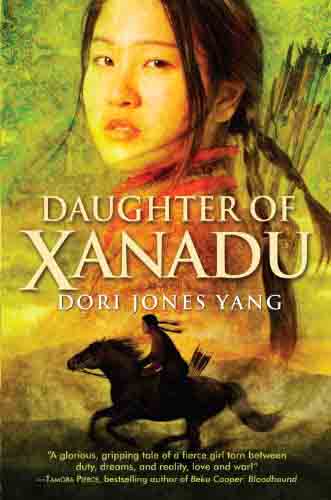


 Posted by Lloyd Lofthouse