China and North Korea

May 27, 2010

Due to the latest tension between North and South Korea over the sinking of a South Korean navy ship by North Korea, China has been asked to step in and help. However, China’s response has been for the “relevant parties” to “calmly and properly handle the issue and avoid escalation of tension.” Source: Politics News

If China is reluctant to be sucked into the latest North Korean conflict, what could be causing this response? One reason might be that China has a history with Korea going back to the Tang Dynasty in 688 AD, when there was an alliance with Silla, a Korean state.
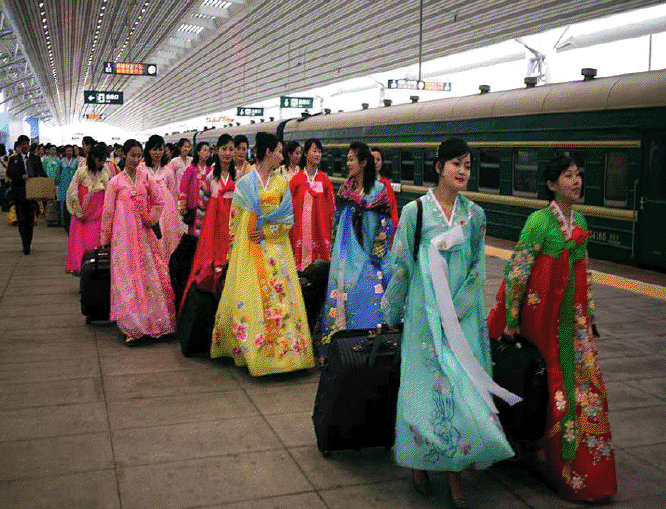
North Korean National Musical Troupe currently visiting China performing “Dream of Red Mansion” (adapted from Chinese classic novel).

Then it could be because Chinese culture, written language and political institutions have had an influence in Korea since the 4th century and in the 14th century, Korea came under the influence  of Confucian thought influenced by Buddhism and Daoism (Taoism).

China’s reluctance to put public pressure on Pyongyang to step off the warhorse might be because the Chinese feel it would be like pressuring a family member. A 1,700-year old relationship might have more weight than the one China has with America that isn’t even forty yet. However, measuring that weight may also depend on the trillion or more China has invested in America.

Punish North Korea or Not?

_______________

Lloyd Lofthouse is the award-winning author of My Splendid Concubine [3rd edition]. When you love a Chinese woman, you marry her family and culture too. This is the love story Sir Robert Hart did not want the world to discover.

His third book is Crazy is Normal, a classroom exposé, a memoir. “Lofthouse presents us with grungy classrooms, kids who don’t want to be in school, and the consequences of growing up in a hardscrabble world. While some parents support his efforts, many sabotage them—and isolated administrators make the work of Lofthouse and his peers even more difficult.” – Bruce Reeves.

lloydlofthouse_crazyisnormal_web2_5

Subscribe to “iLook China”!
Sign up for an E-mail Subscription at the top of this page, or click on the “Following” tab in the WordPress toolbar at the top of the screen.

About iLook China

China’s Holistic Historical Timeline


China’s god Culture Gone

May 27, 2010

For millennia, China’s emperors were considered the Sons of Heaven and worshiped as such.  When referred to as the Son of Heaven, a title that predates the Qin unification (221-207 BC), the emperor was recognized as the ruler of “all under heaven”. 

After Imperial China ended, Sun Yat-sen established a brief Chinese republic soon brought to an end by competing warlords, who plunged China into anarchy and violence. It wouldn’t be until 1928 that Chiang Kai-shek would become the victor and dictator of China and reestablish some order.

Mao won China in 1949 and stayed in power until his death in 1976. Mao has been called the modern emperor since he lived in the Forbidden City and ruled for twenty-seven years.  After Mao’s death, Deng Xiaoping and his supporters decided they didn’t want to have another god-like figure ruling China, and the Communist Party added amendments to the Chinese constitution creating term limits and an age limit. 

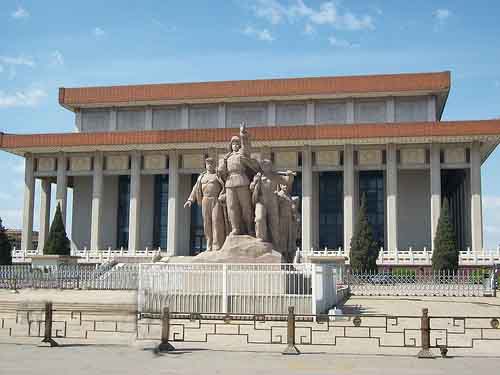
Mao's Tomb

Mao is still revered in China.  His tomb was built in Tiananmen square and his body is preserved beneath the tomb in refrigeration.  Visitors may pay a small fee to visit the tomb and possibly see China’s modern emperor on display behind bulletproof glass with attending guards.

Learn more about China’s Modern Dynasty

____________________________

Lloyd Lofthouse is the author of the award winning novels My Splendid Concubine and Our Hart. He also Blogs at The Soulful Veteran and Crazy Normal.

Sign up for an RSS Feed for iLook China


Food Safety in the People’s Republic of China

May 27, 2010

A friend sent me a piece about tainted supplements in the United States.  One paragraph grabbed my attention.

“In recent years, a vast majority of supplement suppliers have located overseas — principally in China. Nearly all of the vitamin C and many other supplements consumed in the United States are made from ingredients made in Chinese plants. Those plants are almost never inspected by the FDA because the agency is not required to do so, has little money to do so and does not view the plants as particularly risky.” Source: New York Times

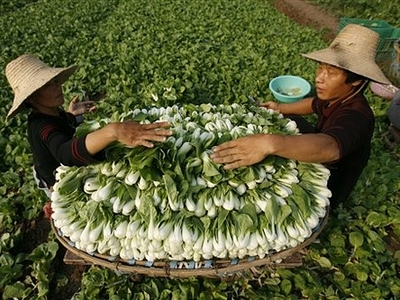
Chinese farmers harvesting bok choy

China has an agency that is similar to America’s FDA. It’s called The State Food and Drug Administration (SFDA) and was founded in 2003 as part of an effort to improve food safety. Today, there are about ten government departments and ministries under the State Council responsible for food safety in China. (Information about China’s SFDA)

Although China’s SFDA is relatively new compared to America’s FDA, China appears to be taking food safety seriously compared to weaknesses discovered in America’s FDA. 

Evidence that China is serious about food safety happened on July 10, 2007, when Zheng Xiaoyu, the former head of the SFDA was executed by lethal injection for taking bribes from various firms in exchange for state licenses related to product safety.

In fact, until the 1906 Food and Drug Act, America did not have an FDA (Source: FDA Early History), and recently the Union of Concerned Scientists revealed that hundreds of agency scientists had been pressured to approve a drug despite reservations about safety.   

Discover more about China’s Eating Culture

____________________________

Lloyd Lofthouse is the author of the award winning novels My Splendid Concubine and Our Hart. He also Blogs at The Soulful Veteran and Crazy Normal.

Sign up for an RSS Feed for iLook China


American Grasshoppers and Chinese Ants

May 26, 2010

In The Ant and the Grasshopper, as retold from Aesop’s fable and illustrated by Amy Lowry Poole, the grasshopper plays, while the ants work and save diligently gathering grain for winter. The ants urge the grasshopper to prepare for hard times, but the grasshopper will not be bothered.

After all, under Confucianism, absolute obedience to authority, a strict family structure and hard work have been valued for more than two millennia so the ants keep working while grasshoppers play.

In Time to Defriend China, Elizabeth Economy (Is that really Liz’s last name—Economy?) and Adam Segal say we should stop negotiating with China. This post at the “Foreign Policy” Blog, like the grasshopper in Aesop’s fable, is self-centered and out of touch.

Liz and Adam say China isn’t cooperating globally as if China has an obligation. They say, “The sticking points in U.S.-China relations are mirrored in China’s relations with much of the rest world. The European Union and Japan, for example, find it no easier to negotiate with China on issues such as trade, climate change, cyber conflict and the Dalai Lama.”

Really— climate change and cyber conflict? Didn’t China recently announce they were going to cut carbon emissions by 40% or more in the next few years while President Obama thought the US might reach 17%? As for cyber conflict, that’s a two-way street, and the Dalai Lama’s claims are a mix of big lies and small truth.

Meanwhile, China has its hands full with a greater challenge—the 1.2 billion Chinese outside the Communist Party who expect a better life.

In 1950, China was generating 0.005 kilowatts of electricity and much of the country was without.  Under Mao, there was the tragedy of The Great Leap Forward and The Cultural Revolution costing tens of millions of lives. It wasn’t until Mao was gone that China started modernizing and improving the lifestyles of hundreds of millions of people.

Today, China is breaking records building modern cities and growing the second largest economy in the world and with a savings account. However, China still has 750 million people without proper medical care, electricity or modern connivances. In addition, they have problems with Tibet and with the Uyghurs in Xinjiang Province, who want to break free with support from Hollywood and maybe the CIA.

Then there is the Taiwan issue. If the US had not interfered in 1949, that issue would not exist. Taiwan would be part of China today and America would have a larger Chinese population.  Don’t forget that the Kuomintang until the 1980s, was a dictatorship that America supported and the Taiwanese were burdened with martial law for more than thirty years.

When China meets its goals at home, then “maybe,” China will be willing to help the West.

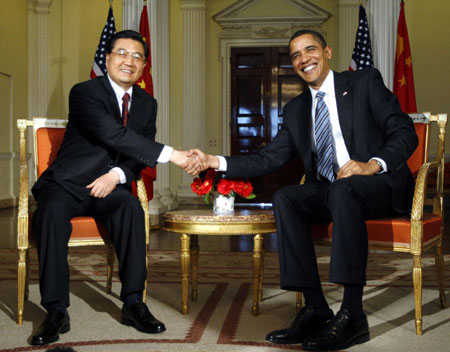
Hu Jintao and Obama shaking hands

Instead of walking away from negotiations as Liz and Adam suggest, the US and the rest of the developed world should find ways to offer a win-win situation that helps China meet its internal goals. How will China do that if they allow the global exchange rate for their currency to fluctuate putting millions of Chinese out of work? If America wants to grow jobs, the US must find ways to do so without hurting the Chinese worker any more than these people have already been hurt. Since the 2008 global economic crises caused by American greed, more than 20 million Chinese workers lost their jobs and 70,000 factories went out of business.

Like those ants in the fable, don’t expect the Chinese to come running to rescue nations that squandered their future while China is still building one. A better opinion on this topic might be this one from Martin Wolf in the Financial Times.

____________________________

Lloyd Lofthouse is the author of the award winning novels My Splendid Concubine and Our Hart. He also Blogs at The Soulful Veteran and Crazy Normal.

Sign up for an RSS Feed for iLook China


China Aiming at Arctic Oil

May 26, 2010

If you are in Iceland and you see someone who may look like an Eskimo dressed in fur against the bitter, winter cold, look twice. That person may be a Chinese oil worker or the crewmember of a Chinese icebreaker.

Icebreaker

The reason is simple. As China brings its 1.3 billion people into the modern age so all Chinese may live like Americans, it takes oil to make that happen.  China’s critics, of course, will find fault no matter what.  If China does nothing to improve the lifestyle of rural Chinese, the government will be blamed. If the air is polluted from all the carbon exhaust from middle-class Chinese driving around enjoying their new Western lifestyle, China will be criticized for that pollution.  If the price for gas and diesel goes up at the pump in Europe or America, China’s hunger for oil will get the blame for that too.

However, China’s government could care less about any foreign patootie’s complaints, because the people they serve in China come first if they want to stay in power. It’s nice to have money, and the Chinese government has it while the rest of the world is in debt.

See “China’s Oil Hunger Grows”

____________________________

Lloyd Lofthouse is the author of the award winning novels My Splendid Concubine and Our Hart. He also Blogs at The Soulful Veteran and Crazy Normal.

Sign up for an RSS Feed for iLook China