Left Coast Voices posted a piece about Liu Xiabo, a leader of the Chinese democracy movement, who won the latest Nobel Peace Prize.
It is a fact that today’s concept of Western style democracy, which Liu Xiabo and the Nobel Peace Prize committee seem to want for China and the rest of the world is seriously flawed.
This flaw was the reason the Founding Fathers of the United States despised democracy, which John Adams, America’s second president, said leads to “mob rule”.
The result of this “mob rule” has led to overcrowded US prisons housing thousands of extremely dangerous felons such as Thomas Silverstein, Ted Kaczynski, Terry Nichols, Richard Reid, and Ramzi Yousef. Source: Searchwarp.com
There are more than a hundred thousand inmates in US prisons serving life sentences. About 30% of all lifers have no chance of parole since many are too dangerous to go free.
In addition, the Policy Almanac says, “gangs remain a problem in many areas throughout the nation.”
Then in 2008, Science Daily reported, “a survey of 17 countries has found that despite its punitive drug policies the United States has the highest levels of illegal cocaine and cannabis use.”
These examples show what Western style democratic freedoms deliver.
In China, most of these criminals would have been executed soon after being convicted of the horrible crimes they committed.
It’s true that in China, the execution rate is the highest in the world, but in the US, the murder rate is higher. At least most of the criminals that are executed in China are the bad guys—not honest, hard working victims.
Lloyd Lofthouse is the award-winning author of the concubine saga, My Splendid Concubine & Our Hart. When you love a Chinese woman, you marry her family and culture too.
If you want to subscribe to iLook China, there is a “Subscribe” button at the top of the screen in the menu bar.
Left Coast Voices posted a piece about Liu Xiabo, a leader of the Chinese democracy movement, who won the latest Nobel Peace Prize. This is Part 2 of my response.
Liu Xiabo won the Nobel Peace Prize for his activism in China. The Nobel Peace Prize is the West’s medal of honor for those who work hardest to spread Western style democracy and Humanitarianism to countries that have not accepted these theories.
In case you are not aware of whom awards the Nobel Peace Prize, I’m going to tell you—a committee of five persons elected by the Norwegian Parliament (four women and one man–all Caucasians).
More than 85% of Norway is Christian and about 82% are Lutheran.
The Islamic religion is worshiped by less than 2% of the population of Norway and Buddhism by one tenth of one percent. Almost 84% Norway is of North Germanic/Nordic descent or Caucasians.
These are the people that decides who wins a Nobel Peace Prize.
There is no international body made of representatives of all races and most nations to decide who wins the Noble Peace Prize.
Instead, a Western, democratic, Christian bias heavily influences these decisions.
For that reason, it is wrong to assume that most Chinese want all of freedoms the West’s Christian dominated democracies offer.
Lloyd Lofthouse is the award-winning author of the concubine saga, My Splendid Concubine & Our Hart. When you love a Chinese woman, you marry her family and culture too.
If you want to subscribe to iLook China, there is a “Subscribe” button at the top of the screen in the menu bar.
What got this post started was a media blitz this morning on the Blogosphere and in the traditional media that Miley Cyrus, now 18, was smoking herbal “Salvia” fumes from a bong.
Curious what herbal “Salvia” was, I Googled the topic and discovered seemly bogus claims that Miley was banned from China early in 2009 when she was still 16.
I discovered that Miley Cyrus Online.co.uk (billed as the “ultimate fan site” for gossip) said in February 2009, that Cyrus had been banned in China due to a photograph showing her pulling her eyes back into an Asian slant.
To verify this, I searched Reuters, United Press International and Associated Press and came up with nothing to support the fan-site claim.
However, the BBC News did report, “The Organization of Chinese Americans criticized Cyrus for setting ‘a terrible example for her young fans’.”
Miley Cyrus singing “Girls Just Wanna Have Fun”
Then I discovered in March 2010, that Cyrus was featured in the China Daily, which is the English version of Xinhua, the state owned media giant in China.
If Cyrus had been banned in China, I doubt the China Daily would feature her a year later.
However, I did learn that “Salvia” comes from the deep roots of the Chinese sage plant and has been used for centuries in China as a salve on damaged, diseased or injured body tissues and is best known for its ability to promote circulation in the capillary beds or the microcirculation system.
Nowhere did this information say one should smoke Salvia to achieve these benefits. After all, inhaling smoke into one’s lungs is not a good idea because it causes damage to the sensitive lining of the lungs and increases cancer risk.
Then I learned from NPR.org that “Salvia” is a powerful and legal hallucinogenic herb that is gaining popularity among teenagers and young adults…. Legislation to make it a controlled substance has failed twice in (in the US) Congress.
If Cyrus were smoking Salvia, what she was doing wasn’t illegal in California. If you want to learn where not to smoke Salvia visit Sage Wisdom.org.
As for celebrities banned in China, such as Brad Pitt, the Dalai Lama, Martin Scorsese, Harrison Ford, Richard Gere (no surprise there), and singer Mjork, check out Elephant Journal.com.
It seems there may be some truth to what Cyrus said, “I definitely feel like the press (and the Blogosphere rumor mill) is trying to make me out as the new ‘bad girl’!” Source: BBC
Lloyd Lofthouse is the award-winning author of the concubine saga, My Splendid Concubine & Our Hart. When you love a Chinese woman, you marry her family and culture too.
If you want to subscribe to iLook China, there is a “Subscribe” button at the top of the screen in the menu bar.
The headline read,China stood up by winner of ‘Confucius peace prize’
The headline used for this Reuters news made mockery of what a few Chinese citizens attempted.
The lead paragraph goes, “It was meant to be China’s answer to the Nobel Peace Prize…”
At first, it sounds as if China’s Communist Party was behind this alternative to the Nobel Peace Prize.
After reading the rest of Martina’s piece, you learn that the Confucius Peace Prize had no link to China’s central government. Since news of it wasn’t reported in China’s state media, few in China probably even heard of it.
A spokesperson for the Confucius Peace Prize said, “This prize is from the people of China, who love and support peace.”
Yet, the people of China had nothing to do with it either.
However, using Confucius’s name for a peace prize makes more sense than using Alfred Bernhard Nobel’s name.
If you compare The Life of Confucius and/or watch the recent Confucius movie starring Chow Yun Fat you might understand why Confucius deserves the honor more.
After all, Nobel built his fortune on death. He was a Swedish chemist, engineer, innovator and armaments manufacturer. He invented dynamite and manufactured cannons and other weapons.
He also waited until after his death to make amends for the suffering and destruction his products had caused.
In his last will, Nobel directed that his enormous fortune be used to institute the Nobel Prizes and made sure to name these prizes after himself so he wouldn’t be remembered as the “Merchant of Death” or the “Lord of War”.
To understand better who Alfred Nobel was, I suggest you watch Nicolas Cage in the Lord of War, a movie released in 2005. Although the movie was not about Nobel, it is about a “Merchant of Death”.
In fact, it may not have been Nobel’s idea to include the Peace Prize.
Although Nobel never married, his first love, a Russian girl named Alexandra corresponded with him until his death in 1896. Many believe she was a major influence in Nobel’s decision to include the Peace Prize among the other prizes provided for in his will.
Is this “hypocrisy” time ten?
______________
Lloyd Lofthouse is the award-winning author of the concubine saga, My Splendid Concubine & Our Hart. When you love a Chinese woman, you marry her family and culture too.
If you want to subscribe to iLook China, there is a “Subscribe” button at the top of the screen in the menu bar.
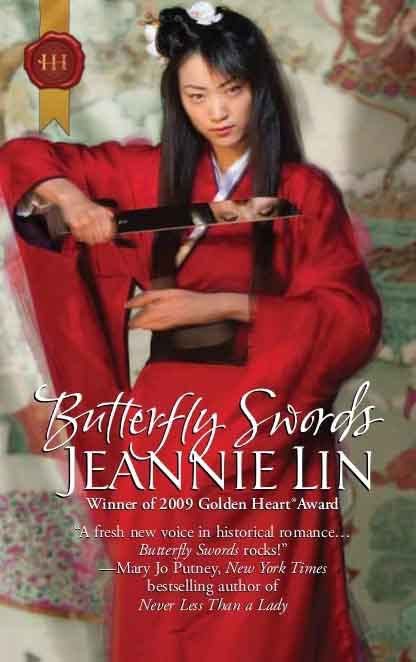
Enter Jeannie Lin, Harlequin’s rising red-star of romance writing. She isn’t the first author on Harlequin’s roster to set her books in China (that honor goes to Jade Lee and her infinite “Tigress” series).
However, Lin’s debut novel, Butterfly Swords, has been attracting a viral buzz louder than a summertime cicada not just for being the first Harlequin novel to NOT feature a man on the cover, but for using an Asian model as the cover girl, another Harlequin first.
The star of Butterfly Swords is a Chinese woman, yes. But to give American readers something that they can relate to, the male love interest of Lin’s novel is not Chinese but a wandering whiteboy from the west.
Ryam is drifting around the Tang (618-906 AD) empire begging for food (this sounds exactly like my own travels across China!) when he spots a disguised female being attacked by a pack of marauding bandits.
The swordsman, who evokes images of bare-chested, fur underwear-wearing Thundarr the Barbarian from the eponymous 80’s cartoon, rescues her, then agrees to escort her home.
Little does Ryam know that young Ai Li is really a princess on the run from an arranged marriage to a dastardly warlord. The two proceed on their journey together across the 7th-century frontier, getting in adventures and slowly but surely falling in love.
Pitting strength, courage and her fabulous butterfly swords against the forces of evil, Ai Li proves herself in the battlefield (“With Ai Li’s swords and determined spirit it was easy to forget that she was innocent”).
However, where the book has significant cultural crossover appeal is in author Jeannie Lin’s ability to keenly capture the multi-dimensional perspectives of both characters throughout their budding interracial relationship.
From Ryam’s course communicative abilities (“Where did you learn how to speak Chinese” Ai Li asks him, laughing. “You sound like you were taught in a brothel”) to his struggles with his inner-white demons as a big, bad bai gui (“It was so much easier to seduce a woman than talk to her”), the reader is introduced not to some empty-headed he-man but a complex male of the species who is genuinely torn between his biological needs and respecting Ai Li’s virtue.
“I don’t understand what she’s talking about half the time,” Ryam grumbles to himself. “Everything is about honor and duty.” Surely even expats living in present-day P.R.C. can relate to this dilemma.
Ai Li, meanwhile, finds herself attracted not only to Ryam’s “musky scent” and “sleek muscles” (Harlequin prerequisites; don’t blame the authoress), but his sincerity (“There was nothing barbaric about him. His manner was direct and honest. It was her own countrymen she needed to be worried about.”).
The protagonist does find herself frustrated with “this swordsman with blue eyes and the storm of emotions that came with him,” but, true to life, Ai Li comes with her own personality flaws as well (“she was being irrational and she knew it”).
Of course, it wouldn’t be a Harlequin without passionate love scenes, something my fiancée missed in the heavily censored Chinese versions.
This Jeannie Lin does in the poetic prose of a Tang Dynasty-era pillow book yet with just enough creatively-provocative language to keep sex-numbed westerners interested (“Ryam slipped his fingers into her silken, heated flesh…her body went liquid and damp in welcome.”). And thankfully without ever once resorting to the word “loin.”
Ryam proves himself to be an ideal lover for nubile Ai Li, “rough enough to make her breath catch, gentle enough to have her opening her knees,” though one can’t help but wonder how these two nomadic warriors can go so long without bathing nor brushing their teeth yet still manage to say things like “her mouth tasted just as sweet as he remembered.”
If only real life were as hygienic as a Harlequin novel.
One of the reasons why Harlequin is able to sell over 100 million units per year (the most profitable publishing company in the industry) is because every book is part of a series.
There are no individual Harlequin titles, which brilliantly leaves the reader yearning for more from the characters they have literally become so intimate with. In this respect, Butterfly Swords concludes with a wide opening that screams sequel, but thankfully lacks the typical Harlequin-happy ending of matrimonial bliss.
One familiar with Chinese culture can’t help but wonder, then, what kind of future Ai Li and Ryam actually have together: in reality, Ai Li would put on weight, cut her hair short and become a shrill nag; her parents and grandparents would all move into their cramped apartment, and a frustrated Ryam, now with beer-belly, would spend more and more time at card games and with karaoke parlor hostesses than at home.
But before the infuriating realties of interracial marriage set in, we hope Jeannie Lin has at least a few more of her trademark sword fights and steamy sensuality in store.


 Posted by Lloyd Lofthouse
 iLook China