The Little Known History of Racism in the United States against the Chinese

July 15, 2020

Thirty-six years before the 1921 Greenwood Massacre of African Americans in Oklahoma, there was a similar incident in Wyoming but the victims were Chinese.

“On September 2, 1885, 150 white miners in Rock Springs, Wyoming, brutally attack their Chinese coworkers, killing 28, wounding 15 others, and driving several hundred more out of town,” History.com reported.

“The Rock Springs massacre was symptomatic of the anti-Chinese feelings shared by many Americans at that time. The Chinese had been victims of prejudice and violence ever since they first began to come to the West in the mid-nineteenth century, fleeing famine and political upheaval (the Christian led Taiping Rebellion and the English and French led Opium Wars). Widely blamed for all sorts of social ills, the Chinese were also singled-out for attack by some national politicians who popularized strident slogans like ‘The Chinese Must Go.’”

The Rock Springs massacre wasn’t the only incident of racism against Chinese immigrants in the United States.


The Chinese Exclusion Act, a United States federal law signed by President Chester A. Arthur on May 6, 1882, ended all immigration of Chinese laborers.  The African American Policy Forum says, “The Chinese Exclusion Act was an immigration law passed in 1882 that prevented Chinese laborers from immigrating to the United States. The Chinese Exclusion Act was the first immigration law that excluded an entire ethnic group. It also excluded Chinese nationals from eligibility for United States citizenship.”

“During their first few decades in the United States,” The Library of Congress informs, “they (Chinese immigrants to the United States) endured an epidemic of violent racist attacks, a campaign of persecution and murder that today seems shocking. From Seattle to Los Angeles, from Wyoming to the small towns of California, immigrants from China were forced out of business, run out of town, beaten, tortured, lynched, and massacred, usually with little hope of help from the law. Racial hatred, an uncertain economy, and weak government in the new territories all contributed to this climate of terror and bloodshed. The perpetrators of these crimes, which included Americans from many segments of society, largely went unpunished.”

Lloyd Lofthouse is the award-winning author of My Splendid Concubine, Crazy is Normal, Running with the Enemy, and The Redemption of Don Juan Casanova.
Where to Buy

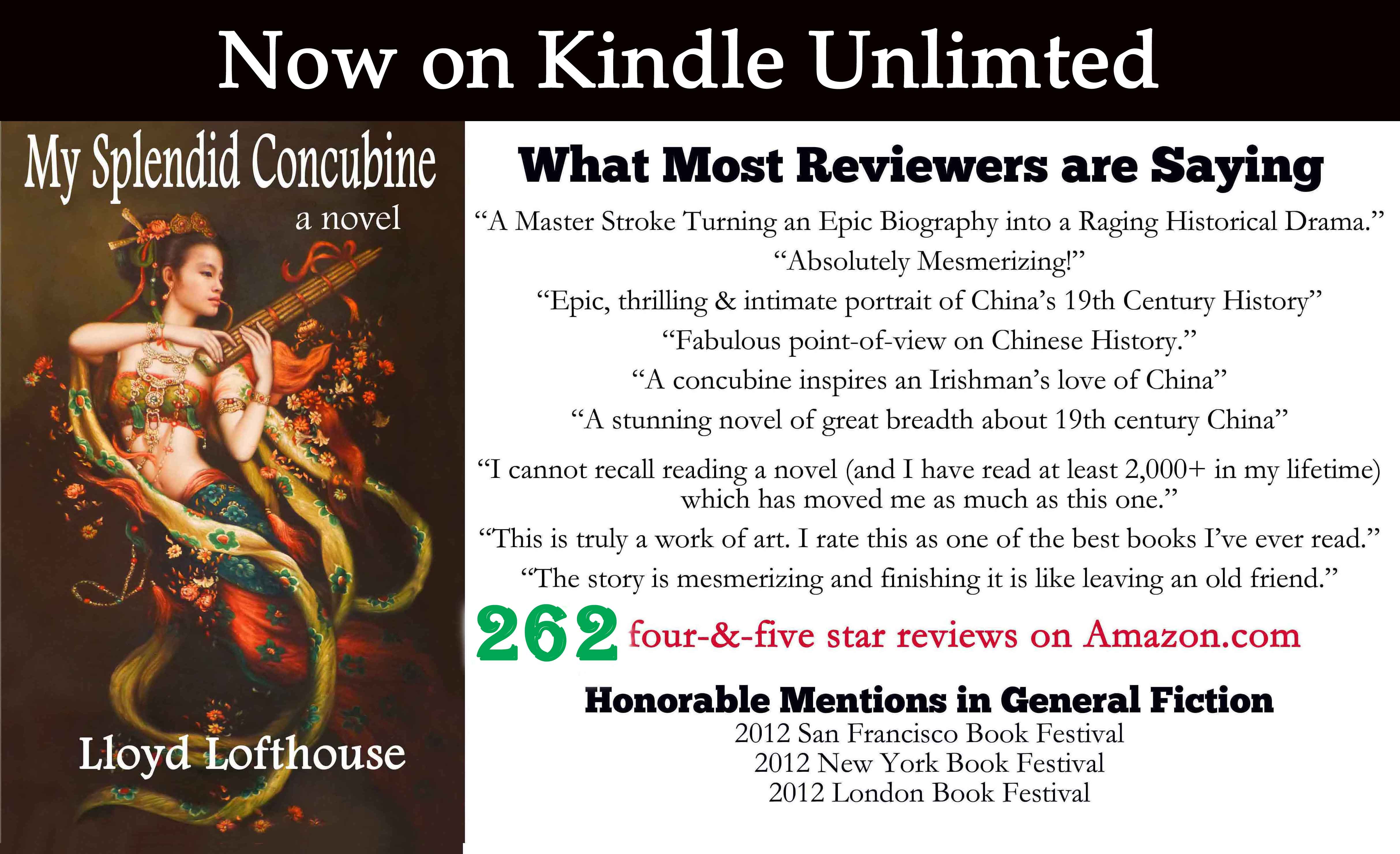
My Splendid Concubine is now available to read through Kindle Unlimited.

About iLook China


How close does China’s Great Firewall watch Tik Tok?

July 1, 2020

The BBC reports “US President Donald Trump sought help from Chinese President Xi Jinping to win re-election, ex-National Security Adviser John Bolton’s new book says.”

The allegations refer to a meeting between President Trump and President Xi at the G20 summit in Osaka, Japan, in June last year. “Trump, stunningly, turned the conversation to the coming US presidential election [in 2020], alluding to China’s economic capability and pleading with Xi to ensure he’d win,” Mr. Bolton wrote in his book The Room Where It Happened, released June 23.


What if Xi Jinping does not want to help Donald Trump win reelection?


Until yesterday, I didn’t know what Tik Tok was. Curious, I Googled it and discovered from Business Insider that this popular video-sharing app has more than 1.5 billion all-time downloads, and is owned by a Chinese internet company called ByteDance.

From Forbes, I learned that ByteDance, the Beijing-based Chinese Digital Giant and Owner of Tik Tok, had impressive 2019 revenue and earnings of $17 Billion.


Does that mean China’s President XI Jinping allowed Tik Tok Tokers and K-pop fans to Tank Trump’s Tulsa rally to embarrass Donald Trump?


After all, the Chinese Communist Party is well known for its Great Firewall. Internet censorship and surveillance have been tightly implemented in China blocking social websites like Gmail, Google, YouTube, Facebook, Instagram, and others. The excessive censorship practices of the Great Firewall of China have now engulfed the VPN service providers as well.

The New York Times even reported, “We Should Worry About How China Uses Apps Like Tik Tok, illiberal innovations created for China’s vast surveilled and censored domestic market are increasingly popular overseas.

“To China’s surveillance state,” The NYT continues, “a video-sharing app offers much more than your dog dancing to Drake. Tik Tok’s domestic Chinese version, Douyin, is heavily censored and surveilled: Last year, the British cartoon Peppa Pig was purged from the platform after the authorities decided she had taken on subversive meaning. (It is unclear whether this was because of a direct government order or the company pre-emptively censoring itself.) … “To date, no evidence suggests that Chinese authorities have used their leverage over Douyin domestically to censor or surveil Tik Tok overseas. But given what we know about Beijing’s illiberal impulses, there is a gap between what is provable beforehand, and what it is prudent to presume.”

Since China keeps a close watch on its social networking sites like Tik Tok, why did its Great Firewall allow all those teens in China and around the world to sabotage Trump’s hate rally in Tulsa and embarrass the most unpopular president in United States history, not only in America but throughout the world?

After all, wouldn’t it be in China’s interest to see Donald Trump defeated in November 2020? Trump even answered that question when he said, “China wants me to lose reelection.”

If true, China would not be alone. Most of the world wants Trump to lose, and so do I. That is why I am asking China’s President Xi Jinping to please help Trump lose this year’s U.S. election and block Russia from helping him like they did in 2016.

Lloyd Lofthouse is the award-winning author of My Splendid Concubine, Crazy is Normal, Running with the Enemy, and The Redemption of Don Juan Casanova.

Where to Buy

My Splendid Concubine is now available to read through Kindle Unlimited.

About iLook China


When it comes to World Heritage Sites, China and Italy are tied for First Place

June 17, 2020

When it comes to World Heritage Sites, China is tied with Italy for first place. Each country has 55 World Heritage Sites.  China has 14 natural and 37 cultural sites vs Italy’s five natural and 50 cultural.

A World Heritage Site is a landmark or area, selected by the United Nations Educational, Scientific and Cultural Organization (UNESCO) for having cultural, historical, scientific or other form of significance, which is legally protected by international treaties. The sites are judged to be important for the collective and preservative interests of humanity.

To be selected, a World Heritage Site must be an already-classified landmark, unique in some respect as a geographically and historically identifiable place having special cultural or physical significance (such as an ancient ruin or historical structure, building, city, complex, desert, forest, island, lake, monument, mountain, or wilderness area). It may signify a remarkable accomplishment of humanity, and serve as evidence of our intellectual history on the planet.

The sites are intended for practical conservation for posterity, which otherwise would be subject to risk from human or animal trespassing, unmonitored/uncontrolled/unrestricted access, or threat from local administrative negligence. Sites are demarcated by UNESCO as protected zones. The list is maintained by the international World Heritage Program administered by the UNESCO World Heritage Committee, composed of 21 “states parties” that are elected by their General Assembly.

The reason Italy and China are tied for 1st place is because Italy was home to the Roman Empire (27 BC to 1453 AD) and China to the Han (206 BC – 280 AD), Tang (618 – 907 AD), and Qing (1368 – 1644 AD) Dynasties.

National Interest.org says, “Contrary to the common perception of China being historically isolated and weak, many Chinese dynasties were very powerful and have had a profound impact on global history. … The Han Dynasty ruled China for a solid four centuries, from 206 B.C.E. to 220 C.E. Although the preceding Qin Dynasty unified China, it was the Han Dynasty that kept it together and developed the institutions that characterized most of Chinese history since. …

“After the Han Dynasty collapsed due to civil war, China entered a period of disunity until being reunited by the Sui Dynasty, which was subsequently succeeded by the Tang Dynasty, which ruled China from 618-907 C.E. The Tang Dynasty was one of China’s most cosmopolitan and urbane dynasties, opening China up to a period of foreign influences. The Tang Dynasty was also likely China’s largest and most powerful dynasty in history and is considered the golden age of imperial China.”

The Qing Dynasty was China’s last and one of its greatest from 1644 to 1911. The National Interest explains why, “The Qing were the first Chinese state to effectively control regions like Tibet, Xinjiang, Manchuria, and Mongolia, peripheral regions that were inhabited by people that had always harassed China.”

Lloyd Lofthouse is the award-winning author of My Splendid Concubine, Crazy is Normal, Running with the Enemy, and The Redemption of Don Juan Casanova.

Where to Buy

About iLook China


The World’s Favorite Dessert is Not Chocolate

May 27, 2020

I am a chocoholic. I’m very fond of chocolate and eat or drink some every day. In fact, I usually start my day with some chocolate, and I was enjoying some really-dark chocolate when I started writing this blog post ten hours later in the early evening.

If world civilization collapsed and global trade suffered, I would not miss most of the luxuries I take for granted, but I would miss chocolate. The World Atlas says, “Unsurprisingly, most of the top 10 cocoa-producing countries come from warm, wet climates similar to where the bean originated.”

You might not find this surprising, but the countries that consume the most chocolate do not produce it.


How about China? If world trade suffered because of the COVID-19 pandemic, would the Chinese miss chocolate?

Chocolate wasn’t introduced to China until the 1980s. China Business Review reports, “Thirty years ago, most Chinese had never eaten a piece of chocolate; their taste for chocolate was ready to be shaped by whichever company entered the country with a winning combination of quality, marketing savvy, and manufacturing and distribution acumen. For chocolate companies, China was the next great frontier—a market of almost limitless potential to be unlocked through a battle between the world’s leading chocolate companies for the hearts, minds, taste buds, and ultimately the wallets of China’s consumers.”

Those chocolate companies failed.

“Even today, the amount of chocolate sold in China is relatively small, accounting for less than 2 percent of total global consumption. Most Chinese would not be able to find chocolate in their vicinity even if they were willing to buy it.”

Why chocolate never caught on in China should be obvious. The favorite dessert in China, Japan, and most, if not all of Southeast Asia is mochi, and that is made from rice.

Mochi is the most popular dessert in the world, but only because there are more Asians than any other ethnic group on the planet. Caucasians (found mostly in North America, Russia, and Europe) only make up 11.5% (850,000,000) of the world’s 7.8 billion people. The Han Chinese, by themselves, represent more than 20%, and that is not counting the populations of Japan and the other countries in that area of the world that love mochi.

Taste Atlas says, “Mochi, the tiny cakes made out of glutinous rice, are an important part of Japanese cuisine and culture (and the rest of East and Southeast Asia). The preparation of mochi starts with a time-consuming process of pounding boiled or steamed rice, usually the glutinous mochigome variety until it forms into a thick and homogenous paste. …The most common confectionery is referred to as daifuku-round cakes filled with different ingredients such as the traditional red bean paste, strawberries, or ice cream. … Due to its chewy texture, it is important to be extra careful and attentive while eating mochi and to take tiny bites of this glutinous treat.”

What ten countries produce the most rice?

The answer is revealed in the last video. If global trade suffers due to the COVID-19 pandemic, China, Japan, and Southeast Asia will not have to give up their favorite dessert. I live in the United States, and I am not a mochi fan.

What is your favorite dessert?

Lloyd Lofthouse is the award-winning author of My Splendid Concubine, Crazy is Normal, Running with the Enemy, and The Redemption of Don Juan Casanova.

Where to Buy

About iLook China


The Impact of Cultural and Lifestyle Choices during a Pandemic

May 13, 2020

China is a collectivist culture based on valuing the needs of a group or a community over the individual.

Better the Future.org says, “The traditional Chinese diet consists of low or moderate amounts of meat or fish and plenty of vegetables accompanied by starches like rice or noodles. Tea is often served with dinner instead of soft drinks. Desserts are generally not part of the meal but fresh fruits can be served to help with digestion.”

The BBC reported, “China reported the cases to the World Health Organization (WHO), the UN’s global health agency, on 31 December.… The mayor of Wuhan has previously admitted there was a lack of action between the start of January – when about 100 cases had been confirmed – and 23 January, when city-wide restrictions were enacted. …

“WHO Director General Dr Tedros Adhanom Ghebreyesus has hailed China for the ‘speed with which [it] detected the outbreak’ and its ‘commitment to transparency’.”

The United States is an individualist culture. Very Well Mind.com says, “Individualistic cultures are those that stress the needs of the individual over the needs of the group as a whole.”

Health.gov tells us about the Current Eating Patterns in the United States. “The typical eating patterns currently consumed by many in the United States do not align with the Dietary Guidelines. … About three-fourths of the population has an eating pattern that is low in vegetables, fruits, dairy, and oils.

“More than half of the population is meeting or exceeding total grain and total protein foods recommendations (and) … are not meeting the recommendations for the subgroups within each of these food groups.

“Most Americans exceed the recommendations for added sugars, saturated fats, and sodium.

“The high percentage of the population that is overweight or obese suggests that many in the United States overconsume calories. As documented, more than two-thirds of all adults and nearly one-third of all children and youth in the United States are either overweight or obese.”

How do these cultural and lifestyle choices translate to death by COVID-19?

On May 6, 2020, Statista reported that the United States was 1st place for COVID-19 deaths worldwide.

1st Place: The United States with 72,284 deaths

2nd place: the UK with 29,427 deaths (the UK is also an individualist culture)

11th place: China with 4,633 deaths (where the pandemic started)

The Smithsonian Magazine reports that “U.S. Life Expectancy Drops for Third Year in a Row, Reflecting Rising Drug Overdoses, Suicides,” and Global News reported, “The novel coronavirus is a bundle of proteins. It doesn’t care about faith, freedom, jobs or right-wing conspiracy theories, but that hasn’t stopped hundreds of Americans from defying all medical advice to protest against lockdown measures meant to keep them safe — often while standing unmasked and shoulder to shoulder.”

What about life expectancy in China? Macrotrends says, “The Current Life expectancy for China in 2020 is 76.96 years, a 0.22 percent increase from 2019.”  In fact, China has seen a slow and steady increase in life expectancy since 1950. Click the link in this paragraph to see for yourself.

It is apparent that the price for individual freedoms in the U.S. means shorter lifespans and a higher risk of death by COVID-19. What freedom means in the United States depends on each individual.

Lloyd Lofthouse is the award-winning author of My Splendid Concubine, Crazy is Normal, Running with the Enemy, and The Redemption of Don Juan Casanova.

Where to Buy

About iLook China