Water – Two Countries Tell a Tale

April 19, 2010

The National Geographic special issue, “Water, Our Thirsty World” (April 2007) compares the world’s largest democracy, India, with China. In “The Big Melt” by Brook Larmer, we see a convincing reason why China’s mix of socialism and capitalism may be the world’s answer to avoid future calamities. Where Western style democracies stall due to partisanship, special interests, religious beliefs and political agendas, China’s government, ruled by engineers and scientists, appears to be planning decades ahead.

The claims by Tibetan separatists and their supporters that China rules over Tibet with an iron dictatorial fist also appears to be wrong when Larmer visits a family of Tibetan nomads. He writes, “There is no sign of human life on the 14,000 foot high prairie that seems to extend to the end of the world.” Larmer sees “the NOMADS’ tent as a pinprick of white against a canvas of brown.”
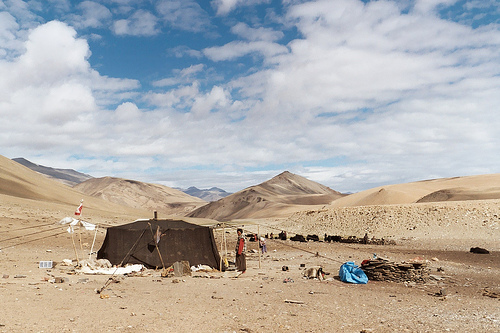
Tibetan Nomads

We meet Ba O, a Tibetan nomad. In Ba O’s tent, “there is a small Buddhist Shrine: a red prayer wheel and a couple of smudged Tibetan texts…” A few years earlier, Ba O had several hundred sheep and the grass was plentiful. Now the Tibetan nomad has about a hundred left and fears this way of life is ending.

Ba O says, “This is the way we’ve always done things. And we don’t want that to change.”

However, change is coming, and there is nothing Ba O can do to stop it. The change is not from China’s government. It is from global warming. The Tibetan grasslands are dying and a way of life that has existed for thousands of years may be dying too.
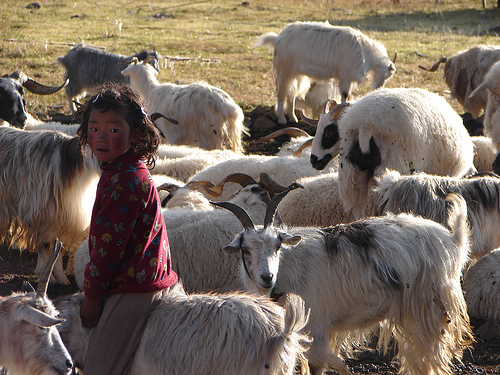
Tibetan girl tending sheep

To insure that the Tibetan nomads will have a place to live, China’s government has been building resettlement villages. The “solid built” houses are subsidized. When the Tibetan nomads can no longer survive on the open Tibetan prairie, it is the nomad’s choice to move into the new villages. The government does not force them to give up their old way of life. Nature does that.

Along with the house comes a small annual stipend for each family so they can eat as they find another way to earn a living. The home Larmer visited had a Buddhist shrine and a free satellite dish for a TV and maybe an Internet connection. In addition, the one child policy does not apply to the Tibetan people since they are a minority in China.

To make sure there will continue to be water to drink, China is planning to build 59 reservoirs in Tibet to capture and save glacial runoff.

In India, the young wife of a fortuneteller spends hours each day searching for water. She lives with her husband and five children in Delhi, India‘s capital. There are fights over water. In a nearby slum, a teenage boy was beaten to death for cutting into a water line.  The demand for water in Delhi exceeds the supply by more than 300 million gallons a day.

What happens to life when there is no water?

See Dictatorship Defined

______________

Lloyd Lofthouse is the award-winning author of the concubine saga, My Splendid Concubine & Our Hart. When you love a Chinese woman, you marry her family and culture too. 

If you want to subscribe to iLook China, there is a “Subscribe” button at the top of the screen in the menu bar.


Where are the Parents – Part 4/4

April 14, 2010

Obesity and diabetes among American children is an epidemic. Many children and teens are not eating nutritious, home cooked meals. Instead, they are surviving off Coke, Pepsi, French fries and fast food. I often had kids come into my class after lunch with sixty-four ounce Cokes. Their speech would be slurred; their eyes glazed. Research shows that too much sugar messes with long-term memory and the area of the brain that solves problems.

School Library

Many American kids cannot find the family they need at home, so they find one on the streets. In Los Angeles, there are one-hundred-thousand kids that belong to street gangs. Other major cities also have street gangs. Street gangs become the family of choice when parents are not there or not talking. Drug use among teens is also a problem leading to depression and low self-esteem. This may result in decreased interest, negative attitude, drop in grades, many absences, truancy, and discipline problems.

When we pick our daughter up from school, we see the ratty dressed kids on their skateboards hanging out by the graffiti covered walls in the mall parking lot. Our daughter says many of the kids she knows at her high school get drunk regularly and smoke.

Return to Where are the Parents – Part 3 or start with Part 1

_______________

Lloyd Lofthouse is the award-winning author of My Splendid Concubine [3rd edition]. When you love a Chinese woman, you marry her family and culture too. This is the love story Sir Robert Hart did not want the world to discover.

Subscribe to “iLook China”!
Sign up for an E-mail Subscription at the top of this page, or click on the “Following” tab in the WordPress toolbar at the top of the screen.

About iLook China


Human Rights the Chinese Way

April 5, 2010

In the West, the individual is more important than the whole. In China, the whole is more important than the individual.

Just like China created capitalism Chinese style, the Chinese are building a bridge to human rights the same way. However, they see things different from Western democracies that are burdened with debt, crime, serious drug problems and swelling prison populations. To allow the freedoms that led to these problems in the West would be a loss of face for China’s leaders.

Due to Confucius’s teachings twenty-five hundred years ago, most Chinese value family and piety first—something that has all but vanished in the West.

Luo Haocai

“China believes that human rights, like other rights, are not ‘absolute’ and the rights enjoyed should conform to obligations fulfilled. China opposes separating rights from obligations,” said Luo Haocai at the Beijing forum on human rights.

Many Chinese know what Western freedom is like. After all, many Chinese have attended universities in Western countries. Most of these individuals have experienced freedom Western style and learned that the Western concept of freedom doesn’t match Chinese values. Family obligations come first in China.

To understand the Chinese better, learn about The First of All Virtues

______________

Lloyd Lofthouse is the award-winning author of the concubine saga, My Splendid Concubine & Our Hart. When you love a Chinese woman, you marry her family and culture too. 

If you want to subscribe to iLook China, there is a “Subscribe” button at the top of the screen in the menu bar. 


The Orphan’s Life

April 2, 2010

More than 90% of babies in Chinese orphanages are girls. Prior to 1949, it was common for parents to murder girl infants. From the 1950s to the end of the 1970s, due to Mao’s leadership and a tough stance for women’s equality, the death rate went down. Then in the 1980s, with the population growing too fast, a desperate government implemented the one-child policy.

After that, many girl babies went missing or were abandoned to state-run orphanages. To end this tragedy, the government eventually allowed rural families to have two children per family—hoping for a boy.

The conditions in these rural, state-run orphanages are often not ideal. Girls, who are not adopted, usually end up being the caregivers for the younger children. Since these orphan caregivers were raised without the love of parents and siblings, they may not be loving themselves creating a cold environment to grow up in.

abandoned at birth

It isn’t as if China’s government has done nothing to stop a practice that has been around for thousands of years. During the 90s, tougher laws were passed but often ignored. Government inspectors were sent to rural areas to enforce these laws, but it isn’t easy controlling a population of 1.3 billion scattered over a mountainous country almost the size of the United States.

I will not criticize the Chinese government for these conditions. I’ve been to China and understand the challenges. What would you do if you had inherited a medieval country in 1949 that was bankrupt due to the Kuomintang looting the banks and treasury as they fled to Taiwan under American protection? Then there is a culture reaching back thousands of years where girls were considered worthless. That is a lot to overcome.

Discover Gendercide in China and India, and also see the conclusion of one orphan’s journey in Saying Goodbye

______________

Lloyd Lofthouse is the award-winning author of The Concubine Saga. When you love a Chinese woman, you marry her family and culture too. This is the love story Sir Robert Hart did not want the world to discover.

To subscribe to “iLook China”, look for the “Subscribe” button at the top of the screen in the menu bar, click on it then follow directions.


Earth to Earth, Dust to Dust, Ashes to Ashes

March 31, 2010

It may take more than a few decades to change China’s culture to value girls equal to boys. China’s government is working to make that happen—that journey started in 1949, when Mao said, “Women hold up half the sky.” It isn’t easy overcoming several thousand years of culture.

Faith’s journey started at the age of two from rural China where poverty and a life of hard labor can be crushing. To encourage poor parents, who want a boy instead of a girl, not to throw a female infant in the closest river, government run orphanages have a no-punishment policy toward parents that abandon girls. Orphanages are surrounded by a wall with a drawer in that wall where parents may leave the child. The parent rings a bell, then hurries away.

Michelle Dremmer traveled from Chicago to China  more than fifteen years ago to rescue one of those orphans. She fell in love with the two-year-old, who was past the desired age of many adoptive parents, and she gave Faith a life of “happiness, opportunity and love” that few orphans in China experience.

Faith Dremmer

Another journey of five-hundred miles started on bikes and ended in tragedy for Faith, who was 17. I first wrote about this in Saying Goodbye, soon after hearing about the accident that claimed Faith’s life. Two of the girls survived. One spent eleven hours in surgery.

The driver of the van, who hit the girls, was an 86-year-old man. He was not injured. A friend of the driver said he was a good Christian who never drank and was close to his family—three children, six grandchildren and several great-grandchildren. I cannot imagine the burden of guilt he will carry for what life he has left.

I cry easily watching movies. It doesn’t take much to turn on the tears. My wife and daughter know this and when one of those scenes appears on the screen, they always look.

Doesn’t make sense. I shouldn’t cry that easily. After all, I’m a former United States Marine. I fought in Vietnam and taught in tough, barrio schools for thirty years where you had to be “mean” (what I call tough love without physical violence) to survive. It embarrasses me when those tears appear in public against my will.

The tears let lose this morning when I was alone. I went on-line and read about Faith’s funeral in the Chicago Tribune. Nearly 1,300 mourners attended. Actually, I read six pieces that started with the accident and Faith’s death to the one where a photo with my  daughter and three of Faith’s friends were walking back into the temple with their arms around each other. They had just carried Faith’s coffin to the hearse.

In another Chicago Tribune piece, there’s a picture showing the four girls carrying the coffin from the temple. The pain is etched on their faces. Maybe I cry easily when others suffer because I saw so much brutality and death in the war, or it’s something in my DNA that I inherited from my mother. She was the weepy sort—not my father.

I’m looking at the “goodbye” photo in the Chicago Tribune as I write this. I see one girl’s head bent in agony.

Although I can’t see her face and eyes, my daughter is holding a tissue in one white gloved hand. I think she is crying.

Every since I drove my wife and daughter to the airport, I’ve been alone with my thoughts—my emotions.

I didn’t know Faith as well as my wife and daughter did. My wife was with Michelle when they went to China to get Faith. My daughter spent six early years of her life in the same house with Faith and Michelle. As children, they grew up closest friends. As teens, they were separated by more than two thousand miles.

I read some of Faith’s words in the Chicago Tribune and heard her voice. “You ask me who my mother is, and I say Michelle Dremmer. She is my mother and will always be.” And Michelle says, “I didn’t save Faith. She saved me.”

1a-242-what-most-reviewers-are-saying-jan-16-2017

Where to Buy

Subscribe to “iLook China”!
Sign up for an E-mail Subscription at the top of this page, or click on the “Following” tab in the WordPress toolbar at the top of the screen.

About iLook China

China’s Holistic Historical Timeline