Note from Blog host — another example of East meets West through business and trade:According to Slate,, “The first Chinese eateries in America, known as ‘chow chows’, arrived in California in the mid-19th century to serve Cantonese laborers.” In addition, NPR.org says, “There are about 40,000 Chinese restaurants in the US (today) — more than the number of McDonald’s and Taco Bells combined.”
_____________________
Guest Post by Bob Grant — publisher/editor forSpeak Without Interruption, an international onlinemagazine.
How can you embrace an enemy of the USA? More important–why would you? If these questions have not been outright asked of me–they have been implied. Why I chose to speak highly of China, and its people, is something that I do willingly and with pride.
I am not the Manchurian Candidate. I was never brainwashed during my visits there. I was not tortured or forced into my feelings in any way. Subliminal messages were not piped into my hotel room at night. I did not have bamboo shoots shoved under my fingernails. I was not drugged or impaired in any way unless it was done willingly by drinking too much of that fine Chinese beer.
Within my small circle of business contacts, experiences, and associations I would say it is Western business people who are trying to brain wash the Chinese. As I developed my business relationships, I have read of those that experienced failures mainly because Western companies tried to “Westernize” their Chinese business partners rather than adapting to their Chinese partners way of doing business.
Maybe it has been different for others who have done business within China but for me, personally, my successes came from letting the Chinese conduct business in “their way”, and I tried to educate my customers in their methods and ways. I won’t say it was not frustrating at times—in fact, it was frustrating most of the time.
However, in the end, it was what worked best for me while others failed. Honor and “saving face” are very important to the Chinese—I tried not to put any of my associates in a position that threatened either.
Again, just from my experience, I have to say that people from any part of the world can work together to achieve a common goal if all parties can be flexible and understanding. From my perspective, this is the true receipt for success among the world’s population.
Note from Blog host – If you plan to do business in China, I recommend visiting the China Law Blog first.
Lloyd Lofthouse is the award-winning author of The Concubine Saga. When you love a Chinese woman, you marry her family and culture too. This is the love story Sir Robert Hart did not want the world to discover.
Subscribe to “iLook China” Sign up for an E-mail Subscription at the top of this page.
Note from Blog host — an example of East meets West through business and trade: General Motors and Ford captured four spots among China’s best-selling passenger cars in 2011, with the Buick Excelle commanding top spot with sales of 253,514 units. Source: Inside Line.com
_____________________
Guest Post by Bob Grant — publisher/editor for Speak Without Interruption, an international online magazine.
I have been traveling to China since 1998 and had a business and personal relationship there since 2003. I have a business that is based on these relationships built up over the years—they continue today.
I am not a young man—but even at 64, I know that the relationships I have made there are once in a lifetime treasures. I have found China and its people to be nothing like they are portrayed in the media.
I will—as best I can recall — write about specific experiences and places, I have visited. Unfortunately, the original computer that I had when I started my China business fried its hard drive, and although I was warned, I never backed up my material so I have lost many excellent photos. However, I have enough remaining pictures to tell a story or two.
One of our US government officials reportedly made a comment with the word “retarded” in it. There was also an attempt to make a joke using “Special Olympics” on a TV show in the past. Why do people say the things they do? Why have I said some of things I have said? When I have made comments at the expense of others, I thought either it was funny or it made me feel important in some perverse way. As I have gotten older, experience has taught me to think before I speak—at least a little more than I did in my younger years. What someone says as a casual statement—or an attempt to make a joke—can offend others on a multitude of levels.
There are a little over 1.3 billion people in China from the figures I have seen. I have had people say to me, “With that many people, how do you tell them apart? They all look alike.”
After having an association with specific Chinese people since 1998, I take great offense when someone says something like this to my face or within earshot. To me, they do not all look alike. They may all have similar physical features but I see each person I have met in my business dealings as a singular and unique individual just as I would feel about anyone I met throughout the world. As you meet people—speak with them—get to know them, I think everyone has personal features, mannerisms, personalities that make them different from other people in the world.
In terms of my feelings for China, and its people, it is only based on those who I have met personally. As I view it, there are values that I have found all Chinese possess—the reverence of family and respect for their elders. I wish these values were more evident in the US.
With 1.3 billion people milling around China, how can they have these values when there are so many of them? I once worked with a product that was to replace the toxic cleaner Nitric Acid. In most instances, the shipping tanks in the ocean liners have to be cleaned out after they are emptied.
They send “Chinese People” into these tanks to spray them out. One contact actually said, “There are so many Chinese that when one dies from being exposed to the Nitric Acid there are a million more to take their place.” It was all I could do to keep my hands from going around his neck or punching his lights out — being older at the time, I felt he was not worth the hassle.
I believe the respect for family—and elders—in China is not something just confined to my small group of acquaintances there. I think this is something that is countrywide, and I feel this is a virtue beyond description. During one of my visits, my friend and primary associate invited me to a party to honor his new young son.
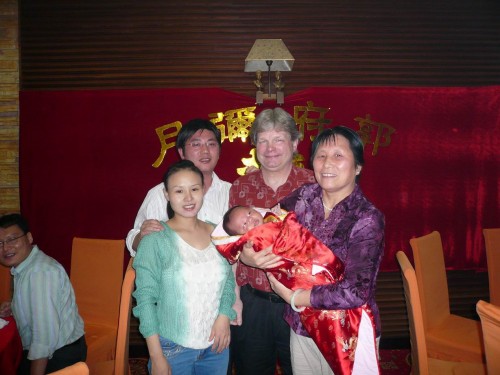
We held this event in a large, private room within a very nice restaurant. There were many people there, and as I have written regarding other situations, I was again the only non-Chinese in the room. I felt completely at ease and extremely honored he would invite me to such an important “family event”. The photo above shows me with my associate, his wife, his mother, and his new young son. I did, and still do, feel like part of their family. To me they remain friends, family and associates, and they “certainly” do not all look alike to me!
Note from Blog host – If you plan to do business in China, I recommend visiting the China Law Blog first.
Lloyd Lofthouse is the award-winning author of The Concubine Saga. When you love a Chinese woman, you marry her family and culture too. This is the love story Sir Robert Hart did not want the world to discover.
Subscribe to “iLook China” Sign up for an E-mail Subscription at the top of this page.
Weir’s piece is a long one but there are some telling points I’m going to share before I launch into a series of guest posts from an American that did business in China successfully for a number of years. Each one of these guest posts stands alone but provides a glimpse into another person’s experience doing business in China.
However, in 2010, Apple was crucified in the Western media due to a number of suicide at Foxconn, which is the Taiwan owned company that assembles/manufactures about 90 percent of Apple’s products. If you were not aware of it before, many Taiwanese do business in China and Foxconn is an example.
In his piece, Weir said, “They (the suicides) went up during a three-month span in the spring of 2010, when nine Foxconn workers jumped to their deaths. A total of 18 Foxconn employees took their own lives, or tried to, in recent years and given the company’s massive size, it is a suicide rate well below China’s national average. But when people started jumping in a cluster, Woo tells me that Tim Cook rallied a team of psychiatric experts for advice. They suggested nets, on the chance it might save impulsive jumpers.
“But Foxconn wasn’t Apple’s only problem. The company says they stopped a supplier named Wintek from using a toxic chemical to clean iPhone screens after 137 workers were injured…
“Apple says they have been ordering audits of its suppliers since 2006, and since 2007 have been publishing the sometimes disturbing results…
“It is a Monday after a Chinese holiday, and since many overworked migrants will just stay home, the people who lined up before dawn know that the chances of getting an assembly line job are better than average. And in a country of 1.3 billion, where jobs are scarce, getting there first matters; especially for their families back in the village, where most of their paycheck will end up…
“Starting salary is around $285 a month or $1.78 an hour. And even with the maximum 80 hours of overtime a month, the Chinese government considers them too poor to withdraw any payroll taxes…
“We mostly found people who face their days through soul-crushing boredom and deep fatigue. Some complained of being overworked, others complained of being under worked and almost all said they were underpaid…
“We do have labor unions at Foxconn … but it’s not a freely elected labor union yet. I expect to see that in the next year or two, they will become more like a collective bargaining union, and they will be freely elected. In fact, I see that some legislations in more progressive provinces (of China) would require labor unions to be sitting on the board of companies…”
The exclusive full report from ABC’s “Nightline” will air Tuesday, February 21 at 11:35 p.m. US ET/PT. This link to Hulu is where much of the full episodes of “Nightline” are posted for online streaming the day after the original broadcast.
Lloyd Lofthouse is the award-winning author of The Concubine Saga. When you love a Chinese woman, you marry her family and culture too. This is the love story Sir Robert Hart did not want the world to discover.
Subscribe to “iLook China” Sign up for an E-mail Subscription at the top of this page.
What just might be the funniest if not first autobiography ever penned by a drug-addicted foreigner in China, Chris Thrall’s “Eating Smoke” contains more spiritual pollution than all of the titles on the Communist Party’s banned books list combined.
In a country whose history was irrevocably altered for the worst by the scourge of foreign-imported opium throughout the nineteenth century, it is no wonder that today’s China has one of the world’s least-tolerant anti-drug laws – including executions for traffickers. Basically, buying or selling drugs in China is a really stupid idea.
Enter Chris: “I’m not a stupid guy, just an average guy who does stupid things”.
Thrall, a 25 year-old Royal Marine who hastily quits the service to pursue a business venture in 1990’s-era Hong Kong, a city “where situations can only get worse,” just to find himself broke, homeless and fulfilling his own ominous prophecy.
Recalling the commando’s motto of “cheerfulness under adversity,” Thrall tries to make the best of his lowly situation by spending his time dancing in discos or hanging out in the notorious Chungking Mansions, “the world’s all-time greatest doshouse.”
The immigrant ghetto of Kowloon is not, however, the best influence on Thrall, who befriends all the wrong people, including a hebephile drug dealer from Ghana and a Filipina working girl, and soon succumbs to that favorite of Chungking pastimes–drugs.
To fund his new crystal meth habit, our detritivorous narrator forages the South China city-by-the-sea like a bottom-feeder for any job that will hire a white face.
From cubicle fixture to phone-book scams, English teacher to nightclub DJ, businessman to bouncer, Thrall manages to get fired from every gig dumb enough to hire a spun-out “chi sun gweilo” (crazy foreigner in Cantonese) who doesn’t sleep for 9 days at a time and tends to forget his own surname.
By the time Thrall reaches his last-resort of a job–as a doorman at a bar operated by the 14K, the largest Triad (Chinese crime family) in the world–he has been reduced to a hyper-paranoid shadow of his former self on the verge of drug psychosis.
“I would listen to the radio phone-ins, suspicious of the Cantonese conversation and wondering if people were calling in to report my movements,” he says during one of his many speed-soaked conspiracy theories.
What ensues is a hilarious amphetamine-paced cautionary tale of what NOT to do when addicted to drugs in Wan Chai gangland, “where the Dai Lo’s rule is law, pride is everything and life means nothing.”
Chris Thrall’s true story evokes Gregory David Roberts’ “Shantaram” and Alex Garland’s “The Beach,” both of which have been licensed to Hollywood, as “Eating Smoke” is sure to follow.
Note from Blog host: Troy Parfitt’s closing statement of about 500 words appears first. To read Lloyd Lofthouse’s closing statement, you may have to scroll down this page.
I would like to thank Tom Carter for suggesting and facilitating this debate. But most of all, I would like to thank Lloyd Lofthouse. True, this is his website, but Lloyd’s been key in getting this organized, and has been nothing but helpful, positive, and polite.
Between the episodes of verbal jousting, which hopefully have kept you interested and entertained, we’ve communicated amicably about China and related topics, which is great. Two literary publications have refused to review my book, one citing arrogance, the other controversy and bigotry. It’s a sign of the times (you have total intellectual freedom to say anything you want, except things people don’t want to hear), so good on Lloyd for being so tolerant of someone like me, whose views on China have little overlap with his.
China is a complicated subject, and because debate about it is so divisive, it’s sometimes difficult for people with only a casual interest to sort fact from fiction. To come to any kind of understanding, you’ve got to spend a lot of time reading about China, and it helps enormously to understand Mandarin and travel or live there.
The West has some serious problems; it always has and it always will. Somber problems are normal for human societies; we’re a troubled species. In light of Western inadequacy and hypocrisy, it’s tempting to see China as a land of answers and alternatives. China can appear as the great Other: the feminine to the West’s masculine; grace to aggression; cultivation to calculation. But that’s a romanticized construct located in the recesses of the Western psyche, with little basis in reality.
That’s not to say China isn’t a noteworthy subject; it’s a fascinating one. Nevertheless, determined and altruistic cadres, heroic Communist leaders, an overriding system of guanxi, a citizenry instilled with the wisdom and morality of Confucianism, a harmonious society, a glorious past, and a mission to help neighboring states, are concepts that exist largely in people’s imaginations. They are myths, both Chinese and Western, that mainly block the view.
People like myths; they’re easy to latch on to; easy to remember; they cover up what isn’t flattering; they justify, and can make you feel good. But they won’t bring anyone closer to understanding what China is, how it got that way, and where it might be headed. To do that, one needs to research, observe, and apply critical thinking. Counter evidence cannot be denied, dubious sources should be treated as such, and a sense of fairness must always be employed. Once you’ve got a working theory about China, its nature, and so on, you must test that hypothesis constantly; that’s how you’ll discover the wonderful and terrible truth.
Again, I’d like to thank Tom and Lloyd for setting this debate up. It was good for me to defend and reflect on my ideas, and China is such an important topic; debate about it is crucial.
In the prologue of Lin Yutang’s My Country and My People, the author says few in the West understand the Chinese and their culture. He writes, “It is difficult to deny the Old China Hand (Note—foreigners that lived or are still living in China) the right to write books and articles about China…”
Lin Yutang says that only one in ten thousand of these “Old China Hands” understands China, while the other 9,999 results in a “constant, unintelligent elaboration of the Chinaman”. He mentions Sir Robert Hart and Bertrand Russell as examples of the few that understand China.
Pearl S. Buck writes in the book’s Introduction that when China was “not able to meet the dangerous and aggressive modernity of the West… They forced out of existence the old dynastic rule, they changed with incredible speed the system of education, and with indefatigable zeal they planned and set up a scheme of modern government”.
This metamorphosis of China that we have witnessed in the last few decades has almost eradicated severe poverty from more than 70% in 1949 to 2.5% of the population today in addition to the growth of a modern, Western style urban consumer middle class that is still a work in progress. This transformation took a literacy rate of 20% in 1976 and increased it to more than 90% today.
In 1949, we witnessed an element of that transformation as Mao declared war on Confucianism and then again as the age of Mao gave way to Deng Xiaoping’s “Getting Rich is Glorious” era, which turned China into the world’s factory floor. Then in 1982, China wrote a new constitution and started a process to reinvent its legal system to be more Western in its structure and laws.
I thank Mr. Troy Parfitt for his participating in this debate. However, he is not a Sir Robert Hart or Bertrand Russell.
In Part 1, he claimed that “face” was a license to behave however one pleases, which is not the case.
He then inferred that because Jonathan Spence never mentions Mao’s war on Confucianism in his biography of Mao that it never happened.
Yet, Henry Kissinger in On China made it clear that Mao was passionately and publicly anti-Confucian. Zhou Enlai even told Kissinger that Confucianism was a doctrine of class oppression.
Parfitt’s “gossip” includes his opinion of “Confucianism”, “face”, “Guanxi”, the “Mandate of Heaven”, corruption in China, and Mao being a monster that deliberately caused millions of deaths from a famine, which took place during the Great Leap Forward in a few of China’s provinces.
As Lin Yutang says, “It is difficult to deny the “Old China Hand” the right to write books and articles about China… Nevertheless, such books and articles must necessarily remain on the level of the gossip along the world’s longest bar.”
Lloyd Lofthouse is the award-winning author of The Concubine Saga. When you love a Chinese woman, you marry her family and culture too. This is the love story Sir Robert Hart did not want the world to discover.
Subscribe to “iLook China” Sign up for an E-mail Subscription at the top of this page.



 Posted by Lloyd Lofthouse
 Don’ Do The Drug!
