Americans doing Business in China – Part 7/16

February 27, 2012

Note from Blog host — another example of East meets West through business and trade: Bloomberg Businessweek says, “Amway salespeople started selling door to door in China in 1995… Their eventual collapse sparked riots. Beijing felt uneasy for another reason: Direct selling seemed custom made to spread religious beliefs or political dissent. The government banned all direct sales companies, including Amway, in 1998. Amway hung on, opening actual stores to show its commitment to the market. Executives made numberless trips to Beijing before the government relented in late 2006 and let Amway agents sell directly to consumers again.”

_____________________

Guest Post by Bob Grant — publisher/editor for Speak Without Interruption, an international online magazine.

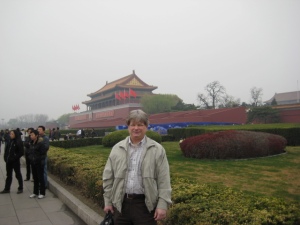
This guest post from Bob Grant had several photos. If you want to see them, I suggest you click on the Originally Published link and visit Speak Without Interruption. I will add two photos here that I took on my last trip, And yes, Bob, I also wish I had taken pictures every time I have visited China since 1999. I took my first pictures in 2008. Digital makes it easy.

Bob Grant wrote, During my trips to China, I wish I had taken more photos of the places I passed, to and from the factories I visited. In lieu of those photos, I am going to mix some that I found on the Internet with those that I took.

The one phenomenon that I experienced was the contradictions in times as I passed through the cities and into the countryside and back again. As I have mentioned in earlier postings, I have been traveling to China since 1998. My time spent there was mainly for business purposes—I rarely took time for sightseeing.

However, it was the “everyday” sights that interested me the most—not the so called tourist spots of which China has many. I would pass from new building construction to old crumbling buildings in a matter of blocks. I would drive by places in the countryside where it appeared to me that people were living the same way they had for millions of years. We would drive from beautiful multi-lane highways to rutted brick and dirt roads in a matter of miles. Workers were sweeping the freeways and other roads with large straw brooms. Everywhere I looked, I could see new and old in a single setting—a large high rise apartment building next to agricultural areas where people were working the land by hand and animals.

Our office was in Bao’an, which is a suburb, if you will, of Shenzhen which is in southern China across from Hong Kong. Here is a photo of the view from our office. Shenzhen has around 14 million people—according to the sources I checked—and it was nothing but swampland almost 30 years ago when it was designated China’s first economic zone.

The construction that goes on in this and other larger cities is unbelievable.

However, we visited one factory in what I would call the countryside where the owner was enticed to build a new factory because of the inexpensive cost of the land—somewhere around $4 per acre as I recall as the government wanted to build up business in this rural area.

This factory was in an extremely picturesque location and from the owner’s balcony, I took a photo of an older boat going down the river. It reminded me of how the setting (or view) must have been centuries ago. China has a tremendous amount of history associated with their country—I could see it, in many ways, as I looked out the vehicle window passing to and from our meetings during my numerous visits in country.

I certainly found China to be a country in transition—but as a visitor—I hope they never modernize their country to the extent that it is no longer a Contradiction of Times.

Note from Blog host – If you plan to do business in China, I recommend visiting the China Law Blog first.

Continued February 28, 2012 in Americans doing Business in China – Part 8 (a guest post) or return to Part 6

______________

Lloyd Lofthouse is the award-winning author of The Concubine Saga. When you love a Chinese woman, you marry her family and culture too. This is the love story Sir Robert Hart did not want the world to discover.

Subscribe to “iLook China”
Sign up for an E-mail Subscription at the top of this page.

About iLook China

Note: This guest post first appeared on March 1, 2010


Americans doing Business in China – Part 6/16

February 26, 2012

Note from Blog host — another example of East meets West through business and trade: Molly McMillan of McClatchy newspapers, reported, “In the past year, China has been ‘snapping up’ U.S. general aviation companies, including a recent deal to buy cash-strapped Cirrus Aircraft… In buying up established companies, China gets the management know-how, brand, distribution, technology in days, not decades,” said Brian Foley, with Brian Foley Associates.

_____________________

Guest Post by Bob Grant — publisher/editor for Speak Without Interruption, an international online magazine.

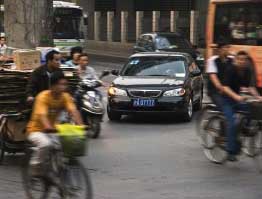
About any time, day or night, in major Chinese cities you can see any type of vehicle transporting all imaginable products on the roads. There are trucks carrying ocean containers and Mercedes carrying people. I have traveled to England, Ireland, Holland, Italy, Canada, Mexico, Indonesia, Malaysia, Korea, and China. I would not call myself a “world traveler” but, of all the countries in which I have traveled, I found China to be the most diverse in terms of the types of vehicles that transported goods on their roads.

Regardless of where my travels took me in China—rural or city—there were always a lot of people transporting goods in any type of vehicle that could move on its own, by animal, or under human power. The fact that people were busy working was not of particular note. It was the diversity of their means of transportation within a single view that was of interest to me. Also, they all seemed to move with purpose—whether carrying large or small items. I suppose that is really not so different than any other parts of the world—for some reason it just struck me as another admirable quality of the Chinese people.

Most of the smaller commercial trucks are blue—I have no idea why? I asked a couple of times but really did not receive an answer. Maybe there was a sale on blue paint? I am certain there is a reason, but since I don’t know it, I can’t share it with you—rather just make reference to it.

I will say that with all those vehicles on the road it did add to the air pollution. In most states in the U.S., vehicles have to pass safety inspections before they can be licensed. I am not certain this is a rule in China—if it can move it is road ready.

In my travels inside China for business, I found the Chinese to be very capitalistic in nature—certainly contrary to how I viewed the Chinese people prior to me actually visiting the country. The diversity in the means of transporting their goods is just one example of this fact at least in my mind.

Note from Blog host – If you plan to do business in China, I recommend visiting the China Law Blog first.

Continued February 27, 2012 in Americans doing Business in China – Part 7 (a guest post) or return to Part 5

______________

Lloyd Lofthouse is the award-winning author of The Concubine Saga. When you love a Chinese woman, you marry her family and culture too. This is the love story Sir Robert Hart did not want the world to discover.

Subscribe to “iLook China”
Sign up for an E-mail Subscription at the top of this page.

About iLook China

Note: This guest post first appeared on February 22, 2010


Americans doing Business in China – Part 5/16

February 25, 2012

Note from Blog host — another example of East meets West through business and trade: Baizhu Chen, writing for Forbes, says,In 2009, iPhones contributed about $2 billion, equivalent to 0.8% of the Sino-U.S. bilateral trade deficit. One iPhone 3GS was sold for about $600. These phones were exclusively manufactured by Foxconn, a factory in a Southern Chinese city called Shenzhen. To produce them, Foxconn had to import $10.75 worth of parts from American companies. The rest of its $172.46 components came from Korea, Japan, Germany, and elsewhere. Out of a $600 iPhone, how much does China get? A puny $6.50, or 1% of the value.”

_____________________

Guest Post by Bob Grant — publisher/editor for Speak Without Interruption, an international online magazine.

When I first traveled to China, I was warned about the food from many well-meaning people—some who had traveled to China and some who had not. I was told that I would starve if I did not take food in my suitcase, so I did. I took trail mix and hard candy nearly overloading my suitcase. It was just one of the stereotypes of China that I had heard and believed before I experienced true Chinese food for myself. For that first trip, I ended up throwing away most of the food that I had brought because I did not want to lug it back to the U.S.

I will admit that the food is different from what I normally eat—to be honest, it is definitely healthier. I found there to be a lot of vegetables, fish, and chicken—I never ate Dog or Cat at least to my knowledge. I ate at restaurants and I ate in factories. I ate what was put in front of me, and I stayed in places where my associates stayed. I had customers who went to China on their own for other products. They would not stay in anything but “Western Style” hotels and would not eat anything but “Western Style” food, and there are places in the larger cities, which have both. Some of them would even go as far as to not eat during the day with their hosts—rather waiting until they returned to their hotels for their “Western Style” food. I always felt that was rather rude to say the least and a bit disrespectful.

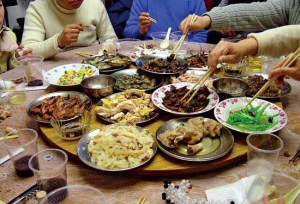
As for the food itself, I found it to be, for the most part, rather tasty. I took my hosts advice and did not drink the tap water. I drank bottled water, their very excellent hot tea, and a lot of their extremely appealing Chinese beer. The food was normally brought out as it was prepared and put on a Lazy Susan. Everyone turned it until the food they wanted was in front of them and then put it on their plates or ate it over, or on, a bowl of steamed white rice. We ate a lot in restaurants in private rooms, which I truly enjoyed. There was no outside noise, and the atmosphere was more personal. When I ate in factories, it was what the employees ate and in their dining area—each experience was unique and enjoyable. I learned to use Chopsticks at least enough to get food from the plate to my mouth. Although people keep bringing me utensils, I stuck with the Chopsticks while in the country. I “never” got sick from anything that I ate or drank in China, which is more than I can say for my normal diet.

The food is just one of the misconceptions of China and its people. I believed what I was told until I experienced it myself—not unlike other things in my life that I have been told by others only to be dispelled once I experienced it personally.

Note from Blog host – If you plan to do business in China, I recommend visiting the China Law Blog first.

Continued February 26, 2012 in Americans doing Business in China – Part 6 (a guest post) or return to Part 4

______________

Lloyd Lofthouse is the award-winning author of The Concubine Saga. When you love a Chinese woman, you marry her family and culture too. This is the love story Sir Robert Hart did not want the world to discover.

Subscribe to “iLook China”
Sign up for an E-mail Subscription at the top of this page.

About iLook China

Note: This guest post first appeared on February 19, 2010


Americans Doing Business in China – Part 4/16

February 24, 2012

Note from Blog host — another example of East meets West through business and trade: On October 22, 2004, according to the Associated Press, “The beer is flowing, John Fogerty is singing on the stereo and six scantily clad young Chinese women are doing the hokey-pokey. Hooters in Shanghai is open for business.”

_____________________

Guest Post by Bob Grant — publisher/editor for Speak Without Interruption, an international online magazine.

I have been traveling to China since 1998. I would not consider myself a seasoned traveler to that country—making around twenty-five visits total. When I traveled there, I usually stayed between one and two weeks. Never during any of my visits did I ever see or meet a “Red” Chinese person. I saw no one wearing an “I am a Communist” sweatshirt, ball cap, t-shirt, sunglasses, button or anything else physically labeling them a Communist. I saw no street banners, bumper stickers, storefront displays, mass gatherings or any other public notice that I was among Communists. What I was among were just people—regular people.

All of my visits were for business purposes. I met with business people only and traveled to see their factories or offices. I did not take much time to “sightsee” which was a mistake in retrospect.

With my business, I tended to visit locations where I was the “only” non-Chinese person within miles. I never felt threatened or out of place. No one ever stared at me or pointed—“Look at that non-Communist person.”

I found “most” of the people with whom I came in contact during both business meetings and other activities to be very pleasant, warm, humble, honorable, respectful and charming. I will have to admit that I did have some dealings with business people who were other than honest; however, China does not hold a monopoly on those types of business people. As a rule, I found the Chinese people with whom I had my dealings to be extremely hard working, dedicated and honest.

I had no fear going out on my own in any part of China that I visited day or night. I was never threatened or accosted in any manner.

One day I was walking around a city on a Sunday afternoon—alone. I felt a tug on my shirtsleeve and turned to find two young girls at my side. One asked me if they could speak with me—in good English. I did not suspect their reasons for talking with me to be anything other than honorable, so I said, “Sure.”

The girls were students at the university and their English professor had given them an assignment to stop, interview and take a photo with any “Westerner”. They said they had been looking for hours and I was the only “Westerner” they had seen. I was happy to answer their questions—one of the girls took my photo with the other girl. They thanked me, and went on their way. These were just two young students with an assignment, and I felt honored that I was able to help them complete it.

Perhaps I am being a bit naive—I was obviously around Communists during my visits to China, but I never felt that I had really “met” one. I had been fortunate enough to meet people from another country and culture, and they had accepted me at face value. I enjoyed each one of my visits to China and care a great deal for China and its people.

I truly believe if people could meet and work with other people around the world that many of the world’s problems would be solved. Perhaps this is a bit Pollyanna of me but this is how I see things from my myopic point of view and experiences, with China and its people, and I will stand by them.

Note from Blog host – If you plan to do business in China, I recommend visiting the China Law Blog first.

Continued February 25, 2012 in Americans doing Business in China – Part 5 (a guest post) or return to Part 3

______________

Lloyd Lofthouse is the award-winning author of The Concubine Saga. When you love a Chinese woman, you marry her family and culture too. This is the love story Sir Robert Hart did not want the world to discover.

Subscribe to “iLook China”
Sign up for an E-mail Subscription at the top of this page.

About iLook China

Note: This guest post first appeared on February 17, 2010


Americans doing Business in China – Part 3/16

February 23, 2012

Note from Blog host — another example of East meets West through business and trade: According to Slate,, “The first Chinese eateries in America, known as ‘chow chows’, arrived in California in the mid-19th century to serve Cantonese laborers.”  In addition, NPR.org says, “There are about 40,000 Chinese restaurants in the US (today) — more than the number of McDonald’s and Taco Bells combined.”

_____________________

Guest Post by Bob Grant — publisher/editor for Speak Without Interruption, an international online magazine.

How can you embrace an enemy of the USA?  More important–why would you?  If these questions have not been outright asked of me–they have been implied.  Why I chose to speak highly of China, and its people, is something that I do willingly and with pride.

I am not the Manchurian Candidate. I was never brainwashed during my visits there. I was not tortured or forced into my feelings in any way. Subliminal messages were not piped into my hotel room at night. I did not have bamboo shoots shoved under my fingernails. I was not drugged or impaired in any way unless it was done willingly by drinking too much of that fine Chinese beer.

Within my small circle of business contacts, experiences, and associations I would say it is Western business people who are trying to brain wash the Chinese. As I developed my business relationships, I have read of those that experienced failures mainly because Western companies tried to “Westernize” their Chinese business partners rather than adapting to their Chinese partners way of doing business.

Maybe it has been different for others who have done business within China but for me, personally, my successes came from letting the Chinese conduct business in “their way”, and I tried to educate my customers in their methods and ways. I won’t say it was not frustrating at times—in fact, it was frustrating most of the time.

However, in the end, it was what worked best for me while others failed. Honor and “saving face” are very important to the Chinese—I tried not to put any of my associates in a position that threatened either.

Again, just from my experience, I have to say that people from any part of the world can work together to achieve a common goal if all parties can be flexible and understanding. From my perspective, this is the true receipt for success among the world’s population.

Note from Blog host – If you plan to do business in China, I recommend visiting the China Law Blog first.

Continued February 24, 2012 in Americans doing Business in China – Part 4 (a guest post) or return to Part 2

______________

Lloyd Lofthouse is the award-winning author of The Concubine Saga. When you love a Chinese woman, you marry her family and culture too. This is the love story Sir Robert Hart did not want the world to discover.

Subscribe to “iLook China”
Sign up for an E-mail Subscription at the top of this page.

About iLook China

Note: This guest post first appeared on February 14, 2010