A “Fruitful Meeting” Between Civilizations – Part 2/2

May 12, 2011

Y Chan’s comment continued with, “In the English language, the word “Christianity” usually refers to the hundreds of religions (some estimate the total number of Christian sects to be about 38,000 worldwide) that are based on Jesus as their Savior… However, to the Chinese people, the words “Catholicism” and “Christianity” seem to refer to two different religions, which is wrong. The translation got lost somewhere.”

“In fact,” Chan wrote, “different Christian sects came to China at different times with different techniques. The Catholics first came to China under Father Matteo Ricci around 1582 “WITHOUT” weapons or gunboats.

“All Ricci brought was the Bible and scientific knowledge and thus gained the respect of the Chinese people [even today the Chinese respect him].

“Actually, the religious exchange went both ways. Whilst the Jesuits brought Christianity to China, they also introduced Taoism, Buddhism and Confucianism to Europe, because Father Ricci studied and translated many Chinese texts and sent them back to the Vatican.

“On the other hand, the Protestants arrived in China [in the 19th century] with the assistance of Western gunboats and opium. The first Protestant missionary was Robert Morrison of the Scottish Presbyterian Church. He pioneered the translation of the Bible into Chinese. He actually was hired by the notorious British East India Company that sold opium in China.

“Therefore, Chinese historians usually give a much higher respect to Father Matteo Ricci than to Rev. Robert Morrison. Today, Morrison has largely been forgotten by most Chinese.

“Father Matteo Ricci was an Italian, came to China 400 years ago, arrived in Macao and learned to speak fluent Cantonese rather than Mandarin.

“He studied Buddhism, dressed as a Buddhist monk and talked as if he were one when he tried to introduce Christianity to the Chinese people. However, Ricci discovered to gain the trust of the Chinese Emperor, he had to understand Confucianism.

“Through the study of Confucianism, he was accepted into the Imperial Court and was the first Westerner to hold a high position in the Chinese Government.

“Father Ricci treated Chinese culture and religions “EQUALLY” as he introduced Christianity to China, whilst the British missionaries [Robert Morrison and the Protestants] looked down on China as a land of barbarians [heathens] to be “saved” as they came ashore supported by gunboats and opium.

Return to A “Fruitful Meeting” Between Civilizations – Part 1

______________

Lloyd Lofthouse is the award-winning author of the concubine saga, My Splendid Concubine & Our Hart. When you love a Chinese woman, you marry her family and culture too.

If you want to subscribe to iLook China, there is a “Subscribe” button at the top of the screen in the menu bar.


A “Fruitful Meeting” Between Civilizations – Part 1/2

May 11, 2011

Pope Benedict XVI (born 1927 – ) has called Matteo Ricci [a 16th century Jesuit, 1552 – 1610] a model for a “fruitful meeting” between civilizations. Source: Catholic News Agency

America and the other Western democracies could learn much from this man, who is being considered for beatification by the
Vatican.

This wasn’t the first time I heard of the Jesuit missionary. In 1999, while my wife and I were on our honeymoon in China, she told me about Ricci. At the time, I was busy learning of Sir Robert Hart, the protagonist in my first two historical fiction novels, “The Concubine Saga”.

When we first visited Book City in Shanghai, I searched for information of Ricci but the only copy I found was in Mandarin, which I do not read.

Over the years, I forgot about Ricci until a commenter, Y Chan, reminded me when he left a comment for The Connection Between Opium, Christianity and Cannon Balls in China , a post republished March 1, 2011.

Here’s what Y Chan first said in his comment.

“You may want to be more specific when using the word “Christianity” in your article.”

Continued on May 12, 2011, A “Fruitful Meeting” Between Civilizations – Part 2

______________

Lloyd Lofthouse is the award-winning author of the concubine saga, My Splendid Concubine & Our Hart. When you love a Chinese woman, you marry her family and culture too.

If you want to subscribe to iLook China, there is a “Subscribe” button at the top of the screen in the menu bar.


Predicting the Fall of a Civilization – Part 1/2

April 12, 2011

For decades, I’ve said that American arrogance (due to being the only super power), run-away consumerism and growing debt of all kinds coupled with how the average American child is being raised by parents obsessed with the child’s self-esteem above all else would lead to the inevitable end of the American experiment in personal freedoms and a rapid decline in living standards followed by chaos and anarchy.

Then I had an e-mail this week from an American friend and expatriate living in China, who recently returned to teaching English to Chinese children.

I asked him in an E-mail how it was going.

He replied, “You’ll be interested to know the kids are WAY fatter and noisier than they were in 2004. I asked some other teachers about this. They attribute it to McDonalds (3 all on the same 3-kilometer street in this very small city). In 2004 there were none (in that city), and Chinese parents spoiling their kids more and more; that sense of entitlement carries over into the classroom….”

After teaching American children and teens for thirty years and experiencing the same decline in child health and behavior, I understood what he meant.

Could this cultural decay be a sign of the pending collapse of civilization?

To be continued on April 13, 2011 in Part 2 or discover Super Power Dawn

______________

Lloyd Lofthouse is the award-winning author of the concubine saga, My Splendid Concubine & Our Hart. When you love a Chinese woman, you marry her family and culture too.

If you want to subscribe to iLook China, there is a “Subscribe” button at the top of the screen in the menu bar.


Heroes and Foreign Devils

February 24, 2011

It is ironic that in the 1940s we were fighting with the Chinese against the Japanese. Then in 1950, China and the US fought against each other in North Korea and Chinese advisers were sent to assist North Vietnam to fight the US in the 1960s.

Then Nixon arrives in China in the 1970s and we were friends again.

In February 2010, I had an instant message chat with Ian Carter, an Australian expatriate living in Southeast China, and learned that during World War II in 1944 an American B-24 Liberator bomber vanished without a trace in Southeast China.

Fifty-two years later in 1996, farmers discovered the bomber’s wreck and the remains of the ten-man crew on Mao’er Shan (Little Cat Mountain), Southern China’s highest peak . The name of the B-24 bomber was Tough Titi.

These Americans are considered heroes (click link to learn more about this story) to the Chinese, and the remains of the crew were returned to the United States for burial.

There’s a memorial stone near the crash site and Chinese tourists pay honor to these Americans by leaving flowers and other gifts.

To honor these heroes further, the Chinese recovered some of the bomber’s parts and used them as a centerpiece for a museum in Xing’an, about four hours from the crash site.

Discover Peter Hessler, an expatriate, on China

______________

Lloyd Lofthouse is the award-winning author of the concubine saga, My Splendid Concubine & Our Hart. When you love a Chinese woman, you marry her family and culture too.

If you want to subscribe to iLook China, there is a “Subscribe” button at the top of the screen in the menu bar.


Note: This post first appeared on iLook China February 13, 2010 as post # 49. This revised version reappears as post # 1082.


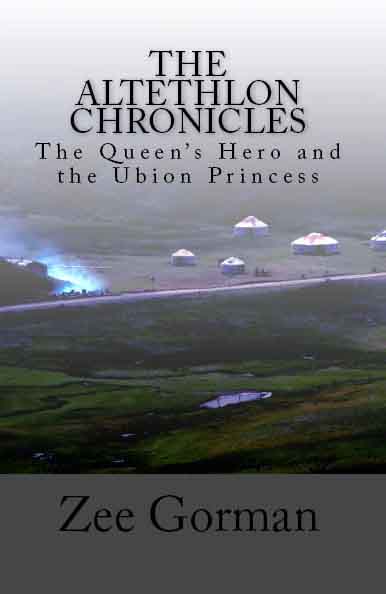
“The Altethlon Chronicles” – China’s Answer to Harry Potter

February 8, 2011

Guest review by Tom Carter

China’s love affair with superstition, pseudoscience and the fantastical may be traced back over five millennia, whence some of history’s oldest myths and legends originated.

Journey to the West (Xi You Ji), published anonymously by scholar Wu Cheng’en in the 16th century Ming Dynasty, remains China’s most beloved fantasy story.  Considered one of the “Four Great Classical Novels” of Chinese literature, the 100 chapters of ‘Journey’ are replete with monkey kings, flesh-eating demons, immortal sages and celestial battles.

When science fiction became all the craze in 1950’s America, Red China followed suit by founding its first sci-fi periodical.

However, unlike the west, where rapid advances in the tech sector fueled science fiction, China promoted sci-fi to help inspire its own dormant technological progress.

Conversely, about the same time during the 70s when American director George Lucas was preparing to film a little space opera called Star Wars, the Cultural Revolution was banishing all China’s scientists to hard-labor communes.

Indeed, where the Chinese have categorically failed in speculative fiction (programming on the Communist-controlled CCTV is evidence enough that future perspective is held in little regard here: of China’s 19 official television channels, all feature serials set in olden times, some in the present, none about the future), they remain masters of mythology and purveyors of the past.

Present-day PRC is seeing a renaissance of the fantasy genre.  The wuxia-inspired Chinese film Crouching Tiger, Hidden Dragon was a critical and commercial success, generations of young, Chinese cyber-punks are hopelessly addicted to the virtual sorcery of World of Warcraft, and Harry Potter remains China’s “most pirated novel ever”.

Even so, no Chinese author has ever been able to replicate the success of Journey to the West; as a result, publishing houses in the Middle Kingdom prefer to translate western best-sellers such as Lord of the Rings and Narnia rather than take their chances on local fantasy fiction writers.

Enter Zee Gorman (nee Yan Zi-hong) China’s response to J.K. Rowling.

Born in Guangdong province during the Cultural Revolution (both her parents were exiled to the countryside for being “intellectuals”), Zee was raised on a literary diet of propaganda and scar literature.

Rather than publish a clichéd daughter-of-the-Revolution memoir about her hardships, the aspiring author opted for the escapism of fantasy. Hence, her decades-in-the-making debut novel, The Altethlon Chronicles.

A high-fantasy fiction set in a parallel universe either far in China’s future or in its past, The Altethlon Chronicles is a complex blend of military, history, romance and sorcery.

Leading the rich cast of green-eyed, purple-skinned characters is the royal yet rebellious teen Ximia (“what kind of princess are you anyway, running around like a wildcat?”) and her forbidden lover, Nikolas, the leader of a rival tribe – a tumultuous relationship most likely inspired by Zee’s own experience with cultural clash when she immigrated to the U.S. and married an American.

Ximia is misled into believing that Nikolas has been killed during an escape attempt, whereby the princess is married off by her father to a dastardly lord.  The two young warriors go on to lead their respective armies until the day when destiny arranges for them to meet again in battle.

Lots of magic, weird names and epic battles of Tolkien proportions (note: this reviewer has never actually read a J. R. R. Tolkien book; I just thought it sounded cool to say that) ensue.

In creating this alternate world, Zee draws heavily on her Chinese heritage.

Kingdoms such as Manchuli, Dalong and Taklaman are each reminiscent of real regions in China.

Nonetheless, Zee, who is bi-lingual and holds dual degrees in English Literature, chose to write The Altethlon Chronicles in her second language and self-publish in America rather than risk having it pirated in China’s nascent fantasy market.

Some realities are worth escaping.

Discover Blond Lotus, another book review by Tom Carter.

____________________

Travel photographer Tom Carter is the author of CHINA: Portrait of a People, a 600-page book of photography from the 33 provinces of China, which may be found on Amazon.com.

If you want to subscribe to iLook China, there is a “Subscribe” button at the top of the screen in the menu bar.