
Chinese in the Gold Rush – Part 1/2

June 5, 2011

Guest post by John Putnam

Of all the diverse peoples that poured into California after the discovery of gold, none stood out more than the Chinese. Radically different in dress, language and culture these new men were first welcomed because of their willingness to work hard for low wages at any task presented them.

John McDougall, the 2nd Governor of California, described them as “one of the most worthy of our newly adopted citizens.”

At the start of 1849 only 54 Chinese were in California. By1852 there were nearly 12,000 living here and only seven of them women. Because of turmoil in Canton another 20,000 would arrive that same year.
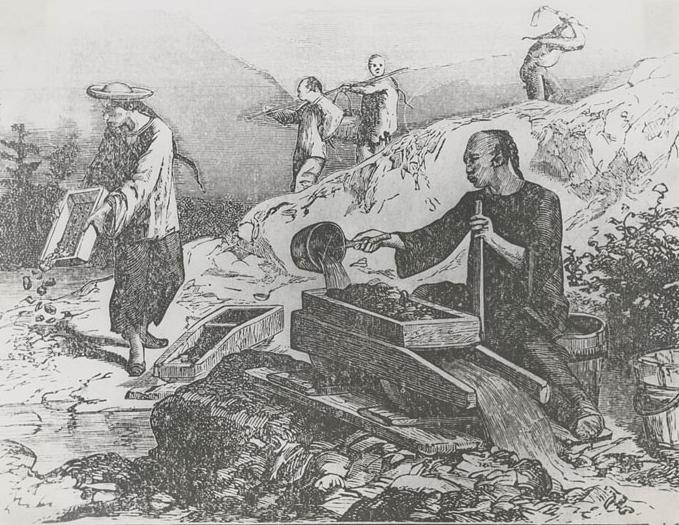
A community of Chinese Americans quickly grew in San Francisco. They marched in Fourth of July parades and rejoiced at California’s statehood, but celebrated their lunar new year in their traditional way.

In 1852 a Cantonese opera was performed at the American Theater and in 1854 a Chinese language newspaper began publishing.

The Kong Chow Association formed to help the new arrivals adapt to their new home. Then another, the Chew Yick, elected Norman As-sing, an English speaking owner of the Macao and Woosung Restaurant as their leader. Soon there were six associations called tongs that combined to form the Six Companies to better represent Chinese interest.

Continued on June 6, 2011 in Chinese in the Gold Rush – Part 2

____________________

Reprinted by permission. First published May 23, 2011 in My gold rush tales. John Putnam is the author of Hangtown Creek, a thrilling saga of the early California gold rush.

To subscribe to “iLook China”, look for the “Subscribe” button at the top of the screen in the menu bar, click on it then follow directions.


Spoiled and Confused — China’s new urban generation – Part 4/4

May 28, 2011

A special (guest) report from the front lines of teaching English in China
By Chris “Foreign Monkey” Bewley

The English “industry” in China is what I call “C.O.O.C”: completely out of control!  There is literally a new, privately run children’s English “school” popping up on every other corner every other week. Nor is it an industry that has grown in a healthy, steady way from its infantile beginning; it is a product for infants in hyper-drive.

A perfect parallel to this is the car situation in China, which is also out of control.

I hate to say it because it has become an international cliché, but, truly, nobody in China knows how to drive or even park properly. Automobile ownership in China has, along with its economy, bloomed at an alarming rate in the past 5 years, resulting in massive congestion everywhere from the smallest towns to the largest cities.

It’s obvious that the people who own these cars use them primarily as status symbols rather than for necessity; it rarely rains in my city and there are no hills, yet every single day, 6 times a day, hundreds of parents dropping off/picking up their children in new, black Audis will cause an hour-long gridlock directly in front of my school rather than be seen walking or riding a bicycle.

Please don’t get me wrong, I am not a “China-hater.”

Colorful street life, extremely friendly people, great food, affordable massage parlors, a handful of good friends both Chinese and foreign, and a decent income have been sufficient to keep me reasonably comfortable.

But in the end, I have to ask myself: what am I here for? Because it’s obvious that China doesn’t want me to actually teach anybody anything.

Return to Spoiled and Confused Part 3, start with Part 1 or discover China’s Sexual Revolution

View as Single Page

_____________________

Chris Bewley has taught English as a foreign language for the past 10 years all over the world, including Japan, Korea, Mexico and Brazil.

To subscribe to “iLook China”, look for the “Subscribe” button at the top of the screen in the menu bar, click on it then follow directions.


Spoiled and Confused — China’s new urban generation – Part 3/4

May 27, 2011

A special (guest) report from the front lines of teaching English in China
By Chris “Foreign Monkey” Bewley

Most recently, I found myself having to literally, physically, throw out my Chinese teaching assistant (a recent college graduate with no classroom experience hired right off the street for a minimal salary) to avoid a mutiny from within.

You see, she absolutely refused to discipline the rowdiest students, and did nothing to help control their deafening volume when I was trying to teach.


A quarter of China’s rural youth overweight!

When I approached her about this, her response was: “you are not a real teacher!” I imagine that this assistant was once (11 years ago, to be precise) a spoiled, indifferent primary school student herself; how sadly ironic that at age 21 she still indentified with the students rather than with me, the teacher.

China’s universities are being touted with utilitarian promise, a promise that trickles down all the way to the elementary school level. The Chinese’s fear of poverty has undermined intellectual diversity; plagiarism and cheating are rampant and go unpunished, reading books is not encouraged, greater importance has been placed on math than any other subject starting in the earliest years of child development, and there are no other languages other than English offered until university.

Continued on May 28, 2011 in Spoiled and Confused Part 4 or return to Part 2

View as Single Page

_____________________

Chris Bewley has taught English as a foreign language for the past 10 years all over the world, including Japan, Korea, Mexico and Brazil.

To subscribe to “iLook China”, look for the “Subscribe” button at the top of the screen in the menu bar, click on it then follow directions.


Spoiled and Confused — China’s new urban generation – Part 2/4

May 26, 2011

A special (guest) report from the front lines of teaching English in China
By Chris “Foreign Monkey” Bewley

In the past year, I’ve had only a handful of students ever raise their hand and ask ME a question about the English language. That’s 1,200 students/week x 30 weeks, which equals 36,000 (thirty-six thousand) chances for a student to raise a question, but only five ever have. On the rare occasion that my students do ask me questions, it’s usually regarding the price of my clothes or how much I get paid.

Criticism about my lessons that I have received from students, parents and Chinese teachers alike includes “it’s too difficult”, “it’s not fun enough”, “there’s not enough participation/activity,” but never have I ever heard that my classes are too easy, which in my opinion they most certainly are.

By now, I have figured out that English lessons in (urban) China are just a show; a clown show; a monkey show – starring myself as the foreign monkey.

For parents’ week last month, whilst dozens of “concerned” parents and school administrators observed my classes for 5 days in a row, rather than actually teach their children, I just played a bunch of silly games and sang some songs with them, and, guess what? That made all the parents really, really happy!

Continued on May 27, 2011 in Spoiled and Confused Part 3 or return to Part 1

View as Single Page

_____________________

Chris Bewley has taught English as a foreign language for the past 10 years all over the world, including Japan, Korea, Mexico and Brazil.

To subscribe to “iLook China”, look for the “Subscribe” button at the top of the screen in the menu bar, click on it then follow directions.


Spoiled and Confused — China’s new urban generation – Part 1/4

May 25, 2011

A special (guest) report from the front lines of teaching English in China
By Chris “Foreign Monkey” Bewley

When I first arrived in China as an English teacher, I had lofty scholastic goals: I wanted to try a creative variety of class activities and apply a broad spectrum of teaching methods that my students could benefit from to make them competitive in academia and, later, the international job market.

Almost 1 year later, my primary responsibility as a “Foreign Expert English Instructor” has been distilled down to little more than babysitting a bunch of spoiled, undisciplined children who for the most part want nothing to do with English.

At my crowded primary school in a small, semi-urban city in East China, there exists what I have coined the “20/20/20” split in each of my classes (60 kids per class): 20 eager/20 indifferent/20 bad. Basically, I’m teaching 20 while trying to control 40.

To make it fair for everyone, I have to dumb-it-down/ fun-it-up every class. Instead of actually teaching, I find myself playing games with them and jumping around for them like a monkey, which is the only way to retain their attention.

On the positive side, of the eager 20, there are several extremely smart students who I expect one day to be quite successful in what ever they do.  Unfortunately, whenever those eager 20 are trying to learn, the other naughty 40 will try just as hard to spoil it for them.

Continued on May 26, 2011 in Spoiled and Confused Part 2 or discover China’s Future Political Divide Revealed

View as Single Page

_____________________

Chris Bewley has taught English as a foreign language for the past 10 years all over the world, including Japan, Korea, Mexico and Brazil.

To subscribe to “iLook China”, look for the “Subscribe” button at the top of the screen in the menu bar, click on it then follow directions.