Beware of Biased Rumors Masquerading as Truth

June 16, 2011

A Music Blog Post written by Caryn Ganz (posted May 13, 2011) reveals how often the Western media plays into the hand of rumors and misinformation. Bias has much to do with that as you may discover.

A 2010 Pew Global Attitudes Project revealed that unfavorable views of China in the West are legion.  The question Pew asked was, “Please tell me if you have a very favorable, somewhat favorable, somewhat unfavorable or very unfavorable opinion of China.”

The response—sixty-one percent (50 million) of those that responded in Germany had an unfavorable opinion of China; France 59% (39 million); Turkey 61% (45 million); Spain 38% (17.5 million); United States 36% (112 million), and Britain 35% (22 million).  More than 285 million minds and mouths may have a negative opinion of China. To see the entire list (for other countries), click the link for the Pew Project.


Mao died in 1976 and the Communist Party guided by Deng Xiaoping repudiated Revolutionary Maoism. When anyone mentions Mao, they are talking of history—not today.

Just to make clear what an “opinion” means, here are a few definitions: judgment or belief not founded on certainty or proof; the prevailing or popular feeling or view (public opinion); an opinion formed by judging something

Just because people believe something that does not mean it is a fact.

With this in mind, consider that many of those people that have unfavorable opinions of China are publishers, editors and reporters working in the Western Media spreading rumors and misinformation in what they write and report.

For example the media rumor mill reported Bob Dylan was refused permission to perform in China.

In fact, Western newspapers and magazines made all kinds of incorrect claims that Bob Dylan played to half-empty audiences, and the Chinese government censored what he would play when he performed in China

Bob Dylan was not pleased. In fact, Bob Dylan wrote on his Website, “Allow me to clarify a couple of things about this so-called China controversy which has been going on for over a year. First of all, we were never denied permission to play in China….”

Dylan said, “According to Mojo magazine, the concerts were attended mostly by ex-pats and there were a lot of empty seats. Not true. If anybody wants to check with any of the concertgoers they will see that it was mostly Chinese young people that came.… Out of 13,000 seats we sold about 12,000 of them, and the rest of the tickets were given away to orphanages.”

“As far as censorship goes, the Chinese government had asked for the names of the songs that I would be playing…. If there were any songs, verses or lines censored, nobody ever told me about it and we played all the songs that we intended to play.”

If you are interested in everything Bob Dylan said, I suggest you visit his Website (the link above).

For those readers with open minds, if we are to learn anything from this,
“It is to take with a grain of salt everything you hear or read in the World about China.”  Most of it will be opinions written as fact based on bias, which shows us that Yellow Journalism  is alive and well in freedom land proving that in the West we have the freedom to lie and pretend it is the truth.

To discover the possible truth about other opinions of China, learn from What is the Truth about Tiananmen Square? and/or 2/28 Massacre in Taiwan

______________

Lloyd Lofthouse is the award-winning author of the concubine saga, My Splendid Concubine & Our Hart. When you love a Chinese woman, you marry her family and culture too.

To subscribe to “iLook China”, look for the “Subscribe” button at the top of the screen in the menu bar, click on it then follow directions.


The Chinese in America – Part 3/3

June 9, 2011

Almost half a century after her death, Anna May Wong (1905 to 1961) has not been forgotten.

In fact, her life is another example of the continued discrimination against Asian-Americans and Chinese in the US by other ethnic groups, which includes Caucasions, African Americans and Latinos.

The first indication of this discrimination and racisim in the US against Chinese and/or Asian Americans appeared during the  California Gold Rush, which John Putnam wrote of in Chinese in the Gold Rush.

As a child, Anna loved going to the movies and even cut school to go to the show.

Between 1919 and 1961, she acted in 62 films. The Internet Movie Data Base says she was the “first Chinese-American movie star”.

However, to act, Anna had to play the roles she was given. The Western stereotype cast her as a sneaky, untrustworthy woman that always fell for a Caucasian man. The dark side of achieving her dream of acting in movies was that Anna had to die so the characters she played got what they deserved.

Anna often joked that her tombstone should read, “Here lies the woman who died a thousand times.”

Until Chinese started to emigrate to the U.S. in the mid-19th century, they had never encountered a people who considered them racially and culturally inferior.

The discrimination against the Chinese in America was only exceeded by the racism and hatred directed at African-Americans.

Then in the 1960s, many of the anti racist laws enacted during the Civil Rights era focused on protecting African-Americans, which created a protected class.

Since the Chinese—due to cultural differences—often did not complain, they were left behind.

In many respects, racism toward the Chinese still exists in the US and manifests itself through the media as China bashing, which supports the old stereotype.

When Anna May Wong visited China in 1936, she had to abandon a trip to her parent’s ancestral village when a mob accused her of disgracing China.

After her return to Hollywood, she was determined to play Chinese characters that were not stereotypes, but it was a losing battle. To escape the hateful racism, she lived in Europe for a few years.

Since U.S. law did not allow her to marry the Caucasian man she loved, and she was afraid that if she married a Chinese man he would force her to give up acting since Chinese culture judged actresses to be the same as prostitutes, she never married.

Anna May Wong smoked and drank too much. She died of a heart attack in Santa Monica, California at age 56.

Return to Part 2 or start with The Chinese in America – Part 1

This post first appeared on November 10, 2010 as Anna May Wong – The Woman Who Died a Thousand Times

______________

Lloyd Lofthouse is the award-winning author of the concubine saga, My Splendid Concubine & Our Hart. When you love a Chinese woman, you marry her family and culture too.

To subscribe to “iLook China”, look for the “Subscribe” button at the top of the screen in the menu bar, click on it then follow directions.


The Chinese in America – Part 2/3

June 8, 2011

This was the second post from 2010 that I remembered after reading John Putnam’s guest post of the Chinese during the California Gold Rush.

Angel Island in San Francisco Bay was America’s west coast Ellis Island.

From 1919 to 1940, mostly Asian immigrants entered the US through Angel Island.

After 1940, the immigration station on Angel Island was forgotten until a California Park Ranger, Alexander Weiss, discovered the stories carved in the walls.

He thought that there were stories here as if there were ghosts waiting to be heard.

Over half of the Angel Island immigrants came from China and Japan and most of the carvings on the walls were poems written in Chinese.

A former detainee, Dale Ching, went through the station in 1937 when he was sixteen. Even though Dale’s father was born in the United States, he still had to go through the immigration station.

While the East Coast’s Ellis Island welcomed immigrants, Angel Island’s story was one of sadness and suffering.

Most European immigrants who went through Ellis Island stayed a few hours, but immigrants on Angel Island were kept locked up under armed guard with barbed-wire fences surrounding the buildings and some people stayed for days, weeks, months and years.

The park service wanted to tear the Angel Island buildings down but Weiss found supporters and they struggled to preserve this history. They succeeded and the restoration project was challenging.

Alexander Weiss sums up the video saying we should know both the right and the wrong from U.S. history.

Continued on June 9, 2011 in The Chinese in America – Part 3 or return to Part 1

This post first appeared on September 8, 2010 as America’s Angel Island

_______________

Lloyd Lofthouse is the award-winning author of the concubine saga, My Splendid Concubine & Our Hart. When you love a Chinese woman, you marry her family and culture too.

To subscribe to “iLook China”, look for the “Subscribe” button at
the top of the screen in the menu bar, click on it then follow directions.


Chinese in the Gold Rush – Part 2/2

June 6, 2011

Guest post by John Putnam

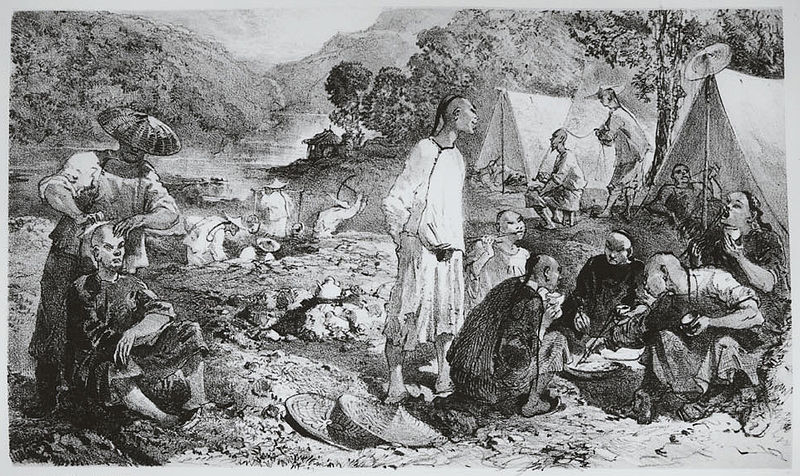
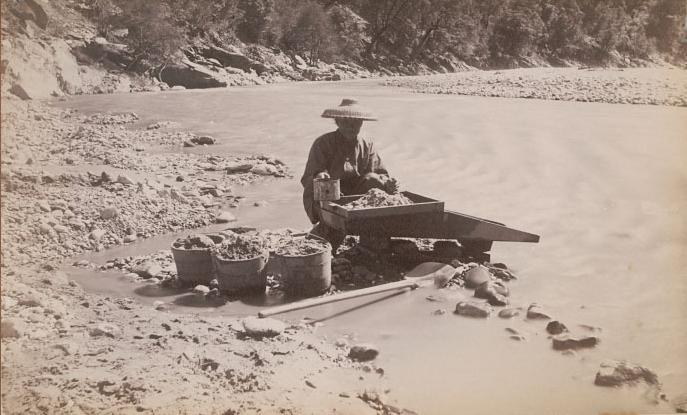
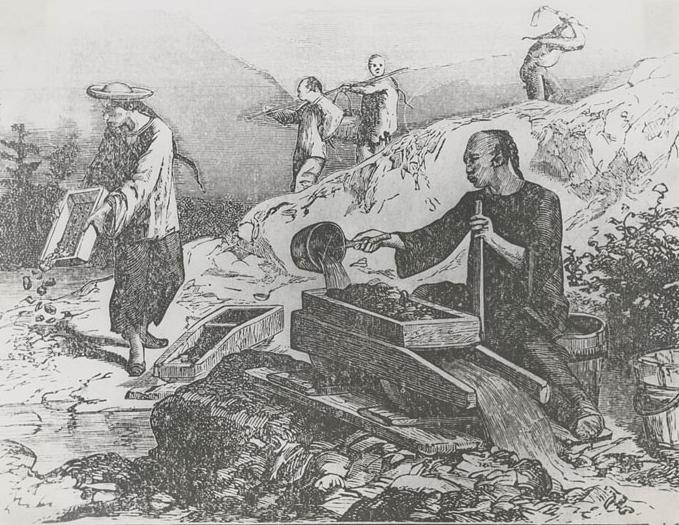
In the mines the Chinese were often forced to work sites that others had abandoned as no longer productive and, by hard work, made these claims pay.

As more men arrived in the gold fields and the amount of surface gold dwindled, tensions increased. Thirty-five Chinese showed up at Camp Salvado in 1849 where men from El Salvador had worked and here they found rich placer deposits.

White miners soon arrived and pushed the Chinese out, but they were taken in at another nearby site called Camp Washington where still more gold was found

Chinese flocked to a place where they were accepted and Tuolumne County’s Chinese Camp survives to this day.

But by 1850, a $20 per month tax on each foreign miner was imposed.

By 1852 Chinese were forced from Mormon Island and Horseshoe Bar along the American River, then from Colombia in the southern mines and Yuba City in the northern.

In 1856 Chinese paid $70,000 for the right to mine in Mokelumne Hill.

By 1868 almost all Chinese had left the mines to work on the transcontinental railroad or in Chinese operated businesses.

Return to Chinese in the Gold Rush – Part 1

____________________

Reprinted by permission. First published May 23, 2011 in My gold rush tales John Putnam is the author of Hangtown Creek, a thrilling saga of the early California gold rush.

To subscribe to “iLook China”, look for the “Subscribe” button at the top of the screen in the menu bar, click on it then follow directions.


Chinese in the Gold Rush – Part 1/2

June 5, 2011

Guest post by John Putnam

Of all the diverse peoples that poured into California after the discovery of gold, none stood out more than the Chinese. Radically different in dress, language and culture these new men were first welcomed because of their willingness to work hard for low wages at any task presented them.

John McDougall, the 2nd Governor of California, described them as “one of the most worthy of our newly adopted citizens.”

At the start of 1849 only 54 Chinese were in California. By1852 there were nearly 12,000 living here and only seven of them women. Because of turmoil in Canton another 20,000 would arrive that same year.

A community of Chinese Americans quickly grew in San Francisco. They marched in Fourth of July parades and rejoiced at California’s statehood, but celebrated their lunar new year in their traditional way.

In 1852 a Cantonese opera was performed at the American Theater and in 1854 a Chinese language newspaper began publishing.

The Kong Chow Association formed to help the new arrivals adapt to their new home. Then another, the Chew Yick, elected Norman As-sing, an English speaking owner of the Macao and Woosung Restaurant as their leader. Soon there were six associations called tongs that combined to form the Six Companies to better represent Chinese interest.

Continued on June 6, 2011 in Chinese in the Gold Rush – Part 2

____________________

Reprinted by permission. First published May 23, 2011 in My gold rush tales. John Putnam is the author of Hangtown Creek, a thrilling saga of the early California gold rush.

To subscribe to “iLook China”, look for the “Subscribe” button at the top of the screen in the menu bar, click on it then follow directions.